Showing posts with label Metriorhynchids. Show all posts

Saturday, 13 April 2019

Cricosaurus bambergensis: A new species of Metriorhynchid Crocodylomorph from the Late Jurassic of Bavaria, southern Germany.

The Metriorhynchids were Mesozoic Thalattosuchian Crocodylomorphs adapted to a fully aquatic marine lifestyle. Their limbs were modified into paddle-like flippers, they has a shark-like tail-fin and had lost the osteoderms in their skin. Meriorhynchids appear to have been fully pelagic, i.e. capable of swimming freely in ocean currents, rather than being restricted to inshore environments. The Meriorhynchids appeared in the Middle Jurassic and survived into the Early Cretaceous. The genus Cricosaurus currently contains nine species of Metriorhynchid Crocodylomorphs from the Late Jurassic and Early Cretaceous of Europe and North America, however cladistic analysis (computerised analysis of relationships within the group based entirely upon shared common features rather than assumed relationships) has suggested that two members of the genus, Cricosaurus saltillensis and Cricosaurus macrospondylus may be more closely related to other Metriorhynchids than they are to the other members of the genus.

In a paper published in the journal Acta Palaeontologica Polonica on 4 April 2019, Sven Sachs of the Naturkunde-Museum Bielefeld, Mark Young of the School of GeoSciences at the University of Edinburgh, Pascal Abel of the Senckenberg Centre for Human Evolution and Palaeoenvironment at Eberhard- Karls Universität Tübingen, and Heinrich Mallison of Palaeo3D, describe a new species of Cricosaurus from the Late Jurassic Torleite Formation of Wattendorf near Bamberg in Bavaria, southern Germany.

The late Kimmeridgian (roughly 155-152 million years old) Torleite Formation of the Franconian Jura comprises a series of Late Jurassic shallow-marine sediments, including numerous Sponge-Microbial reef structures and micritic lithographic limestones, the oldest examples of these highly fossiliferous deposits in southern Germany. The new specimen comes from the Wattendorf Member from a quarry near Bamburg, a course microtic limestone dated to the Aulacostephanus pseudomutabilis  Ammonite Zone (about 153.96 to 153.55 million years old), a deposit that has produced numerous Plants, Invertebrates Fish, Rhynchocephalians, Turtles, Pterosaurs, and Thalattosuchians, which were preserved after settling on the floor of lagoons between the reefs, where dysoxic or anoxic conditions prevailed beneath an oxidated, plankton-rich upper water column, favouring the preservation of articulated skeletons in calcareous mud.

The new species is named Cricosaurus bambergensis, meaning 'from Bamburg'. It is described from a single specimen comprising an almost complete articulated skeleton preserved with the skull in ventral view and the body in lateral view.

Metriorhynchid Thalattosuchian Cricosaurus bambergensis, late Kimmeridgian of Wattendorf (southern Germany). Skeleton in ventrolateral view. Sachs et al. (2019).

The skull of the specimen is damaged, but the mandible and palate are well preserved, with sutures clearly visible. Twenty three teeth are visible on the right maxilla, with three teeth present on the premaxila; the dentary is less well preserved and the number of teeth unclear. The teeth are slender, labiolingually compressed (i.e. longer front-to-back than side-to-side), and elliptical in cross-section. A low-keeled carina (ridge) is present on the front and back edges of the teeth.

Metriorhynchid Thalattosuchian Cricosaurus bambergensis, late Kimmeridgian of Wattendorf (southern Germany). (A) Dentition. (B) Palatines showing the midline keel seperating symmetrical depressions (dashed outline). (C) First cervical vertebrae. Abbreviations: aac, atlas-axis vertebrae; cv, cervical vertebra; hy, hyoid. Sachs et al. (2019).

The specimen has seven cervical (neck), eighteen dorsal (back), and two sacral (lower back) vertebrae, with each of the dorsal and sacral vertebrae supporting a slender, slightly offset, rib. Within the rib cage parts of a gastralium (gastral basket) can be seen. The tail comprises fifty four vertebrae, twenty eight preflexural, six flexural (the bit where the tail bends) and twenty postflexural, though there is a break after the thirteenth vertebra.

Metriorhynchid Thalattosuchian Cricosaurus bambergensis, late Kimmeridgian of Wattendorf (southern Germany). Distal part of the tail showing the flexural and postflexural region. Sachs et al. (2019).

See also...

https://sciencythoughts.blogspot.com/2016/05/gryposuchus-pachakamue-gavialoid.htmlhttps://sciencythoughts.blogspot.com/2015/06/redescription-of-thalattosuchian.html
https://sciencythoughts.blogspot.com/2015/03/a-large-bodied-crocodylomorph-from.htmlhttps://sciencythoughts.blogspot.com/2015/02/dwarf-crocodile-remains-from.html
https://sciencythoughts.blogspot.com/2015/01/an-allodaposuchian-crocodylian-from.htmlhttps://sciencythoughts.blogspot.com/2014/12/a-baurusuchidcrocodyliforme-with.html
Follow Sciency Thoughts on Facebook.

Sunday, 7 June 2015

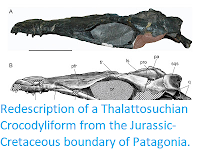
Redescription of a Thalattosuchian Crocodyliform from the Jurassic-Cretaceous boundary of Patagonia.


Purranisaurus potens is known from a single partial specimen from the left margin of the Arroyo del Cajón Grande in southeast Malargüe Department, Mendoza Province, in the Neuquún Basin of west-central Argentina. It was first described in 1948 as a Plesiosaur, then reclassified as a Nothosaur in 1967. Since this time it has generally been considered to be a Metriorhynchid Thalattosuchian, a sort of Mesozoic Marine Crocodyliform, and a close relationship to two Chilean species, Metriorhynchus  casamiquelai and Metriorhynchus westermanni, and it has been suggested that the three species be placed in a single genus, though these analyses have been based upon photographs and descriptions from the original papers describing the specimen, rather than re-examination of the material.

In a paper published in the Journal of Vertebrate Paleontology on 20 February 2015, Yanina Herrera, Zulma Gasparini and Marta Fernández of the División Paleontología Vertebrados at the Museo de La Plata at the Universidad Nacional de La Plata redescribe the Purranisaurus potens, following repreparation of the original specimen at the Museo de La Plata during which more of the skull was exposed from the matrix.

The single known specimen of Purranisaurus potens comprises a three-dimensionally preserved skull with damage to the orbital region (area around the eyes) caused by post-mortem compression, as well as a partial left lower jaw. The original description also included several ribs and vertebrae, however these could not be located and appear to have been lost.

Purranisaurus potens in left lateral view. (A) Photograph; (B) line interpretation. Abbreviations: eor, external otic recess; fr, frontal; gd, nasal gland duct; j, jugal; la, lacrimal; ls, laterosphenoid; mx, maxilla; na, nasal; or, orbit; pa, parietal; pfr, prefrontal; po, postorbital; pro, prootic; q, quadrate; sq, squamosal; sqs, squamosal flat surface. Scale bar equals 10 cm. Herrera et al. (2015).

Based upon the new description Herrera et al. were able to re-analyse the phylogenetic position of Purranisaurus potens. This new analysis suggests that the species belongs firmly within the Geosaurine group of Metriorhynchids, and shows no close relationship with Metriorhynchus  casamiquelai and Metriorhynchus westermanni, and the true relationships of these two species remains unclear, with Herrera et al.’s analysis suggesting they occupy a basal position within the Geosaurinae, and are not closely related to other members of the genus Metriorhynchus.

Strict consensus topology of the unordered phylogenetic analysis. Herrera et al. (2015).

See also…

The Rosso Ammonitico Veronese is a red nodular limestone found on the Trento Plateau in northern Italy, and Middle to Late Jurassic in age. It is noted for its numerous Ammonite fossils, but also produces occasional Marine Reptiles, notably Thalattosuchian Crocodylomorphs and Plesiosaurians. The earliest recorded discovery of such a Reptile is a...


The Thalattosuchians were a group of marine Crocodiliformes (the group of Archosaurs that includes modern Crocodiles and a diverse range of Mesozoic animals) that were found in seas around the world from the Early Jurassic to the Early Cretaceous. They...

Follow Sciency Thoughts on Facebook.

Sunday, 8 June 2014

A Metriorhynchid Crocodylomorph tooth from the Late Jurassic of Chesil Beach, England.

The Metriorhynchids were a group of Crocodylomorphs that adopted a fully marine lifestyle in the Middle Jurassic and persisted into the Early Cretaceous. They were a highly successful group, producing a wide range of body shapes, and therefore, by implication, survival strategies. One group of Metriorhynchid Crocodylomorphs, the Geosaurini, apparently specialized in the capture and consumption of large prey, attaining large sizes and having wide gapes and specialized jaws adapted to shearing bites, with fewer, but larger teeth. Within this group one genus, Dakosaurus, became particularly specialized, with the shortest tooth-row of any known Metriorhynchid, and further specialized teeth and jaws. The morphology of Dakosaurus has been compared to both Killer Whales and False Killer Whales.

In a paper published in the journal Historical Biology on 16 May 2014, a group of palaeontologists led by Mark Young of the Institute of Evolutionary Biology at the University of Edinburgh and the School of Ocean and Earth Science at the University of Southampton describe an of Dakosaurus tooth recovered by a dredger from of Chesil Beach in Dorset, England. 

The tooth is 53 mm high, 21 mm deep and 19 mm wide, being single cusped and slightly compressed. It is curved backwards, but only on its middle and apex. The root is missing, but by comparison with other teeth it is thought to be the tip of a Dakosaurus tooth about 55 mm in length, and assigned to the species Dakosaurus maximus.

Dakosaurus maximus, isolated tooth in (a) lingual view, (b) labial view, (c) mesial view, (d) distal view, (e) basal view and (f) apical view. This specimen is from Chesil Beach, near Weymouth, England (Kimmeridge Clay Formation). Scale bar is 10 mm. Young et al. (2014).

Kimmeridge Clay Formation outcrops in the Dorset type area. Young et al. (2014).

See also…


The Slender-snouted Crocodile, Mecistops cataphractus, is found throughout West and Central Africa. It is the only species in the genus Mecistops, which apparently diverged from the related genus...


The Metriorhynchids were Mesozoic Crocodylomorphs adapted to a fully aquatic marine lifestyle. Their limbs were modified into paddle-like flippers, they has a shark-like tail-fin and had lost the...


Follow Sciency Thoughts on Facebook.

Monday, 13 January 2014

A giant Metriorhynchid Crocodylomorph from the Middle Jurassic of England.

The Metriorhynchids were Mesozoic Crocodylomorphs adapted to a fully aquatic marine lifestyle. Their limbs were modified into paddle-like flippers, they has a shark-like tail-fin and had lost the osteoderms in their skin. Meriorhynchids appear to have been fully pelagic, i.e. capable of swimming freely in ocean currents, rather than being restricted to inshore environments. The Meriorhynchids appeared in the Middle Jurassic and survived into the Early Cretaceous.

In a paper published in the Journal of Systematic Palaeontology on 4 January 2013, a team of scientists led by Mark Young of the Institute of Biodiversity, Animal Health and Comparative Medicine at the University of Glasgow, and the School of Geosciences at the University of Edinburgh, describe a new species of Metriorhynchid Crocodylomorph based upon fragmentary material excavated from a clay it at Fletton in Cambridgeshire by Alfred Leeds between 1907 and 1909, which has remained undescribed in the collection of the Hunterian Museum in Glasgow since this time.

The new species is named Tyrannoneustes lythrodectikos, where 'Tyrannoneustes' means 'tyrant-swimmer' and 'lythrodectikos' means 'blood-biting'. It is described from a partial mandible (lower jaw), part of the jugal and quadratojugal  (bones in the upper jaw) and a collection of vertebrae and rib fragments.

Tyrannoneustes lythrodectikos. Right mandibular ramus in: (A) lateral view; (B) medial view; and (C) dorsal view. Abbriviations: an, angular; co, coronoid; cp, coronoid process; den, dentary; rp, reception pit; san, surangular; sp, splenal; sym, mandibular symphysis; tc, tooth crown. Young et al. (2013).


The bones of the mandible of Tyrannoneustes lythrodectikos are not completely fused, suggesting that it is a sub-adult. While it is not possible to estimate the size of the full animal from the material available, the 670 mm length of the partial mandible suggests that it was big, probably in excess of 3 m, larger than any other known Metriorhynchid Crocodylomorph from this early.

Teeth of Tyrannoneustes lythrodectikosYoung et al. (2013).


Follow Sciency Thoughts on Facebook.