Showing posts with label Crocodylomorphs. Show all posts

Monday, 24 June 2019

Isisfordia molnari: A new species of Crocodyliform from the Middle Cretaceous of New South Wales.

The Crocodyliforms were the only group of Crocodylomorphs to survive the End Triassic Extinction event. The group includes all modern Crocodylians, but also a number of extinct groups, such as the Dog-like Peirosaurians, the short-snouted, long-legged Notosuchins, the fully marine Metriorhynchids, and the Dyrosaurids, a diverse group which survived till the Eocene. These Crocodyliforms were abundant in the Mesozoic of most of the Southern Hemisphere, but are startlingly absent from the Australian continent, where only a single species has been described, Isisfordia duncani, from the Middle Cretaceous of Queensland, a species thought to be closely related to, but not placed within, the still extant Crocodylians.

In a paper published in the journal PeerJ on 21 June 2019, Lachlan Hart and Phil Bell of the Palaeoscience Research Centre at the University of New England, Elizabeth Smith of the Australian Opal Centre, and Steven Salisbury of the School of Biological Sciences at the University of Queensland describe a second species of Isisfordia from two opalised bone fragments from mines in the Lightning Ridge area of New South Wales and Queensland.

Opal is an amorphous form of silica containing as much as 21% water, It is made up of tiny spheroids of crystalline silica some 150 to 300 nm in diameter, with random alignments to one another. Light passing through these crystaloids is refracted as by a prism, leading to the 'opalescent' sheen which gives the mineral its value. Opal is formed by water percolating through silica rocks, where it dissolves some of the mineral forming a silica-rich solution. This can accumulate in any cracks or gaps in the rock, where if it reaches a high enough concentration it can precipitate out as opal. The Cretaceous Griman Creek Formation of northern New South Wales and southern Queensland is noted for the occurrence of opalised vertebrate fossils, replacement fossils formed when opal forms in gaps in the rock left by the dissolution of bone or earlier replacement material. However, these are rare and are not always spotted in areas where the opal is mined using mechanised equipment, which also means that the material that is recovered is often fragmented.

The new species is named Isisfordia molnari, in honour of Ralph Molnar, for his work on Crocodylomorphs from the Griman Creek Formation, and Australian vertebrate palaeontology in general. The species is described from two specimens, a braincase recovered from a mine in 2000 and donated to the Australian Museum by opal miners Peter and Lisa Caroll, and a partial maxilla (upper jawbone) extracted in 1914 and donated to the Australian Museum by Colonel Reuter Emerich Roth. The precise locations where these specimens were found is unclear, though the jaw was probably from Three Mile Field, close to the town of Lightning Ridge, and the braincase is probably from Coocoran Fields, 30 -40 km to the west.

Isisfordia molnari, maxillary fragment from the Griman Creek Formation. (A) medial, (B) lateral, (C) palatal views. Arrows indicate rostral end. Scale bars equal 10 mm. Abbreviations: ag, alveolar groove; is, interalveolar septa; ms, medial `shelf'; pp, palatal process. Hart in Hart et al. (2019).

Isisfordia molnari is differentiated from Isisfordia duncani on the basis of the shape of the pariedal bones (the bones which form the side and roof of the skull in Humans), which are flat in Isisfordia molnari and have ridges on them in Isisfordia duncani, and the shape and spacing of the tooth sockets, which are rounded in Isisfordia duncani  and oval in Isisfordia molnari.

Reconstruction of Isisfordia molnari in life, swimming next to a wading Sauropod. José Vitor Silva in Hart et al. (2019).

See also...


https://sciencythoughts.blogspot.com/2019/06/fostoria-dhimbangunmal-opalised.htmlhttps://sciencythoughts.blogspot.com/2019/04/cricosaurus-bambergensis-new-species-of.html
https://sciencythoughts.blogspot.com/2016/10/queensland-miner-killed-in-trench.htmlhttps://sciencythoughts.blogspot.com/2016/05/gryposuchus-pachakamue-gavialoid.html
https://sciencythoughts.blogspot.com/2015/06/redescription-of-thalattosuchian.htmlhttps://sciencythoughts.blogspot.com/2015/03/hydrated-silicate-minerals-in-mariner.html
Follow Sciency Thoughts on Facebook.

Saturday, 13 April 2019

Cricosaurus bambergensis: A new species of Metriorhynchid Crocodylomorph from the Late Jurassic of Bavaria, southern Germany.

The Metriorhynchids were Mesozoic Thalattosuchian Crocodylomorphs adapted to a fully aquatic marine lifestyle. Their limbs were modified into paddle-like flippers, they has a shark-like tail-fin and had lost the osteoderms in their skin. Meriorhynchids appear to have been fully pelagic, i.e. capable of swimming freely in ocean currents, rather than being restricted to inshore environments. The Meriorhynchids appeared in the Middle Jurassic and survived into the Early Cretaceous. The genus Cricosaurus currently contains nine species of Metriorhynchid Crocodylomorphs from the Late Jurassic and Early Cretaceous of Europe and North America, however cladistic analysis (computerised analysis of relationships within the group based entirely upon shared common features rather than assumed relationships) has suggested that two members of the genus, Cricosaurus saltillensis and Cricosaurus macrospondylus may be more closely related to other Metriorhynchids than they are to the other members of the genus.

In a paper published in the journal Acta Palaeontologica Polonica on 4 April 2019, Sven Sachs of the Naturkunde-Museum Bielefeld, Mark Young of the School of GeoSciences at the University of Edinburgh, Pascal Abel of the Senckenberg Centre for Human Evolution and Palaeoenvironment at Eberhard- Karls Universität Tübingen, and Heinrich Mallison of Palaeo3D, describe a new species of Cricosaurus from the Late Jurassic Torleite Formation of Wattendorf near Bamberg in Bavaria, southern Germany.

The late Kimmeridgian (roughly 155-152 million years old) Torleite Formation of the Franconian Jura comprises a series of Late Jurassic shallow-marine sediments, including numerous Sponge-Microbial reef structures and micritic lithographic limestones, the oldest examples of these highly fossiliferous deposits in southern Germany. The new specimen comes from the Wattendorf Member from a quarry near Bamburg, a course microtic limestone dated to the Aulacostephanus pseudomutabilis  Ammonite Zone (about 153.96 to 153.55 million years old), a deposit that has produced numerous Plants, Invertebrates Fish, Rhynchocephalians, Turtles, Pterosaurs, and Thalattosuchians, which were preserved after settling on the floor of lagoons between the reefs, where dysoxic or anoxic conditions prevailed beneath an oxidated, plankton-rich upper water column, favouring the preservation of articulated skeletons in calcareous mud.

The new species is named Cricosaurus bambergensis, meaning 'from Bamburg'. It is described from a single specimen comprising an almost complete articulated skeleton preserved with the skull in ventral view and the body in lateral view.

Metriorhynchid Thalattosuchian Cricosaurus bambergensis, late Kimmeridgian of Wattendorf (southern Germany). Skeleton in ventrolateral view. Sachs et al. (2019).

The skull of the specimen is damaged, but the mandible and palate are well preserved, with sutures clearly visible. Twenty three teeth are visible on the right maxilla, with three teeth present on the premaxila; the dentary is less well preserved and the number of teeth unclear. The teeth are slender, labiolingually compressed (i.e. longer front-to-back than side-to-side), and elliptical in cross-section. A low-keeled carina (ridge) is present on the front and back edges of the teeth.

Metriorhynchid Thalattosuchian Cricosaurus bambergensis, late Kimmeridgian of Wattendorf (southern Germany). (A) Dentition. (B) Palatines showing the midline keel seperating symmetrical depressions (dashed outline). (C) First cervical vertebrae. Abbreviations: aac, atlas-axis vertebrae; cv, cervical vertebra; hy, hyoid. Sachs et al. (2019).

The specimen has seven cervical (neck), eighteen dorsal (back), and two sacral (lower back) vertebrae, with each of the dorsal and sacral vertebrae supporting a slender, slightly offset, rib. Within the rib cage parts of a gastralium (gastral basket) can be seen. The tail comprises fifty four vertebrae, twenty eight preflexural, six flexural (the bit where the tail bends) and twenty postflexural, though there is a break after the thirteenth vertebra.

Metriorhynchid Thalattosuchian Cricosaurus bambergensis, late Kimmeridgian of Wattendorf (southern Germany). Distal part of the tail showing the flexural and postflexural region. Sachs et al. (2019).

See also...

https://sciencythoughts.blogspot.com/2016/05/gryposuchus-pachakamue-gavialoid.htmlhttps://sciencythoughts.blogspot.com/2015/06/redescription-of-thalattosuchian.html
https://sciencythoughts.blogspot.com/2015/03/a-large-bodied-crocodylomorph-from.htmlhttps://sciencythoughts.blogspot.com/2015/02/dwarf-crocodile-remains-from.html
https://sciencythoughts.blogspot.com/2015/01/an-allodaposuchian-crocodylian-from.htmlhttps://sciencythoughts.blogspot.com/2014/12/a-baurusuchidcrocodyliforme-with.html
Follow Sciency Thoughts on Facebook.

Friday, 15 September 2017

British tourist killed by Crocodile in Sri Lanka.

A British tourist is believed to have been killed by a Crocodile attack near Arugam Bayon the southeast coast of Sri Lanka on Thursday 14 September 2017. The man has been identified as Paul McClean, 24, a journalist with the Financial Times in London. Witnesses from a local village reported seeing Mr McLean being dragged into a river while he was washing his hands. They summoned a group of other tourists who had just completed a surfing lesson, but a search for him proved unsuccessful. A body, believed to be Mr McLean, was later recovered from the river by divers from the Sri Lanka Navy. Local villagers report that there have been a number of attacks by Crocodiles on people in the last year, but this is the first known fatality.

British journalist Paul McLean, killed by a Crocodile in Sri Lanka on 14 September 2017. Financial Times/AP.

Sri Lanka is home to two species of Crocodile, the Mugger Crocodile, Crocodylus palustris, and the Saltwater Crocodile, Crocodylus porosus, and it is unclear which was responsible for the 14 September attack. Crocodile attacks on Humans are relatively rare, but they are opportunistic ambush predators and will potentially attack anything going close to the water. Saltwater Crocodiles have a particularly poor reputation for such behaviour, being the largest species of Crocodile and notoriously aggressive. However, while Saltwater Crocodiles are one of the few Crocodile species not considered vulnerable to extinction, being found from India to Australia  and inhabiting many areas that Humans shun, such as Mangrove forests and islands without fresh water, but are relatively uncommon in Sri Lanka. Mugger Crocodiles are considered Vulnerable under the terms of the International Union for the Conservation of Nature's Red List of Threatened Species, formerly having been found across much of South Asia, but now probably absent from Bangladesh, Myanmar and Bhutan, and greatly reduced in number in India, Pakistan, Nepal and Iran. In Sri Lanka, however, the species is still numerous. Mugger Crocodiles are a much smaller species than Saltwater Crocodiles, and do not usually attack prey as large as Humans. However such an animal would be consistent with local stories of several failed attacks on Humans before a successful attack, as few people manage to escape from the much larger Saltwater Crocodile.

A Mugger Crocodile in the Wilpaththu National Park in Sri Lanka. Jungle Dragon.

See also...

http://sciencythoughts.blogspot.co.uk/2016/05/gryposuchus-pachakamue-gavialoid.htmlhttp://sciencythoughts.blogspot.co.uk/2015/02/dwarf-crocodile-remains-from.html
http://sciencythoughts.blogspot.co.uk/2015/01/an-allodaposuchian-crocodylian-from.htmlhttp://sciencythoughts.blogspot.co.uk/2014/03/a-new-species-of-crocodile-from-west.html
Follow Sciency Thoughts on Facebook.

Saturday, 7 May 2016

Gryposuchus pachakamue: A Gavialoid Crocodylian from the Middle Miocene of Peru.

Gavialoid Crocodylians, or Gharails (Gavialoidea), are highly specialized Crocodylians with elongate, slender jaws and eyes and nostrils high on their heads. They are specialists piscavores, adapted to catching Fish rather than more generalist ambush predators like other Crocodylians. Today only a single species is extant, the Indian Gharail, Gavialis gangeticus, but the group has an extensive fossil record, and a contested evolutionary history. Generic studies have suggested that the closest relative of the living Gharail is the Indonesian False Gharial, Tomistoma schlegelii, and that the two probably diverged some time in the Eocene; this fits well with the presence of a number of fossil species assigned to the genus Gavialis in Indonesia, and suggests that the group may have originated in southern Asia at this time. However analysis of the fossil record suggests that Gavialoids diverged from other Crocodylians in the Cretaceous, with primative members of the group appearing in the Late Cretaceous in North America, Europe, and Africa. One possible key to understanding this group are the South American Gavialoids, a group which persisted at least till the Miocene, and which appear to have included advanced forms similar to modern and recent Asian species, as well as more primative members of the group.

In a paper published in the journal PLoS One on 20 April 2016, Rodolfo Salas-Gismondi of the Institut des Sciences de l’Évolution at the Université de Montpellier and the Departamento de Paleontología de Vertebrados at the Museo de Historia Natural at the Universidad Nacional Mayor de San Marcos, John Flynn of the Division of Paleontology at the American Museum of Natural History, Patrice Baby of Géosciences-Environnements Toulouse at the Université de Toulouse, the Institut de reserche pour le developpement and PeruPetro, Julia Tejada-Lara, also of the Departamento de Paleontología de Vertebrados at the Museo de Historia Natural at the Universidad Nacional Mayor de San Marcos and the Division of Paleontologyat the American Museum of Natural History and of the Department of Earth and Environmental Sciences at Columbia University and Julien Claude and Pierre-Olivier Antoine also of the Institut des Sciences de l’Évolution at the Université de Montpellier, describe a new species of Gavialoid Crocodylian from the Middle Miocene Pebas Formation of Peru.

The Pebas formation was laid down in an extensive wetland system formed by the drainage of an ancient riverway from what is now the Amazon Basin running west into the Pacific Ocean. This ancient west-flowing Pebas river system has been replaced by the modern east-flowing Amazon river system due to the formation of the Andes mountains, driven by subduction of the Nazca Plate beneath the South American Plate along the west coast of South America.

The new species is placed in the previously described South American genus Gryposuchus, and given the specific name pachakamue, Pachakamue being a Quechua god who was the first storyteller and who preserved ancient knowledge about the origin of living things in Amazonia. The species is described from an almost complete skull, slightly distorted around the right orbit abd lacking most of the temporal and occipital bones, as well as the pterygoid flanges, plus nine less complete skulls, which together give a good impresion of the head of the animal, thought the post-cranial skeleton is unknown.

Gryposuchus pachakamue. Photograph and schematic drawing of the skull in dorsal (A), ventral (B), and lateral (C) view. (D) Photograph of the right mandible and schematic drawing in dorsal view. Details of the skull (E,F). (E) In lateral view. (F) In occipital view. Abbreviations: an, angular; ar, articular; bo, basioccipital; d, dentary; d4, d22, dentary tooth positions; ec, ectopterygoid; ec.j, jugal surface for ectopterygoid; ec.mx, maxilla surface for ectopterygoid; EN, external nares; eo, exoccipital; f, frontal; fo, foramen; IF, incisive foramen; j, jugal; j.mx, maxilla surface for the jugal; l, lacrimal; ls, laterosphenoid; m22, maxillary tooth position 22; mcq, medial condyle of the quadrate; mx, maxilla; mx. j, jugal surface for maxilla; n.mx, maxilla surface for nasal; n, nasal; OR, orbit; p, parietal; pa, palatine; pf, prefrontal; pm, premaxilla; p2, premaxillary tooth position 2; po, postorbital; ppo, paraoccipital process; pt, pterygoid; ptb, pterygoid bullae; q, quadrate; qj, quadratojugal; qj.q, quadrate surface for quadratojugal;; rac, retroarticular crest; sp, splenial; sa, surangular; so, supraoccipital; sq, squamosal; SOF, suborbital fenestra; STF, supratemporal fenestra. Scale bars are 5 cm. Salas-Gismondi et al. (2016).

Gryposuchus pachakamue is a long-snouted Gavialoid with 22 mandibular (lower) teeth plus 22 maxilary and four premaxilary teeth (i.e. 26 upper teeth) on each side of the mouth. The number of premaxilary teeth is the same as in other members of the genus Gryposuchus, all of which have four on eact side, while all members of the genus Gavialis have five premaxilary teeth on each side.

A phylogenetic analysis carried out by Salas-Gismondi et al. suggests that these two advanced Gavialoid genera (Gryposuchus and Gavialis) are in fact closely related. This supports the idea of a modern Asian, origin of modern Gavialoids, some of which then migrated to South America, probably along the ancient Tethys Seaway and across a narower Atlantic to the Caribbean and then the Pebas River Basin. Earlier 'primitive' South American Gavialoids are suggested to be the results of an earlier radiation within the group, more closely related to other 'primative' forms elsewhere than to Gryposuchus.

 Time calibrated phylogenetic tree of the Gavialoidea and relevant paleogeographic distributions associated with the evolution and diversification of gavialoids in marine and freshwater settings. During the Late Paleocene-Early Eocene interval, peaks of sea surface temperature (SST) and global sea surface level (GSL) occurred together with tropical marine connections through the Tethys Ocean and Caribbean Sea. During the Neogene, distinct biomes dominated tropical South America: (A) Acre Phase, after the onset of the eastern-draining Amazon and northward-draining Orinoco river systems; and (B) Pebas Mega-Wetland System, with its drainage northward to the Caribbean Sea. Abbreviations: Olig., Oligocene; Ple., Pleistocene; Pli., Pliocene. Salas-Gismondi et al. (2016).

See also...

http://sciencythoughts.blogspot.co.uk/2015/02/dwarf-crocodile-remains-from.htmlDwarf Crocodile remains from the Oligo–Miocene of northwestern Queensland.            The Mekosuchine Crocodile Mekosuchus whitehunterensis was described from Late Oligocene deposits exposed at the White Hunter Site in the Riversleigh World Heritage Area innorthwestern Queensland. It is interpreted to have been largely terrestrial, and to have been a dwarf...
http://sciencythoughts.blogspot.co.uk/2014/03/a-new-species-of-crocodile-from-west.htmlA new species of Crocodile from West Africa.                                                                         The Slender-snouted Crocodile, Mecistops cataphractus, is found throughout West and Central Africa. It is the only species in the genus Mecistops, which apparently diverged from the related genus Osteolaemus in the Miocene. The species is...
Follow Sciency Thoughts on Facebook.
 

Sunday, 7 June 2015

Redescription of a Thalattosuchian Crocodyliform from the Jurassic-Cretaceous boundary of Patagonia.


Purranisaurus potens is known from a single partial specimen from the left margin of the Arroyo del Cajón Grande in southeast Malargüe Department, Mendoza Province, in the Neuquún Basin of west-central Argentina. It was first described in 1948 as a Plesiosaur, then reclassified as a Nothosaur in 1967. Since this time it has generally been considered to be a Metriorhynchid Thalattosuchian, a sort of Mesozoic Marine Crocodyliform, and a close relationship to two Chilean species, Metriorhynchus  casamiquelai and Metriorhynchus westermanni, and it has been suggested that the three species be placed in a single genus, though these analyses have been based upon photographs and descriptions from the original papers describing the specimen, rather than re-examination of the material.

In a paper published in the Journal of Vertebrate Paleontology on 20 February 2015, Yanina Herrera, Zulma Gasparini and Marta Fernández of the División Paleontología Vertebrados at the Museo de La Plata at the Universidad Nacional de La Plata redescribe the Purranisaurus potens, following repreparation of the original specimen at the Museo de La Plata during which more of the skull was exposed from the matrix.

The single known specimen of Purranisaurus potens comprises a three-dimensionally preserved skull with damage to the orbital region (area around the eyes) caused by post-mortem compression, as well as a partial left lower jaw. The original description also included several ribs and vertebrae, however these could not be located and appear to have been lost.

Purranisaurus potens in left lateral view. (A) Photograph; (B) line interpretation. Abbreviations: eor, external otic recess; fr, frontal; gd, nasal gland duct; j, jugal; la, lacrimal; ls, laterosphenoid; mx, maxilla; na, nasal; or, orbit; pa, parietal; pfr, prefrontal; po, postorbital; pro, prootic; q, quadrate; sq, squamosal; sqs, squamosal flat surface. Scale bar equals 10 cm. Herrera et al. (2015).

Based upon the new description Herrera et al. were able to re-analyse the phylogenetic position of Purranisaurus potens. This new analysis suggests that the species belongs firmly within the Geosaurine group of Metriorhynchids, and shows no close relationship with Metriorhynchus  casamiquelai and Metriorhynchus westermanni, and the true relationships of these two species remains unclear, with Herrera et al.’s analysis suggesting they occupy a basal position within the Geosaurinae, and are not closely related to other members of the genus Metriorhynchus.

Strict consensus topology of the unordered phylogenetic analysis. Herrera et al. (2015).

See also…

The Rosso Ammonitico Veronese is a red nodular limestone found on the Trento Plateau in northern Italy, and Middle to Late Jurassic in age. It is noted for its numerous Ammonite fossils, but also produces occasional Marine Reptiles, notably Thalattosuchian Crocodylomorphs and Plesiosaurians. The earliest recorded discovery of such a Reptile is a...


The Thalattosuchians were a group of marine Crocodiliformes (the group of Archosaurs that includes modern Crocodiles and a diverse range of Mesozoic animals) that were found in seas around the world from the Early Jurassic to the Early Cretaceous. They...

Follow Sciency Thoughts on Facebook.

Monday, 23 March 2015

A large-bodied Crocodylomorph from the Middle Triassic of North Carolina.


The Triassic Period was a time of great evolutionary experimentation, with many new groups of organisms arising and developing to fill ecological niches left vacant by the End Permian Extinction. During this time many familiar groups of animals arose, including Lizards, Turtles, Mammals, Dinosaurs and Crocodylomorphs. By the Late Triassic Dinosaurs and Crocodylomorphs had come to dominate many terrestrial ecosystems, and were often the largest predators present, but in the Middle Triassic the earliest members of these groups were generally smaller, medium-sized predators, with the top niches being filled by Rauisuchians, and extinct Archosaur group.

In a paper published in the journal Nature Scientific Reports on 19 March 2015, Lindsay Zanno and Susan Drymala of Research & Collections at the North Carolina Museum of Natural Sciences and the Department of Biological Sciences at North Carolina State University, Sterling Nesbitt of the Department of Geosciences at the Virginia Polytechnic Institute and State University and Vincent Schneider also of Research & Collections at the North Carolina Museum of Natural Sciences describe a new species of large-bodied Crocodylomorph from the Middle Triassic Pekin Formation of Chatham County, North Carolina.

The new Crocodylomorph is given the name Carnufex carolinensis, where ‘Carnufex’ means ‘butcher’ and ‘carolinensis’ means ‘from Carolina’. It is described from a partial skull and postcranial skeleton including the right dentigerous premaxilla, left maxilla, left lacrimal, left jugal, left articular, right angular, isolated maxillary tooth, cervical neural arch, dorsal neural arch, cervical rib, dorsal ribs and left humerus.

Three dimensional skull reconstruction and representative elements of Carnufex carolinensis. (a) reconstructed skull, clockwise from upper left, rostral, oblique, and lateral views; (b) right premaxilla, lateral view; (c) left maxilla, lateral view; (d) left lacrimal, lateral view; (e) left jugal, lateral view; (f) right angular, lateral view; (g) left articular, in (clockwise from upper left) lateral, medial, dorsal, caudal views; (h) cervical neural arch, in (left to right) caudal, lateral, cranial, and dorsal views; (i) dorsal neural arch, in (left to right) right lateral, cranial, and caudal views. Abbreviations: apm, ascending process, maxilla; bt, bulbous tuberosity; cpa, caudal process, articular; cpj, caudal process, jugal; cpm, caudal process, maxilla; dpa, dorsal process, articular; dpl, descending process, lacrimal; emf, external mandibular fenestra; gl, glenoid, gr, groove; lra, lateral ridge, angular; lrm, lateral ridge, maxilla; maj, maxillary articulation, jugal; mpp, maxillary process, premaxilla; n, naris; pol, centropostzygapophyseal lamina; poz, postzygapophysis; ppj, postorbital process, jugal; pr, prong; prl, centroprezygapophyseal lamina; prz, prezygapophysis; sn, subnarial notch; tp, transverse process; vmp, ventromedial process. Scale bar is 10 cm. Zanno et al. (2015).

Carnufex carolinensis has an estimated skull length of 50 cm, making it by far the largest predator known from the Pekin Formation, as well as larger than any other known Crocodylomorph or Theropod Dinosaur from the Middle Triassic, and suggesting that Crocodylomorphs evolved into top-predator niches earlier than had previously been realized.

See also…

The Mekosuchine Crocodile Mekosuchus whitehunterensis was described from Late Oligocene deposits exposed at the White Hunter Site in the Riversleigh World Heritage Area innorthwestern Queensland. It is interpreted to have been largely terrestrial, and to have been a dwarf species...

The Adamantina Formation from the Late Cretaceous of southern Brazil produces a wide variety of Crocodyliformes, including...

The Tethysuchians were a group of largely marine Crocodyliforms that are reasonably well known from the Middle and Late Cretaceous, with one group, the Dyrosauridae surviving the End Cretaceous extinction and surviving till the end of the Eocene. The origins of...


Follow Sciency Thoughts on Facebook.

Monday, 9 February 2015

Dwarf Crocodile remains from the Oligo–Miocene of northwestern Queensland.


The Mekosuchine Crocodile Mekosuchuswhitehunterensis was described from Late Oligocene deposits exposed at the White Hunter Site in the Riversleigh World Heritage Area innorthwestern Queensland. It is interpreted to have been largely terrestrial, and to have been a dwarf species reaching maturity at little over a meter in length. However dwarfism is hard to diagnose in fossil Crocodilian species, as the animals grow throughout their entire lives, only slowing their growth rate when they reach maturity, and because small Crocodillian species tend to be essentially similar to juveniles of larger species.

In a forthcoming paper in the journal Acta Palaeontologica Polonica, available online from 16 January 2015, Michael Stein, Michael Archer and Suzanne Hand of the School of Biological, Earth and Environmental Sciences at the University of New South Wales describe additional material assigned to Mekosuchus whitehunterensis from the Early Miocene Price is Right Site and Late Oligocene Hiatus and LSO sites, also in the Riversleigh World Heritage Area.

The original material from the White Hunter Site comprised entirely cranial material. The new material from the Price is Right Site comprises a left maxilla and dentary (upper and lower jaw bones) which appear to belong to the same species, as well as a series of five associated cervical vertebrae. The material from the Hiatus Site comprises two vertebrae which appear to be from the same species as those at the Price is Right Site, while the LSO site material comprises a single vertebra, again apparently of the same species.

Rostra of Mekosuchine Crocodile Mekosuchus whitehunterensis.(A) Left maxilla in buccal (A1) and ventral (A2) views. (B) Left dentary in lingual (B1), dorsal (B2), and buccal (B3) views. Scale bars 5 cm. Stein et al. (2015).

Vertebrae are much more useful in assessing the maturity of a Crocodilian than cranial material, as the neurocentral suture closes (mineralizes) in mature individuals. The new vertebrae appear to come from a mature individual, and have a mean anterioposterior length (front-to-back length, thickness) of 19.3 mm. The most complete known skull of Mekosuchus whitehunterensis is about 10 cm in length, which combined with the proportions of the vertebrae suggest a mature individual measuring about 60 cm, considerably smaller than the smallest modern Crocodilians, Osteolaminus and Paleosuchus, both of which typically exceed a meter in length at maturity.

Vertebrae of Mekosuchine Crocodile Mekosuchus whitehunterensisin left (A1–H1) and right (A2–H2) views. (A) Axis vertebra. (B) Third cervical vertebra. (C) Fourth cervical vertebra. (D) Sixth cervical vertebra. (E) Ninth cervical vertebra. (F) Third thoracic vertebra. (G) Third cervical vertebra. (H) Eighth cervical vertebra. Arrows indicate extent of the neurocentral suture. Scale bars 2 cm. Stein et al. (2015).

The cervical vertebrae show significantly enlarged muscle attachments, suggesting that the living animal had powerful neck muscles. This has implications for the feeding strategy of the living animal. Modern Crocodiles remove meat from prey animals in two ways. Firstly they body role, taking a firm grip of their prey they rotate their entire bodies in order to tear digestible pieces from the prey. However this strategy is seldom employed by small Crocodilians, which lack the mass use this strategy effectively. It is also a feeding method best suited to an aquatic environment, where the water cushions the body from any damage, and could be rather more risky in a terrestrial environment (where Mekosuchus whitehunterensisis thought to have fed) as friction with the ground could potentially lead to damage to the body or limbs. Secondly Crocodiles can remove meat from a prey animal by vigorously shaking their heads in a manner similar to a Dog. This is a strategy of limited usefulness in an aquatic environment, where the prey is likely to simply move with the head, but can be very effective on dry land, where the prey is held down to some extent by gravity and experiences friction with the ground. The enlarged neck muscles of Mekosuchus whitehunterensis would seem suitable for such a feeding method, supporting the idea that it hunted or scavenged away from the water.

See also…

http://sciencythoughts.blogspot.co.uk/2014/12/a-baurusuchidcrocodyliforme-with.htmlA Baurusuchid Crocodyliforme with preserved stomach contents from the Late Cretaceous of Brazil.                                                                     The Adamantina Formation from the Late Cretaceous of southern Brazil produces a wide variety of Crocodyliformes, including semi-aquatic...
The Tethysuchians were a group of largely marine Crocodyliforms that are reasonably well known from the Middle and Late Cretaceous, with one group, the Dyrosauridae surviving the End Cretaceous extinction...
The Rosso Ammonitico Veronese is a red nodular limestone found on the Trento Plateau in northern Italy, and Middle to Late Jurassic in age. It is noted for its numerous Ammonite fossils, but also produces occasional Marine Reptiles, notably Thalattosuchian Crocodylomorphs and Plesiosaurians. The earliest recorded discovery of such a Reptile is a Crocodylian...

Follow Sciency Thoughts on Facebook.
Wednesday, 7 January 2015

An Allodaposuchian Crocodylian from the Late Cretaceous of the southeast Pyrenees.


All modern Crocodylomorphs are assigned to a single suborder, the Eusuchia, which appeared in the Early Cretaceous in Europe and North America (which were then connected), and underwent a major radiation in the Late Cretaceous, when the modern Crocodylians (defined as all living Crocodiles, Alligators and Gavials, there most recent common ancestor, and everything descended from that ancestor) appeared and rapidly diversified. The Late Cretaceous of Europe had a highly diverse Crocodylomorph diversity, includingCrocodiles, Alligators, Gavails, the non-Crocodylian Eusuchian Hylaeochampsids and non-Eusuchian groups such as Dyrosaurids, Pholidosaurids, Notosuchians, Atoposaurids and Goniopholidids. This fauna also includes a number of enigmatic taxa, of uncertain affinities, such as the genus Allodaposuchus, which currently contains two described species, Allodaposuchus precedens, which is known from fragmentary material from Romania, France and Spain (some of which is disputed and assigned to other taxa by some experts) and Allodaposuchus subjuniperus, which is known from a single, almost complete, skull from Huesca in northeast Spain. Allodaposuchus is considered to be a Eusuchian, but its position within that group is unclear.

In a paper published in the journal PLoS One on 31 December 2014, Alejandro Blanco of the Institut Català de Paleontologia Miquel Crusafont at the Universitat Autònomade Barcelona, Eduardo Puértolas-Pascual of the Área de Paleontología at the Universidadde Zaragoza, Josep Marmi, also of the Institut Català de Paleontologia Miquel Crusafont at the Universitat Autònoma de Barcelona, Bernat Vila also of the Área de Paleontología at the Universidad de Zaragoza and Albert Sellés, again of the the Institut Català de Paleontologia Miquel Crusafont at the Universitat Autònoma de Barcelona describe a new species of Allodaposuchus from the Late Cretaceous Tremp Formation in the southeast Pyrenees.

The new species is named Allodaposuchus palustris, from the Latin ‘palus’, meaning ‘swamp’, the specimen was recovered from a layer of grey organic mudstones interpreted as having been laid down in a swampy lagoon environment. The species is described from a fragmentary and disarticulated skull and jaw, plus numerous isolated vertebrae and limb bones. While the remains are disarticulated, they were all found in close association, often touching, and were in approximately the correct life position (i.e. head at one end, tail at the other etc.), were all from an animal or animals of similar size, and there were no duplicate bones, leading Blanco et al. to conclude that this was the disarticulated remains of a single animal rather than a bone assemblage, and that they had probably been disarticulated due to exposed decomposition rather than transportation or scavenging.

Mapping of the Crocodylian bones at the Fumanya Sud locality and their anatomical location. (A) Distribution of the fossils along a 2.3 m-long accumulation with indication of the type of bone. Grid square is 10 centimeters. (B) Anatomical location of the recovered bones. Abbreviations: a, astragalus; ar, articular; ca, calcaneum; cdv, caudal vertebra; cr, cervical rib; cv, cervical vertebra; d, dentary; dr, dorsal rib; dv, dorsal vertebra; eo, exoccipital; ept, ectopterygoid; f, frontal; fi, fibula; fm, femur; h, humerus; il, ilium; lv, lumbar vertebra; ost, osteoderm; pa, parietal; pf, prefrontal; ph, phalanx; q, quadrate; r, radius; rb, rib; sf: skull fragment; sq, squamosal; t, tooth; ti, tibia; ul, ulna. Blanco et al. (2014).

All of the remains are black in colour, indicative of a high hydrocarbon content in the sediments which buried them, which is typical of swampy environments. A layer of coal was located about 60 cm below the remains, suggesting a peat-forming environment, and the deposits also contained remains of the Cheirolepidiaceous Conifer Frenelopsis, the Palm Sabalites longirhachis and a variety of Ferns, all of which are typical of wetlands with shrubby vegetation; Turtle remains have also been found nearby, as have Oysters, Saccostrea, which are typical of brackish environments, and Unionid Bivalves (Freshwater Mussels) which are found in freshwater. Blanco et al. interpret this as representing a system of freshwater lakes and marshes near the edge of a system of brackish mudflats.

Mandibular bones and teeth of Allodaposuchus palustris from the Fumanya locality. (A, C, E)Anterior tip of the left dentary in occlusal, lingual and ventral views; (B, D, F) interpretative drawings of (A, C and E); (G) articular; (H) interpretative drawing of (G); (I) a tooth in labial, lingual and lateral views and a detail of the ornamentation of the crown surface (scale 1 mm). Abbreviations: an, angular; dt1-7, tooth alveoli1-7; de, dentary; fim, foramen intermandibularisoralis; fo, foramen; glfo, glenoid fossa; mc, Meckelian canal; re pro, retroarticular process; spcs, splenial scar; sym, symphysis. Blanco et al. (2014).

The large size of the lumbar vertebrae of Allodaposuchus palustris combined with the well-developed ligament attachments on its limb-bones suggests that it was a powerful muscular animal. Its teeth are robust but pointed rather than bulbous, indicative of a generalist predator. The living animal is calculated to have weighed about 211 kg, and to have been capable of biting down with a force of 6788.63 Newtons, comparable to large modern Crocodiles. Small Sauropod Dinosaurs have been found in nearby, associated deposits, which would have made ideal prey for such an animal.

While the remains of Allodaposuchus palustrisare somewhat fragmentary, they do add considerably to our understanding of the morphology of the genus, and its relationships to other Eusuchians. Blanco et al. conclude that these were members of the Crocodylia, more closely related to Crocodiles and Alligators than to Gavials. They also suggest that Allodaposuchus is closely related to another enigmatic European Crocodylian, Arenysuchus gascabadiolorum, known from Late Cretaceous fluvial (river) deposits in the Pyrenees, and erect the name ‘Allodaposuchians’ to include the three species of Allodaposuchus plus Arenysuchus gascabadiolorum.

See also…

http://sciencythoughts.blogspot.co.uk/2014/12/a-baurusuchidcrocodyliforme-with.htmlA Baurusuchid Crocodyliforme with preserved stomach contents from the Late Cretaceous of Brazil.                                                     The Adamantina Formation from the Late Cretaceous of southern Brazil produces a wide variety of Crocodyliformes, including semi-aquatic...
The Tethysuchians were a group of largely marine Crocodyliforms that are reasonably well known from the Middle and Late Cretaceous, with one group, the Dyrosauridae surviving the End Cretaceous extinction...
The Rosso Ammonitico Veronese is a red nodular limestone found on the Trento Plateau in northern Italy, and Middle to Late Jurassic in age. It is noted for its numerous Ammonite fossils, but also produces occasional Marine Reptiles, notably Thalattosuchian Crocodylomorphs and Plesiosaurians. The earliest recorded discovery of such a Reptile is a Crocodylian...

Follow Sciency Thoughts on Facebook.

Monday, 15 December 2014

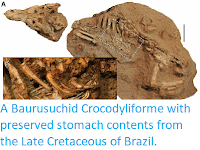
A Baurusuchid Crocodyliforme with preserved stomach contents from the Late Cretaceous of Brazil.


The Adamantina Formation from the Late Cretaceous of southern Brazil produces a wide variety of Crocodyliformes, including semi-aquatic Trematochampsids and Peirosaurids and terrestrial forms such as the large, predatory Baurusuchids, which often reached four meters in length, and smaller forms such as the Notosuchids and Sphagesaurids, which are thought to have been omnivorous or even fully herbivorous. The deposits are unusual in that they are almost completely lacking in Dinosaurs, with only Sauropods being common, Theropods represented only by isolated and fragmentary bones and Ornithischians completely absent. This is quite different from deposits from Argentina from roughly the same time period, which had a diverse Dinosaurian fauna, and is thought to be indicative of the Brazilian ecosystem being somehow isolated from that of Argentina.

In a paper published in the journal PLoS One on 8 May 2014, Pedro Godoy of the Departamento de Biologia at the Universidade de São Paulo and the Division of Paleontology at the American Museum of Natural History, Felipe Montefeltro of the Departamento de Zoologia at the Universidade Estadual Paulista, Mark Norell of the Division of Paleontology at the American Museum of Natural History and Max Langer of the Departamento de Biologia at the Universidade de São Paulo describe a new species of Baurusuchid Crocodyliforme from the Adamantina Formation in São Paulo State, Brazil, from a single specimen preserved with stomach contents intact.

The new species is named Aplestosuchus sordidus, where ‘Aplestosuchus’ means ‘greedy Crocodile’and ‘sordidus’ means ‘filthy’, in reference to the animals apparently voracious eating habits. The specimen is preserved on two blocks as a partially disarticulated skeleton on its side with the tail and ends of the hindlimbs missing.

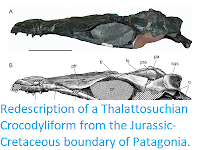
Fossil Crocodyliformes showing predator-prey interaction.(A) Aplestosuchus sordidus skeleton. Scale bar, 10 cm. (B) Area highlighted in (A) with details of the abdominal content, including sphagesaurid remains. Scale bar, 5 cm. C, Reconstructed predator and prey. Reconstruction by Rodolfo Nogueira. Scale bar, 50 cm. Godoy et al. (2014).

Aplestosuchus sordidus has a short snout (for a Crocodyleforme), with a low number of teeth, four on each premaxilla and five on each maxilla (elements of the upper jaw); the dentary (lower jaw) is less well preserved, but it is thought unlikely that the living animal had more than nine lower teeth on each side. The teeth at the front of the jaws are rounded in profile (conical) and curve backwards slightly, those at the back are flattened and serrated and curve backwards more strongly (conical teeth are good for gripping and holding prey, flattened, blade-like teeth good for cutting).

Skull of Aplestosuchus sordidus in lateral (right) view.(A) Photograph. (B) Interpretative drawing. Abbreviations: a, angular; ap, anterior palpebral; ar, articular; d, dentary; d4, dentary tooth 4; f, frontal; j, jugal; m, maxilla; ma, mandibular fenestra; m3, maxillary tooth 3; pa, parietal; pm, premaxilla; po, postorbital; pp, posterior palpebral; q, quadrate; sa, surangular. Scale bar equals 10 cm. Godoy et al. (2014).

The stomach contents include the frontal, parietal, palpebral, and jugal bones, and three isolated teeth, of a small Sphagesaurid Crocodyliforme, as well as other isolated bones of uncertain origin, held within the preserved articulated gastralia of the Baurusuchid. These remains are thought to have come from an animal about 60 cm in length, which, if Aplestosuchus sordidus fed in a similar way to modern Crocodilians, would have been small enough to have been swallowed whole. Preserved stomach contents are more-or-less unknown in Crocodyliformes (despite their habit of swallowing prey whole), with this being only the second instance reported (the first being an Eocene fossil from the Green River Formation of Wyoming). This is almost certainly due to high acidity in the digestive system of the living animals (extant Crocodilians have the most acidic forgut contents of any known Vertebrate), which aids rapid digestion of bone. As such almost everything we know about the diet of extinct Crocodyliformes comes from analysis of their teeth and jaws and from marks on presumed prey animals.

Details of the preserved remains of the prey Crocodyliforme. (A, B) Teeth of in lateral view. The red arrow in (A) indicates one of the basiapical keels, typical for Sphagesauridae. (C) Detail of the teeth of another Sphagesaurid, Caryonosuchus pricei. (D) Cranial bones preserved. Abbreviations: f, frontal; j, jugal; p, parietal; pl, palpebral. Scale bars, 10 mm.Godoy et al. (2014).

See also…

The Tethysuchians were a group of largely marine Crocodyliforms that are reasonably well known from the Middle and Late Cretaceous, with one group, the Dyrosauridae surviving the End Cretaceous extinction...

The Rosso Ammonitico Veronese is a red nodular limestone found on the Trento Plateau in northern Italy, and Middle to Late Jurassic in age. It is noted for its numerous Ammonite fossils, but also produces occasional Marine Reptiles, notably Thalattosuchian Crocodylomorphs and Plesiosaurians. The earliest recorded discovery of such a Reptile is a Crocodylian...

The Sebecosuchians were the only group of Crocodylomorphs other than the modern Crocodyliforms to survive the end Cretaceous extinction, radiating in South America and Europe during the Palaeogene, then going extinct later in the Tertiary. A variety of South American forms have been described, and the group is reasonably well...


Follow Sciency Thoughts on Facebook.