Showing posts with label Non-vascular Plants. Show all posts

Monday, 7 October 2019

Fissidens ezukanmae: A new species of Moss from Termite mounds in Nigeria.

Mosses (Bryophytes) are simple plants which lack vascular systems to pump water and nutrients from a root system, instead relying on what they can absorb through their leaves, and generally only reaching a few cm in height. This means that they are at their most diverse in moist habitats, though some species are surprisingly drought-tolerant. Despite their simple nature, Mosses are an important part of ecosystems the world over, creating a water-holding layer which covers soil, rocks, trees and some animals, inside which entire miniature communities of organisms thrive. Mosses also differ from vascular plants in that they are haploid (have one set of chromosomes) rather than diploid (have paired chromosomes); though they have a diploid spore stage used to propagate the species in the same way that the (haploid) pollen of vascular plants is.

In a paper published in the journal Cryptogamie Bryologie on 27 March 2019, Maria Bruggeman-Nannenga of Zeist in the Netherlands describes a new species of Moss from Termite mounds in Nigeria.

The new species is placed in the genus Fissidens, a group of highly distictive and predominantly aquatic Mosses with a global distribution, and given the specific name ezukanmae, in honour of Izuchukwu Ezukanma, who collected the specimens from which the species is described from Termite mounds in Taraba State, Nigeria. The new species closely resembles the pan-tropical species Fissidens pellucidus, having rather large, clear laminal cells with firm walls and leaves elimbate or with limbidia restricted to the upper leaves (either not having elongate cells which help to support the leaves, or having these only on the upper surfaces)of perichaetial plants (plants in their reproductive stage during which they produce enlarged leaves that surround the reproductive cells). The new species has genuine mammillose cells (hair-bearing cells) and limbidia on both the upper as well the mid leaves of perichaetial stems. Moreover, it has axillary archegonia (spore producing bodies) in addition to the usual terminal perichaetium.

Fissidens ezukanmae: (A) Stem with terminal perichaetium; (B) branched vegetative stem; (C) part of stem with axillary archegonia (upper one left anomalously developed); (D)-(G) leaves; (H) basal part of vaginant lamina of subperichaetial leaf with limbidium; (I) leaf apex; (J) mid leaf; (K) insertion of leaf; (L) detail mid-vaginant lamina; (M) cross-section of stem; (N) cross-section of lleaf with bryoides-type of costa. Scale bars: (A), (B) 1 mm; (C) 0.5 mm; (D) 0.1 mm; (E)-(G) 0.1 mm; (H) 50 μm; (I) 100 μm; (J), (K) 50 μm; (L), (M) 50 μm. Bruggeman-Nannenga (2019).

See also...

https://sciencythoughts.blogspot.com/2018/12/mawenzhangia-thamnobryoides-new-species.htmlhttps://sciencythoughts.blogspot.com/2016/06/didymodon-novae-zelandiae-new-species.html
https://sciencythoughts.blogspot.com/2017/03/three-new-species-of-fairy-wasp-from.htmlhttps://sciencythoughts.blogspot.com/2016/07/unravelling-diversity-of-podaxis-fungi.html
https://sciencythoughts.blogspot.com/2016/06/didymodon-novae-zelandiae-new-species.htmlhttps://sciencythoughts.blogspot.com/2014/10/interpreting-relationship-between-ants.html
Follow Sciency Thoughts on Facebook.

Saturday, 29 December 2018

Mawenzhangia thamnobryoides: A new species of Moss from Shangri-la.

Mosses (Bryophytes) are simple plants which lack vascular systems to pump water and nutrients from a root system, instead relying on what they can absorb through their leaves, and generally only reaching a few cm in height. This means that they are at their most diverse in moist habitats, though some species are surprisingly drought-tolerant. Despite their simple nature, Mosses are an important part of ecosystems the world over, creating a water-holding layer which covers soil, rocks, trees and some animals, inside which entire miniature communities of organisms thrive. Mosses also differ from vascular plants in that they are haploid (have one set of chromosomes) rather than diploid (have paired chromosomes); though they have a diploid spore stage used to propagate the species in the same way that the (haploid) pollen of vascular plants is.

In a paper published in the journal Phytotaxa on 6 April 2018, Johannes Enroth of the Department of Biological Sciences and Botany Unit at the Finnish Museum of Natural History, James Shevock of the Department of Botany at the California Academy of Sciences, and Michael Ignatov of the Main Botanical Garden of the Russian Academy of Sciences, describe a new species of Moss from the Niru River watershed in the Hengduan Mountains of Shangri-la County in Yunnan Province, China.

The Hengduan Mountains form the southeastern tip of the Himalayas, stretching from eastern Sichuan Province through northern Yunnan and southeaster Tibet into southern Myanmar. The range comprises a series of parallel north-south mountain ridges with south-flowing rivers between. The area is considered to be one of the world's biodiversity hotspots, with sharp divisions in flora and fauna both between the valleys of the range and at different altitudes on the mountains, leading to a very high number of endemic species.

The new species is placed in a new genus, Mawenzhangia, named in honour of Wen Zhang Ma, the Curator of Bryophytes at the Kunming Institute of Botany, and given the specific name thamnobryoides, in reference to the thickened dendroid erect shoots and branches of younger plants. The species was found growing on metamorphic boulders along the banks of the Niru River in a Pine/Oak forest. The individual plants grow up to 5 cm in height, and are yellowish green or brownish-grey and slightly glossy, with branching fronds.

 Mawenzhangia thamnobryoides. (1)−(2) Habit. (3) Portion of flagelliform branch. (4) Portion of leafy flagella. (5) Portion of leaf stipe. (6)−(8) Main branch leaves. (9)−(10) Secondary branch leaves. (11)−(12) Stipe leaves. (13) Perichaetium. (14) Inner perichaetial leaf. (15) Innermost perichaetial leaf with archegonia. (16) Perigonium. (17) Inner perigonial bract. (18) Innermost perigonial bract with antheridia. Scale bars: (a) 0.5 cm (3); (b) 1 mm (14)−(15), (17)−(18); (c) 1 mm (11)−(12); (d) 1 cm (1)−(2) and 1 mm (13), (16); (e) 1 mm (6)−(10); (f) 1 mm (5); (g) 100 μm (4). Enroth et al. (2018).

See also...

https://sciencythoughts.blogspot.com/2018/11/macrobiotus-hannae-new-species-of.htmlhttps://sciencythoughts.blogspot.com/2016/06/didymodon-novae-zelandiae-new-species.html
https://sciencythoughts.blogspot.com/2016/06/didymodon-novae-zelandiae-new-species.htmlhttps://sciencythoughts.blogspot.com/2014/08/a-new-species-of-liverwort-from-new.html
https://sciencythoughts.blogspot.com/2014/07/mosses-from-late-eocene-rovno-amber.htmlhttps://sciencythoughts.blogspot.com/2012/12/two-new-species-of-moss-from-permian-of.html
Follow Sciency Thoughts on Facebook.

Sunday, 26 June 2016

Didymodon novae-zelandiae: A new species of Moss from Manukau Harbour, New Zealand.

Mosses are among the simplest and most ancient groups of plants. They lack flowers, seeds and roots, and only have very simple vascular systems. Despite this primitive nature they are still some of the most abundant plants today, due to their ability to colonise short-lived environments and live upon other plants.

In a paper published in the journal Phytotaxa on 3 May 2016, Jessica Beever of Landcare Research and Allan Fife of the Allan Herbarium describe a new species of Moss from the northern shore of the Manukau Harbour on the Auckland Isthmus of North Island, New Zealand.

The new species is placed in the genus Didymodon and given the specific name novae-zelandiae, in reference to the country where it was discovered. The Moss was found growing at a single site on a vertical sea-cliff made up of volcanic tuff (rock formed from ash) shaded by a canopy of Pōhutukawa (Metrosideros excelsa) trees. The plants brownish in colour and were small even for a Moss, with stems reaching 1-2 mm in length.

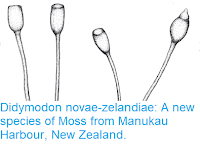
Didymodon novae-zelandiae habit with capsules. Beever & Fife (2016).

Areas of the cliff colonised by Didymodon novae-zelandiae were apparently more easily colonised by a larger Moss, Bryum clavatum, which was able to settle in such patches then competitively exclude the smaller Didymodon novae-zelandiae. This process, called succession by ecologists, is common in plat communities, where one plant modifies an environment in a way that makes it suitable for a second plant to take over and exclude the original coloniser. However the tuffa cliffs where the Mosses were found were extremely soft and poorly consolidated, with areas of the cliff surface regularly falling away and revealing fresh surface, suitable for colonisation by Didymodon novae-zelandiae but not Bryum clavatum. A more serious threat to the whole ecosystem appeared to come from invasive Kikuyu Grass (Cenchrus clandestinus) which was begging to settle soft unstable sediments at the base of the cliff.

 Type locality of Didymodon novae-zelandiae on Manukau Harbour foreshore. Didymodon novae-zelandiae (position arrowed) on the cliff face, below a denser band of vegetation (mainly Bryum clavatum), some 1.5 m above high tide mark. The remains of trunks of trees buried by eruption of nearby Mount Maungataketake can be seen in the cliff base both to the right and left of the standing figure. The large Pōhutukawa tree (Metrosideros excelsa) to the right, above, has now fallen from the cliff. Jessica Beever in Beever & Fife (2016).

Didymodon novae-zelandiae was found growing only at a single site, on a poorly consolidated volcanic cliff. Such habitats are not common, even in volcanic New Zealand, however the small size of the Moss does leave the possibility that it is present in other environments and has been overlooked. For this reason Beever and Fife suggest that it be classified as an Data Deficient Endemic Plant for conservation purposes.

See also...

http://sciencythoughts.blogspot.co.uk/2014/07/mosses-from-late-eocene-rovno-amber.htmlMosses from Late Eocene Rovno Amber. Mosses are thought to be among the most ancient of plant groups, and still make up a significant proportion of all plant communities. They are an ancient group, considerably predating vascular plants such as...
http://sciencythoughts.blogspot.co.uk/2012/12/two-new-species-of-moss-from-permian-of.htmlTwo new species of Moss from the Permian of Brazil.                                                  Mosses (Bryophytes) are simple plants which lack vascular systems to pump water and nutrients from a root system, instead relying on what they can absorb through their leaves, and generally only reaching a few cm in height. This means that they are at their... 
Follow Sciency Thoughts on Facebook. 

Sunday, 10 August 2014

A new species of Liverwort from New Zealand.

Liverworts are non-vascular plants related to Mosses and thought to be among the most ancient plant groups. They lack roots or any form of vascular tissue, have leaves only one or two layers of cells thick and are incapable of retaining water in dry conditions. The visible plants of Liverworts are Haploid (their cells contain only a single set of chromosomes), with diploid cells (which contain two, paired, sets of chromosomes) only occurring in sex cells; this is the reverse of the situation in almost all other plants and animals, where most cells are diploid, except the sex cells which are haploid.

In a paper published in the journal Phytotaxa on 25 June 2014 Endymion Cooper of the Department of Cell Biology and Molecular Genetics at the University of Maryland and Matt Renner of the Royal Botanic Gardens & Domain Trust in Sydney describe a new species of Liverwort from New Zealand.

The new species is placed in the genus Lepidozia, and given the specific name bragginsiana, in honour of John Braggins, a distinguished New Zealand botanist and bryologist (scientist who studies mosses and liverworts), who led the expedition during which the new species was first discovered. Lepidozia bragginsiana is an erect branching Liverwort, pale green or golden yellow-green in colour, with shoots reaching 2 cm.

Lepidozia bragginsiana in situ at Cross Creek showing the erect, bipinnately ramified shoots with imbricate appressed leaves on primary shoots. Cooper & Renner (2014).

Lepidozia bragginsiana is widespread in the hyper-humid forests to the west of the southern Alps on South Island, from Nelson in the north to Fiorland in the south. It is also found on North Island as far north as Mount Te Aroha, though it appears to be less common here. It is found at altitudes of between 200 m and 1000 m in both Podocarp and Beech forests, and is considered likely to be found beyond its current known range.

Photograph of habitat at Cross Creek. Cooper & Renner (2014).

See also…


Mosses are thought to be among the most ancient of plant groups, and still make up a significant proportion of all plant communities. They are an ancient group...


Mosses (Bryophytes) are simple plants which lack vascular systems to pump water and nutrients from a root system, instead relying on what they can absorb through their leaves, and generally only reaching a few...


The Ordovician Period lasted roughly 44 million years, from approximately 488 million years ago to about 444 million years ago. It is thought to have been extremely warm, possibly the warmest geological period since the evolution of large, complex lifeforms, with a CO₂ rich...


Follow Sciency Thoughts on Facebook.

Sunday, 5 February 2012

Did the first land plants cause an Ordovician glaciation?

The Ordovician Period lasted roughly 44 million years, from approximately 488 million years ago to about 444 million years ago. It is thought to have been extremely warm, possibly the warmest geological period since the evolution of large, complex lifeforms, with a CO₂ rich atmosphere, average sea temperatures reaching 45 °C and most of the continents covered by shallow seas. However the end of the period was marked by a glaciation event, the Hirnantian Glaciation, which saw a drop in sea levels, glaciers across large chunks of Africa and South America, and the second most severe mass extinction event in the fossil record (after the End Permian). Scientists have struggled to explain this sudden climatic shift, since the Ordovician atmosphere appears to have been too rich in CO₂ for glaciers to develop (CO₂ is a powerful greenhouse gas so an atmosphere with a lot of it will be a warm one), and consequently some fairly silly explanations have been put forward.

Map showing the distribution of land-masses, and the extent of sea coverage on them, from the Middle Ordovician. From The Paleontology Portal.

This month, in a paper in the journal Nature Geoscience, a team led by Timothy Lenton of the College of Life and Environmental Sciences at the University of Exeter and the Earth and Life Systems Alliance at the School of Environmental Sciences, University of East Anglia, lay out a new theory in which they propose that the first land plants may have caused a drop in CO₂ levels, brining about the Hirnantian Glaciation and indirectly causing an extinction event in the oceans.

Lenton et al. note that the Ordovician was a time of considerable mountain building (orogeny) in the northeast of North America, and that along with mountain building comes the potential for mountain erosion. They also note that the period saw the spread of the first non-vascular land plants. Since mosses are associated with erosion of rocks in the modern world, Lenton et al. reasoned that this might also have been the case in the Ordovician.

To measure the extent to which modern mosses help erode rocks Lenton et al. set up an experiment in which samples of granite and andesite (rocks commonly associated with newly formed mountains) were cultured with micro-organisms known to aid erosion, and with or without macerated (chopped up) mosses. They found that the cultures with the moss were much better at releasing a range of nutrients into the culture medium than those without.

Two cultures from Lenton et al.'s study; granite chips with (left) and without (right) moss. From Lenton et al. (2012), Supplementary Material.


Lenton et al. accept that moss has had a long time to evolve since the Ordovician, but suggest that the ability to release nutrients from rocks would have been just as advantageous to Ordovician mosses as it is to modern ones. They suggest that these early mosses may have released large amounts of nutrients into the Ordovician oceans, causing vast algal blooms, and that these algal blooms may have in turn absorbed much of the CO₂ from the atmosphere, causing the climate to turn abruptly colder, and bringing about the End Ordovician Mass Extinction.