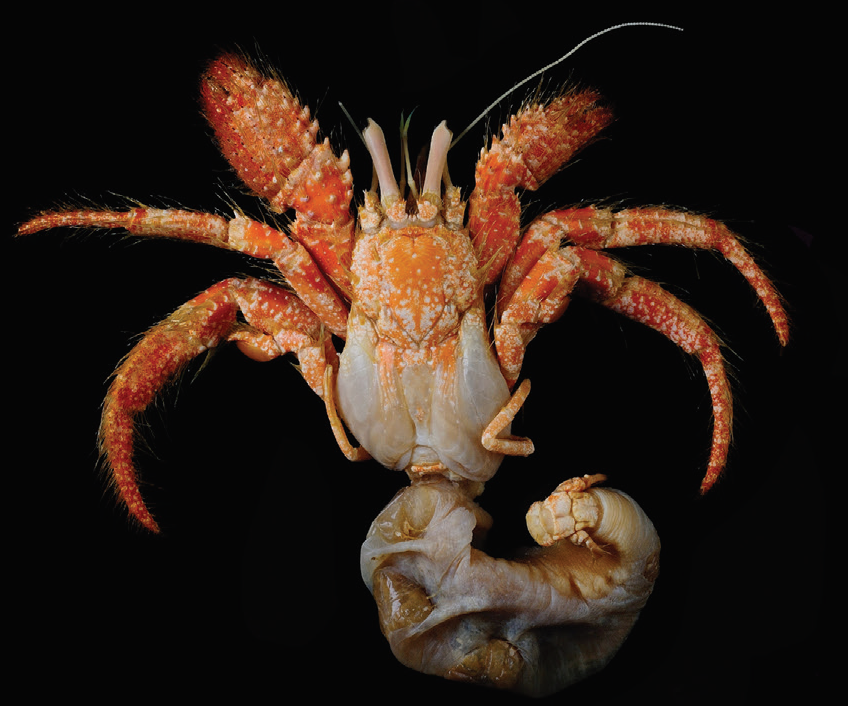
Hermit Crabs, Paguroidea, are highly specialised Decapod Crustaceans
that have largely soft exoskeletons and recycle the shells of other
animals, usually Gastropod Molluscs, as protection for their bodies.
This enables them to live high in the litoral zone (beach environments)
where calcium for making shells is hard to get but Crab-eating predators
are common, thereby exploiting an environment effectively closed to
other Crabs. Hermit Crabs are found on beaches throughout the world's
tropical and temperate regions, though they are far more abundant in the
tropics, and some members of the group have colonised other
environments. Phimochirus holthuisi is considered to be a morphologically highly variable species with a broad distribution in the western Atlantic from North Carolina and the Gulf Mexico throughout the Caribbean to Brazil, yet consistent differences in colouration of live specimens assignable to this presumed variable species occur in certain parts of its distributional range, despite a lack of obvious morphological differences, suggesting that there may be a deeper generic difference between populations of the species than has been realised.
In a paper published in the journal Zootaxa on 10 October 2019, Darryl Felder of the Department of Biology and Laboratory for Crustacean Research at the University of Louisiana at Lafayette, Rafael Lemaitre of the Department of Invertebrate Zoology at the National Museum of Natural History, and Catherine Craig, also of the Department of Biology and Laboratory for Crustacean Research at the University of Louisiana at Lafayette, describe two new species of Hermit Crabs from the Gulf of Mexico, based upon genetic analysis of populations previously assigned to Phimochirus holthuisi.
The first new species described is named Phimochirus formani, in honour of Wayne Forman, a New Orleans based environmental scientist whose talents include an unusually broad grasp of marine biota, and who has over many years brokered access to research sites, acquisition of research specimens, and the securing of financial support for marine scientists working throughout the northern Gulf of Mexico. This species has a distinctive blueish-purple band on its eyestalks, which is either blotched with, or surrounded by, red, as well as an orange 'trident'-pattern on its carapace. It also has less ornamentation on its right claw than Phimochirus holthuisi, and lacks the lavender patches on its walking legs that that species has.

Phimochirus formani is found on offshore calcareous banks and deep platforms around Coral reefs in the northeastern, northwestern, and southeastern Gulf of Mexico, and on the coast of Suriname. It favours environments richly covered by Macroalgae (Seaweeds) and epifauna, including Rhodoliths (calcifying Red Algae), on the inner to middle continental shelf at depths of 27–62 m. It utilises the shells of variety of small to medium sized Gastropod shells, especially Faciolariids (Tulip Snails), Turbinids (Turban Snails), and Muricids (Murexes).
The second new species described is named Phimochirus tunnelli, in honour of the late John Tunnell, formerly of Texas A&M University, whose deep appreciation for, and professional understanding of, coastal and marine biodiversity in the Gulf of Mexico region is reflected in many books and other publications that he authored or orchestrated over his long and productive career. This species also has a blueish-purple band on its eyestalks, with an orange band beneath this. The carapace and legs of Phimochirus tunnelli are almost uniformly orange, although it does have lavender patches on the tips of its claws and forward walking legs.

Phimochirus tunnelli is found in the northeastern, northwestern, and southeastern Gulf of Mexico. It favours offshore Rhodolith and other calcareous banks, especially where richly covered by Macroalgae and epifaunal communities on the inner to middle continental shelf at depths of 38–72 m. It utilises the shells of variety of small to medium sized Gastropod shells, especially Faciolariids (Tulip Snails), Turbinids (Turban Snails), and Muricids (Murexes).
See also...

Phimochirus formani, (C) specimen, length 3.1 mm, northeastern Gulf of Mexico, (D) male specimen, length 2.8 mm, northeastern Gulf of Mexico. Felder et al. (2019).
Phimochirus formani is found on offshore calcareous banks and deep platforms around Coral reefs in the northeastern, northwestern, and southeastern Gulf of Mexico, and on the coast of Suriname. It favours environments richly covered by Macroalgae (Seaweeds) and epifauna, including Rhodoliths (calcifying Red Algae), on the inner to middle continental shelf at depths of 27–62 m. It utilises the shells of variety of small to medium sized Gastropod shells, especially Faciolariids (Tulip Snails), Turbinids (Turban Snails), and Muricids (Murexes).
The second new species described is named Phimochirus tunnelli, in honour of the late John Tunnell, formerly of Texas A&M University, whose deep appreciation for, and professional understanding of, coastal and marine biodiversity in the Gulf of Mexico region is reflected in many books and other publications that he authored or orchestrated over his long and productive career. This species also has a blueish-purple band on its eyestalks, with an orange band beneath this. The carapace and legs of Phimochirus tunnelli are almost uniformly orange, although it does have lavender patches on the tips of its claws and forward walking legs.

Phimochirus tunnelli, male specimen, length 4.1 mm, northwestern Gulf of Mexico; (F) female specimen, length 3.9 mm, northwestern Gulf of Mexico. Felder et al. (2019).
Phimochirus tunnelli is found in the northeastern, northwestern, and southeastern Gulf of Mexico. It favours offshore Rhodolith and other calcareous banks, especially where richly covered by Macroalgae and epifaunal communities on the inner to middle continental shelf at depths of 38–72 m. It utilises the shells of variety of small to medium sized Gastropod shells, especially Faciolariids (Tulip Snails), Turbinids (Turban Snails), and Muricids (Murexes).
See also...



Follow Sciency Thoughts on Facebook.