Plastics are designed to be light-weight, convenient, and durable; several characteristics that make them suitable packaging alternatives compared to other materials such as wood, glass or metal, but also makes them problematic in marine and terrestrial environments. Low manufacturing costs have contributed to huge demand for new plastic materials, with global production increasing by 6–8% per annum. Globally, less than 10% of the 348 million tonnes of plastic produced annually is ever recycled, with approximately 40% of plastic waste comprised of single-use packaging. The significant increase in disposal rates in the last half century, combined with inadequate or ineffective waste management, has led to huge quantities of plastic polluting ecosystems worldwide. Once in the ocean, plastic items can either sink or float, becoming dispersed over long distances via tides and currents Significant quantities of plastic are now recorded in all aquatic ecosystems, accounting for more than 95% of all debris items observed at-sea, on beaches, and along river banks. These synthetic materials persist for decades in the environment, posing a considerable threat to aquatic flora and fauna Mortality of wildlife from plastic debris can occur directly (e.g. through entanglement) or indirectly through exposure to plastic-associated toxins, which may contribute to reduced body condition or survival in some species. While evidence of harmful effects on individual organisms is increasing, there is currently little knowledge or agreement regarding whether plastic debris poses an ecologically relevant threat, affecting wildlife at the population level and contributing to an overall decline in species’ abundance. Establishing a clear link between debris interactions and population persistence is crucial, as loss of biodiversity contributes to the degradation of ecosystems and the valuable services they provide. While much of the focus of plastic impacts has understandably been on the marine ecosystem, increasing quantities of debris accumulating on beaches and adjacent vegetated areas has the potential to disrupt terrestrial species and ecosystems. In tropical ecosystems, Crabs, Malacostraca, play a crucial role in forest growth and development through aeration of soils and creation of carbon-rich soil microhabitats, therefore reductions in Crab abundance may impact plant recruitment.
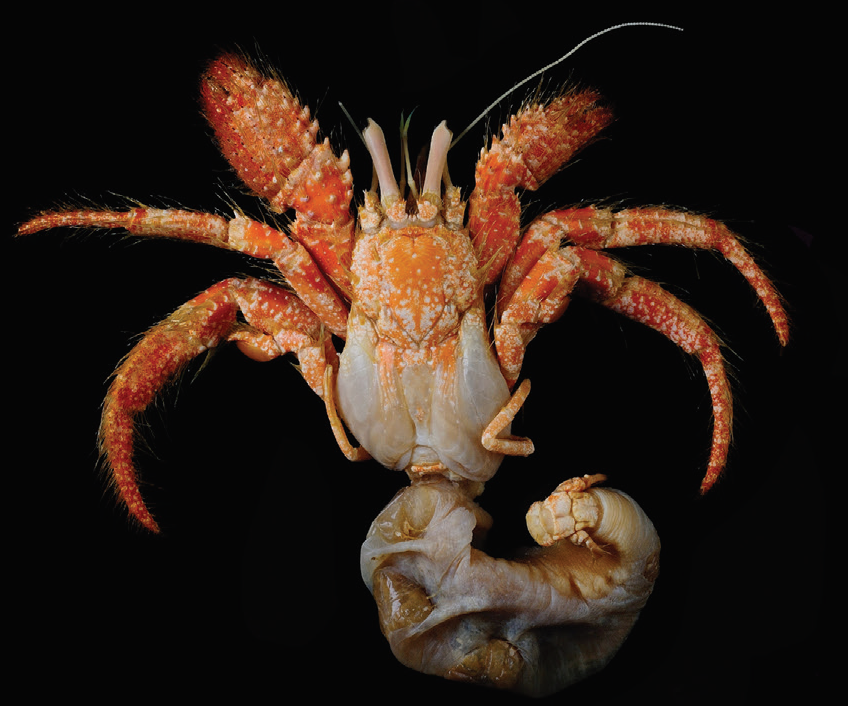
In a paper published in the Journal of Hazardous Materials on 16 November 2019, Jennifer Lavers of the Institute for Marine and Antarctic Studies at the University of Tasmania, Paul Sharp and Silke Stuckenbrock of the Two Hands Project, and Alexander Bond of the Bird Group at the Natural History Museum, describe the results of a study into the effects of plastic waste on Hermit Crabs on two remote Pacific locations, the Cocos Islands and Henderson Island.
In order to understand the potential impact accumulating plastic may have on coastal crab populations, Lavers et al. recorded the number and frequency of Strawberry Hermit Crabs, Coenobita perlatus, entrapped in beach debris on individual beaches within the Cocos Islands and on Henderson Island, in the Pitcairn group, two remote areas where significant quantities of debris accumulate. We then estimate entrapment rates across both islands to provide an estimate of population-level impact of plastic beach debris on Crab populations.
The Cocos Islands are two small, mid-oceanic atolls (total land area 14 km²) located approximately 2760 km north-west of Perth, Western Australia. The southern atoll consists of a horseshoe chain of 26 islands around a shallow, central lagoon. The northern atoll (North Keeling, administered as Pulu Keeling National Park) is a relatively pristine, uninhabited island. Most of the Human population (around 600 people) reside on Home and West Islands. A range of marine resources are fished for food and tourism, including Crabs and other Crustaceans which are consumed or used for bait. Henderson Island is a raised coral atoll and UNESCO World Heritage Site (total land area 43 km²), administered as part of the Pitcairn Islands (UK). It is extremely remote, uninhabited, and located on the western boundary of the South Pacific Gyre, a known plastic-accumulation zone. Both Henderson and Cocos are very polluted, with about 38 million (239 items/m²) and 414 million debris items (713items/m²) deposited on beaches and throughout the beach-back vegetation, respectively.


Lavers et al. recorded visible macro-debris located on the surface within randomly-placed quadrats. In the beach-back, significant quantities of debris accumulate amongst the vegetation, creating an obvious hazard for Crabs. On Cocos, four quadrats were established on Direction Island and four on West Island from 20 to 29 March 2017, one on Pulu Blan Madar, and two on Home Island, from 1 to 2 September 2019, and 20 quadrats along the East Beach of Henderson Island during 12 to 16 June 2019. The boundary of each quadrat was located along the top edge of the beach and extended into the vegetation towards the centre of the island. On Cocos, the dimensions of each quadrat were 5 × 3 m (2017) or 6 × 4 m (2019), and on Henderson 6 × 6 m, reflecting differences in accessibility at each site. The size was reduced slightly for some quadrats (2/8 on Cocos in 2017 and 2/20 on Henderson) to enable navigation through thick forest and to protect sensitive habitats.

The location of the beach-back quadrats and timing of surveys overlapped periods when a range of Crab size classes were present on both islands and encompassed a diversity of habitats (e.g., areas dominated by Velvetleaf Soldierbush, Heliotropium foertherianum, or Small-leaved Mangrove, Pemphis acidula). However, the density of Crabs within these habitats was not recorded and no attempt was made to survey across seasons due to the remote nature of each site and limited access.
Within each quadrat, all intact plastic containers (e.g., drink, commercial, and industrial bottles) were recorded. Containers were then assessed for whether they posed a potential entrapment hazard to crabs based on meeting both of these criteria: (1) The lid was missing or the container was damaged such that it allowed Crabs access to the inside of the container, and (2) the container was positioned with the opening facing an upward angle, such that a Crab would have difficulty exiting and would therefore become entrapped. Lavers et al. then counted the number of Crabs (dead or alive) that had become entrapped in each container.
Lavers et al.used the density of bottles available to entrap Crabs across the eight quadrats on Cocos, 20 quadrats in the beach-back vegetation of Henderson, and four transects along Henderson’s East Beach (totalling 1139 m) to extrapolate the total number across the archipelago by resampling the values, with replacement, 10,000 times and scaling this to the area of beach-back vegetation (defined as the length of the vegetation line and extending 10 m inland). Beach length and beach-back dimensions were obtained using Google Earth Pro (version 7.3.2) and satellite imagery from 2016 to 2018 for beaches that were ocean-facing. Beaches that faced into the lagoon on Cocos (e.g., away from prevailing currents, sheltered by other islands) or small unnamed and potentially ephemeral sand bars were excluded as they do not likely accumulate significant quantities of plastic debris.
The estimated mean number of bottles on each beach was then used to predict the total entrapment using the probability and intensity values.
On Cocos we recorded 218 bottles that could potentially entrap Crabs across eight quadrats. Of these, 190 (87%) contained no Crabs, and the probability of entrapment was 0.128 (i.e. 12.8% of bottles contained Crabs). Of bottles that contained Crabs, the mean entrapment intensity was 7.857 Crabs per bottle. The overall entrapment rate was therefore 1.009 Crabs per bottle.
The density of plastic bottles in beach back ranged from 0.13 to 3.67 bottles per m². Across the 454 720 m² of ocean-facing beach back habitat, Lavers et al. estimated there were 562 352 bottles that could potentially entrap Crabs, producing an estimate of 507 938 Crabs entrapped in bottles across the archipelago.
In the beach-back vegetation on Henderson Island, Lavers et al. recorded 77 bottles across 20 quadrats covering 690 m², of which 65 (84%) contained no Crabs, and the probability of entrapment was 0.156 (i.e. 15.5% of bottles contained Crabs). There were 106.25 individuals in those containers with Crabs, resulting in an overall entrapment rate of 16.55 Crabs per bottle.
On East Beach, Crabs were found in 8 of 33 bottles (24%) across 12 762 m² of the beach. The probability of entrapment was 0.242 (i.e. 24.2% of bottles contianed crabs), and the entrapment intensity 60.0 Crabs per bottle. The overall entrapment rate was therefore was 14.55 Crabs per bottle.
The density of bottles ranged from 0.083 to 1.103 bottles per m² in the beach-back, and was 0.035 bottles/m² on East Beach of Henderson Island, resulting in a potential 2046 bottles in 7600 m² of beach-back vegetation and 865 bottles on 24 908 m² of East Beach where Crabs could become entrapped. Combining the entrapment values, Lavers et al. estimate 33 922 Crabs entrapped on the beachback, and 28 003 Crabs on the beach, for a total of 60 961 entrapped Crabs on Henderson Island.
Overall Hermit Crab entrapment rates were extremely high on both Henderson and Cocos, with nearly 61 000 (2.447 Crabs/m²) and 508 000 crabs (1.117 crabs/m²) becoming entrapped, respectively. Though overall mortality on Henderson is lower, the beach area is much smaller than that on Cocos, and both the rate and severity of entrapment and mortality is much higher. These estimates are liberal, as the rate of degradation of Crab carcasses is unknown, therefore some shells may have been present in the bottles for more than 12 months. Furthermore, Lavers et al.'s analysis does not account for temporal patterns, such as localised abundance during the breeding season, which could influence entrapment rates, and must be considered as point estimates rather than a temporal rate (e.g., annual mortality). Such rates should be a research priority on sites that are heavily polluted and can be visited regularly.
At a temperature of 28–29 °C and relative air humidity of 75 % (similar to conditions at both field sites), reported average survival of Hermit Crabs was 5–9 days when the Crabs lacked access to water. Thus, once entrapped in plastic containers, mortality of Hermit Crabs likely occurs over a very brief period, depending on rainfall. Hermit Crabs, including Coenobita perlatus, use the odour of dead conspecifics to locate available shells, increasing shell-acquisition behaviour by up to 10 times, which are a limiting resource and both live and freshly Dead Crabs were occasionally observed together inside plastic containers. This suggests entrapments occur on a regular basis and conspecific attraction, the very mechanism that evolved to ensure Hermit Crabs could replace their shells, has resulted in a lethal lure. Accumulation of more than 20 Crabs in containers suggests a threshold, or dose response, may exist whereby the chemical signals of decaying Crabs act additively or multiplicatively with a maximum of 526 Crabs observed in a single container on Henderson Island.

The significant entrapment rate has the potential to negatively impact Hermit Crab populations. While no population size data exist for any Hermit Crab species on Henderson or Cocos, and estimates of adult or juvenile survival are not available, existing pressure on these Crabs is appreciable on Cocos as small Crabs are used as bait in recreational and artisanal fishing and there are localised depletions of Crabs around populated areas. Concerns have been raised regarding the current recreational fishery bag limit on Cocos, 9 l per day for mixed, small Crabs, and a no-take regulation was considered as part of a Parks Australia review of recreational fishing regulations. Information on longevity of Crabs is sparse, but suggests Anomuran Crabs (the group which includes Hermit Crabs) are long-lived (5–30 years in the wild). Entrapment in debris along beaches, and in the beach back vegetation, therefore presents an additional, significant threat to Crab populations which are already under pressure and likely rely on high survivorship of breeding adults to maintain populations. On Henderson, Crab populations are likely under predation pressure from introduced Pacific Rats, Rattus exulans, which can modify coastal ecosystems greatly.
Significant reductions in crab populations have the potential to harm islands in several ways. On Cocos, tourism is a major source of employment, providing substantial economic and social benefits, and receiving widespread community support. On the main islands of Cocos, Seabirds no longer breed, therefore charismatic species like Hermit Crabs may provide an important opportunity for tourists to observe native wildlife. For example, on Christmas Island, the diversity and abundance of Crabs is a well-known tourist attraction. Cocos and Henderson Island lack native ground predators, therefore Crabs play a critical role in seed dispersal, removing detritus, and provide a range of benefits, such as soil turbation through burrow excavation and collection of leaf litter. Entrapment and mortality of large numbers of Crabs could therefore affect ecosystem function of coastal areas, which would have consequences for other biota as well as for tourism.
The accumulation of plastic debris alters water movement and heat transfer through beach sediments. Accumulated debris can also create a physical barrier, reducing the accessibility of beaches for breeding and hatchling Sea Turtles. Limited information is available for other species, especially invertebrates, however the presence of beach debris smothers benthic communities resulting in fewer Polychaete Worms and reduces the number of burrows constructed by Crabs. Significant annual losses of Crabs could lead to reduced breeding, and consequently lower recruitment. The larval duration and transport distance of most small Decapods, including Hermit Crabs, is relatively short with populations maintained through a combination of allochthonous (long distance) and autochthonous (local) recruitment. However, with the increasing isolation of an island, it becomes difficult for shallow water species to traverse the open ocean and establish a viable population, and Crab species richness on Cocos and Henderson is markedly lower than other island and mainland populations in the region. Similarly, Henderson’s remoteness would significantly impede successful larval dispersal to the island. Successful recruitment of Crabs therefore relies on considerable new individuals being released into the environment. Depleted populations, or those located on smaller, isolated islands therefore have less resilience to acute stressors than mainland ones, since they do not have the diversity of habitats to act as refuge for populations of species under pressure.
The increasing urbanisation and pollution of much of the world’s coasts with plastic debris threatens increasing and irreversible damages to beach ecosystems. Over the last three decades, plastic drink bottles have shown the fastest growth rate of all debris types reported on some remote islands. When such widespread changes are overlaid with the broad distribution of hermit crabs throughout the subtropics and tropics, it becomes clear the negative interactions between Crabs and debris are set to increase. This is of particular concern in areas of high Hermit Crab abundance, diversity, and endemism.
The mortality of Hermit Crabs attributed to beach debris, documented here for the first time, is significant, and likely a key factor contributing to the reported declines in hermit crabs on Cocos. Unfortunately, Cocos and Henderson are not unique, with similarly high concentrations of debris reported on beaches and in coastal vegetation worldwide. Other beaches with high debris load and Hermit Crabs may well experience similar mortality. The global mortality of Hermit Crabs is undocumented, likely to be substantial, and requires urgent investigation.
See also...
The Cocos Islands are two small, mid-oceanic atolls (total land area 14 km²) located approximately 2760 km north-west of Perth, Western Australia. The southern atoll consists of a horseshoe chain of 26 islands around a shallow, central lagoon. The northern atoll (North Keeling, administered as Pulu Keeling National Park) is a relatively pristine, uninhabited island. Most of the Human population (around 600 people) reside on Home and West Islands. A range of marine resources are fished for food and tourism, including Crabs and other Crustaceans which are consumed or used for bait. Henderson Island is a raised coral atoll and UNESCO World Heritage Site (total land area 43 km²), administered as part of the Pitcairn Islands (UK). It is extremely remote, uninhabited, and located on the western boundary of the South Pacific Gyre, a known plastic-accumulation zone. Both Henderson and Cocos are very polluted, with about 38 million (239 items/m²) and 414 million debris items (713items/m²) deposited on beaches and throughout the beach-back vegetation, respectively.


Map of the study sites (blue circles): Cocos Islands (top; North Keeling not shown on inset map) and Henderson Island (bottom) with sampling regions shown in red. Lavers et al. (2019).
Lavers et al. recorded visible macro-debris located on the surface within randomly-placed quadrats. In the beach-back, significant quantities of debris accumulate amongst the vegetation, creating an obvious hazard for Crabs. On Cocos, four quadrats were established on Direction Island and four on West Island from 20 to 29 March 2017, one on Pulu Blan Madar, and two on Home Island, from 1 to 2 September 2019, and 20 quadrats along the East Beach of Henderson Island during 12 to 16 June 2019. The boundary of each quadrat was located along the top edge of the beach and extended into the vegetation towards the centre of the island. On Cocos, the dimensions of each quadrat were 5 × 3 m (2017) or 6 × 4 m (2019), and on Henderson 6 × 6 m, reflecting differences in accessibility at each site. The size was reduced slightly for some quadrats (2/8 on Cocos in 2017 and 2/20 on Henderson) to enable navigation through thick forest and to protect sensitive habitats.

(A) Accumulated plastic debris creates an obstacle for crabs on the beaches of the Cocos Islands. (B) A Hermit Crab inside a green bucket along the high tide of South Island. (C) Accumulated plastic debris in the beach-back vegetation on West Island. (D) Crabs that became trapped and died inside a plastic drink bottle that washed up on Cocos. (2019). Lavers et al. (2019).
The location of the beach-back quadrats and timing of surveys overlapped periods when a range of Crab size classes were present on both islands and encompassed a diversity of habitats (e.g., areas dominated by Velvetleaf Soldierbush, Heliotropium foertherianum, or Small-leaved Mangrove, Pemphis acidula). However, the density of Crabs within these habitats was not recorded and no attempt was made to survey across seasons due to the remote nature of each site and limited access.
Within each quadrat, all intact plastic containers (e.g., drink, commercial, and industrial bottles) were recorded. Containers were then assessed for whether they posed a potential entrapment hazard to crabs based on meeting both of these criteria: (1) The lid was missing or the container was damaged such that it allowed Crabs access to the inside of the container, and (2) the container was positioned with the opening facing an upward angle, such that a Crab would have difficulty exiting and would therefore become entrapped. Lavers et al. then counted the number of Crabs (dead or alive) that had become entrapped in each container.
Lavers et al.used the density of bottles available to entrap Crabs across the eight quadrats on Cocos, 20 quadrats in the beach-back vegetation of Henderson, and four transects along Henderson’s East Beach (totalling 1139 m) to extrapolate the total number across the archipelago by resampling the values, with replacement, 10,000 times and scaling this to the area of beach-back vegetation (defined as the length of the vegetation line and extending 10 m inland). Beach length and beach-back dimensions were obtained using Google Earth Pro (version 7.3.2) and satellite imagery from 2016 to 2018 for beaches that were ocean-facing. Beaches that faced into the lagoon on Cocos (e.g., away from prevailing currents, sheltered by other islands) or small unnamed and potentially ephemeral sand bars were excluded as they do not likely accumulate significant quantities of plastic debris.
The estimated mean number of bottles on each beach was then used to predict the total entrapment using the probability and intensity values.
On Cocos we recorded 218 bottles that could potentially entrap Crabs across eight quadrats. Of these, 190 (87%) contained no Crabs, and the probability of entrapment was 0.128 (i.e. 12.8% of bottles contained Crabs). Of bottles that contained Crabs, the mean entrapment intensity was 7.857 Crabs per bottle. The overall entrapment rate was therefore 1.009 Crabs per bottle.
The density of plastic bottles in beach back ranged from 0.13 to 3.67 bottles per m². Across the 454 720 m² of ocean-facing beach back habitat, Lavers et al. estimated there were 562 352 bottles that could potentially entrap Crabs, producing an estimate of 507 938 Crabs entrapped in bottles across the archipelago.
In the beach-back vegetation on Henderson Island, Lavers et al. recorded 77 bottles across 20 quadrats covering 690 m², of which 65 (84%) contained no Crabs, and the probability of entrapment was 0.156 (i.e. 15.5% of bottles contained Crabs). There were 106.25 individuals in those containers with Crabs, resulting in an overall entrapment rate of 16.55 Crabs per bottle.
On East Beach, Crabs were found in 8 of 33 bottles (24%) across 12 762 m² of the beach. The probability of entrapment was 0.242 (i.e. 24.2% of bottles contianed crabs), and the entrapment intensity 60.0 Crabs per bottle. The overall entrapment rate was therefore was 14.55 Crabs per bottle.
The density of bottles ranged from 0.083 to 1.103 bottles per m² in the beach-back, and was 0.035 bottles/m² on East Beach of Henderson Island, resulting in a potential 2046 bottles in 7600 m² of beach-back vegetation and 865 bottles on 24 908 m² of East Beach where Crabs could become entrapped. Combining the entrapment values, Lavers et al. estimate 33 922 Crabs entrapped on the beachback, and 28 003 Crabs on the beach, for a total of 60 961 entrapped Crabs on Henderson Island.
Overall Hermit Crab entrapment rates were extremely high on both Henderson and Cocos, with nearly 61 000 (2.447 Crabs/m²) and 508 000 crabs (1.117 crabs/m²) becoming entrapped, respectively. Though overall mortality on Henderson is lower, the beach area is much smaller than that on Cocos, and both the rate and severity of entrapment and mortality is much higher. These estimates are liberal, as the rate of degradation of Crab carcasses is unknown, therefore some shells may have been present in the bottles for more than 12 months. Furthermore, Lavers et al.'s analysis does not account for temporal patterns, such as localised abundance during the breeding season, which could influence entrapment rates, and must be considered as point estimates rather than a temporal rate (e.g., annual mortality). Such rates should be a research priority on sites that are heavily polluted and can be visited regularly.
At a temperature of 28–29 °C and relative air humidity of 75 % (similar to conditions at both field sites), reported average survival of Hermit Crabs was 5–9 days when the Crabs lacked access to water. Thus, once entrapped in plastic containers, mortality of Hermit Crabs likely occurs over a very brief period, depending on rainfall. Hermit Crabs, including Coenobita perlatus, use the odour of dead conspecifics to locate available shells, increasing shell-acquisition behaviour by up to 10 times, which are a limiting resource and both live and freshly Dead Crabs were occasionally observed together inside plastic containers. This suggests entrapments occur on a regular basis and conspecific attraction, the very mechanism that evolved to ensure Hermit Crabs could replace their shells, has resulted in a lethal lure. Accumulation of more than 20 Crabs in containers suggests a threshold, or dose response, may exist whereby the chemical signals of decaying Crabs act additively or multiplicatively with a maximum of 526 Crabs observed in a single container on Henderson Island.

(A) A Strawberry Hermit Crab navigates through natural and anthropogenic debris on East Beach, Henderson Island. (B) Accumulated debris on East Beach, Henderson Island. (C) 526 Hermit Crabs trapped inside a single container on Henderson Island in June 2019. (D) Some of the 526 Hermit Crab shells from the container shown in panel (C). Lavers et al. (2019).
The significant entrapment rate has the potential to negatively impact Hermit Crab populations. While no population size data exist for any Hermit Crab species on Henderson or Cocos, and estimates of adult or juvenile survival are not available, existing pressure on these Crabs is appreciable on Cocos as small Crabs are used as bait in recreational and artisanal fishing and there are localised depletions of Crabs around populated areas. Concerns have been raised regarding the current recreational fishery bag limit on Cocos, 9 l per day for mixed, small Crabs, and a no-take regulation was considered as part of a Parks Australia review of recreational fishing regulations. Information on longevity of Crabs is sparse, but suggests Anomuran Crabs (the group which includes Hermit Crabs) are long-lived (5–30 years in the wild). Entrapment in debris along beaches, and in the beach back vegetation, therefore presents an additional, significant threat to Crab populations which are already under pressure and likely rely on high survivorship of breeding adults to maintain populations. On Henderson, Crab populations are likely under predation pressure from introduced Pacific Rats, Rattus exulans, which can modify coastal ecosystems greatly.
Significant reductions in crab populations have the potential to harm islands in several ways. On Cocos, tourism is a major source of employment, providing substantial economic and social benefits, and receiving widespread community support. On the main islands of Cocos, Seabirds no longer breed, therefore charismatic species like Hermit Crabs may provide an important opportunity for tourists to observe native wildlife. For example, on Christmas Island, the diversity and abundance of Crabs is a well-known tourist attraction. Cocos and Henderson Island lack native ground predators, therefore Crabs play a critical role in seed dispersal, removing detritus, and provide a range of benefits, such as soil turbation through burrow excavation and collection of leaf litter. Entrapment and mortality of large numbers of Crabs could therefore affect ecosystem function of coastal areas, which would have consequences for other biota as well as for tourism.
The accumulation of plastic debris alters water movement and heat transfer through beach sediments. Accumulated debris can also create a physical barrier, reducing the accessibility of beaches for breeding and hatchling Sea Turtles. Limited information is available for other species, especially invertebrates, however the presence of beach debris smothers benthic communities resulting in fewer Polychaete Worms and reduces the number of burrows constructed by Crabs. Significant annual losses of Crabs could lead to reduced breeding, and consequently lower recruitment. The larval duration and transport distance of most small Decapods, including Hermit Crabs, is relatively short with populations maintained through a combination of allochthonous (long distance) and autochthonous (local) recruitment. However, with the increasing isolation of an island, it becomes difficult for shallow water species to traverse the open ocean and establish a viable population, and Crab species richness on Cocos and Henderson is markedly lower than other island and mainland populations in the region. Similarly, Henderson’s remoteness would significantly impede successful larval dispersal to the island. Successful recruitment of Crabs therefore relies on considerable new individuals being released into the environment. Depleted populations, or those located on smaller, isolated islands therefore have less resilience to acute stressors than mainland ones, since they do not have the diversity of habitats to act as refuge for populations of species under pressure.
The increasing urbanisation and pollution of much of the world’s coasts with plastic debris threatens increasing and irreversible damages to beach ecosystems. Over the last three decades, plastic drink bottles have shown the fastest growth rate of all debris types reported on some remote islands. When such widespread changes are overlaid with the broad distribution of hermit crabs throughout the subtropics and tropics, it becomes clear the negative interactions between Crabs and debris are set to increase. This is of particular concern in areas of high Hermit Crab abundance, diversity, and endemism.
The mortality of Hermit Crabs attributed to beach debris, documented here for the first time, is significant, and likely a key factor contributing to the reported declines in hermit crabs on Cocos. Unfortunately, Cocos and Henderson are not unique, with similarly high concentrations of debris reported on beaches and in coastal vegetation worldwide. Other beaches with high debris load and Hermit Crabs may well experience similar mortality. The global mortality of Hermit Crabs is undocumented, likely to be substantial, and requires urgent investigation.
See also...



Follow
Sciency Thoughts on Facebook.