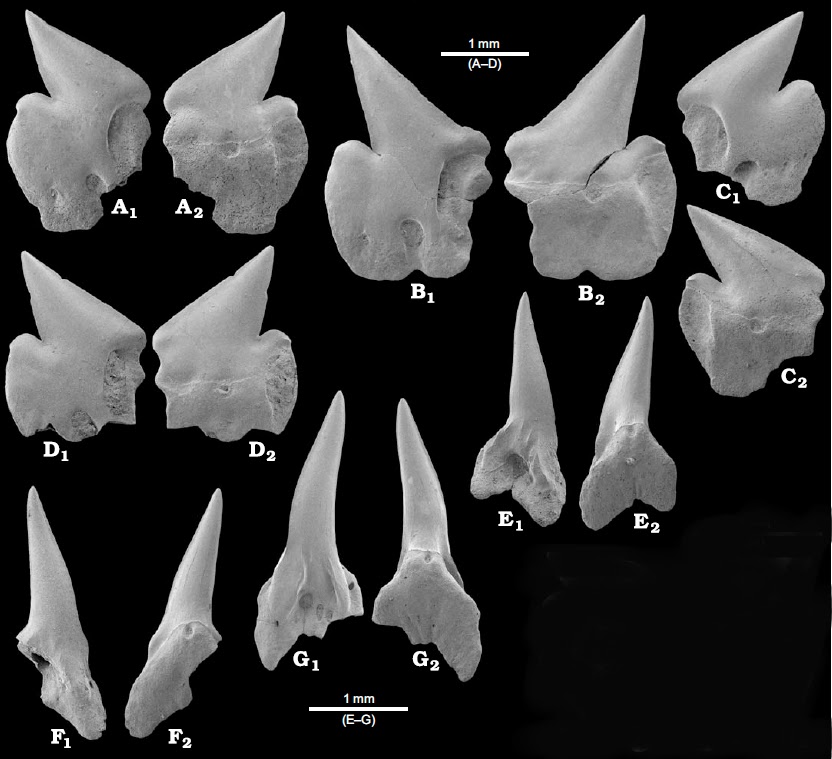
Modern Madagascar is considered one of the world's biodiversity hotspots, with a unique flora and fauna shaped by a long isolation from other landmasses. The history of Madagascar's wildlife is therefore of great interest to naturalists, but sadly, while the island has an excellent Cretaceous fossil record, post-Cretaceous fossils are very rare on the island, so most of what we know about the origins of the island's unique terrestrial biota is based upon genetic studies using molecular clock techniques to estimate times of divergence of Madagascar's organisms from their relatives elsewhere. For the island's marine fauna this is more complicated still, as such organisms are less isolated, making molecular techniques less useful. Some Miocene marine strata have been known on the northwest of the island since the 1920s, and have produced a range of Shark, Bony Fish, Crocodile, Turtle, Marine Mammal and Invertebrate fossils, and recently Eocene exposures have also been discovered, producing similar fossils.
In a paper published in the journal PLoS One on 27 February 2019, Karen Samonds of the Department of Biological Sciences at Northern Illinois University, Tsiory Andrianavalona of Mention Bassins Sédimentaires Evolution Conservation at the Université d’Antananarivo, Lane Wallett of the Department of Integrative Physiology and Neuroscience at Washington State University, Iyad Zalmout of the Department of Paleontology at the Saudi Geological Survey, and David Ward of the Department of Earth Sciences at The Natural History Museum describe a series of Eocene Shark and Ray fossils collected from two sites on the northeastern coast of Madagascar.
All of the specimens were collected from an exposure of Tertiary sediments from the Mahajanga Basin along the northwest shores of Madagascar. Sediment samples were collected from two locations, Ampazony, approximately 15 km northeast of Mahajanga, and Katsepy, west of Mahajanga across the Betsiboka River, and sieved for Shark teeth and other fragments.

The first Shark species recorded is Nebrius blankenhorni, a form of Nurse Shark, Ginglymostomatidae, previously recorded from the mid to late Eocene of Egypt and the middle Eocene of Togo. A single anterolateral tooth of this species was found, measuring 5.5 mm in total height, 7.9 mm in mesiodistal width, and is 6.0 mm in labiolingual thickness. The crown compromises most of the tooth. It is broad labially, asymmetrical labiolingually and mediolaterally with strongly serrated cutting edges on both mesial and distal of the apex of the crown. The distal cutting edge is concave, the mesial slightly convex. A large labial apron (almost a tongue) tapers to overhang base of root. The lingual face possesses a less pronounced protuberance, ending at base of root. The root is broad laterally but thin vertically; the basal face is broad and flat, and possesses a central foramen.

The second species recorded is Brachycarcharias koerti, a form of Sand Shark, Odontaspididae, known from the middle Eocene phosphates of Togo, the middle Eocene of of Ameki, southern Nigeria, middle Eocene sediments of North and South Carolina, USA, and possibly the Lisbon Formation of Andalusia, Alabama. Three left upper lateral teeth of this species was found, though only two are described. The first is 21.8 mm in total height, 16.4 mm in mediolateral width, and 6.4 mm in anteroposterior thickness. The tooth crown is tall and gracile but corroded by ongoing weathering. The crown is narrow and slim, the root lobes form a 'V' shape. The lateral cusps are small, conical, multiple on the mesial root. There is a pronounced nutrient groove. Its relative size and narrow crown suggest that it is a tooth from a juvenile individual.. The second tooth is 16.9 mm in total height, 17.4 mm in mediolateral width, and 6.1 mm in anteroposterior thickness.

The next species recorded is Galeocerdo eaglesomei, a form of Requiem Shark, Carcharhinidae, known from the middle-to-late Eocene of Nigeria, Togo, Morocco, Egypt, Texas, and North Carolina, and possibly the Oligocene of Pakistan. 31 teeth of this species were found, these having broad, triangular blades and serrations on the mesial and distal cutting edges with a distally-bent cusp. The mesial heel is concave, the distal heel is convex. The distal heel is longer than the mesial, possessing finer serrations and a shorter cutting edge. The serrations are simple, never compound. The root has higher lingual face; the labial surface is concave. A strong nutritive groove bisects the lingual aspect of the root.

Two teeth are recorded from an unknown species of Physogaleus, a type of Requiem Shark, Carcharhinidae, known from Palaeocene-Miocene deposits in Africa, Europe, Central Asia, India, North and Central America. One of these appears to be a lower anterolateral tooth, the other has a more gereralised morphology.

Samonds et al. describe a new species of Carcharhinus, the extant genus of Requiem Shark, Carcharhinidae, that includes Reef Sharks, Silky Sharks, and Bull Sharks, from twelve teeth found at Ampazony. This is named as Carcharhinus underwoodi in honour of Charlie Underwood of the Department of Earth and Planetary Sciences at Birkbeck College, University of London, for his work on fossil Sharks and Rays in general and Carcharhiniform Sharks in particular. This is the oldest described species in the genus, although there are some isolated teeth assigned to the genus but not a species from the Early Eocene of Jamaica that are thought to be slightly older. The crown of these teeth is roughly triangular with a slightly distally directed cusp. The labial crown surface is flat to slightly convex with no obvious basal ledge. There are serrae becoming more finely serrate towards the tip. The distal cutting edge of the cusp is slightly convex and lightly serrated. At the base of the cusp the edge curves abruptly through an angle of 50˚ to form a rounded notch. The distal base of the crown bears ten serrae becoming smaller towards the root/crown junction. On the lingual surface the root occupies the basal 45% of the tooth with a prominent protuberance divided by a distinct nutritive groove and a slit-like centrally placed foramen.

Samonds et al. also a tooth from a second, undescribed, species of Carcharhinus. These differ from Carcharhinus underwoodi in having evenly spaced serrae on the mesial cutting edge and a pronounced distal notch. The labial aspect of the crown is slightly convex with a distally directed cusp and virtually no basal ledge. The cutting edge is continuous and serrated. The mesial cutting edge is convex with serrae increasing in size towards its midpoint where there are 3 serrae/mm and disappearing on the slightly upturned tip of the cusp. The distal cutting edge of the cusp is also convex and faintly serrated. At its base, there is a sharp angle where the distal crown slopes toward the tooth edge. The cutting edge of the shoulder bears seven serrae decreasing in size basally. The lingual root is low, with a small protuberance with a wide nutritive groove.

The next species recorded is Rhizoprionodon ganntourensis, another species of Requiem Shark, Carcharhinidae. Members of the genus Rhizoprionodon are still alive today, and are known as Sharpnose Sharks or Milk Sharks. Rhizoprionodon ganntourensis is known from Middle Eocene deposits globally, and do not differ significantly from their Recent counterparts. They exhibit gynandric heterodonty, lower teeth of adult males having somewhat sigmoid apically curved crowns.

Two teeth are recorded from an unknown species of Hammerhead Shark, Sphyrna sp., a genus that dates back to the Palaeocene. These teeth resemble Sphyrna teeth from the Eocene of Morocco, which also have not been assigned to a species. These teeth has a distally directed cusps, a complete cutting edge and distal heel. The shoulder is rounded and smooth. The root possesses a rectilinear basal margin and distinct nutrient groove.

A total of 632 individual teeth and tooth plates assigned to the Eagle Ray genus Myliobatis were collected, making them the most common vertebrate remains from the Ampazony locality, though due to the fragmentary nature of much of this material it is not assigned to species level. Eagle Rays are common in Eocene deposits, although the Malagasy material is unusual in showing a lack of diversity; typically Eocene deposits contain members of other genera such as Aetobatis, Rhinoptera, Leidybatis and Burnhamia, though none of the Ampazony material could be assigned to any of these genera.

Four Stingray tail spines were also found; it is not possible to assign such spines to a specific genus based upon their morphology, so they are simply recorded as Myliobatiformes, though given the lack of diversity seen in the specimens, Samonds et al. suggest that they are likely to have come from Myliobatis sp..

A single tooth of a Whiptail Stingray, Dasyatidae, was also found. This is 2.2 mm wide, and is too corroded to warrant a detailed description. There is a labial visor and a distinct medial lingual ridge flanked laterolingually by marginal hollows. The labial face is tabulate and lightly ornamented. Remains of a lingually displaced bilobed root are present.

Finally 19 rostral spines of a Sawfish, Pristis sp., are recorded. Only one is well preserved, and is 22.8 mm in length, 8.8 mm in anteroposterior thickness and 5.3 mm in mediolateral dimensions. The spines are relatively long, with narrow anterior tip and pronounced groove on the posterior edge. Growth bands are visible in lateral and cross section. Spines of Pristis are known from the Palaeocene onwards, and are not really assignable to species level. Despite this, many authors refer Eocene specimens to Pristis lathami, though Samonds et al. refrain from this.

The dating of the Ampazony sediments is somewhat uncertain, as there have been no biostratigraphically useful microfossils found to date, however, the macrofossil assemblage strongly suggests a middle-to-late Eocene origin. The Katsepy strata include nummulitic limestones (limestones made up of the tests of the giant Foraminiferan Nummulites), which also suggests a middle-to-late Eocene origin, though this is not conclusive. The Sharks and Rays of these deposits show clear affinities to those of African assemblages from the same interval, despite Madagascar’s isolation in the Southern Ocean in the Eocene.
See also...
In a paper published in the journal PLoS One on 27 February 2019, Karen Samonds of the Department of Biological Sciences at Northern Illinois University, Tsiory Andrianavalona of Mention Bassins Sédimentaires Evolution Conservation at the Université d’Antananarivo, Lane Wallett of the Department of Integrative Physiology and Neuroscience at Washington State University, Iyad Zalmout of the Department of Paleontology at the Saudi Geological Survey, and David Ward of the Department of Earth Sciences at The Natural History Museum describe a series of Eocene Shark and Ray fossils collected from two sites on the northeastern coast of Madagascar.
All of the specimens were collected from an exposure of Tertiary sediments from the Mahajanga Basin along the northwest shores of Madagascar. Sediment samples were collected from two locations, Ampazony, approximately 15 km northeast of Mahajanga, and Katsepy, west of Mahajanga across the Betsiboka River, and sieved for Shark teeth and other fragments.

Map showing location of study localities: Ampazony and Katsepy, northwestern Madagascar. Also indicated is the port city of Mahajanga. Elevation model from Aster Global Digital Elevation Model. Samonds et al. (2019).
The first Shark species recorded is Nebrius blankenhorni, a form of Nurse Shark, Ginglymostomatidae, previously recorded from the mid to late Eocene of Egypt and the middle Eocene of Togo. A single anterolateral tooth of this species was found, measuring 5.5 mm in total height, 7.9 mm in mesiodistal width, and is 6.0 mm in labiolingual thickness. The crown compromises most of the tooth. It is broad labially, asymmetrical labiolingually and mediolaterally with strongly serrated cutting edges on both mesial and distal of the apex of the crown. The distal cutting edge is concave, the mesial slightly convex. A large labial apron (almost a tongue) tapers to overhang base of root. The lingual face possesses a less pronounced protuberance, ending at base of root. The root is broad laterally but thin vertically; the basal face is broad and flat, and possesses a central foramen.

Nebrius blankenhorni, anterolateral tooth in labial (A), basal (B), and lateral views. Samonds et al. (2019).
The second species recorded is Brachycarcharias koerti, a form of Sand Shark, Odontaspididae, known from the middle Eocene phosphates of Togo, the middle Eocene of of Ameki, southern Nigeria, middle Eocene sediments of North and South Carolina, USA, and possibly the Lisbon Formation of Andalusia, Alabama. Three left upper lateral teeth of this species was found, though only two are described. The first is 21.8 mm in total height, 16.4 mm in mediolateral width, and 6.4 mm in anteroposterior thickness. The tooth crown is tall and gracile but corroded by ongoing weathering. The crown is narrow and slim, the root lobes form a 'V' shape. The lateral cusps are small, conical, multiple on the mesial root. There is a pronounced nutrient groove. Its relative size and narrow crown suggest that it is a tooth from a juvenile individual.. The second tooth is 16.9 mm in total height, 17.4 mm in mediolateral width, and 6.1 mm in anteroposterior thickness.

Brachycarcharias koerti, left upper anterior tooth in labial (D) and lingual views (E). Samonds et al. (2019).
The next species recorded is Galeocerdo eaglesomei, a form of Requiem Shark, Carcharhinidae, known from the middle-to-late Eocene of Nigeria, Togo, Morocco, Egypt, Texas, and North Carolina, and possibly the Oligocene of Pakistan. 31 teeth of this species were found, these having broad, triangular blades and serrations on the mesial and distal cutting edges with a distally-bent cusp. The mesial heel is concave, the distal heel is convex. The distal heel is longer than the mesial, possessing finer serrations and a shorter cutting edge. The serrations are simple, never compound. The root has higher lingual face; the labial surface is concave. A strong nutritive groove bisects the lingual aspect of the root.

Galeocerdo eaglesomei, upper anterior tooth in labial (I) and lingual views (J). Samonds et al. (2019).
Two teeth are recorded from an unknown species of Physogaleus, a type of Requiem Shark, Carcharhinidae, known from Palaeocene-Miocene deposits in Africa, Europe, Central Asia, India, North and Central America. One of these appears to be a lower anterolateral tooth, the other has a more gereralised morphology.
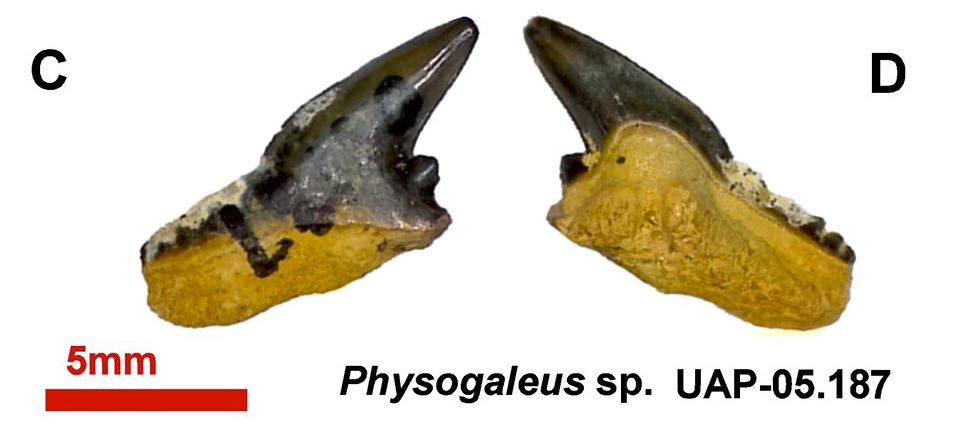
Physogaleus sp., lower anterolateral tooth in labial (C) and lingual views (D). Samonds et al. (2019).
Samonds et al. describe a new species of Carcharhinus, the extant genus of Requiem Shark, Carcharhinidae, that includes Reef Sharks, Silky Sharks, and Bull Sharks, from twelve teeth found at Ampazony. This is named as Carcharhinus underwoodi in honour of Charlie Underwood of the Department of Earth and Planetary Sciences at Birkbeck College, University of London, for his work on fossil Sharks and Rays in general and Carcharhiniform Sharks in particular. This is the oldest described species in the genus, although there are some isolated teeth assigned to the genus but not a species from the Early Eocene of Jamaica that are thought to be slightly older. The crown of these teeth is roughly triangular with a slightly distally directed cusp. The labial crown surface is flat to slightly convex with no obvious basal ledge. There are serrae becoming more finely serrate towards the tip. The distal cutting edge of the cusp is slightly convex and lightly serrated. At the base of the cusp the edge curves abruptly through an angle of 50˚ to form a rounded notch. The distal base of the crown bears ten serrae becoming smaller towards the root/crown junction. On the lingual surface the root occupies the basal 45% of the tooth with a prominent protuberance divided by a distinct nutritive groove and a slit-like centrally placed foramen.

Carcharhinus underwoodi, upper anterior tooth in lingual (G) and labial views (H). Samonds et al. (2019).
Samonds et al. also a tooth from a second, undescribed, species of Carcharhinus. These differ from Carcharhinus underwoodi in having evenly spaced serrae on the mesial cutting edge and a pronounced distal notch. The labial aspect of the crown is slightly convex with a distally directed cusp and virtually no basal ledge. The cutting edge is continuous and serrated. The mesial cutting edge is convex with serrae increasing in size towards its midpoint where there are 3 serrae/mm and disappearing on the slightly upturned tip of the cusp. The distal cutting edge of the cusp is also convex and faintly serrated. At its base, there is a sharp angle where the distal crown slopes toward the tooth edge. The cutting edge of the shoulder bears seven serrae decreasing in size basally. The lingual root is low, with a small protuberance with a wide nutritive groove.

Carcharhinus sp., tooth in lingual (S) and labial views (T). Samonds et al. (2019).
The next species recorded is Rhizoprionodon ganntourensis, another species of Requiem Shark, Carcharhinidae. Members of the genus Rhizoprionodon are still alive today, and are known as Sharpnose Sharks or Milk Sharks. Rhizoprionodon ganntourensis is known from Middle Eocene deposits globally, and do not differ significantly from their Recent counterparts. They exhibit gynandric heterodonty, lower teeth of adult males having somewhat sigmoid apically curved crowns.

Rhizoprionodon ganntourensis, tooth in lingual (A) and labial views (B). Samonds et al. (2019).
Two teeth are recorded from an unknown species of Hammerhead Shark, Sphyrna sp., a genus that dates back to the Palaeocene. These teeth resemble Sphyrna teeth from the Eocene of Morocco, which also have not been assigned to a species. These teeth has a distally directed cusps, a complete cutting edge and distal heel. The shoulder is rounded and smooth. The root possesses a rectilinear basal margin and distinct nutrient groove.

Sphyrna sp., tooth in labial (E) and lingual views (F). Samonds et al. (2019).
A total of 632 individual teeth and tooth plates assigned to the Eagle Ray genus Myliobatis were collected, making them the most common vertebrate remains from the Ampazony locality, though due to the fragmentary nature of much of this material it is not assigned to species level. Eagle Rays are common in Eocene deposits, although the Malagasy material is unusual in showing a lack of diversity; typically Eocene deposits contain members of other genera such as Aetobatis, Rhinoptera, Leidybatis and Burnhamia, though none of the Ampazony material could be assigned to any of these genera.

Myliobatis sp., tooth in occlusal (G) basal (H), and lateral views (I), and in section (J). Samonds et al. (2019).
Four Stingray tail spines were also found; it is not possible to assign such spines to a specific genus based upon their morphology, so they are simply recorded as Myliobatiformes, though given the lack of diversity seen in the specimens, Samonds et al. suggest that they are likely to have come from Myliobatis sp..

Myliobatidae indet., tail spine. Samonds et al. (2019).
A single tooth of a Whiptail Stingray, Dasyatidae, was also found. This is 2.2 mm wide, and is too corroded to warrant a detailed description. There is a labial visor and a distinct medial lingual ridge flanked laterolingually by marginal hollows. The labial face is tabulate and lightly ornamented. Remains of a lingually displaced bilobed root are present.

Dasyatidae indet., tooth in lingual view. Samonds et al. (2019).
Finally 19 rostral spines of a Sawfish, Pristis sp., are recorded. Only one is well preserved, and is 22.8 mm in length, 8.8 mm in anteroposterior thickness and 5.3 mm in mediolateral dimensions. The spines are relatively long, with narrow anterior tip and pronounced groove on the posterior edge. Growth bands are visible in lateral and cross section. Spines of Pristis are known from the Palaeocene onwards, and are not really assignable to species level. Despite this, many authors refer Eocene specimens to Pristis lathami, though Samonds et al. refrain from this.

Pristis sp., rostral spine in lateral (O, P), and basal views (Q). Samonds et al. (2019).
The dating of the Ampazony sediments is somewhat uncertain, as there have been no biostratigraphically useful microfossils found to date, however, the macrofossil assemblage strongly suggests a middle-to-late Eocene origin. The Katsepy strata include nummulitic limestones (limestones made up of the tests of the giant Foraminiferan Nummulites), which also suggests a middle-to-late Eocene origin, though this is not conclusive. The Sharks and Rays of these deposits show clear affinities to those of African assemblages from the same interval, despite Madagascar’s isolation in the Southern Ocean in the Eocene.
See also...



Follow Sciency Thoughts on
Facebook.