From about 4000 BC onwards the use of silver became widespread in the ancient world. This was obtained by smelting lead-ores in a furnace, and then cupellatiting (oxidising) the resultant metal to separate silver and gold. Lead ores, generally galena (lead sulphate) and cerussite (lead carbonate), were typically mined by a deep pit method, digging vertically down to a seem then following it horizontally. Silver was important to many ancient peoples, among whom were the Phoenicians, who built city states such as Tyre, Sidon and Byblos, ‘Akko and Dor in Lebanon and on the northern shores of the southern Levant during the Iron Age, roughly from the eleventh century BC onwards, and who travelled widely on trading expeditions, bringing innovations such as the alphabet, murex-based purple dyeing and masterful craftsmanship to the western Mediterranean, where they established colonies in North Africa, Sardinia and Iberia. In the ninth century BC the Phoenicians began to exploit jarosite (potassium-iron sulphate) ores in Iberia, from which silver was also extracted as a biproduct.
Cupellation remained the most common way to obtain silver throughout the classical period, producing silver that still contains small amounts of lead. This is useful to modern archaeologists, who can use lead-isotope analysis to determine the source of silver. Other elements tend to be largely purged from the silver by this method, although gold and bismuth isotopes have sometimes been used to determine the origin of silver.
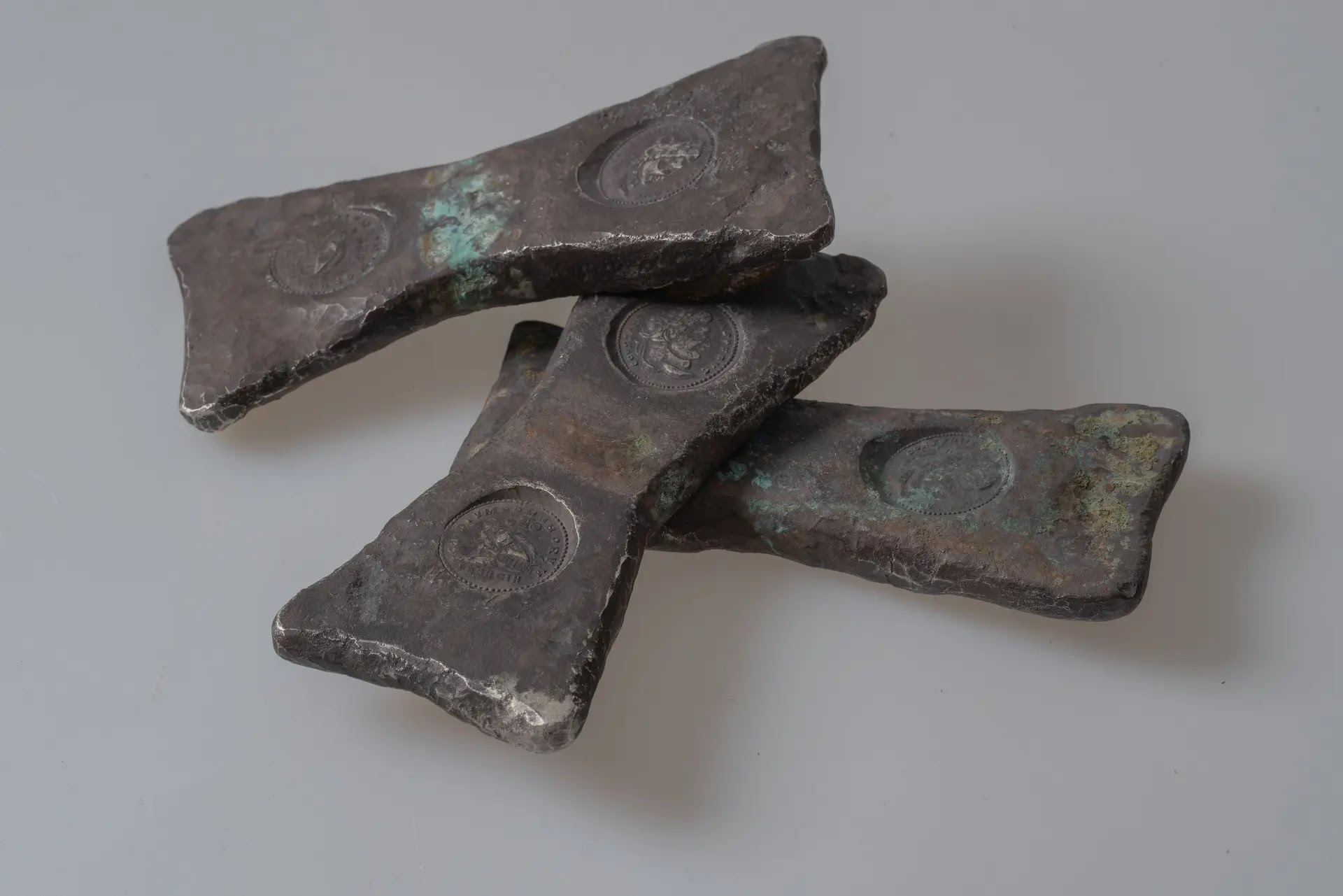
Silverware was widely used as a trade commodity in the Near East before the adoption of coinage, with more than 40 silver hoards dating to between 2000 and 600 BC having been unearthed in the southern Levant.
In a paper published in the journal Applied Sciences on 12 January 2022, Tzilla Eshel of the Zinman Institute of Archaeology and School of Archaeology and Maritime Cultures at the University of Haifa, Ofir Tirosh of the Fredy and Nadine Herrmann Institute of Earth Sciences at the Hebrew University of Jerusalem, Naama Yahalom-Mack of the Institute of Archaeology at the Hebrew University of Jerusalem, Ayelet Gilboa, also of the Zinman Institute of Archaeology and School of Archaeology and Maritime Cultures at the University of Haifa, and Yigal Erel, also of the Fredy and Nadine Herrmann Institute of Earth Sciences at the Hebrew University of Jerusalem, present the results of a study which used lead and silver isotopes in silver artefacts to show changes in the source of silver reaching the southern Levant over a period of almost 1500 years, spanning the Bronze and Iron ages.

Map of the Southern Levant showing sites with Bronze and Iron Age silver hoards. Svetlana Matskevich in Eschel et al. (2022).
Examination of the lead isotope content of 250 silver items from 22 hoards suggests that Middle Bronze Age items (dating from between 2000 and 1550 BC), were made using silver from Anatolia and the Aegean. In the Late Bronze Age (from about 1550 to about 1250 BC), a time when gold probably replaced silver as the main trading currency, silver from the mines of Laurion (about 50 km south of Athens) begins to appear. During the Early Iron Age (roughly 1200 to 950 BC), following the end-Bronze Age collapse, silver appears to have been rare in the region, and was frequently adulterated with high lead content copper, making it hard to identify the origin of the artefacts. From about 950 BC onwards, Phoenicians revived the trade in silver, importing the metal from the Taurus mountains in Anatolia, and from Iglesiente in south-west Sardinia and later from the Pyrite Belt in Iberia, then from 630 BC onwards Greek traders slowly supplanted the Phoenicians, bringing in silver and copper from Laurion and Siphnos in the Aegean.
This fits well with the previous understanding of the trade in sliver in the ancient Mediterranean Basin, but only gives a broad view of the geographic areas from which silver was being imported to the region; it does not shed any light on development of silver production practices and the exploitation of new ores. For this purpose, Eschel et al. turned to silver isotopes, which have a number of advantages in the tracing of the origin of ores. Silver will fractionate isotopically during supergene weathering; that is to say weathering caused by oxidation of minerals as water percolates through the rock in near surface environments, as well as during the formation of salts and sulphosalts. The upshot of this is that the proportion of different silver isotopes can vary even within different parts of the same mine, potentially giving a very high resolution way of determining the origin of the metal, and at very least, it is usually possible to tell the difference between silver minerals that formed in deep or shallow environments, with those that formed hydrothermally in shallow environments typically having a higher proportion of the heavier isotope silver¹⁰⁹ than those from deeper environments.
This method has been applied previously to Hellenistic, Roman, and Medieval coins with some success, but not to pre-coinage silver hoards. As well as studying the origin of silver in Bronze and Iron Age hoards, Eschel et al. were able to study how the way in which the silver was preserved altered the isotopic ratio of the metal. It has previously been shown that the patterna on silver coins is isotopically lighter than the coins themselves, as the lighter isotope silver¹⁰⁷ is preferentially consumed in the making of silver sulphates. The silver from the Levantine hoards was stored in different ways, with some hoards stored in ceramic vessels, some in cloth bundles, and some in both, offering different levels of protection against intrusions by ground-water, which will tend to re-mineralise silver, altering its isotopic composition.

Silver hoards analysed in the study: (a) silver from the Shiloh hoard (without pendant), courtesy of the Israel Museum, Jerusalem. (b) Silver from hoard Tell el-‘Ajjul 1312, courtesy of the Israel Antiquities Authority. (c) The Dor silver hoard, the Israel Museum and the Tel Dor Expedition. (d) The ‘Akko silver hoard. (e) The ‘Ein Hofez silver hoard image courtesy of the Israel Antiquities Authority. (f) The ‘Arad silver hoard, courtesy of the Institute of Archaeology at Tel Aviv University. (g) Selected items from ‘Ein Gedi hoard, the Israel Museum, Jerusalem. Eschel et al. (2022). Eschel et al. chose 45 silver artefacts for silver isotope analysis, all of known chemical and lead isotopic compositions and generally not suspected to be alloyed or mixed with metals from different sources.
The oldest of these items came from the Middle/Late Bronze Age transitional period (roughly 1650-1500 BC) sites at Shiloh on the West Bank and Tell el-‘Ajjul in the Gaza Strip. The precise origin of these hoards is unclear, but both have jewelery with Anatolian motifs and lead isotopic analysis has suggested that the silver came from Anatolia or the Aegean. Both hoards were found wrapped in cloth bundles.
Silver from the Iron Age (roughly 950-700 BC) hoards at Dor, south of Haifa on Israel's Mediterranean coast, and ‘Akko in the coastal plain region of the Northern District of Israel, have been shown to come from Iglesiente, on southwest Sardinia, and have been associated with Phoenician trading in Anatolia and Sardinia in the Iron Age. The Dor hoard was found wrapped in a bundle, then placed within a ceramic vessel which was covered by a bowl, the 'Akko hoard was simply placed within a ceramic pot.
Silver items from the Iron Age (roughly 950-700 BC) hoards at ‘Ein Hofez inthe Carmel Mountains of northern Israel and 'Arad in the Southern District of Israel, on the border of the Negev and the Judean deserts have been shown to contain lead from Rio Tinto in Iberia, although this is only provides an approximate location for its origin, since jarosite ores from several parts of Iberia are known to have been brought to Rio Tinto for processing with lead. Other items from the ‘Ein Hofez hoard contain lead from Linares and other parts of Iberia, with one item coming from Anatolia.
The Late Iron Age (roughly 630-586 BC) hoard from ‘Ein Gedi, in Israel west of the Dead Sea, near Masada and the Qumran Cave, contains silver placed unbundled within a cooking pot, covered by a ceramic lamp under the floor of a room. The lead in this silver indicates that it comes from Laurion in Greece, suggesting that it was brought to the area by a Greek trader.
Combining the silver and lead isotope analyses strongly suggests that the Phonicean hoards of Dor, ‘Akko, ‘Ein Hofez and Arad contain silver from Sardinia, Iberia and Anatolia, while the Late Iron Age hoard from ‘Ein Gedi contains Aegean silver, and the earlier, Bronze Age hoards of Shiloh and Tell el-‘Ajjul contain a mixture of Anatolian and Aegean silver. The isotopic ratios of the silver items from Phoenician hoards showed predominantly ratios consistent with having
come from hypogene ores, that is to say ores that formed deep within the
Earth, which had not undergone significant weathering related isotopic
fractionation, whereas the isotopic ratios seen in the earlier Bronze Age and later Greek hoards showed more fractionation, probably indicating that they came from shallower ores which had undergone some surface weathering.
While all the samples used were taken by drilling into the items to extract silver free from corrosion, some of the items still showed signs of sliver chloride formation at the level from which the sample was taken. This is symptomatic of corrosion through exposure to chlorine ions in groundwater, indicating that these samples were less protected from the environment than other samples. This was found in items from the hoards from Tell el-‘Ajjul, ‘Akko, and ‘Ein Hofez. The silver from Shiloh, Dor, ‘Arad and ‘Ein Gedi were apparently better protected.
Based upon these findings, Eschel et al. were able to make the following observations.
Hoards sealed in ceramic vessels were predicted to be best protected against contact with the soil and groundwater within it. The hoards from Dor (which was sealed in a vessel and bundled in cloth, and Ein ‘Gedi, which was sealed in a vessel but not bundled, showed no signs of corrosion, and therefore were apparently protected as expected.
Hoards wrapped tightly within cloth bundles were predicted to be less well protected against groundwater, though it was likely that the silver in the middle of the bundle would be protected somewhat by the silver around it. This would include the hoards at ‘Arad, which was tightly bundled and placed within a ceramic vessel, and which showed no signs of corrosion, and Shiloh, which was bundled but not placed within a vessel, where again no signs of corrosion were found.
Hoards placed within unsealed ceramic vessels were thought likely to be less well protected against groundwater. This included the hoards from ‘Ein Hofez and ‘Akko, both of which showed signs of corrosion.
Finally, silver which was neither bundled nor placed in a vessel was thought to be at the greatest risk of corrosion due to contact with the soil and groundwater. This was the case only with the hoard from Tell el-’Ajjul, which again showed signs of silver chloride formation.
The hoards from Tell el-‘Ajjul, ‘Akko, and ‘Ein Hofez all showed greater isotopic fractioning, which was taken as a sign of the silver in them having come from shallow ore sources, where this could occur prior to the silver being mined. Eschell et al. also note that the silver from these hoards also appeared to be less pure, and suggest that these combined may be a sign that they have been altered after deposition by their original owners, rather than evidence of a different mining origin or smelting technique to the other material.
Eschell et al.'s findings suggest that native silver (silver found in a pure state, which typically comes from deep, hypogene sources) was quite rare in the ancient world, and that most of the silver used came from shallow, supergene sources,
The Phoenicians are known to have brought silver to the Levan from the mid-10th century BC onwards, and from Iberia during the ninth and eighth centuries BC. It is unclear whether the Phoenicians themselves were the drivers of the improving metallurgical techniques being used in the areas where they traded, or whether they were just skilled traders able to aquire this silver and ship it across the Mediterranean. Anatolia is known to have been major centres of silver production from about the third millennium onwards, but the amount of silver being exported appears to have rapidly grown during the Phoenician era. Silver confidently assigned to a Sardinian origin is often found in Phoenician hoards, but no ancient mineworking have been discovered in Sardinia, so it is unclear when mining started there. Silver extracted in Iberia, in contrast, appears to have been exclusively developed by the Pheonicians, who targeted deep, low-lead ore bodies in the Iberian Pyritic Belt from about 800 BC onwards. The Romans began exporting silver from Iberia around 200 BC, but only targeted shallow ores with silver isotope fractionation, not the deep ores the Phoenicians were able to access.
The low levels of isotope fractionation seen in Phoenician sliver objects from Anatolia and Sardinia suggest that the Phoenicians were using the same deep-mining methods there in the tenth century BC, indicating that these people were more than talented sailors, but skilled workers in other fields, capable of transfering skills from one end of the Mediterranean to the other.
See also...


Follow Sciency Thoughts on Facebook.
Follow Sciency Thoughts on Twitter.



%20(1)%20(1).png)