Showing posts with label Israel. Show all posts

Tuesday, 28 July 2026

UNESCO adds three new sites to its World Heritage List.

The United Nations Educational, Scientific, and Cultural Organisation (UNESCO) has added seven new sites to its World Heritage List, which is made up of sites deemed to be of natural or cultural significance which gives them outstanding universal significance for mankind, according to a press release issued on 26 July 2026. All three of these sites have additionally been placed on the World Heritage in Danger list of sites which are facing imminent threats due to Human or natural causes. In addition, three sites already on the World Heritage List have also been placed on the World Heritage in Danger list.

The first new site added to the World Heritage List is the Boma-Badingilo Migratory Landscape in South Sudan; this is the first site in South Sudan to be added to the World Heritage List. This area comprises two National Parks, Boma and Badingilo, which are contiguous with one another, currently managed by African Parks on behalf of the South Sudanese government. The parks lie in the White Nile catchment area, and are home to the world's largest Mammal migration, with over six million Antelope trasversing the area each year, as well as being an important part of the migrant Bird route between Southern Africa and Europe. The area is a biodiversity hotspot of global significance, as well as being home to a number of ethnic groups with their own unique cultural and linguistic heritage, who have acted as custodians of this landscape.

An Antelope migration in the Boma-Badingilo Migratory Landscape. African Parks.

The UNESCO World Heritage Committee has identified the Boma-Badingilo Migratory Landscape as facing a number of serious threats, including infrastructure development, commercial poaching, and wildlife trafficking and trade, while at the same time lacks meaningful protection from the South Sudanese government, which is under-financed and has a weak infrastructure, with the country suffering from a poor security situation. For these reasons the Boma-Badingilo Migratory Landscape has been placed on the World Heritage in Danger list.

Traditional herders within the Boma-Badingilo Migratory Landscape. African Parks.

The second new addition to the World Heritage List is the Mount Amel Castles sites in Lebanon. This site compromises a series of five castles across southern Lebanon, built during the Crusader Period on strategic high ground sites, and subsequently used by the Ayyubids, Mamluks, and later powers. These are Qalaat al-Chakif, or Beaufort Castle, dominating the Litani River valley from a strategic ridge, Qalaat Tibnin, or Toron Castle, on a mountain overlooking the road from Tyre to Damascus, Qalaat Chakra, or Dubieh Castle, in the Chakra agricultural region, Qalaat Deir Kifa, or Maron Castle, on an isolated hill overlooking the route from Lebanon towards Galilee and Jerusalem, and Qalaat Chama’, on a hill overlooking the coastal plain near Tyre.

Qalaat Tibnin, or Toron Castle, in 2006. T Dakroub/Wikimedia Commons.

In November 2024 the Mount Amel Castles were given 'enhanced protection status by the UNESCO Committee for the Protection of Cultural Property in the Event of Armed Conflict, a status which grants access to the Fund for the Protection of Cultural Property in the Event of Armed Conflict, as well helping to make applications for other forms of international assistance. However, since that time the sites have suffered heavy damage due to the ongoing conflict in the region, and are now considered to be in jeopardy of complete destruction, prompting the World Heritage Committee to move the sites to both the World Heritage List and the World Heritage in Danger list as a way to highlight the risk of losing these sites.

Qalaat al-Chakif, or Beaufort Castle. UNESCO.

The third new site added to the World Heritage List is the Palestinian village of Sebastia in the Nablus Governate of the State of Palestine. This is a site of significant archaeological heritage, having been inhabited since at least the ninth century BC, when it served as the capital of the northern Kingdom of Israel, and has since been occupied by Assyrians, Babylonians, Persians, Hellenistic Greeks, Romans, Byzantines, Crusaders, Ayyubids, Mamluks, and Ottomans. The village was the site of a fortified town associated with Herod the Great during the Roman period, and  was a Throne Village (administrative centre governed by local leaders) during the Ottoman period. It is considered to be the burial place of St John the Baptist.

A Roman theatre in the Palestinian village of Sebastia. Wikimedia Commons.

The site has been chosen for inclusion on the World Heritage List and the World Heritage in Danger list both because it is threatened by the ongoing conflict in the region, and also because it is threatened with expropriation, with half the site, including many privately owned propertied, earmarked to become part of the proposed Shomron National Park, a development which would allow access to the site only from Israel, excluding many Palestinians who have worked as traditional guides at the site. This project sits alongside plans for the expansion of Jewish settlements in the region, again almost certainly at the detriment of the local Palestinian population.

Roman ruins on the hilltop site near Sebastia. Jason Burke/The Guardian.

The first site already on the World Heritage List which is being additionally added to the World Heritage in Danger list is the Tauric Chersonese, an ancient city on the Crimean Peninsula founded by Ionian Greeks in the sixth century BC, and subsequently occupied by Megarian Greeks, the Pontic Empire, the Roman Empire, and the Byzantine Empire, before being abandoned in the fourteenth century. Although Crimea is part of Ukraine, it has been occupied by Russia since 2014, with no apparent plan for its protection, conservation, or management. The site is currently monitored remotely by UNITAR/UNOSAT, which has revealed significant degradation of the site, due to construction and large-scale excavation at the site. The World Heritage Committee believes there is a significant danger of the illicit trafficking of cultural property from the Crimea.

The ruins of Chersonesos, Crimea, in 2009. Dmitry Mottl/Wikimedia Commons.

The second site from the World Heritage List added to the World Heritage in Danger list is the Historic Inner City of Paramaribo in Suriname, a former Dutch colonial town from the seventeenth and eighteenth centuries planted on the northern coast of tropical South America. At the moment, original and highly characteristic street plan of the historic centre remains intact, with buildings that illustrate the gradual fusion of Dutch architectural influence with traditional local techniques and materials. However, the World Heritage Committee feels that the new National Assembly hall and the Yogh parking garage detract from the property’s historic urban landscape and result in a significant loss of its authenticity and integrity, that constitute a threat to the site's outstanding universal value.

Houses in the Historic Inner City of Paramaribo in Suriname. Ron Van Oers/UNESCO.

The final site to be added to the World Heritage in Danger list is the city of Tyre in Lebanon. This site has been occupied since the Bronze Age, but rose to prominence as a major Phoenician city-state between ninth and sixth centuries BC, and was subsequently occupied by the Assyrians, Babylonians, Persians, Hellenic Greeks, Romans, Byzantines, Early Muslims, Crusaders, Mamluks, Ottomans, Egyptians, and French, prior to Lebanon gaining independence in 1943. As such, the city is home to numerous archaeological sites of great significance, with those of the Roman Period being particularly spectacular. 

Roman ruins at Tyre on the coast of Lebanon. VĂ©ronique Dauge/UNESCO.

Like the Mount Amel Castles, the city of Tyre is threatened by the ongoing conflict in southern Lebanon, and while the World Heritage Committee commends Lebanon for its efforts to protect Tyre, they also feel that the historic sites are now directly threatened by the conflict.

See also...

Thursday, 5 October 2023

Archaeologists in Israel believe they have found the first known grave of a Greek hetaira (courtesan).

Archaeologists from the Israel Antiquities Authority and Tel Aviv University believe that they have uncovered the first ever grave of a Greek hetaira (courtesan) in a carved limestone tomb, which was discovered beside the road between Jerusalem and Hebron in 2019. The hetairai were women who travelled with men of rank in Hellenic Greek society, and thereby gained some social standing themselves; they did not have the status of wives, who were expected to remain at home (Penelope, considered an icon of virtue in Ancient Greek society, was supposed to have faithfully waited decades for her husband, Odysseus, to return from the Trojan wars, rejecting over a hundred suitors in that time), but neither were they common prostitutes (although they did provide sexual services), typically being literate, educated, and accomplished women. The hetaira were a sufficiently important part of Hellenic society that we know the names of many of their number (such as Thais, hetaira to Alexander the Great, or Phyne, reputed to have been the richest woman in the Hellenic world). Despite this prominence, no tomb of a hetaira has ever been found.

The tomb comprised a entrance room, which it was necessary to climb down into, from which a burial chamber could be entered, although this was then sealed with large stone blocks, sealed with bitumen, and then plastered over. This was not a typical Hellenic Greek burial, however within the chamber were found charred bones (a sign of incomplete cremation, which is known among Greeks of the period), ascribed to a woman in her 20s or 30s, some iron nails, which were commonly included in burials by Greeks, Romans, and Hebrews, as a ward against evil magic, and a type of folding bronze mirror, associated with high-status women in the Hellenic world.

Archaeologists opening a tomb near Jerusalem now believed to have belonged to a Greek hetaira. Shai Halevi/Israel Antiquities Authority.

It is the presence of a folding mirror that has led to the conclusion that the woman in the tomb was a hetaira. These were high-status items, only 63 such mirrors have ever been discovered, all associated with high status women. The items clearly had strong gender and status associations; Hellenic Greek men are known to have been quite capable of considerable vanity, but were never buried with mirrors, while poor women are highly unlikely to have owned such an item. The location of the tomb, by a road through a desert and far from any ancient settlement, makes it highly unlikely that the occupant was a stay-at-home Greek wife, leading the conclusion that the woman was most likely a hetaira. Exactly how she came to be buried in such a remote spot will probably never be known, but it is possible she was accompanying an officer in the army of Alexander the Great, which passed through the area during his war against Persia; Alexander was criticised during this campaign for investing more effort in burying dead hetairai than soldiers who had died fighting for him - with specific reference to burying heterai beside roads.

Folding mirror from the tomb of the hetaira. Yuli Schwartz/Israel Antiquities Authority.

Hellenic folding mirrors were often elaborately decorated both inside and out, commonly with pornographic scenes (apparently seen as suitable gifts for virtuous wives by high status men of the period). The mirror from the tomb of the hetaira is decorated on the outside with a simple pattern of concentric circles; the mirror is corroded shut making it impossible to tell if there is a design on the interior.

See also...


Follow Sciency Thoughts on Facebook.

Follow Sciency Thoughts on Twitter. 


Sunday, 10 September 2023

Cache of stolen Roman weapons found in cave in Israel.

Four Roman swords and a pilum (short throwing spear) have been found in a cave in the En Gedi Nature Reserve in the Judean Desert of Israel, according to a statement by the Israel Antiquities Authority. The cave has previously been explored by archaeologists in the 1970s, when a stalactite with an inscription was discovered, written in a form of ancient Hebrew typical of the First Temple Period (roughly 1200 to 586 BC). A group of archaeologists recently re-visited this cave with the intention of photographing this inscription, when one of them noticed the haft of the pilum, leading to an investigation which revealed the four swords hidden within a hidden crevice.

The four Roman swords, and the head of the pilum which acompanied them, discovered in a cave in the En Gedi Nature Reserve, on display at an exhibition in Jerusalem which opened on 6 September 2023. Ohad Zwigenberg/AP.

The swords comprise three spatha-type blades between 60 and 65 cm in length (a spatha was a slightly longer version of the typical Roman gladius sword, which was typically carried by cavalry officers) and a 45 cm long ring-pommel sword (a ring-pommel was used to tie the sword to the owners wrist in case it was dropped, and again is typically associated with cavalry warfare). All were found with wood and leather scabbards and leather straps, and appear to have had hilts made of metal and wood. The weapons are thought likely to have been captured during the Bar Kokhba Revolt against Roman rule in Judea in 132-135 AD, and subsequently hidden by the rebels. Although they have not been fully analysed by archaeologists yet, they are thought unlikely to be of local manufacture, and instead were probably brought to Judea by soldiers from Europe when they were posted there.

Archaeologists exploring the cave where the cache of Roman weapons was found. Israel Antiquities Authority.

See also...

Follow Sciency Thoughts on Facebook.

Follow Sciency Thoughts on Twitter.


Saturday, 23 July 2022

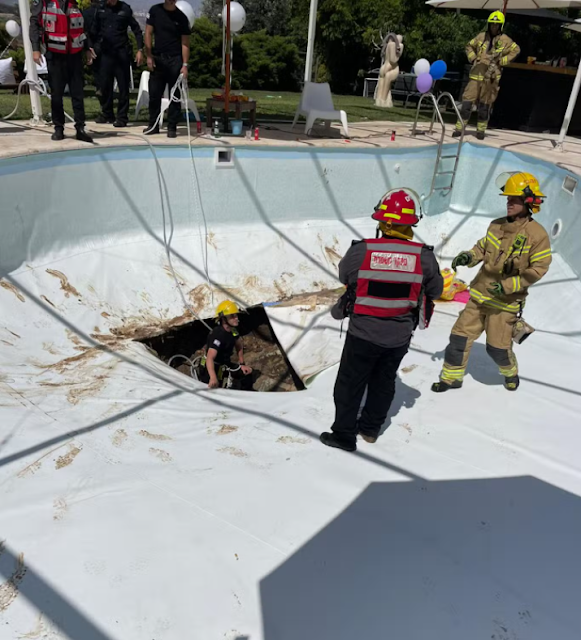
Sinkhole opens up beneath swimming pool in Israel, killing one.

One person has died and another injured after a sinkhole opened up beneath a swimming pool in Israel on Thursday 21 July 2022. Both the victims were male, and were attending a company party at the villa where the pool was located, at Carmel Yosef, 40 km to the southeast of Tel Aviv, when the incident happened. Witnesses report that six people were in the pool when the hole opened, rapidly drawing in all the water in the pool, along with several floating toys and the two victims. Other bathers were able to avoid being drawn in by clinging on to the side of the pool. One of the men drawn into the hole was able to climb out with minor injuries, but the second, identified as Klil Kimhi, 32, from Tel Aviv, was found dead by rescue workers four hours later at the bottom of a fifteen metre pit.

Rescue workers preparing to enter a sinkhole which opened under a swimming pool in Carmel Yosef, Israel, on Thursday 21 July 2022, in search of the body of a man pulled into the hole when it opened. Israel Fire and Rescue Service.

Sinkholes are generally caused by water eroding soft limestone or unconsolidated deposits from beneath, causing a hole that works its way upwards and eventually opening spectacularly at the surface. Where there are unconsolidated deposits at the surface they can infill from the sides, apparently swallowing objects at the surface, including people, without trace. Potash, a potassium salt, is readily soluble and can be dissolved quickly if water gains access to deposits, leading to the rapid formation of sinkholes.

While the precise cause of the sinkhole in Carmel Yosef is unknown, the area is known to be prone to such problems, with Neogene alluvial sediments overlying soft Eocene and Cretaceous limestone deposits, and numerous cave systems. Local authorities report that the swimming pool had been built without planning permission, and that the owners of the villa where the pool was located, have been arrested for causing death by negligence, and are now under house arrest pending further investigations.

See also...

Follow Sciency Thoughts on Facebook.

Follow Sciency Thoughts on Twitter.


Wednesday, 19 January 2022

Analysing silver from Phoenician hoards.

From about 4000 BC onwards the use of silver became widespread in the ancient world. This was obtained by smelting lead-ores in a furnace, and then cupellatiting (oxidising) the resultant metal to separate silver and gold. Lead ores, generally galena (lead sulphate) and cerussite (lead carbonate), were typically mined by a deep pit method, digging vertically down to a seem then following it horizontally. Silver  was important to many ancient peoples, among whom were the Phoenicians, who built city states such as Tyre, Sidon and Byblos, ‘Akko and Dor in Lebanon and on the northern shores of the southern Levant during the Iron Age, roughly from the eleventh century BC onwards, and who travelled widely on trading expeditions, bringing innovations such as the alphabet, murex-based purple dyeing and masterful craftsmanship to the western Mediterranean, where they established colonies in North Africa, Sardinia and Iberia. In the ninth century BC the Phoenicians began to exploit jarosite (potassium-iron sulphate) ores in Iberia, from which silver was also extracted as a biproduct.

Cupellation remained the most common way to obtain silver throughout the classical period, producing silver that still contains small amounts of lead. This is useful to modern archaeologists, who can use lead-isotope analysis to determine the source of silver. Other elements tend to be largely purged from the silver by this method, although gold and bismuth isotopes have sometimes been used to determine the origin of silver. 

Silverware was widely used as a trade commodity in the Near East before the adoption of coinage, with more than 40 silver hoards dating to between 2000 and 600 BC having been unearthed in the southern Levant.

In a paper published in the journal Applied Sciences on 12 January 2022, Tzilla Eshel of the Zinman Institute of Archaeology and School of Archaeology and Maritime Cultures at the University of Haifa, Ofir Tirosh of the Fredy and Nadine Herrmann Institute of Earth Sciences at the Hebrew University of Jerusalem, Naama Yahalom-Mack of the Institute of Archaeology at the Hebrew University of Jerusalem, Ayelet Gilboa, also of the Zinman Institute of Archaeology and School of Archaeology and Maritime Cultures at the University of Haifa, and Yigal Erel, also of the Fredy and Nadine Herrmann Institute of Earth Sciences at the Hebrew University of Jerusalem, present the results of a study which used lead and silver isotopes in silver artefacts to show changes in the source of silver reaching the southern Levant over a period of almost 1500 years, spanning the Bronze and Iron ages.

 
Map of the Southern Levant showing sites with Bronze and Iron Age silver hoards. Svetlana Matskevich in Eschel et al. (2022).

Examination of the lead isotope content of 250 silver items from 22 hoards suggests that Middle Bronze Age items (dating from between 2000 and 1550 BC), were made using silver from Anatolia and the Aegean. In the Late Bronze Age (from about 1550 to about 1250 BC), a time when gold probably replaced silver as the main trading currency, silver from the mines of Laurion (about 50 km south of Athens) begins to appear. During the Early Iron Age (roughly 1200 to 950 BC), following the end-Bronze Age collapse, silver appears to have been rare in the region, and was frequently adulterated with high lead content copper, making it hard to identify the origin of the artefacts. From about 950 BC onwards, Phoenicians revived the trade in silver, importing the metal from the Taurus mountains in Anatolia, and from Iglesiente in south-west Sardinia and later from the Pyrite Belt in Iberia, then from 630 BC onwards Greek traders slowly supplanted the Phoenicians, bringing in silver and copper from Laurion and Siphnos in the Aegean. 

This fits well with the previous understanding of the trade in sliver in the ancient Mediterranean Basin, but only gives a broad view of the geographic areas from which silver was being imported to the region; it does not shed any light on development of silver production practices and the exploitation of new ores. For this purpose, Eschel et al. turned to silver isotopes, which have a number of advantages in the tracing of the origin of ores. Silver will fractionate isotopically during supergene weathering; that is to say weathering caused by oxidation of minerals as water percolates through the rock in near surface environments, as well as during the formation of salts and sulphosalts. The upshot of this is that the proportion of different silver isotopes can vary even within different parts of the same mine, potentially giving a very high resolution way of determining the origin of the metal, and at very least, it is usually possible to tell the difference between silver minerals that formed in deep or shallow environments, with those that formed hydrothermally in shallow environments typically having a higher proportion of the heavier isotope silver¹⁰⁹ than those from deeper environments. 

This method has been applied previously to Hellenistic, Roman, and Medieval coins with some success, but not to pre-coinage silver hoards. As well as studying the origin of silver in Bronze and Iron Age hoards, Eschel et al. were able to study how the way in which the silver was preserved altered the isotopic ratio of the metal. It has previously been shown that the patterna on silver coins is isotopically lighter than the coins themselves, as the lighter isotope silver¹⁰⁷ is preferentially consumed in the making of silver sulphates. The silver from the Levantine hoards was stored in different ways, with some hoards stored in ceramic vessels, some in cloth bundles, and some in both, offering different levels of protection against intrusions by ground-water, which will tend to re-mineralise silver, altering its isotopic composition.

 
Silver hoards analysed in the study: (a) silver from the Shiloh hoard (without pendant), courtesy of the Israel Museum, Jerusalem. (b) Silver from hoard Tell el-‘Ajjul 1312, courtesy of the Israel Antiquities Authority. (c) The Dor silver hoard, the Israel Museum and the Tel Dor Expedition. (d) The ‘Akko silver hoard. (e) The ‘Ein Hofez silver hoard image courtesy of the Israel Antiquities Authority. (f) The ‘Arad silver hoard, courtesy of the Institute of Archaeology at Tel Aviv University. (g) Selected items from ‘Ein Gedi hoard, the Israel Museum, Jerusalem. Eschel et al. (2022).

Eschel et al. chose 45 silver artefacts for silver isotope analysis, all of known chemical and lead isotopic compositions and generally not suspected to be alloyed or mixed with metals from different sources. 

The oldest of these items came from the Middle/Late Bronze Age transitional period (roughly 1650-1500 BC) sites at Shiloh on the West Bank and Tell el-‘Ajjul in the Gaza Strip. The precise origin of these hoards is unclear, but both have jewelery with Anatolian motifs and lead isotopic analysis has suggested that the silver came from Anatolia or the Aegean. Both hoards were found wrapped in cloth bundles.

Silver from the Iron Age (roughly 950-700 BC) hoards at Dor, south of Haifa on Israel's Mediterranean coast, and ‘Akko in the coastal plain region of the Northern District of Israel, have been shown to come from Iglesiente, on southwest Sardinia, and have been associated with Phoenician trading in Anatolia and Sardinia in the Iron Age. The Dor hoard was found wrapped in a bundle, then placed within a ceramic vessel which was covered by a bowl, the 'Akko hoard was simply placed within a ceramic pot.

Silver items from the Iron Age (roughly 950-700 BC) hoards at ‘Ein Hofez inthe Carmel Mountains of northern Israel and 'Arad in the Southern District of Israel, on the border of the Negev and the Judean deserts have been shown to contain lead from Rio Tinto in Iberia, although this is only provides an approximate location for its origin, since jarosite ores from several parts of Iberia are known to have been brought to Rio Tinto for processing with lead. Other items from the ‘Ein Hofez hoard contain lead from Linares and other parts of Iberia, with one item coming from Anatolia. 

The Late Iron Age (roughly 630-586 BC) hoard from ‘Ein Gedi, in Israel west of the Dead Sea, near Masada and the Qumran Cave, contains silver placed unbundled within a cooking pot, covered by a ceramic lamp under the floor of a room. The lead in this silver indicates that it comes from Laurion in Greece, suggesting that it was brought to the area by a Greek trader.

Combining the silver and lead isotope analyses strongly suggests that the Phonicean hoards of Dor, ‘Akko, ‘Ein Hofez and Arad contain silver from Sardinia, Iberia and Anatolia, while the Late Iron Age hoard from ‘Ein Gedi contains Aegean silver, and the earlier, Bronze Age hoards of Shiloh and Tell el-‘Ajjul contain a mixture of Anatolian and Aegean silver. The isotopic ratios of the silver items from Phoenician hoards showed predominantly ratios consistent with having come from hypogene ores, that is to say ores that formed deep within the Earth, which had not undergone significant weathering related isotopic fractionation, whereas the isotopic ratios seen in the earlier Bronze Age and later Greek hoards showed more fractionation, probably indicating that they came from shallower ores which had undergone some surface weathering. 

While all the samples used were taken by drilling into the items to extract silver free from corrosion, some of the items still showed signs of sliver chloride formation at the level from which the sample was taken. This is symptomatic of corrosion through exposure to chlorine ions in groundwater, indicating that these samples were less protected from the environment than other samples. This was found in items from the hoards from Tell el-‘Ajjul, ‘Akko, and ‘Ein Hofez. The silver from Shiloh, Dor, ‘Arad and ‘Ein Gedi were apparently better protected. 

Based upon these findings, Eschel et al. were able to make the following observations. 

Hoards sealed in ceramic vessels were predicted to be best protected against contact with the soil and groundwater within it. The hoards from Dor (which was sealed in a vessel and bundled in cloth, and Ein ‘Gedi, which was sealed in a vessel but not bundled, showed no signs of corrosion, and therefore were apparently protected as expected.

Hoards wrapped tightly within cloth bundles were predicted to be less well protected against groundwater, though it was likely that the silver in the middle of the bundle would be protected somewhat by the silver around it. This would include the hoards at ‘Arad, which was tightly bundled and placed within a ceramic vessel, and which showed no signs of corrosion, and Shiloh, which was bundled but not placed within a vessel, where again no signs of corrosion were found.

Hoards placed within unsealed ceramic vessels were thought likely to be less well protected against groundwater. This included the hoards from ‘Ein Hofez and ‘Akko, both of which showed signs of corrosion.

Finally, silver which was neither bundled nor placed in a vessel was thought to be at the greatest risk of corrosion due to contact with the soil and groundwater. This was the case only with the hoard from Tell el-’Ajjul, which again showed signs of silver chloride formation.

The hoards from Tell el-‘Ajjul, ‘Akko, and ‘Ein Hofez all showed greater isotopic fractioning, which was taken as a sign of the silver in them having come from shallow ore sources, where this could occur prior to the silver being mined. Eschell et al. also note that the silver from these hoards also appeared to be less pure, and suggest that these combined may be a sign that they have been altered after deposition by their original owners, rather than evidence of a different mining origin or smelting technique to the other material.

Eschell et al.'s findings suggest that native silver (silver found in a pure state, which typically comes from deep, hypogene sources) was quite rare in the ancient world, and that most of the silver used came from shallow, supergene sources,

The Phoenicians are known to have brought silver to the Levan from the mid-10th century BC onwards, and from Iberia during the ninth and eighth centuries BC. It is unclear whether the Phoenicians themselves were the drivers of the improving metallurgical techniques being used in the areas where they traded, or whether they were just skilled traders able to aquire this silver and ship it across the Mediterranean. Anatolia is known to have been major centres of silver production from about the third millennium onwards, but the amount of silver being exported appears to have rapidly grown during the Phoenician era. Silver confidently assigned to a Sardinian origin is often found in Phoenician hoards, but no ancient mineworking have been discovered in Sardinia, so it is unclear when mining started there. Silver extracted in Iberia, in contrast, appears to have been exclusively developed by the Pheonicians, who targeted deep, low-lead ore bodies in the Iberian Pyritic Belt from about 800 BC onwards. The Romans began exporting silver from Iberia around 200 BC, but only targeted shallow ores with silver isotope fractionation, not the deep ores the Phoenicians were able to access.

The low levels of isotope fractionation seen in Phoenician sliver objects from Anatolia and Sardinia suggest that the Phoenicians were using the same deep-mining methods there in the tenth century BC, indicating that these people were more than talented sailors, but skilled workers in other fields, capable of transfering skills from one end of the Mediterranean to the other.

See also...


Follow Sciency Thoughts on Facebook.

Follow Sciency Thoughts on Twitter.


Monday, 11 January 2021

Thousands of stolen archaeological artefacts recovered in Israel.

The Israel Antiquities Authority has reported the recovery of thousands of artefacts believed to have been looted from sites across the Middle East, southern Europe, South America, Asia and Africa, following a raid on a flat in Tel Aviv on Monday 4 January 2021. Three people have been arrested following the raid, described as two men in their fifties from Tel Aviv in their sixties, and a man from Holon in his forties. The artefacts were removed from the flat by truck, and are still being inventoried. It is thought that the men arrested were trading in artefacts looted by other people and smuggled into Israel to take advantage of the countries market in such artefacts, with numerous licenced traders in antiquities, something not found in any other country in the region, although none of those arrested was a licenced dealer.

 
Amir Ganor, head of the Antiquities Robbery Prevention Unit of the Israel Antiquities Authority with a Red and Black Pottery Greek Urn, which had apparently been restored at some point. Yoli Schwartz/Israel Antiquities Authority.

The hoard includes hundreds of coins dating to the Seleucid Empire, which ruled much of Western Asia between 312 BC, when the Macedonian Empire of Alexander the Great broke up into a number of smaller units, and 63 BC, when it was absorbed into the Roman Empire. There is also a large amount of distinctive Red and Black Pottery, produced in Greece and southern Italy in the fifth and sixth centuries BC, much of which appears to have been restored (such objects are seldom found intact).

 
Seleucid Era coins recovered by the Israel Antiquities Authority during a raid on a flat used by illegal antiquities traders in January 2021. Yoli Schwartz/Israel Antiquities Authority.

The Israel Antiquities Authority also recovered large amounts of Roman era goods during the raid, including many bronze items, such as jewellery and lamps, glassware, stone heads, and statues, many of which are thought to have been looted from tombs across the Middle East.

 
Stone heads, thought to be mainly of Roman origin, recovered by the Israel Antiquities Authority during a raid on a flat used by illegal antiquities traders in January 2021. Yoli Schwartz/Israel Antiquities Authority.

A large number of Egyptian artefacts were also recovered, including sarcophagus lids, wooden boxes and statues. As well as the ancient artefacts, a number of African masks of uncertain origin were found; these are outside the usual remit of the Israel Antiquities Authority, which generally only handles objects dating to before 1700 AD. The Authority is working with Interpol to try to locate the origin of objects from outside the region, with photographs being circulated to law enforcement agencies around the world.

See also...


Follow Sciency Thoughts on Facebook.

Follow Sciency Thoughts on Twitter.