Showing posts with label Dolphins. Show all posts

Saturday, 23 March 2024

Pebanista yacuruna: A new species of South Asian River Dolphin from the Miocene of Peru.

Toothed Whales, Odontocetes, are known to have colonised freshwater systems multiple times during the Neogene, resulting in four distinct lineages of 'River Dolphins' in different geographical areas, the Iniidae, Lipotidae, Platanistidae, and Pontoporiidae. The Lipotidae had a single species which persisted into modern times, Yangtze River Dolphin, Lipotes vexillifer, but which is thought to have become extinct in the late twentieth century due to Human activities. The Platanistidae comprises two species of completely freshwater-dwelling Dolphins from South Asia, Platanista minor from the Indus River system, and Platanista gangetica from the Ganges River and associated waterways. The Iniidae comprises a single genus of River Dolphins from South America, Inia, as well as a number of fossil species in four extinct genera. The single known species of Pontoporiidae, the La Plata River Dolphin, Pontoporia blainvillei, is also found in South America, but is not an obligate freshwater dweller, also venturing into coastal waters.

The two species of Platanista are among the most highly specialised Cetaceans, with large enlarged, thin and pneumatic supraorbital crests enclosing their melons (fatty organs used in echolocation), and eyes reduced to the point where they are almost blind; an evolutionary adaptation to living in sediment laden waters. A number of fossil Dolphins have been assigned to the Platanistidae, but all are from marine sediments, leaving no clear indicator as to when the group moved into freshwater systems. The South American Iniidae present a similar situation, with most known fossil species coming from marine deposits, although one freshwater species, Ischyrorhynchus vanbenedeni, has been described from the Late Miocene of Argentina.

In a paper published in the journal Science Advances on 20 March 2024, Aldo Benites-Palomino of the Department of Paleontology at the University of Zurich, and the Departamento de Paleontología de Vertebrados at the Museo de Historia Natural of the Universidad nacional Mayor de San Marcos, Gabriel Aguirre-Fernández, also of the Department of Paleontology at the University of Zurich, Patrice Baby of Geosciences-Environnements Toulouse at the Université de Toulouse, Diana Ochoa of the Centro de Investigación para el Desarrollo integral y Sostenible at the Universidad Peruana Cayetano Heredia, and the Departmento de Geología at the Universidad de Salamanca, Ali Altamirano, also of the Departamento de Paleontología de Vertebrados at the Museo de historia natural of the Universidad nacional Mayor de San Marcos, John Flynn of the Division of Paleontology at the American Museum of Natural History, the Department of Earth & Environmental Sciences at Columbia University, and the Graduate Programs in Biology and Earth and Environmental Sciences at the City University of New York, Marcelo Sánchez-Villagra, again of the Department of Paleontology at the University of Zurich, Julia Tejada, again of the Departamento de Paleontología de Vertebrados at the Museo de Historia Natural of the Universidad nacional Mayor de San Marcos, the Division of Paleontology at the American Museum of Natural History, and of the Division of Geological and Planetary Sciences at the California Institute of Technology, Christian de Muizon of the Departement Origines et Evolution at the Muséum Nation-al d’Histoire Naturelle, and Rodolfo Salas-Gismondi, once again of the Departamento de Paleontología de Vertebrados at the Museo de Historia Natural of the Universidad nacional Mayor de San Marcos, the Centro de Investigación para el Desarrollo integral y Sostenible at the Universidad Peruana Cayetano Heredia, and the Division of Paleontology at the American Museum of Natural History, describe a new species of  Platanistid Dolphin from the Early to Middle Miocene Pebas Formation of Peruvian Amazonia.

The new species is named Pebanista yacuruna, where 'Pebanista' is a combination of Pebas, after the formation from which the fossil came, and Platanista, the only living genus of Platanistid Dolphin, and 'yacuruna' is a mythical water creature from the folklore of the Kichua peoples of the Peruvian Amazon. The new species is described from a single partial skull, comprising the posterior part of the rostrum, the facial region including part of the right supraorbital crest, the temporal and occipital regions.

Pebanista yacuruna, MUSM 4017. holotype skull in dorsal (A) and (B), ventral (C) and (D), left lateral (E) and (F), and anterodorsal views (F) and (G). Benites-Palomino et al. (2024).

The skull has a preserved length of 698 mm and an estimated width of 281 mm. The sutures of the skull are well fused, indicating that it was an adult at the time of death. The vertex of the skull is deviated leftwards, the premaxillae in the rostrum and facial areas is asymmetric, the braincase is anteroposteriorly shorter than wide; and the palatines lack contact and project dorsolaterally, all of which are diagnostic of the Platanistidae. Based upon the width of the skull, the living Dolphin is estimated to have been between 281 cm and 247 cm in length. Although Pebanista yacuruna undoubtedly occupied an inland, freshwater environment, it is similar in size to marine members of the group, considerably larger than living Platanista spp., and recent River Dolphins in general.

Size comparison between 'River Dolphins' and marine Platanistoids and River Dolphins. White silhouettes indicate the minimum body length calculated or recorded; gray body outlines indicate the largest size recorded or estimated in: (A) Macrosqualodephis ukupachai, (B) Zarhachis flagellator, (C) Pontoporia blainvillei, (D) Pebanista yacuruna, (E) Inia geoffrensis, (F) Platanista gangetica, and (G) Lipotex vexillifer. (H) Artistic reconstruction of Pebanista yacuruna. Jaime Bran in Benites-Palomino et al. (2024).

All known living members of the Platanistidae are restricted to the river systems of South Asia. Fossil Platanistid Dolphins are fairly common in the Oligocene and Miocene, when they appear to have had a global distribution and to have occupied a range of ecological niches, but all previously described fossils of the group are considered to have been marine. The group reached peak diversity in the Early Miocene, declining in numbers and diversity after this time, following the emergence of f other toothed Cetacean groups such as Delphinoids, Beaked Whales, and Physeteroids around the time of the Middle Miocene Climatic Optimum. 

The Early Miocene was a time of global cooling, as well as increased subsidence in the Andean-Amazonian foreland basin system, with most of the modern west Amazon rainforest area in Colombia, Peru, and Brazil covered by a continental-scale fresh water to brackish water foreland system (the Pebas System) parallel to the Andes. During the Early Miocene there were at least two large scale marine influxes from the Caribbean Sea into this basin. This wetland ecosystem reached its maximum extent during the Middle Miocene Climatic Optimum, as a complex arrangement of terrestrial and aquatic environments rich in nutrients and prey types, inhabited by a wide range of Fish, Turtles, Crocodylians (Caimans and Gharials), and mammals (Marsupials, Sloths, Rodents, Primates, and Ungulates), among others. This resource rich ecosystem appears to have favoured large sizes in predators such as Pebanista yacuruna and Gharials, a group of Crocodilians which also have marine ancestry, but which today are restricted to South Asia.

See also...

Tuesday, 15 August 2023

Monitoring Cetaceans in the Azores.

Gathering data on the numbers and movements of far-ranging ocean Animals such as Cetaceans is notoriously difficult, which is unfortunate, as such Animals are considered to be key indicators of the condition of marine ecosystems, with current concerns about the long-term health of the marine environment making such data particularly crucial. The Marine StrategyFramework Directive requires European Union member states with coasts to monitor the biodiversity of their territorial waters in order to maintain the marine environment. However, this does not include dedicated Cetacean surveys, due to the complexity and expense of maintaining such programs. This leaves Cetacean surveys largely in the hands of citizen scientists and commercial organizations.

The highly charismatic nature of Whales and Dolphins makes them ideal for citizen science projects, with the public often keen to take a role in their conservation. Whale watching tours have become popular tourist activities in many parts of the world in recent decades, providing both a tool for educating the public about marine ecology and an excellent opportunity for scientific programs studying Whales to piggyback onto the commercial activity. Such programs have proven particularly good for gathering long-term data on Whales within areas where tours are carried out. Whale-watching tours are therefore a cost-effective tool for monitoring Whale populations, particularly in areas where funding is limited or unavailable. Successful examples include the ORCA Survey Network operating in UK waters, the Fixed Line Transect Mediterranean monitoring Network, which works from European Atlantic and Mediterranean ferries, the CETUS project, which operates from cargo boats out of Macaronesia (the Azores, Madeira, the Canaries, and the Cape Verde islands) and mainland Portugal, and the Kakila database, which gathers data from Whale watching tours in the Caribbean. Data gathered from such sources has led to numerous publications on the distribution, movements, and habitat preferences of Cetaceans.

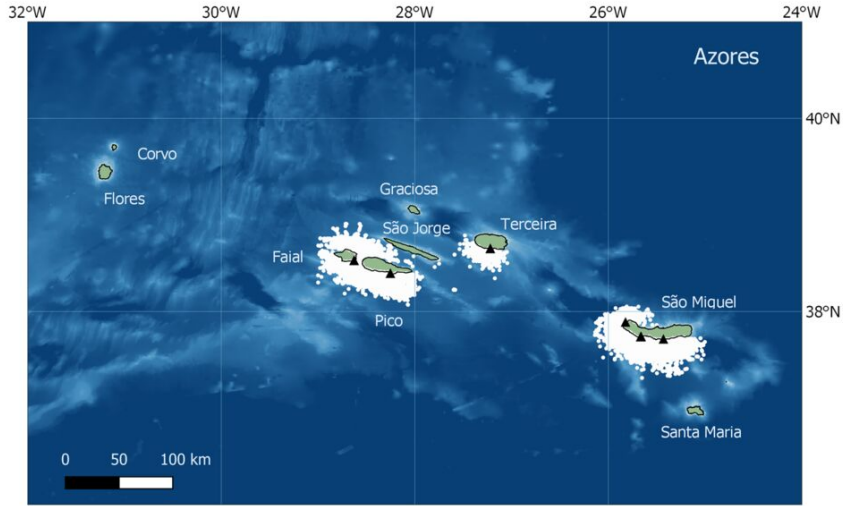
The Azores Islands are located in the North Atlantic Ocean at 36-41° North and 24-32° West. The archipelago is composed of nine volcanic islands organised into three groups separated by deep waters (i.e. deeper than 2000 m): the Western (Flores and Corvo), Central (Faial, Pico, Graciosa and Terceira) and Eastern groups (São Miguel and Santa Maria). The archipelago presents a well-defined oceanographic seasonality: March is usually the coldest month (average sea surface temperature 15°C), while the highest temperatures are generally reached in September (average sea surface temperature 25°C). The spring bloom is noticeable each year by the increase in chlorophyll concentrations, which drastically drop to oligotrophic conditions during summer. 

The people of the Azores have been linked to Cetaceans since the islands were first colonised in the fifteenth century, when early settlers are known to have harvested Whales stranded on beaches or found dead at sea. In the mid eighteenth century, whalers from North America began to visit the islands in pursuit of Sperm Whales, Physeter macrocephalus, often recruiting local people as crew for their vessels. The Azoreans learned the techniques used by the Americans, and adapted them to their own needs, replacing spotters mounted high upon ships with spotters at high points on land, and using these to guide small boats towards sited Whales in the same way. 

Over time the oil for which Sperm Whales was hunted was replaced by oil from other sources, making Whaling less profitable, and the practice began to die out in the 1960s. In 1982, Portugal ratified the Moratorium of theInternational Whaling Commission, and in 1986 Whaling was officially banned in all Portuguese territories, including the Azores, where the last two Sperm Wales were killed in 1987. 

The whaling industry provided the first accurate data on Whales collected in the Azores, with whalers collecting data on changes in the distribution of Whales over time, the first accurate descriptions of the Animals, and even the first records of their eating giant Cephalopods. In 1987 the government of the Azores, with support from the European Union, invited the International Fund for Animal Welfare to carry out a feasibility study on the potential for developing a Whale-watching industry in the Islands. The first tours were carried out from Pico Island in 1989, and rapidly became popular with tourists. Some the earliest recruits to the new business were former lookouts from the Whaling industry, and they were soon followed by former whalers, who worked as skippers on the new boats, brining with them their expertise in the ecology and behaviour of the Whales. In 1993 Whale-watching tours also began from São Miguel Island, with tours later starting from Faial and Terciera islands.

To date, 28 species of Whales and Dolphins have been observed around the Azores, making the islands one of the most popular Whale-watching destinations in the world. From the outset, the Whale-watching industry in the Azores was built on an ecotourism model, with regulations developed through collaboration between the tour operators, the scientific community, and the government of the Azores. The first Bienal das Baleias conference was held in Lajes do Pico in October 1998, with the various groups involved seeking to come to a consensus on further developing an ecologically friendly industry. As a consequence of this, legislation was introduced in 1999, which required the mandatory collecting of data on Whales by the tour boats, although this proved to be highly impractical, and was quickly dropped, although all parties involved agreed that a system of gathering this data was needed, both to develop the Whale-watching industry and to further the study and conservation of the Whales. 

The MONICET project grew out of a discussion at the 2006 Bienal das Baleias conference, with a scientific consortium working with three Whale-watching companies to develop a methodology for collecting data in a scientifically usable manner, and a remit to develop a database to store this data, all funded by a grant from the Azores government. 

In a paper published in the Biodiversity Data Journal on 8 August 2023, Laura González García of the  Institute of Marine Sciences at the University of the Azores, Marc Fernández of the Marine and Environmental Sciences Centre of the Agência Regional para o Desenvolvimento da Investigação Tecnologia e Inovação, and José Azevedo, also of the Institute of Marine Sciences at the University of the Azores, describe the methodology used by the MONICET project, the data gathered by that project so far, and ways in which this data might be used by researchers outside the Azores. 

González García et al. describe eleven years of MONICET data, collected between 2009 and 2020, and provided by 11 of the 23 Whale watching companies active in the Azore, operating out of four of the nine volcanic islands which make up the Azores (Azores Experiences and Peter Whale Watch from Faial Island; Aqua  Açores and Espaço Talassa from Pico Island; Futurismo Azores Adventures, Picos de Aventura, Terra Azul, Terra do Pico and Sea Colors from São Miguel Island and Atlantiangra, Ocean Emotion and Picos de Aventura from Terceira Island). Not every company reported data every year; participitation in the project is voluntary, and data will always be accepted from any company wishing to participate. In the first year of the project only three companies reported data, while the greatest number was reached in 2019, when nine companies reported.

The Azores Archipelago, with the locations (white dots) of all the sightings recorded between 2009 and 2020 in the MONICET database. Base ports of contributing companies are indicated by black triangles. González García et al. (2023).

MONICET uses a collaborative platform to collect and disseminate data on Cetacean sightings and movements, as well as photo images used for Whale identification. The data is collected on a voluntary basis, and is available to all interested persons, including the general public. 

Whale-watching tours in the Azores typically last 2.5-3 hours, with most companies operating two tours per day, although some run three per day in the peak of the tourist season. Tours operate from São Miguel Island year-round, but from the other islands is more seasonal, typically running from May to September. In all cases, Whales are first spotted from land, with experienced spotters guiding boats to the Cetaceans. This typically results in at least one Whale encounter per trip, with boats moving to the Whales then slowing down for periods of observation. 

The data used by MONICET is typically gathered by trained guides on board the boats (often trained biologists), who record the times at which the boats leave and return to their home ports, the location of the boats throughout their voyage (recorded with a GPS system), and the time, location, and species of any Whales encountered, as well as the number of Whales, their approximate age (adults, juveniles or calves), and behaviour, as well as other data about weather, sea conditions etc. Guides are provided with annual training on data collection by MONICET.

Tourists encountering a group of Cetaceans on a Whale-watching tour in the Azores. Futurismo Azores Adventures.

During the period recorded in González García et al.'s data, 37 000 sightings were recorded of 22 Cetacean and three Turtle species, including Minke Whale, Balaenoptera acutorostrata, Sei Whale, Balaenoptera borealis, Bryde's Whale, Balaenoptera edeni, Blue Whale, Balaenoptera musculus, Fin Whale, Balaenoptera physalus, Humpback Whale, Megaptera novaeangliae, Common Dolphin, Delphinus delphis, Short-finned Pilot Whale, Globicephala macrorhynchus, Long-finned Pilot Whale, Globicephala melas, Risso's Dolphin, Grampus griseus, Killer Whale, Orcinus orca, False Killer Whale, Pseudorca crassidens, Striped Dolphin, Stenella coeruleoalba, Atlantic Spotted Dolphin, Stenella frontalis, Bottlenose Dolphin, Tursiops truncatus, Pygmy Sperm Whale, Kogia breviceps, Sperm Whale, Physeter macrocephalus, North Atlantic Bottlenose Whale, Hyperoodon ampullatus, Sowerby's Beaked Whale, Mesoplodon bidens, Blainville's Beaked Whale, Mesoplodon densirostris, True's Beaked Whale, Mesoplodon mirus, and Cuvier's Beaked Whale, Ziphius cavirostris, as well as Loggerhead Turtle, Caretta caretta, Green Turtle, Chelonia mydas, and Leatherback Turtle, Dermochelys coriacea.

One problem noted by González García et al. is that the MONICET data tends to reflect the commercial preferences of the tourist industry. Thus spotters will guide boats towards more appealing Cetaceans, such as families of Sperm Whales or active pods of Dolphins, over Beaked or diving Whales which spend little time at the surface. The data set is presumed to be good, given the training and experience of the guides, but some caution needs to be applied to sightings of more elusive Whales, as these are less often seen, and spend less time at the surface where they can be identified. 

Some types of Whale will alter their behaviour in response to the presence of boats; this is particularly true of Dolphins, which tend to break off other activities in order to investigate Human visitors. For this reason, the activity of Whales is recorded when the boats first arrive, although there is a danger that the Whales may already have been affected by the presence of earlier boats.

Whales active at the surface are more attractive to tour boats than deep diving Whales. Azores Experiences.

See also...


Follow Sciency Thoughts on Facebook.

Follow Sciency Thoughts on Twitter.


Monday, 18 April 2022

Orcaella brevirostris: Irrawaddy River Dolphin extinct in Laos, less than 90 surviving in Cambodia.

The Irrawaddy River Dolphin, Orcaella brevirostris, is now officially extinct in Laos after the last surviving member of the species inhabiting a trans-border pool shared with Cambodia, died in February this year. The Dolphin, a male identified as ID#35, was found on a shore of the Chheuteal Pool in Stung Treng Province, Cambodia, having apparently died of injuries sustained when he became entangled in fishing nets on the Laos side of the pool. Irrawaddy River Dolphins are (or were) officially protected in both Laos and Cambodia, with a ban on gill nets, which are notoriously dangerous to small Cetaceans, in environments where they are found. However, while this rule was enforced on the Cambodian side of the border, where there are patrols by river guards and a public education program, part of Chheuteal Pool lies within Laos, where the rules were not enforced, and where Cambodian river guards are unable to operate.

 
ID#35, the last Irrawaddy River Dolphin living in the Chheuteal Pool spanning the border between Laos and Cambodia, found dead in February 2022. Phnom Penh Post.

In 1993 there were 17 Irrawaddy River Dolphins living in Chheuteal Pool, by 2009 this number had fallen to seven, by 2012 there were only six, in 2018 three Dolphins were recorded, and since 2021 ID#35 had been on his own. The Dolphin had been visibly unwell since becoming entangled in fishing gear in January, and was about half of his normal bodyweight when he died. Officials from the Cambodian Fisheries Administration and WWF Cambodia had considered moving him to a site lower in the Mekong Valley in Cambodia, where there is another population, but concluded that they lacked the expertise to do so. 

 
An Irrawaddy River Dolphin, Orcaella brevirostris, in a deep-water pool in Cambodia. Lor Kimsan/WWF Cambodia.

The Mekong Valley population in Cambodia is now thought to comprise only 89 individual Dolphins, with few other populations, in the Irrawaddy River in Myanmar, the Mahakam River in Indonesian Borneo, in Chilika Lagoon in India, in Malampaya Sound in the Philippines, and on the Trat coast in Thailand, each now thought to be less than 100 individuals, although a much larger population is present in the Sundarbans Mangrove Forest of Bangladesh, possibly numbering as many as 6000 individuals. The species is currently classified as Endangered under the terms of the International Union for the Conservation of Nature's Red List of Threatened Species. 

See also...


Follow Sciency Thoughts on Facebook.

Follow Sciency Thoughts on Twitter. 


Thursday, 7 January 2021

British Divers Marine Life Rescue successfully return stranded Killer Whale to water in the Orkneys.

A Killer Whale, Orcinus orca, stranded on a beach on Sanday in the Orkney Islands, Scotland, has been successfully returned to the sea by volunteers from British Divers Marine Life Rescue. The Whale was spotted by members of the public on a beach in the Bay of Newark on Monday 4 January 2020, who called the local coordinator for the group. On arrival the Animal was found to be a juvenile about 3.4 m in length, and probably a male (although the volunteers concentrated on rescuing the Animal rather than determining its sex). The Whale, which was on its side, was righted to enable it to breath better, and refloated on the incoming tide. The Whale is thought to have been about 3-4 years old, at which age it would no longer be depemdant on its mother, and a member of the North Isles 27s Pod, which is commonly seen in the area.

 
A young Killer Whale, Orcinus orca, stranded on a beach on Sanday in the Orkney Islands, on Monday 4 January 2020. British Divers Marine Life Rescue.

Killer Whales are the largest members of the Dolphin Family, Delphinidae, and have a global distribution. They are highly inteligent and adaptable Animals, able to take a wide range of prey, with different populations often specialising in hunting different prey items. It is possible that Killer Whales are a cluster of cryptic species (species which appear identical but which are genetically distinct and reproductively isolated) rather than a true biological species (single global population with all members potentially able reproduce with one-another), which makes their conservation status difficult to assess. Killer Whales are thriving in some areas, but in others are threatened by Human activities, such as heavy shipping, fishing, and offshore drilling. This means that if the species is in fact a species cluster, then the populations of each biological species might be quite small and potentially threatened.

See also...


Follow Sciency Thoughts on Facebook.

Follow Sciency Thoughts on Twitter.
 

Wednesday, 16 December 2020

International Union for the Conservation of Nature declares 31 species extinct in 2020.

The European Bison, Bison bonasus, Europe’s largest land Mammal, has moved from Vulnerable to Near Threatened thanks to continued conservation efforts, according to a press release issued by the International Union for the Conservation of Nature on 10 December 2020. With this update, 31 species also move into the Extinct category, and all of the world’s Freshwater Dolphin species are now threatened with extinction.

 
European Bison, Bison bonasus. Rafał Kowalczyk/International Union for the Conservation of Nature.

There are now 128 918 species on the International Union for the Conservation of Nature's Red List of Threatened Species, of which 35,765 are threatened with extinction.

'The European Bison and twenty-five other species recoveries documented in today’s IUCN Red List update demonstrate the power of conservation,' said Bruno Oberle, International Union for the Conservation of Nature's Director General. 'Yet the growing list of Extinct species is a stark reminder that conservation efforts must urgently expand. To tackle global threats such as unsustainable fisheries, land clearing for agriculture, and invasive species, conservation needs to happen around the world and be incorporated into all sectors of the economy.'

'The conservation successes in today’s Red List update provide living proof that the world can set, and meet, ambitious biodiversity targets. They further highlight the need for real, measurable commitments as we formulate and implement the post-2020 global biodiversity framework,' said Jane Smart, Global Director of International Union for the Conservation of Nature's Biodiversity Conservation Group. 

As a result of long-term conservation management, the wild population of European Bison, Bison bonasus, has grown from around 1800 in 2003 to over 6200 in 2019, justifying the move from Vulnerable to Near Threatened. The species survived only in captivity in the early 20th century, and was reintroduced to the wild in the 1950s. The largest subpopulations are now found in Poland, Belarus and Russia. There are currently 47 free-ranging European Bison herds. However, herds are largely isolated from one another and confined to non-optimal forest habitats, and only eight of them are large enough to be genetically viable in the long term. The species remains dependent on ongoing conservation measures such as translocations of Bison to more optimal open habitats and reduction of Human-Bison conflicts.

'Historically, European Bison were reintroduced mostly to forest habitats, where they don’t find enough food in winter. However, when they move out of the forest into agricultural areas, they often find themselves in conflict with people. To reduce the conflict risk and the bison’s dependence on supplementary feeding, it will be important to create protected areas that include open meadows for them to graze”, said Rafał Kowalczyk, co-author of the new assessment and member of the International Union for the Conservation of Nature's Bison Specialist Group. 

 
A European Bison, Bison bonasus. Rafał Kowalczyk/International Union for the Conservation of Nature.

With the Tucuxi, Sotalia fluviatilis, moving from Data Deficient to Endangered, all of the world’s Freshwater Dolphin species are now listed as threatened on the International Union for the Conservation of Nature's Red List. This small grey Dolphin species found in the Amazon river system has been severely depleted by incidental mortality in fishing gear, damming of rivers and pollution. Eliminating the use of gillnets, curtains of fishing net that hang in the water, and reducing the number of dams in Tucuxi habitat are priorities to enable numbers to recover. Enforcing the ban on the deliberate killing of Tucuxis is also essential.

 
Tucuxi, Sotalia fluviatilis. Fernando Trujillo/International Union for the Conservation of Nature.

The Lost Shark, Carcharhinus obsoletus, which was only formally described last year, enters the Red List as Critically Endangered (Possibly Extinct). The species was last recorded in 1934. Its habitat in the South China Sea has been extensively fished for more than a century and remains one of the most overexploited marine regions in the world. As it is unlikely that the species could have persisted under this heavy pressure, the Lost Shark may already be extinct.

All of the 17 Freshwater Fish species endemic to Lake Lanao and its outlet in the Philippines are now Extinct (15 species) or Critically Endangered (Possibly Extinct) (two species). The extinctions were caused by predatory introduced species, compounded by overharvesting and destructive fishing methods.


Extinct Cyprinid Fish from Lake Lanao, the Philippines. Armi Torres/International Union for the Conservation of Nature.

Three Central American Frog species have been newly declared Extinct. Additionally, twenty-two Frog species across Central and South America were listed as Critically Endangered (Possibly Extinct). The main driver of these drastic declines is Chytridiomycosis disease. Conservation efforts to protect critical habitat are helping populations of several other Amphibian species to recover. Among them is the Oaxaca Treefrog, Sarcohyla celata, which moved from Critically Endangered to Near Threatened thanks to actions by local communities in Mexico.

The Protea family has been comprehensively assessed with this update, revealing that 45% (637 of 1464 species) of these striking Flowering Plants that grow mainly across the Southern Hemisphere are Vulnerable, Endangered or Critically Endangered. Many of the species have highly restricted ranges, making them more vulnerable to the spread of invasive alien species, changes to natural fire cycles caused by Humans and linked with climate change, and loss of habitat to agriculture. The Protea family includes three Macadamia species, the same species that produce the farmed Macadamia nut crop, which have entered the International Union for the Conservation of Nature's Red List as threatened with extinction in the wild. The Macadamia Nut (Macadamia integrifolia) is listed as Vulnerable, while Macadamia ternifolia and Macadamia tetraphylla are listed as Endangered.

 
The Protea, Grevillea caleyi, from New South Wales, now classified as Critically Endangered. Tony Auld/International Union for the Conservation of Nature.

Oak trees have been comprehensively assessed, revealing that almost one third (31%, 113 of 430 species) are threatened with extinction. Nine Asian oaks enter the International Union for the Conservation of Nature's Red List already Critically Endangered (Possibly Extinct or Possibly Extinct in the Wild). The highest numbers of threatened species are in China and Mexico, followed by Viet Nam, the United States and Malaysia. Land clearance for agriculture and logging are the most common threats in China, Mexico and Southeast Asia. Invasive alien species and diseases and climate change are the key threats to Oaks in the United States.

 
Quercus liaoi, a species of Oak known only from Taiwan. Béatrice Chassé/International Union for the Conservation of Nature.

See also...


Follow Sciency Thoughts on Facebook.

Follow Sciency Thoughts on Twitter.


Thursday, 5 November 2020

About 120 Short-finned Pilot Whales returned to the sea following mass stranding in Sri Lanka.

About 120 Short-finned Pilot Whales, Globicephala macrorhynchus, have been returned to the sea, following a mass stranding event. The Whales began to wash up on a beach near Panadura, on the southwest coast about 25 km to the south of the capital, Colombia, on Monday 2 November 2020. Volunteers from the local community, joined by members of the country's Navy and Coast Guard, immediately began work to return the Whales to the sea, with most of the Animals thought to have been returned safely, although at least four have known to have died.

 
A Short-finned Pilot Whale, Globicephala macrorhynchus, that died following a mass stranding event in Sri Lanka on 4 November 2020, one of four Whales known to have died as a result of the incident. Lakruwan Wanniarachchi/AFP/Getty Images.

Short-finned Pilot Whales, Globicephala macrorhynchus, are considered to be of Least Concern under the terms of the International Union for the Conservation of Nature's Red List of Threatened Species, with a global population of over 700 000 individuals, split into four distinctive populations, two in the Pacific and one each in the Indian and Atlantic oceans. They typically live in pods of eight to ten individuals, but sometimes assemble into larger groups, sometimes with many hundreds of individuals congregating at the same location. However, this behaviour can make these Whales vulnerable to mass strandings, if large gatherings become spooked or disorientated by some event. The actual causes of such strandings are unclear, with a variety of causes having been suggested, including naval sonar, soar activity, and anomalies in the Earth's geomagnetic field.

See also...


Follow Sciency Thoughts on Facebook.

Follow Sciency Thoughts on Twitter.