Showing posts with label Xizang. Show all posts

Wednesday, 15 October 2014

Three new species of Katydid from China.


Katydids of the genus Xizicus and its close relatives are found across eastern Asia, though the taxonomy of the group is currently somewhat confused, in part due to publications being published in different languages without translation. New species are being described within the group every year, with different authors using slightly different classifications. Several subgenera have been created within the genus, some of which have been promoted to full genus status, others being synonymized (a taxa described separately by two different authors is correctly called by the first name used, the second description becoming a junior synonym of the first; junior synonyms are not used subsequently, but are recorded so that taxonomists encountering them know what they refer to).

In a paper published in the journal Zootaxa on 16 September 2014, Hanqiang Wang and Jun Jing of the School of Life Science at East China NormalUniversity in Shanghai, Xianwei Liu of the Shanghai Entomological Museum of the Chinese Academy of Sciences and Kai Li, also of the School of Life Science at East China Normal University, revise the genus Xizicus, raising the number of subgenera within the genus from two (Xizicus and Paraxizicus) to four (Xizicus, Paraxizicus, Zangxizicus and Haploxizicus), and three new species are described.

The first new species described is placed in the subgenus Xizicus (Paraxizicus) and given the specific name fallax, meaning ‘similar’ due to its similarity to Xizicus (Paraxizicus) biprocerus. Xizicus (Paraxizicus) fallax is a yellowish Katydid with dark lines along its body, with females slightly larger than males. It is found in Guangxi and Jiangxi Provinces, China.

Xizicus (Paraxizicus) fallax (top) male and (bottom) female.Wang et al. (2014).

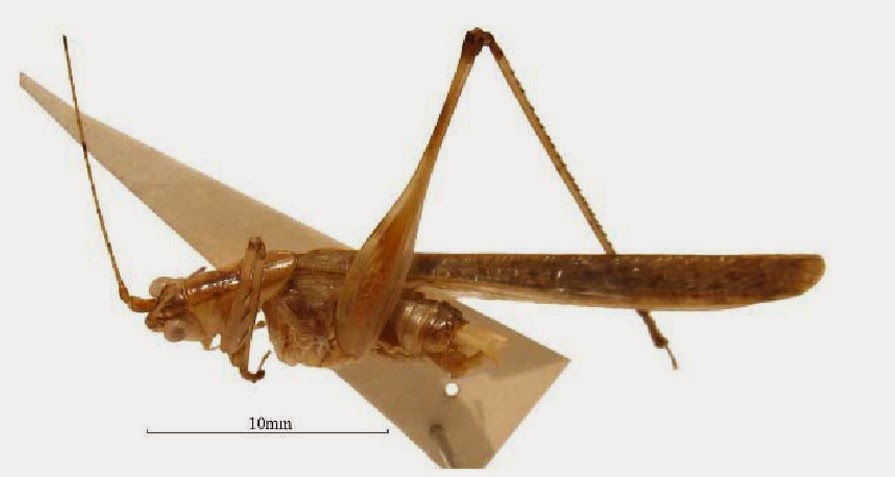
The second new species is placed in the new subgenus Xizicus (Zangxizicus), which derives from a combination of the genus name (Xizicus) and ‘Xizang’, the Chinese name for Tibet, and given the specific name quadrifascipes, meaning ‘four-stripes’, referring to markings on the hind femora. This species is described from a single male specimen from Motuo County in Xizang, at an altitude of 1060 m, which is yellow and brown in colour.

Xizicus (Zangxizicus) quadrifascipes, male specimen.Wang et al. (2014).

The third new species is also placed in the subgenus Xizicus (Zangxizicus), and given the specific name tibeticus, which derives from Tibet. This species is described from a single male from Chayu in Xizang, found at an altitude of 1900 m, and a single female from Motuo, at an altitude of 1100 m. Xizicus (Zangxizicus) tibeticus is a yellowish brown Katydid, the male slightly smaller than the female.
Xizicus (Zangxizicus) tibeticus(top) male and (bottom) female.Wang et al. (2014).

The second new subgenus erected is named Xizicus (Haploxizicus), in reference to the male anatomy (expand). This subgenus is erected to include five previously described species from China, previously placed in different taxa.

See also…

Katydids (or Bush Crickets) are members of the Cricket and Grasshopper Order, Orthoptera, noted for their exceptionally long antennae and the way in which they...

Bush Crickets, or Katydids, are large Insects in the Order Tettigoniidae, related to Grasshoppers and True Crickets. The are distributed widely around the globe, but reach their maximum diversity in the tropics and in temperate North America. The males of each species attract their mates with a distinctive call, made by...

Reconstructing the sounds made by ancient organisms is not something that palaeontologists can normally attempt. There are some fairly well published studies on Hadrosaurs, which suggest that if they had chosen to...


Follow Sciency Thoughts on Facebook.

Wednesday, 5 September 2012

Five new species of Snout Moth from China.

Snout Moths are one of the larger groups of Lepidopterans (Butterflies and Moths), with over 6000 described species known from across the globe. Most of these are small and inconspicuous, and generally ignored by humans, though the larval forms of some species are considered to be pests, since they consume dried food products.

In a paper published in the journal ZooKeys on 7 August 2012, Yongling Sun of the Department of Biology at Dezhou University and Houhun Li of the College of Life Sciences at Nankai University describe five new species of Snout Moths in the widespread and species-numerous genus Endotricha, and in addition describe the females of three species previously known only from male specimens.

The first new species described is named Endotricha dentiprocessa, where dentiprocessa means 'toothed process', in reference to the genital structure of the Moth. The species is described from two male and two female specimens, all collected in 2008 from Qinmu Village in Yongfu County in the Guangxi Zhuang Autonomous Region. Endotricha dentiprocessa is a small black, white and brown moth with a wingspan of 17.0−18.5 mm.

Endotricha dentiprocessa. Female specimen. Sun & Li (2012).

The second new species is named Endotricha unicolor, where unicolor means single-coloured, a reference to the unpatterned rear wing. The species is named from one male and female specimens collected in Millen and Linzhi Counties in the Xizang (Tibet) Autonomous Region, at altitudes of between 2980 and 3065 m. Endotricha unicolor is a yellowish-brown Moth with a 20 mm wingspan.

Endotricha unicolor. (Top) Male. (Bottom) Female. Sun & Li (2012).

The third new species described is named Endotricha shafferi, in honour of the late Michael Shaffer, an entomologist at the British Museum of Natural History. The species is named from One male and two female specimens from the Yinsha Protection Station in Jinxiu County in the Guangxi Zhuang Autonomous Region. Endotricha shafferi is a black and yellow Moth with a 21 mm wingspan.

Endotricha shafferi. Female specimen. Sun & Li (2012).

The fourth new species is named Endotricha convexa, refering to the shape of the forewing. The species is described on the basis of three male and one female specimens from Yinggeling and Mount Wuzhi in Hainan Province. Endotricha convexa is a brown and yellow moth with purple markings on its wings and a wingspan of 20-22 mm. 

Endotricha convexa. (Top) Male. (Bottom) Female. Sun & Li (2012).

The fifth new species described is named Endotricha whalleyi, in honour of the late Paul Whalley, a noted entomologist. The species is described from two male specimens from Hanmi in Mêdog County in the Xizang (Tibet) Autonomous Region. Endotricha whalleyi is a brown moth with a 16 mm wingspan.

Endotricha whalleyi. Male specimen. Sun & Li (2012).

The first of the three species to have its female described for the first time is Endotricha hoenei, the male of which was described in 1963 by Paul Whalley, from Guangdong Province. Sun and Li detail five new male and 19 female specimens from Fujian and Guangxi Provinces. The female is a yellow and brown Moth with a 19-21 mm wingspan.

Endotricha hoenei. Female specimen. Sun & Li (2012).

The second species to have its female described for the first time is Endotricha luteogrisalis, originally described in 1896 from a male specimen from Bhutan. Sun and Li describe five new male and twelve female specimens from Fujian and Hainan Provinces. The female of Endotricha luteogrisalis is a brown and yellow Moth with a 16.5-20 mm wingspan.

Endotricha luteogrisalis. Female specimen. Sun & Li (2012).

The final species to have its female described for the first time is Endotricha simipunicea, originally described in 2005 from a male specimen from Zhejiang Province. Sun and Li describe eight new male specimens and three female specimens from Fujian and Guizhou Provinces. The female of Endotricha simipunicea is a red and yellow Moth with a 13.5-15 mm wingspan.

Endotricha simipunicea. Female specimen. Sun & Li (2012).


Follow Sciency Thoughts on Facebook.

Monday, 1 August 2011

Magnitude 5.1 Earthquake in Western Tibet/Xizang. 2 August 2011.

At 3.40 am on the 2nd of August 2011 (7.40 pm on the 1st, GMT) a magnitude 5.1 earthquake occurred in Western Tibet (Xizang Province, China) at a depth of about 13 km. This is likely to have caused considerable disturbance at ground level, though there are no reports of any casualties or notable damage.

Map showing the quake location (green arrow) and the nearest settlement (A).

Tibet is extremely sparsely populated, with only 2.2/km², comparable to Australia at 2.8/km²; so quite a lot can happen without affecting anyone.

The Tibetan Plateau is a vast upland created by the impact of India and Eurasia; the 32 highest mountains in the world are on the Plateau (the 33rd, Tirich Mir, is in the nearby Hindu Kush, Afghanistan). India is still moving northwards, but Eurasia is unable to do the same, resulting in an unusual degree of folding and uplift. This has resulted in a number of faults running east-west across the plateau, with sections being forced eastward into China.

Faults and Plate Movement on the Tibetan Plateau.

See also Earthquake on the Krygyzstan/Uzbekistan Border, The End of the Cretaceous, and Earthquakes on Sciency Thoughts YouTube.