Showing posts with label Katydids. Show all posts

Monday, 2 February 2015

First evidence of Human consumption by Katydids and Woodlice.

Modern forensic science typically involves the detailed examination of corpses where foul play is suspected, with the aim of identifying any marks on the body, and relating them to the cause of, and circumstances surrounding, the death of the person in question. Numerous Arthropods are known to feed on vertebrate carrion, including Human remains, and marks left by feeding Arthropods have in the past been mistaken for burns, evidence of intravenous drug use, bite marks, defensive wounds and a variety of other forms of evidence. As such forensic scientists in a number of areas have begun to experiment with Human remains left to decompose in the environment, in order to better understand how Arthropod feeding traces and other forms of environmental destruction affect a body after death.

In a paper published in the Journal of Medical Entomology in January 2015, a team of scientists led by Jennifer Pechal of the Department of Biology at the University of Dayton and the Department of Entomology at Michigan State University, discuss the results of an experiment in which a body was left exposed at the Forensic Anthropology Center at Texas State University, and subsequently targeted by a variety of Arthropods not previously associated with the consumption of Human remains.

Firstly the cadaver was targeted by a gravid female Katydid, Pediodectes haldemani, which began feeding on the lower right arm of the body, approximately 32 hours after it was placed in the field. Katydids, Tettigoniidae, are Orthopteran Insects related to Grasshoppers and Crickets, but unlike these plant-eating groups they are generally omnivorous in their dietary preferences, and the species Pediodectes haldemani is known to be almost totally carnivorous. While Katydid have previously been recorded consuming vertebrate carrion, this is the first recorded instance of the consumption of Human remains by a Katydid, and Pechal et al. suggest that this might be slightly atypical behaviour, fuelled by a need for extra protein in the gravid female.

A gravid, female Pediodectes haldemani (Orthoptera: Tettigoniidae) feeding on the right forearm of a set of human remains (top), and the resulting physical artifact (indicated by the black arrow) on the remains by the feeding Pediodectes haldemani (bottom). Pechal et al. (2015).

Secondly the remains were visited by a Common Woodlouse, Armadillidium cf. vulgare, this time feeding on the lower left arm. Woodlice are terrestrial Isopod Crustaceans, with a typicalldetritivorous diet; they are most commonly associated with plant remains, but are known to eat carrion, though once again this is the first time that a Woodlouse has been recorded eating Human remains.
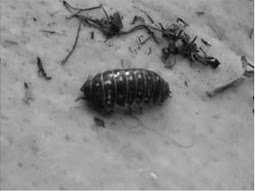
Armadillidium cf. vulgare (Isopoda: Armadilidiidae) feeding on the left forearm of a human set of remains (top), and the resulting artifact (indicated by theblack arrow) on the remains from the isopod activity (bottom). Pechal et al. (2015).

Finally the body was visited by a colony of Red Fire Ants, Solenopsis invicta, an imported species in the US, but which has become common in grasslands; Ants, including Red Fire Ants, are common visitors to carrion. On this occasion it is unclear whether the Ants actually fed on the remains, rather they entered the body via the hole left by the Katydid’s feeding and appeared to build a shelter there, using soil and small pieces of woody debris, a structure which would have been difficult to interpret had its construction not been observed.

A structure consisting of soil, small organic woody debris, and other organic material by red imported Fire Ants, Solenopsis invicta (Hymenoptera: Formicidae), in the artifact resulting from Pediodectes haldemani feeding activity on the leftforearm of the descendent. The structure was re-constructed each time the remains were disturbed for sampling purposes. The small dots surrounding the debris pile are fly artifacts or speck. Pechal et al. (2015).

See also…

http://sciencythoughts.blogspot.co.uk/2015/01/two-new-species-of-katydids-from.htmlTwo new species of Katydids from Pakistan. Katydids (or Buschcrickets), Tettigonioidea, are Members of the Insect Order Orthoptera, which also includes Crickets and Grasshoppers. They are...


http://sciencythoughts.blogspot.co.uk/2014/11/the-impact-of-yellow-crazy-ant-on.htmlThe impact of the Yellow Crazy Ant on the VallĂ©e de Mai Palm Forest of Praslin Island. Ants are often highly adaptable animals, and many species have proven to be highly invasive pests, able to reach new homes by hitching a ride on cargo moved by Humans, and often proceeding modify the ...
http://sciencythoughts.blogspot.co.uk/2014/10/three-new-species-of-katydid-from-china.htmlThree new species of Katydid from China. Katydids of the genus Xizicusand its close relatives are found across eastern Asia, though the taxonomy of the group is currently somewhat confused, in part due to publications being published in different languages...

Follow Sciency Thoughts on Facebook.

Wednesday, 7 January 2015

Two new species of Katydids from Pakistan.


Katydids (or Buschcrickets), Tettigonioidea, are Members of the Insect Order Orthoptera, which also includes Crickets and Grasshoppers. They are voracious eaters and can consume a wide variety of plant (and sometimes animal) material; as such many species are considered to be serious agricultural pests.

In a paper published in the journal ZooKeys on 18 December 2014, Riffat Sultana, Waheed Ali Panhwar and Muhammad Saeed Wagan of the Department of Zoology at the University of Sindh and Imran Khatri of the Department of Entomology at Sindh Agricultural University describe two new species of Katydids from Rawalakot Province (check) in Pakistan. Both are placed in the genus Sathrophyllia.

The first new species is named Sathrophyllia saeedi, in honour of Muhammed Saeed Wagan of the Department of Zoology at the University of Sindh. The species is described from a single female specimen, 29 mm in length and light brown in colour. The specimen was collected from agricultural land between dunes in valleys with highly diverse plant communities.

Sathrophyllia saeedi, adult female. Sultana et al. (2014).

The second new species is named Sathrophyllia irshadi, in honour of Muhammad Irshad of the National Agricultural Research Council in Islamabad, for his contributions to entomology. This species is also described from a single female specimen, 38 mm in length and light brown in colour. It was collected from high-nutrient grasslands, again in an area of high plant biodiversity.

Sathrophylliairshadi, adult female. Sultana et al. (2014).

See also…

http://sciencythoughts.blogspot.co.uk/2014/10/three-new-species-of-katydid-from-china.htmlThree new species of Katydid from China. Katydids of the genus Xizicusand its close relatives are found across eastern Asia, though the taxonomy of the group is currently somewhat confused, in part due to publications being published in different languages...
Katydids (or Bush Crickets) are members of the Cricket and Grasshopper Order, Orthoptera, noted for their exceptionally long antennae and the way in which they...

Bush Crickets, or Katydids, are large Insects in the Order Tettigoniidae, related to Grasshoppers and True Crickets. The are distributed widely around the globe, but reach their maximum diversity in the tropics and in temperate North America. The males of each species attract their mates with a distinctive call, made by...
Follow Sciency Thoughts on Facebook.

Wednesday, 15 October 2014

Three new species of Katydid from China.


Katydids of the genus Xizicus and its close relatives are found across eastern Asia, though the taxonomy of the group is currently somewhat confused, in part due to publications being published in different languages without translation. New species are being described within the group every year, with different authors using slightly different classifications. Several subgenera have been created within the genus, some of which have been promoted to full genus status, others being synonymized (a taxa described separately by two different authors is correctly called by the first name used, the second description becoming a junior synonym of the first; junior synonyms are not used subsequently, but are recorded so that taxonomists encountering them know what they refer to).

In a paper published in the journal Zootaxa on 16 September 2014, Hanqiang Wang and Jun Jing of the School of Life Science at East China NormalUniversity in Shanghai, Xianwei Liu of the Shanghai Entomological Museum of the Chinese Academy of Sciences and Kai Li, also of the School of Life Science at East China Normal University, revise the genus Xizicus, raising the number of subgenera within the genus from two (Xizicus and Paraxizicus) to four (Xizicus, Paraxizicus, Zangxizicus and Haploxizicus), and three new species are described.

The first new species described is placed in the subgenus Xizicus (Paraxizicus) and given the specific name fallax, meaning ‘similar’ due to its similarity to Xizicus (Paraxizicus) biprocerus. Xizicus (Paraxizicus) fallax is a yellowish Katydid with dark lines along its body, with females slightly larger than males. It is found in Guangxi and Jiangxi Provinces, China.

Xizicus (Paraxizicus) fallax (top) male and (bottom) female.Wang et al. (2014).

The second new species is placed in the new subgenus Xizicus (Zangxizicus), which derives from a combination of the genus name (Xizicus) and ‘Xizang’, the Chinese name for Tibet, and given the specific name quadrifascipes, meaning ‘four-stripes’, referring to markings on the hind femora. This species is described from a single male specimen from Motuo County in Xizang, at an altitude of 1060 m, which is yellow and brown in colour.

Xizicus (Zangxizicus) quadrifascipes, male specimen.Wang et al. (2014).

The third new species is also placed in the subgenus Xizicus (Zangxizicus), and given the specific name tibeticus, which derives from Tibet. This species is described from a single male from Chayu in Xizang, found at an altitude of 1900 m, and a single female from Motuo, at an altitude of 1100 m. Xizicus (Zangxizicus) tibeticus is a yellowish brown Katydid, the male slightly smaller than the female.

Xizicus (Zangxizicus) tibeticus(top) male and (bottom) female.Wang et al. (2014).

The second new subgenus erected is named Xizicus (Haploxizicus), in reference to the male anatomy (expand). This subgenus is erected to include five previously described species from China, previously placed in different taxa.

See also…

Katydids (or Bush Crickets) are members of the Cricket and Grasshopper Order, Orthoptera, noted for their exceptionally long antennae and the way in which they...

Bush Crickets, or Katydids, are large Insects in the Order Tettigoniidae, related to Grasshoppers and True Crickets. The are distributed widely around the globe, but reach their maximum diversity in the tropics and in temperate North America. The males of each species attract their mates with a distinctive call, made by...

Reconstructing the sounds made by ancient organisms is not something that palaeontologists can normally attempt. There are some fairly well published studies on Hadrosaurs, which suggest that if they had chosen to...


Follow Sciency Thoughts on Facebook.

Thursday, 8 November 2012

Four new species of Katydid from Singapore and Malaysia.

Katydids (or Bush Crickets) are members of the Cricket and Grasshopper Order, Orthoptera, noted for their exceptionally long antennae and the way in which they produce their 'song' by rubbing stridulatory files on their wings together, something which fossil Katydid's from the Jurassic were already doing this. Katydids are found throughout the world, though they are most abundant in the tropics and North America.

In a paper published in The Raffles Bulletin of Zoology on 29 February 2012, Sigfrid Ingrisch of the Alexander Koenig Zoological Research Museum and Ming Kai Tan of the Department of Biological Sciences at the National University of Singapore describe four new species of Katydid from Singapore and Malaysia, based upon previously undescribed specimens from museums and recently collected material.

The first new species described is placed in the previously described genus Nahlaksia, and given the specific name bidadari, named after the exhumed Bidadari cemetery, a multi-faith burial ground in use from 1901 till 1973, which was redeveloped in 2001-6. The species is described on the basis of specimens collected at the Mandai Reservoir in 1967, as well as more recent material from both Singapore and Malaysia.

Nahlaksia bidadari is an 18-22 mm ochre or brown Katydid, sometimes with green spots. The males are slightly larger than the females. The recent specimens were collected living on dead branches of felled trees and climbers.

Nahlaksia bidadari (Top) adult male, (Bottom) nymph. Ingrisch & Tan (2012).

Nahlaksia bidadari nymph hiding within hollow twig. Ingrisch & Tan (2012).

The second new species described is placed in the genus Oxylakis, and given the specific name singaporensis, meaning 'coming from Singapore'. The description is based upon two specimens, a 15 mm male collected at the Tenga airbase in 1958 and a 22 mm female collected at an unspecified location in Singapore in 1901. The male has an exceptionally dense stridulatory file, suggesting that it's call would be quite distinctive.

Oxylakis singaporensis, male specimen. Scale bar is 10 mm. Ingrisch & Tan (2012).

The remaining two species are both placed in the genus Jambiliara. The first of these species is named Jambiliara selita, Selita being the locality in Singapore where the earliest of the specimens used in describing the species was found, in 1871. The species is described from this as well as a specimen collected in 1901, and more recent specimens from Singapore, as well as an undated specimen from a collection made in Malaysia. Jambiliara selita is a brown and black Insect, similar to other species in the same genus, but with a distinctive stridulatory file.

Jambiliara selita, male (top) and female (bottom). Scale bars are 10 mm. Ingrisch & Tan (2012).

The second species of Jambiliara described is Jambiliara angula, described from a single male specimen that landed on a jungle path in front of a collector in Malaysia in 1956. It is a 27 mm brown and yellow Katydid.

Jambiliara angula, male. Scale bar 10 mm. Ingrisch & Tan (2012).

See also New species of Bush Cricket from the Eastern Carpathian Mountains, An early Cricket from southeast India and What Jurassic Katydids did.

Follow Sciency Thoughts on Facebook.

Sunday, 28 October 2012

New species of Bush Cricket from the Eastern Carpathian Mountains.

Bush Crickets, or Katydids, are large Insects in the Order Tettigoniidae, related to Grasshoppers and True Crickets. The are distributed widely around the globe, but reach their maximum diversity in the tropics and in temperate North America. The males of each species attract their mates with a distinctive call, made by rubbing stridulatory files on the back of their wings together, something they have apparently been doing since at least the Jurassic.

In a paper published in the journal Zootaxa on 18 October 2012, Gergely SzövĂ©nyi of the Department of Systematic Zoology & Ecology at Eötvös Loránd University, GellĂ©rt Puskás of the Department of Zoology at the Hungarian Natural History Museum and Kerill Márk Orci of the Ecology Research Group of the Hungarian Academy of Sciences, Eötvös Loránd University and the Hungarian Natural History Museum, describe a new species of Bush Cricket from the ancient Caliman Caldera of the Eastern Carpathian Mountains in northern Romania.

The location of the Caliman Caldera. Google Maps.

The interior of the Caliman Caldera at (left) 1400 m and (right) 1600 m. SzövĂ©nyi et al. (2012).

The new species is placed in the previously described genus Isophya, and given the specific name nagyi, in honour of Barnabás Nagy of the Plant Protection Institute of Hungarian Academy of Sciences, a leading expert on the Orthoptera (Crickets and Grasshoppers etc.) in Hungary.

The species is essentially similar to other species in the genera, a green Bush Cricket averaging 24 mm in length, and was identified on the basis of the male song, which is distinctive and indicates reproductive isolation. This is not simply a cultural difference, as in the songs of Whales or Primates, the song of a male Bush Cricket is preset by the physical structure of its stridulatory file.

Two colour variations of Isophya nagyi. SzövĂ©nyi et al. (2012).

The stridulatory files of (A) Isophya nagyi, (B) Isophya camptoxypha, (C) Isophya ciucasi, (D) Isophya posthumoidalis, (E) Isophya sicula. (H) detail of the center part of the stridulatory file of Isophya nagyi. SzövĂ©nyi et al. (2012).


Follow Sciency Thoughts on Facebook.

Tuesday, 7 February 2012

What Jurassic Katydids did.

Reconstructing the sounds made by ancient organisms is not something that palaeontologists can normally attempt. There are some fairly well published studies on Hadrosaurs, which suggest that if they had chosen to blow air through their head structures then they would have made a haunting, plaintive, tooting noise, but we have no real way to tell if they actually did this. Other than that we have very little idea what the Mesozoic sounded like. Model dinosaurs in museums often produce roaring noises, but there is no evidence to support this (to the general annoyance of palaeontologists).

On 6 February 2012 a paper appeared in the Proceedings of the National Academy of Sciences by a team lead by Jun-Jie Gu of the College of Life Sciences at Capital Normal University in Beijing and Fernando Montealegre-Zapata of the School of Biological Sciences at the University of Bristol in which they describe for the first time a species of Katydid insect from the Middle Jurassic of Inner Mongolia, and are able to make deductions about the noises it would have made.

Katydids, or Bush Crickets, are largish, nocturnal, insects related to crickets and grasshoppers. Modern Katydids are found throughout the tropics, and temperate North America. They have a varied range of diets, with herbiverous, detrivorous, omnivorous and carnivorous members of the group, and pursue a similarly wide range of lifestyles. The males attract mates from ground-based perches, using species-specific calls, made by rubbing the edges of their wings together; the left wing has a 'file' structure,which is rubbed over sounding cells on the right wing. A fossil species from the Lower Tertiary of Denmark, Pseudotettigonia amoena appears to have used its wings to produce sound in the same way as modern Katydids.

The newly described species, named as Archaboilus musicus, comes from the Middle Jurassic Jiulongshan Formation of Inner Mongolia, making it roughly 165 million years old. It is not the first species of Archaboilus to have been described, but is apparently the first species for which a reconstruction of the possible musical ability has been possible; the name musicus means musical. Unlike modern Katydids it seems to have had both files and sounding cells on each wing (this is seen in the related Hump-winged grigs of North America).

The wings of Archaboilus musicus, (A-D) photographs and line drawings of the left and right wings, showing wing venation. Red arrows show the locations of the files. (E) Detail of left File. (F) Detail of right file. From Gu et al. (2012).

From the anatomy of the preserved wings Gu et al. have been able to reconstruct the song of Archaboilus musicus. They interpret this as being a mono-tone chirp, deeper than the chirp of modern Katydids, but well suited to the open coniferous woodland in which A. musicus lived; in such an environment the call would have carried a long way.