Monday, 23 May 2016

Callionymus alisae: A new species of Dragonet from New Ireland.

Dragnets, Callionymidae, are benthic, sublittoral (dwelling between the low tide livel and the edge of the continental shelves), Perciform Fish found throughout the world's temperate, subtroipical and tropical seas (and occasionaly esturine or even freshwater environments), but most abundant and diverse in the western Indo-Pacific region. They have elongate, slightly flattened bodies with two dorsal fins and spines on their gill-coverings, which is venemous in some species.

In a paper published in the journal FishTaxa on 9 April 2016, Ronald Fricke of the Staatliches Museum für Naturkunde Stuttgart describes a new species of Dragonet from New Ireland Province, Papua New Guinea.

The new species is named Callionymus alisae, in reference to the French research vessel RV Alis, which collected the specimen from which the species is described. The species is describd from a single male specimen, caught to the southeast of Bauddisson Island at a depth of between 90 and 228 m. The specimen, yellowish in colour, darker towards the rear and white on the underside, with dark blue eyes and greyish spots.

Callionymus alisae, holotype, male, 32.1 mm SL, Papua New Guinea, New Ireland Province, Kavieng District. Lateral view, left side (scale indicates 15 mm). Fricke (2016).

See also...

http://sciencythoughts.blogspot.co.uk/2015/10/symphysanodon-andersoni-second-specimen.htmlSymphysanodon andersoni: A second specimen of the Bucktoothed Slopefish from the south coast of Oman.                       Slopefish, Symphysanodontidae, are deepwate Perciform...
http://sciencythoughts.blogspot.co.uk/2015/04/philometrid-nematodes-from-perciform.htmlPhilometrid Nematodes from Perciform Fish off the north Australian coast.                   Philometrids are large Nematodes parasitizing Fish . They show a high degree of sexual dimorphism, with males typically only a few mm in length, while...


http://sciencythoughts.blogspot.co.uk/2015/02/a-new-species-of-serranineperchlet-from.htmlA new species of Serranine Perchlet from the Philippines.                                                   The Philippines form a major component of the...


Follow Sciency Thoughts on Facebook.
 

Pyroclastic flow kills at least seven on Mount Sinabung, North Sumatra.

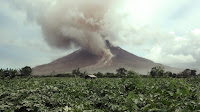
Seven people have been confirmed dead and an unknown number are still missing following a pyroclastic flow (avalanche of hot rock, ash and gas) that swept through farms and villages on the slopes of Mount Sinabung in North Sumatra on Sunday 22 May 2016. A number of other people are being treated for extensive burns following the event, with rescue teams still scouring the mountain.

Rescue workers searching a ash-covered village near Mount Sinabung, North Sumatra. Dedi Sinuhaji/EPA.

Mount Sinabung, a 2460 m stratovolcano (cone shaped volcano made up of layers of ash and lava) in the Karo Regency; it is potentially a very dangerous volcano, as a large number of people live in its immediate vicinity. The last major eruption prior to the twenty-first century happened in about 1600, with small eruptions occurring in 1889 and 1912. However the volcano returned to life in late August 2010, erupting throughout September and causing about 12 000 people to flee their homes.
 
 The location of Mount Sinabung. Google Maps.
 
The Indo-Australian Plate, which underlies the Indian Ocean to the west of Sumatra, is being subducted beneath the Sunda Plate, a breakaway part of the Eurasian Plate which underlies Sumatra and neighboring Java, along the Sunda Trench, passing under Sumatra, where friction between the two plates can cause Earthquakes. As the Indo-Australian Plate sinks further into the Earth it is partially melted and some of the melted material rises through the overlying Sunda Plate as magma, fueling the volcanoes of Sumatra.
 
 The Subduction zone beneath Sumatra. NASA/Earth Observatory.
 
The two plates are not directly impacting one-another, as occurs in the subduction zones along the western margins of North and South America, but at a steeply oblique angle. This means that as well as the subduction of the Indo-Australian plate beneath the Sunda, the two plates are also moving past one-another. This causes rifting within the plates, as parts of each plate become stuck to the other, and are dragged along in the opposing plate's direction. The most obvious example of this is the Sumatran Fault, which runs the length of Sumatra, with the two halves of the island moving independently of one-another. This fault is the cause of most of the quakes on the island, and most of the island's volcanoes lie on it.

The movement of the tectonic plates around Sumatra. NASA/Earth Observatory.

See also...
 
http://sciencythoughts.blogspot.co.uk/2016/05/seventeen-students-confirmed-dead-after.htmlSeventeen students confirmed dead after flash flood and landslide at popular Sumatran tourist spot.                                          Seventeen students have been confirmed dead and another...
http://sciencythoughts.blogspot.co.uk/2016/03/magnitude-78-earthquake-to-southwest-of.htmlMagnitude 7.8 Earthquake to the southwest of Sumatra triggers small tsunami.              The United States Geological Survey recorded a Magnitude 7.8 Earthquake at a depth of 10 km...
http://sciencythoughts.blogspot.co.uk/2016/02/eruption-on-mount-sinabung.htmlEruption on Mount Sinabung.                 Residents of villages close to Mount Sinabung on North Sumatra have been forced to evacuate their homes following two eruptions on the volcano on Thursday 25 February 2016. The first eruption...

Follow Sciency Thoughts on Facebook.
 

Laelaspis natanziensis: A new species of Laelapid Mite from Isfahan Province, Iran.

Laelapid Mites are a large and diverse group, including free-living carnivorous forms as well as both obligate and facultative parasites (species that feed only parasitically and species that are sometimes parasitic but can feed in other ways). Members of the group are also found in a variety of environments, including soil and leaf litter and the nests of vertebrate and invertebrate animals. The family takes its name from the genus Laelaspis, which is found in the nests of Ants, though exactly how members of this genus feed is unknown, with suggestions having been made that they feed on substances secreted by the Ants, smaller invertebrates living in the nests or even the eggs of the Ants.

In a paper published in the Persian Journal of Acarology on 15 January 2016, Elham Masoomi of the Department of Entomology at the Islamic Azad University, Omid Joharchi of the Young Researchers and Elite Club, also at the Islamic Azad University and Alireza Jalalizand, again of the Department of Entomology at the Islamic Azad University, describe a new species of Laelaspis from Natanz County in Isfahan Province, Iran.

The new species is named Laelaspis natanziensis, meaning 'from Natanz'. The Mites were extracted from soil associated with the nests of Ants of the genus Tetramorium. Females range from 532 to 545 μm in length and from 437 to 451μm in width, the single male discovered measured 413 by 312 μm.

 Laelaspis natanziensis (female) Left: Dorsal view of idiosoma. Right: Ventral view of idiosoma. Masoomi et al. (2016).

See also...

http://sciencythoughts.blogspot.co.uk/2014/03/a-new-species-of-gall-mite-from-tripura.htmlA new species of Gall Mite from Tripura State, northeast India.                                   Gall Mites (Eriophyidae) are small Archnids related to Spider Mites and Scrub Itch Mites. They are exclusively parasitic, targetting higher plants. Gall Mites have only two pairs of legs, and an...
http://sciencythoughts.blogspot.co.uk/2013/12/a-new-species-of-feather-mite-from.htmlA new species of Feather Mite from Saudi Arabia.                                                        Mites (Acari) are small Arachnids related to Microwhip Scorpions (Palpigradi) and Sea Spiders (Pycnogonida). They are one of the...
  

Follow Sciency Thoughts on Facebook. 

Sunday, 22 May 2016

Flooding and landslides kill at least seventy three in Sri Lanka.

Seventy three people have been confirmed dead and hundreds more are still missing after the heaviest rains in over twenty years have brought widespread flooding and numerous landslides. The worst hit area is in the Kegalle District in the central part of the country, where a series of huge landslides have engulfed at least three villages, and driven back repeated rescue missions by the Sri Lankan military. Landslides are a common problem after severe weather events, as excess pore water pressure can overcome cohesion in soil and sediments, allowing them to flow like liquids. Approximately 90% of all landslides are caused by heavy rainfall. Other areas of the country, including the capital, Colombo, have suffered extensive flooding, with close to a quater of a million people in temporary shelters.

The aftermath of a landslide in Kegalle District, Sri Lanka, on Wednesday 18 May 2016. Eranga Jayawardina/AP.

The rains are associated with the onset of the Sri Lankan summer monsoon, which lasts from May to October, typically brining around 400 mm of rain to many parts of the country in an average year. Monsoons are tropical sea breezes triggered by heating of the land during the warmer part of the year (summer). Both the land and sea are warmed by the Sun, but the land has a lower ability to absorb heat, radiating it back so that the air above landmasses becomes significantly warmer than that over the sea, causing the air above the land to rise and drawing in water from over the sea; since this has also been warmed it carries a high evaporated water content, and brings with it heavy rainfall. In the tropical dry season the situation is reversed, as the air over the land cools more rapidly with the seasons, leading to warmer air over the sea, and thus breezes moving from the shore to the sea (where air is rising more rapidly) and a drying of the climate. 

 Diagrammatic representation of wind and rainfall patterns in a tropical monsoon climate. Geosciences/University of Arizona.

See also...

http://sciencythoughts.blogspot.co.uk/2015/12/heavy-rains-bring-further-flooding-to.htmlHeavy rains bring further flooding to Chennai, Tamil Nadu.                                                 Heavy rains have brought further flooding to the city of Chennai in Tamil Nadu, India, with about 8 cm of rain falling on the morning of Tuesday 1 December...
http://sciencythoughts.blogspot.co.uk/2014/12/at-least-six-dead-following-landslide.htmlAt least six dead following landslide in Badulla District, Sri Lanka.                             At least six people are known to have died following a landslide at Rilpola in the Badulla District of Uva...
http://sciencythoughts.blogspot.co.uk/2013/08/a-least-five-dead-following-landslide.html 
At least five dead following landslide in Kerala State, India.                                      Five people are known to have died and another fifteen, including two foreign tourists, are believed to still be buried in their vehicles following a...


Follow Sciency Thoughts on Facebook.
 

Asteroid 2016 JD18 passes the Earth.

Asteroid 2016 JD18 passed by the Earth at a distance of 625 300 km (1.63 times the average distance between the Earth and the Moon, or 0.42% of the average distance between the Earth and the Sun), at about 11.25 pm on Monday 16 May 2016. There was no danger of the asteroid hitting us, though had it done so it would have presented only a minor threat. 2016 JD18 has an estimated equivalent diameter of 22-68 m (i.e. it is estimated that a spherical object with the same volume would be 22-68  m in diameter), and an object of this size would be expected to explode in an airburst (an explosion caused by superheating from friction with the Earth's atmosphere, which is greater than that caused by simply falling, due to the orbital momentum of the asteroid) in the atmosphere between 20 and 4 km above the ground, with only fragmentary material reaching the Earth's surface, though an object at the upper end of this range would explode with the equivalent energy to about 15 megatons of TNT (roughly 880 times the energy released by the Hiroshima bomb explosion), so being directly underneath it might be rather unpleasant.

 The calculated orbit of  2016 JD18JPL Small Body Database.

2016 JD18 was discovered on 8 May 2016 (eight days before its closest approach to the Earth) by the Defense Advanced Research Projects Agency's Space Surveillance Telescope. The designation 2016 JD18 implies that it was the 454th asteroid (asteroid D18) discovered in the first half of May 2016 (period 2016 J).

2016 JD18 has a 1706 day orbital period and an eccentric orbit tilted at an angle of 5.40° to the plane of the Solar System that takes it from 0.87 AU from the Sun (i.e. 87% of the average distance at which the Earth orbits the Sun) to 4.72 AU from the Sun (i.e. 472% of the average distance at which the Earth orbits the Sun, considerably more than three times the distance at which Mars orbits the Sun and slightly inside the orbit of Jupiter). It is therefore classed as an Apollo Group Asteroid (an asteroid that is on average further from the Sun than the Earth, but which does get closer).2016 JD18 also has occasional close encounters with the planet Jupiter, with the last calculated to have occurred in November 2013. 
See also...
http://sciencythoughts.blogspot.co.uk/2016/05/asteroid-2016-jc6-passes-earth.htmlAsteroid 2016 JC6 passes the Earth.      Asteroid 2016 JC6 passed by the Earth at a distance of 4 922 000 km (12.8 times the average distance between the Earth and the Moon, or 3.29% of the average distance between the Earth and the Sun), at about 4.25 pm GMT on Sunday 8 May 2016...
http://sciencythoughts.blogspot.co.uk/2016/05/asteroid-388495-2008-tz3-passes-earth.htmlAsteroid (388495) 2008 TZ3 passes the Earth.                                                      Asteroid (388495) 2008 TZ3 passed by the Earth at a distance of 5 046 000 km (13.1 times the average distance between the Earth and the Moon, or 3.37% of the average distance between the Earth and the...
http://sciencythoughts.blogspot.co.uk/2016/05/asteroid-2016-hd3-passes-earth.htmlAsteroid 2016 HD3 passes the Earth.    Asteroid 2016 HD3 passed by the Earth at a distance of 843 000 km (2.19 times the average distance between the Earth and the Moon, or 0.56% of the average distance between the Earth and the Sun), slightly before 6.10 am GMT on Monday 2 May...
Follow Sciency Thoughts on Facebook. 
 

Saturday, 21 May 2016

Cylisticus masalicus: A new species of Woodlouse from the rainforests of northern Iran.

Woodlice, Oniscidea, are terrestrial Isopod Crustacians with rigin exoskeletons and fourteen limbs. They are found in moist terrestrial environments (and in the case of a few species, dry terrestrial environments) across the globe, being largly active at night, and consuming dead plant matter. Like all Crustaceans (and unlike other terrestrail Arthropods) Woodlice must regularly shed their exoskeletons as they grow. Female Woodlice carry fertilized eggs in a pouch, the marsupium, until they hatch, giving birth to live young; they can also reproduce asexaully if no males are available. Woodlice are known for the ability to enrole into an almost perfect sphere as a defence mechanism (conglobating), though only members of one family, the Armadillidae, can do this, with other Woodlice enroling to a lesser degree, or not at all.

In a paper published in the journal ZooKeys on 21 April 2016, Ghasem Kashani of the Department of Biology at the University of Zanjan describes a new species of Woodlouse from the subtropical rainforests of northern Iran, as part of a wider study of the Isopod family Cylisticidae in Iran.

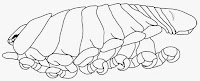
The new species is placed in the genus Cylisticus, and given the specific name masalicus, in reference to the city of Masal in Gilan Province, the species having first been identified in forests close to this city. Cylisticus masalicus is a slate grey Woodlouse, with pale muscle spots, reaching a maximum length of about 15 mm. It has long, slender antenae, which remain folded along the back when conglobating.

 Active specimen of Cylisticus masalicus. Kashani (2016).

See also...

http://sciencythoughts.blogspot.co.uk/2016/03/parasitic-isopod-crustaceans-from.htmlParasitic Isopod Crustaceans from the Philippines, Australia and Taiwan.              Bopyrid Isopods are parasites infesting the bodies of other marine (and occasionally freshwater) Crustaceans. About 800 species have been described, with maximum diversity thought be found in the...
http://sciencythoughts.blogspot.co.uk/2015/12/myopiarolis-tona-new-species-of-isopod.htmlMyopiarolis tona: A new species of Isopod Crustacian from the west coast of New Zealand.                                                       The Serolidae are a group of Marine Isopod Crustaceans found predominantly in the Southern Hemisphere. Most species are found between...
http://sciencythoughts.blogspot.co.uk/2014/09/a-parasitic-cymothoid-isopod-from.htmlA parasitic Cymothoid Isopod from the Virgin Islands.                                                         Cymothoids are Isopod Crustaceans, related...
Follow Sciency Thoughts on Facebook.

Milnesium swansoni: A new species of Tardigrade from the Kansas tree canopy.

Tardigrades, or Water Bears, are minute (generally less than 1 mm and always less than 3 mm) aquatic animals related to Arthropods and Nematodes. They are noted for their remarkable toughness, able to enter a dormant state in which they can survive freezing, high temperatures, dehydration and even exposure to vacuum, becoming active again when normal conditions return. This means that Tardigrades are able to colonize a remarkable variety of environments, from the deepest of marine trenches to arid mountain ranges at the heart of continents. Members of the genus Milnesium are predatory Tardigrades favouring limno-terrestrial environments (environments that are seasonally wet, but which are also desicated for part of the year) and consuming animals such as Rotifers, Nematodes and other, smaller, Tardigrades. The genus was first described in 1840, and was for a long while thought to be monospecific, comprising a single species, Milnesium tardigradum, with a near-global distribution, but improvements in both microscopic imaging techiniques and genetic sampling methods have led to a revision of this view, with a number of new species being described in the species since 1990, and many Tardigrade experts now considering all records of Milnesium tardigradum outside Europe as probably eroneous.

In a paper published in the journal Zootaxa on 4 February 2016, Alexander Young of the Department of Biology at Lewis & Clark College, Benjamin Chappell of the Department of Biology at the University of Kansas, William Miller of the Department of Biology at Baker University and Margaret Lowman of the California Academy of Sciences describe a new species of Milnesium from the tree canopy at several sites in Kansas.

The new species is named Milnesium swansoni in honour of Kent Swanson whose family established the Swanson Family Scholarship, of which Alexander Young was a beneficiary. The species is described from five male and five female specimens, out of a total of 115 individuals collected from Lichen and Moss growning in the canopy of a variety of trees. The specimens range from 329 to 404 μm in length, and show slight sexual dimorphism, the males having thickened secondary claws lacking sub-branches on their forelimbs, while the females have thinner, branching secondary claws on this limb.

Milnesium swansoni. (A) Body of holotype showing smooth cuticle. (B) Mouth showing holotype with narrow buccal tube and four peribuccal lamellae. (C) Secondary characteristic of male. (D) Claw I of male showing [3-3] claw formation. (E) Claw IV with [3-3] claw formation. Young et al. (2016).

See also...

http://sciencythoughts.blogspot.co.uk/2015/06/quisarctus-yasumurai-new-species-of.htmlQuisarctus yasumurai: A new species of Tardigrade from a submarine cave in the Okinawa Islands.                                                Tardigrades, or Water Bears, are minute (generally less than 1 mm and always less than 3 mm) aquatic animals related to Arthropods, Nematodes and...
http://sciencythoughts.blogspot.co.uk/2014/05/a-new-species-of-tardigrade-from-latvia.htmlA new species of Tardigrade from Latvia. Tardigrades are small animals (adult sizes of 0.1-1.5 mm) distantly related to Arthropods and Onychophorans (Velvet Worms). They are plump...

Follow Sciency Thoughts on Facebook.