Showing posts with label Albian. Show all posts

Friday, 31 October 2025

A Elasmosaurid Plesiosaur from the middle Cretaceous Cambridge Greensand of England.

The Plesiosaurians were possibly the most successful clade of Mesozoic Marine Reptiles, first appearing in the Late Triassic, and surviving till the End Cretaceous Extinction. Their basic bauplan was simple, with a rigid body and four paddle-like limbs used for propulsion, although within this framework they produced considerable diversity, with distinctive groups such as the Thalassophonean Pliosaurs and Cryptoclidian Plesiosaurs appearing in the Middle Jurassic and the Leptocleidids and Elasmosaurids appearing around the End of the Jurassic.

The middle Cretaceous was a period of about 14 million years during which there was significant turnover in many groups of organisms. It was during this period that the Ichthyosaurs disappeared and the Mosasaurs first appeared and diversified. Within the Plesiosaurians, the Pliosaurs vanished during this interval, while the Euelasmosaurida underwent a significant evolutionary radiation.

The  Cambridge Greensand forms the lowest member of the West Melbury Marly Chalk Formation. This Albian–early Cenomanian bed comprises micaceous, glauconitic, silt marl with a basal lag of reworked phosphatic nodules usually associated with Vertebrate fossils and exotic clasts, often encrusted in small Oysters and other epibionts. The Cambridge Greensand contains one of England's richest Vertebrate fossil assemblages, and dates to the crucial middle Cretaceous period of high biotic turnover. However, many of the skeletons recovered from this deposit are fragmentary in nature, and some may have been reworked from the underlying Gault Formation. Furthermore, most of the sites from which they were recovered are not exposed on the surface; these sites were uncovered by phosphate miners in the nineteenth century, and have largely been covered over again.

In a paper published in the journal Acta Palaeontologica Polonica on 30 October 2025, Jose O'Gorman of the División Paleontología Vertebrados at the Museo de La Plata, and Roger Benson of the American Museum of Natural History and the Department of Earth Sciences at the University of Oxford, redescribe CAMSM X50356, a partial Elasmosaurid Plesiosaur skeleton in the collection of the Sedgwick Museum in Cambridge.

CAMSM X50356 was excavated near the village of Fen Ditton in Cambridgeshire. It is a disarticulated, partial skeleton, comprising 37 cervical centra, 3 pectoral centra, 20 dorsal centra, 5 sacral centra, 3 caudal centra, isolated neural arches, fragmentary ribs, part of a scapula, one almost complete propodial, and several propodial fragments. A basioccipital bone included with the original collection is rejected by O'Gorman and Benson as clearly belonging to an Platypterygiine Ichthyosaur.

(A) Location of the study area in the UK. (B) Geological map of eastern England showing the distribution of the Cambridge Greensand (red star). (C) Cambridge Greensand phosphate quarrying areas near Cambridge.  (D) Lithologic and stratigraphic scheme of the Albian/Cenomanian boundary interval in Cambridgeshire. (E) Original inked label of CAMSM X50356. O'Gorman & Benson (2025).

The skeleton if thought to have come from an immature Animal, as the neural arches of the vertebrae have detached from the centra, a sign of incomplete ossification. Many of the elements show signs of abrasion, and some of encrustation by Oysters, suggesting that the remains were exposed on the seabed for some time before being buried. 

(A)–(D) Taphonomic features of four cervical centra of CAMSM X50356 (Elasmosauridae indet.) from Fen Ditton, near Cambridge, UK, upper Albian–lower Cenomanian, Oyster encrustations. (A₁) Cervical cetrum in posterior view; (A₂) and (A₃), details of incrusted oysters; (B₁) cervical centrum in ventral view; (B₂) detail of incrusted oyster; (C₁) cervical centrum in left lateral view; (C₂) detail of incrusted oyster. (D) Cervical centrum in dorsal view. (E) Platypterygiinae indet. CAMSM X50356 (Elasmosauridae indet.) from Fen Ditton, near Cambridge, UK, upper Albian–lower Cenomanian, basioccipital in dorsal (E₁) and posterior (E₂) views. Scale bars are 20 mm. O'Gorman & Benson (2025).

CAMSM X50356 has 37 preserved cervical vertebrae, which can be identified as such by the presence of a  ventrolateral parapophysys (bony ridge on the underside). This sequence is incomplete, with the atlas and axis (first two vertebrae, which form a joint with the skull and are slightly modified for this purpose), and potentially other vertebrae missing, giving a minimum count of 39. Furthermore, there are twenty preserved dorsal vertebrae, defined by the absence of parapophysis, which again is the minimum number, suggesting that CAMSM X50356 was long, even for an Elasmosaur.

CAMSM X50356 (Elasmosauridae indet.) from Fen Ditton, near Cambridge, UK, upper Albian–lower Cenomanian. (A) Sacral centra in posterior (A₁), right lateral (A₂), ventral (A₃), and dorsal (A4) views. (B) Caudal centra in posterior (B₁), left lateral (B₂), ventral (B₃), and dorsal (B₄) views. Scale bars are 20 mm. O'Gorman & Benson (2025).

A phylogenetic analysis recovered CAMSM X50356 as the basalmost known Elasmosaurid, not corresponding to any other described member of the group. It is also the only Elasmosaurid with cervical central longer than high but without lateral ridges, suggesting that this was the basal condition in the group, even if absent from all other members. 

CAMSM X50356 (Elasmosauridae indet.) from Fen Ditton, near Cambridge, UK, upper Albian–lower Cenomanian. (A) Sacral centra in posterior (A₁), right lateral (A₂), ventral (A₃), and dorsal (A₄) views. (B) Caudal centra in posterior (B₁), left lateral (B₂), ventral (B₃), and dorsal (B₄) views. Scale bars are 20 mm. O'Gorman & Benson (2025).

The Sedgwick Museum collection also contains several Elasmosaur specimens from the Cambridge Greensand listed under the names Plesiosaurus euryspondilus and Plesiosaurus euryspondilus, species for which no known formal description exists. These specimens were collected by the palaeontologist Hary Seely in the 1860s, who noted that 'These names are only intended for the convenience of students using the Museum, and not necessarily to take rank as names of described species'. O'Gorman and Benson examined several of these specimens, and could not find any features which could be used to distinguish them from CAMSM X50356, however, they do not consider that either that specimen, nor any of Seely's material, show sufficient diagnostic features to be formally described as a species.

See also...

Wednesday, 19 December 2012

Goblin Spiders from Cretaceous Amber.

Goblin Spiders (Oonopidae) are one of the most abundant groups of Spiders, with at least 600 and possibly over 1000 extant species described, though this is generally considered to be a poor representation of their diversity, since the Spiders are tiny (often under 1 mm) and at their most abundant in the tropics. Goblin Spiders have a fossil record that dates back to the Cretaceous, being quite common in amber, though not known from sedimentary rocks. Goblin Spiders have six eyes rather than the eight of most Spiders, though some species have lost additional eyes. The back pair of legs are modified for jumping.

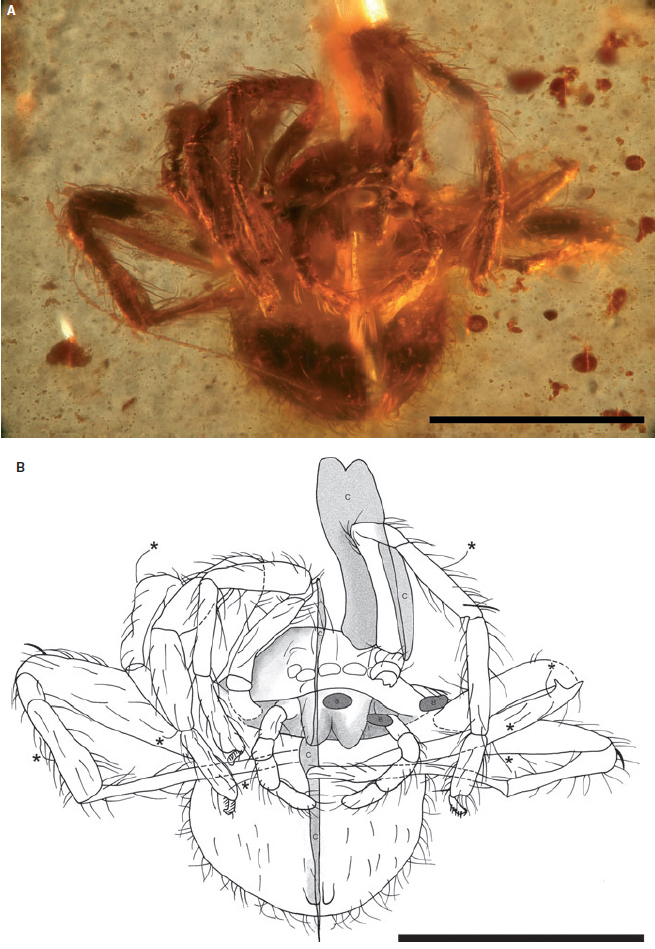
In a paper published in the journal Palaeontology in January 2012, a team of scientists led by Erin Saupe of the Department of Geology & Paleontological Institute at the University of Kansas describe four new Goblin Spider specimens from Cretaceous Amber from France and Spain. All the Spiders are placed in the genus Orchestina, which is still extant. Only two specimens are assigned to species, the other two (probably) being females, which are hard to distinguish to species level in modern specimens.

The first new Spider described is named Orchestina gappi, after Ian Wesley Gapp, a student at the University of Kansas. Orchestina gappi is a 1 mm Goblin spider preserved in a piece of dark brown, opaque amber from the Font-de-Benon Quarry, 1 km east of Archingeay-Les Nouillers in the Charente-Maritime Department of France. The sediments from which the amber was recovered are uppermost Albian–lowermost Cenomanian in age, making the fossil roughly 100 million years old. The specimen is barely visible through the dark amber matrix, but was revealed by synchrotron imaging at the European Synchrotron Radiation Facility in Grenoble.

Synchrotron images of Orchestina gappi. Scale bar is 1 mm. Saupe et al. (2012).

The second specimen is named Orchestina rabagensis, after the Rábago, the municipality in Cantabria, Spain where the fossil was found. Orchestina rabagensis is a 1.1 mm Goblin Spider preserved in light
yellow amber from the El Soplao Outcrop. It is early Albian in age, or about 110-113 million years old.

Orchestina ragagensis: (Top) Photograph and (Bottom) interpretive drawing. Stars indicate the locations of trichobothria, sensitive hairs capable of detecting air movements. Scale bars are 0.5 mm. Saupe et al. (2012).

The first unnamed specimen is a 1.11 mm female(?) Goblin Spider preserved in clear orange amber from the San Just Outcrop at Teruel in Spain. It is Middle Albian in age, or about 105 million years old.

Orchestina sp. from the San Just Outcrop. (Top) Photograph, scale bar is 0.5 mm. (Bottom) Synchrotron images, scale bar is 1 mm. Saupe et al. (2012).

The second unnamed specimen is a female over 1 mm in length from embedded in a piece of clear, dark orange amber, slightly clouded by organic debris. The specimen was found at the Peñacerrada Outcrop in Burgos, Spain. It is early Albian in age, or about 110-113 million years old.

Orchestina sp. from the Peñacerrada Outcrop. (Top) photograph, (Bottom) interpretive drawing. Stars indicate known trichobothria. C = crack, B = bubble. Scale bars represent 0.5 mm. Saupe et al. (2012).


Follow Sciency Thoughts on Facebook.

Sunday, 1 July 2012

Snakeflies in amber from the Early Cretaceous of northern Spain.

Snakeflies (or Camel Flies)are a group of carnivorous flying insects related to the Lacewings, Antlions and Alderflies. They have long life cycles, with a number of larval stages, but still feed as adults. Modern Snakeflies are found throughout Europe and Temperate Asia, and in North America west of the Rockies, but they are more widespread in the fossil record, which dates back to the Early Jurassic. In the Early Cretaceous they have previously been described from three localities in East Asia and one in Brazil. 

In a paper published in the journal Zookeys on 25 June 2012, a team of scientists led by Ricardo Pérez-de la Fuente of the Departament d’Estratigrafia, Paleontologia i Geociències Marines at the Facultat de Geologia at the Universitat de Barcelona, describe a number of Snakeflies preserved in amber from the Albian (Early Cretaceous, 112-99.6 million years ago) of northern Spain.

Map of the Earth during the Middle Albian, showing locations where Snakeflies have been found in the Early Cretaceous. (1) Baissa, Buryat Republic, Russia. (2) Liaoning, China. (3) Bon-Tsagan, Mongolia. (4) Ceará, Brazil. (5) Burgos, Spain.

The amber is thought to have originated in Coniferous forests on coastal and riverine plains close to the Atlantic. These forests are thought to have been prone to forrest fire, due to the inclusion of what appear to be charred plant fibers in the amber. The exact nature of the trees that produced the resin from which the amber formed is unclear, but Araucarians (Monkey Puzzles), Yews, Cypresses, Pines, Podocarps, Ginkos, Cheirolepids, Cycads, Gnetophyts, Tree Ferns and Mirovian trees are known to have been present as well as understory plants including Club-mosses, Ferns, Cycads, Ginkos, Bennettitales and early Flowering Plants.

Pérez-de la Fuente et al. descibe three new species of Snakefly from reasonably intact specimens, and a further three species from wings only.

The first of the complete specimens is named as Amarantoraphidia ventolina, meaning 'unfading Raphidia' (Raphidia is a genus of extant Snakeflies) and 'ventoline' a fairy of Spanish legend. It is a female slightly over 6 mm in length (small for a Snakefly).

Amarantoraphidia ventolina. (A) Complete specimen, scale bar is 1 mm. (B) Left metatarsi showing bilobed third tarsomere, scale bar is 0.1 mm. (C) distal portion of ovipositor, note its dense annulation; arrow points to a gonostylus, scale bar is 0.1 mm. Pérez-de la Fuente et al. (2012).
The second complete specimen is named Alavaraphidia imperterrita, from Álava, the Spanish for amber and Raphidia, and 'imperterritus', Latin for fearless. It is a female 5.7 mm in length, lacking wings (which leaves the danger of it being described elsewhere from wings alone, common in palaeoentomology).

Alavaraphidia imperterrita. (A) Lateral view, scale bar is 1 mm. (B) Dorsal view,  scale bar is 1 mm. (C) Left distal foretarsus, showing bilobed third tarsomere with digitiform processes, scale bar is 0.1 mm 

The third intact specimen is placed in the previously described species Cantabroraphidia marcanoi. There are a great number of charred wood fibers in the matrix, preventing any detailed study of the specimen.

Cantabroraphidia marcanoi, laterodorsal view, scale bar is 1 mm. Pérez-de la Fuente et al. (2012).

The three species named from wings only are Baissoptera? cretaceoelectra, that is to say probably in the pre-described genus Baissoptera, the specific name meaning Cretaceous amber in Greek; Necroraphidia arcuata, where 'Necroraphidia' means 'dead Raphidia' and 'arcuata' means bent in Latin; and Styporaphidia? hispanica, probably in the genus Styporaphidia, with a specific name meaning 'Spanish'.

Baissoptera? cretaceoelectra. (A) Forewing. (B) Hind wing. Scale bars are 1 mm. Pérez-de la Fuente et al. (2012).

Necroraphidia arcuata. (A) Ventral view, note some charcoalified plant fibers nearby the specimen (arrow), Scale bar is 2 mm. (B) Right forewing pterostigmal crossvein, scale bar is 0.5 mm. (C) Right hind wing pterostigmal crossvein, scale bar is 0.5 mm. (D) Right forewing pterostigmal diffuse base, scale bar is 0.5 mm. (E) Right hind wing pterostigmal diffuse base, scale bar is 0.5 mmPérez-de la Fuente et al. (2012).


Styporaphidia? hispanica, hind wing apical fragment and genitalia; arrow 1 points to gonostyli 9, whereas arrow 2 points to the paired genital sclerites interpreted as the distalmost part of the parameres, scale bar is 1 mm. Pérez-de la Fuente et al. (2012).

See also A Hatchet Wasp preserved in Tertiary amber from MexicoNew species of Bess Beetle from GuatemalaThree new species of Braconid Wasps from the Late Cretaceous of Magadan Province in the Russian Far EastThree new species of Braconid Wasp from Peru and An Eocene False Scorpion from Baltic amber.

Follow Sciency Thoughts on Facebook.

Monday, 26 March 2012

A fresh look at the Albian Ichthyosaur Platypterygius hercynicus.

The Ichthyosaurs were a group of marine tetrapods that resembled dolphins. They appear in the fossil record in the mid-Triassic about 245 million years ago, and survive till the mid-Cretaceous, about 90 million years ago. During the Jurassic they appear to have been the top marine predators, but in the Cretaceous they were overshadowed by other groups, most notably the Plesiousaurs. They are generally referred to as 'marine reptiles', but their relationship to other tetrapods is unclear, beyond the fact that they were clearly descended from terrestrial vertebrates. They bore live young, were fully aquatic, and may have been warm blooded, suggesting that they were as distinct from the Reptiles as Birds and Mammals are, and should probably just be called Ichthyosaurs.

Early Cretaceous Ichthyosaurs are not well understood, due to a small number of specimens, and the fragmentary nature of these specimens. One of these fragmentary specimens is a fragmentary Ichthyosaur skull found in the mid 1970s by amateur palaeontologist Jean−Pierre Debris at Saint−Jouin in the Seine−Maritime Department of northwestern France, and donated by him to the Muséum d’Histoire Naturelle du Havre.

Map of northern France, showing where Platypterygius hercynicus was originally discovered (star). Fischer (2012).

In a paper in the April 2012 edition of the journal Acta Palaeontologica Polonica, Valentin Fischer of the Geology Department at the University of Liège redescribes the Saint−Jouin Ichthyosaur, and uses it to draw conclusions about the classification of Early Cretaceous European Ichthyosaurs.

Fischer found that the Saint-Jouin specimen closely resembled the holotype (and only specimen of) Platypterygius hercynicus, and since in taxonomy a specimen is named as the holotype for each species, then any other specimen deemed to be similar enough belongs in the same species, the Saint-Jouin specimen was also allocated to the species Platypterygius hercynicus. Fischer also found individuals of the ammonite Callihoplites gr. strigosus in the rock-matrix in which the Ichthyosaur was preserved, dating the specimen to the Mortoniceras inflatum Zone or early Callihoplites auritus Subzone of the Albian age (the last subdivision of the Early Cretaceous), making it roughly 106.4 million years old.

The skull from Saint-Jouin newly assigned to Platypterygius hercynicus. Top, photograph. Middle, interpretive drawing. Bottom, reconstruction. Fischer (2012).

The new material is more extensive than the previous material assigned to Platypterygius hercynicus, allowing a better comparison to other members of the genus Platypterygius and other Ichthyosaurs within the Ophthalmosauridae, the group of Ichthyosaurs within which the genus Platypterygius is placed. Based upon this Fischer observes that some of the features originally assigned as definitive of the genus Platypterygius are not present in all the members of the genus, and that others are present in members of the Ophthalmosauridae not currently included within the genus. Based upon this he concludes that the genus Platypterygius as it currently stands is not a good taxonomic unit, and is in urgent need of revision.

The original German specimen of Platypterygius hercynicus from the late Aptian of Salzgitter. Right, photograph. Center, interpretative drawing by Kolb and Sander (2009). Left, new interpretative drawing, taking into account data from the Saint-Jouin specimen. Fischer (2012).