Showing posts with label Cenomanian. Show all posts

Friday, 31 October 2025

A Elasmosaurid Plesiosaur from the middle Cretaceous Cambridge Greensand of England.

The Plesiosaurians were possibly the most successful clade of Mesozoic Marine Reptiles, first appearing in the Late Triassic, and surviving till the End Cretaceous Extinction. Their basic bauplan was simple, with a rigid body and four paddle-like limbs used for propulsion, although within this framework they produced considerable diversity, with distinctive groups such as the Thalassophonean Pliosaurs and Cryptoclidian Plesiosaurs appearing in the Middle Jurassic and the Leptocleidids and Elasmosaurids appearing around the End of the Jurassic.

The middle Cretaceous was a period of about 14 million years during which there was significant turnover in many groups of organisms. It was during this period that the Ichthyosaurs disappeared and the Mosasaurs first appeared and diversified. Within the Plesiosaurians, the Pliosaurs vanished during this interval, while the Euelasmosaurida underwent a significant evolutionary radiation.

The  Cambridge Greensand forms the lowest member of the West Melbury Marly Chalk Formation. This Albian–early Cenomanian bed comprises micaceous, glauconitic, silt marl with a basal lag of reworked phosphatic nodules usually associated with Vertebrate fossils and exotic clasts, often encrusted in small Oysters and other epibionts. The Cambridge Greensand contains one of England's richest Vertebrate fossil assemblages, and dates to the crucial middle Cretaceous period of high biotic turnover. However, many of the skeletons recovered from this deposit are fragmentary in nature, and some may have been reworked from the underlying Gault Formation. Furthermore, most of the sites from which they were recovered are not exposed on the surface; these sites were uncovered by phosphate miners in the nineteenth century, and have largely been covered over again.

In a paper published in the journal Acta Palaeontologica Polonica on 30 October 2025, Jose O'Gorman of the División Paleontología Vertebrados at the Museo de La Plata, and Roger Benson of the American Museum of Natural History and the Department of Earth Sciences at the University of Oxford, redescribe CAMSM X50356, a partial Elasmosaurid Plesiosaur skeleton in the collection of the Sedgwick Museum in Cambridge.

CAMSM X50356 was excavated near the village of Fen Ditton in Cambridgeshire. It is a disarticulated, partial skeleton, comprising 37 cervical centra, 3 pectoral centra, 20 dorsal centra, 5 sacral centra, 3 caudal centra, isolated neural arches, fragmentary ribs, part of a scapula, one almost complete propodial, and several propodial fragments. A basioccipital bone included with the original collection is rejected by O'Gorman and Benson as clearly belonging to an Platypterygiine Ichthyosaur.

(A) Location of the study area in the UK. (B) Geological map of eastern England showing the distribution of the Cambridge Greensand (red star). (C) Cambridge Greensand phosphate quarrying areas near Cambridge.  (D) Lithologic and stratigraphic scheme of the Albian/Cenomanian boundary interval in Cambridgeshire. (E) Original inked label of CAMSM X50356. O'Gorman & Benson (2025).

The skeleton if thought to have come from an immature Animal, as the neural arches of the vertebrae have detached from the centra, a sign of incomplete ossification. Many of the elements show signs of abrasion, and some of encrustation by Oysters, suggesting that the remains were exposed on the seabed for some time before being buried. 

(A)–(D) Taphonomic features of four cervical centra of CAMSM X50356 (Elasmosauridae indet.) from Fen Ditton, near Cambridge, UK, upper Albian–lower Cenomanian, Oyster encrustations. (A₁) Cervical cetrum in posterior view; (A₂) and (A₃), details of incrusted oysters; (B₁) cervical centrum in ventral view; (B₂) detail of incrusted oyster; (C₁) cervical centrum in left lateral view; (C₂) detail of incrusted oyster. (D) Cervical centrum in dorsal view. (E) Platypterygiinae indet. CAMSM X50356 (Elasmosauridae indet.) from Fen Ditton, near Cambridge, UK, upper Albian–lower Cenomanian, basioccipital in dorsal (E₁) and posterior (E₂) views. Scale bars are 20 mm. O'Gorman & Benson (2025).

CAMSM X50356 has 37 preserved cervical vertebrae, which can be identified as such by the presence of a  ventrolateral parapophysys (bony ridge on the underside). This sequence is incomplete, with the atlas and axis (first two vertebrae, which form a joint with the skull and are slightly modified for this purpose), and potentially other vertebrae missing, giving a minimum count of 39. Furthermore, there are twenty preserved dorsal vertebrae, defined by the absence of parapophysis, which again is the minimum number, suggesting that CAMSM X50356 was long, even for an Elasmosaur.

CAMSM X50356 (Elasmosauridae indet.) from Fen Ditton, near Cambridge, UK, upper Albian–lower Cenomanian. (A) Sacral centra in posterior (A₁), right lateral (A₂), ventral (A₃), and dorsal (A4) views. (B) Caudal centra in posterior (B₁), left lateral (B₂), ventral (B₃), and dorsal (B₄) views. Scale bars are 20 mm. O'Gorman & Benson (2025).

A phylogenetic analysis recovered CAMSM X50356 as the basalmost known Elasmosaurid, not corresponding to any other described member of the group. It is also the only Elasmosaurid with cervical central longer than high but without lateral ridges, suggesting that this was the basal condition in the group, even if absent from all other members. 

CAMSM X50356 (Elasmosauridae indet.) from Fen Ditton, near Cambridge, UK, upper Albian–lower Cenomanian. (A) Sacral centra in posterior (A₁), right lateral (A₂), ventral (A₃), and dorsal (A₄) views. (B) Caudal centra in posterior (B₁), left lateral (B₂), ventral (B₃), and dorsal (B₄) views. Scale bars are 20 mm. O'Gorman & Benson (2025).

The Sedgwick Museum collection also contains several Elasmosaur specimens from the Cambridge Greensand listed under the names Plesiosaurus euryspondilus and Plesiosaurus euryspondilus, species for which no known formal description exists. These specimens were collected by the palaeontologist Hary Seely in the 1860s, who noted that 'These names are only intended for the convenience of students using the Museum, and not necessarily to take rank as names of described species'. O'Gorman and Benson examined several of these specimens, and could not find any features which could be used to distinguish them from CAMSM X50356, however, they do not consider that either that specimen, nor any of Seely's material, show sufficient diagnostic features to be formally described as a species.

See also...

Saturday, 12 March 2016

Fragmentary Abelisaurid remains from the early Late Cretaceous of Morocco.

Cretaceous deposits in Morocco and at other sites across North Africa have produced a large assemblage of Dinosaur remains, with the most abundant finds being medium-to-large Theropods, particulary Abelisaurids, Carcharodontosaurids, and Spinosaurids. No known modern terrestrial environment is dominated by large predators in this way, suggesting that either North Africa had a very strange ecological network in the Middle Cretaceous, or that the known fossil assemblage has been influenced by either taphonomic or collecting bias (i.e. either the bones of large Theropods have been preferentially preserved for some reason, or collectors are overlooking bones from other groups).

In a paper published in the journal Peer J on 29 February 2016, Alfio Alessandro Chiarenza of the Department of Earth Science and Engineering at Imperial College London and Andrea Cau of Earth, Life and Environmental Sciences at the University of Bologna and the Giovanni Capellini Geological and Palaeontological Museum, describe a partial femur of a large Theropod from the Late Cretaceous of Morocco.

The specimen was collected by local artisanal fossil collectors, and sold by a Moroccan trader to a buyer who donated it to the Gaetano Giorgio Gemmellaro Geological and Palaeontological Museum in Palermo. As such it does not come with complete location and horizon information, however the matrix in which the fossil is preserved is consistent with sediments from the Kem Kem Compound Assemblage in the Taouz Region of Errachidia Province, close to the border with Algeria. This would make the specimen Cenomanian in age, i.e. between 100.5 and 93.9 million years old, dating from the earliest Late Cretaceous.

The specimen comprises the proximal end of a right femur (i.e. the part of the upper leg bone closest to the trunk) including the head, neck and trochanteric region. This is assigned to an Abelisaurid, but not described to species level due to its fragmentary nature, indeed Chiarenza and Cau argue strongly against the describing of new North African Theropod taxa from fragmentary remains, and note that many named species have been described from such limited remains that no further specimens could ever be confidently identified as having come from the same species.

Abelisaurid femur from the Kem Kem Compound Assemblage of Morocco. (A) proximal view, (B) anterior view, (C) medial view, (D) posterior view, (E) lateral view, (F) distal view (not at same scale as other views). Scale bars are 5 cm. Abbreviations: gt, greater trochanter; iMie, insertion for the M. iliofemoralis externus; fn, femoral neck; s, shallow sulcus. Chiarenza & Cau (2016).

The specimen is reconstructed to have been at least 776-924 mm in length, and possibly as long as 1200 m. Even the most conservative estimate of the complete size of this bone suggests an animal weighing around 1850 kg, suggesting an animal towards the upper end of the known range for Abelisuarids (or any closely related group), suggesting that these Dinosaurs were already reaching very large sizes by the Cenomanian, somewhat earlier than has previously been suggested.

See also...

http://sciencythoughts.blogspot.co.uk/2015/08/isolated-theropod-teeth-from-middle.htmlIsolated Theropod teeth from the Middle Jurassic of Niger.                                                         Unlike Mammals, Dinosaurs replaced their teeth throughout their lives, continuously growing new teeth and shedding older, worn ones. This, combined with the hard enamel coating found on all vertebrate teeth, makes isolated teeth the most commonly...
http://sciencythoughts.blogspot.co.uk/2014/03/dinosaur-remains-from-northwestern.htmlDinosaur remains from northwestern Saudi Arabia.                                                   Dinosaurs are the most distinctive element of Mesozoic Vertebrate faunas, arising in the Triassic, and coming to dominate all known terrestrial ecosystems during the Jurassic and Cretaceous, before disappearing abruptly (other than the still extant Birds) at the end of that period. Despite this widespread distribution, very...
http://sciencythoughts.blogspot.co.uk/2014/03/a-new-species-of-theropod-dinosaur-from.htmlA new species of Theropod Dinosaur from the Late Jurassic of Portugal.                       The Late Jurassic Megalosaurid Theropod Dinosaur...

Follow Sciency Thoughts on Facebook.

Sunday, 30 June 2013

A fossil Snake from the Cretaceous of Brazil.

Snakes are generally accepted to have appeared and diversified during the Mesozoic, though their fossil record is not extensive. This is due to their lightly mineralized, easily disarticulated skeletons, which tends to result in Snake fossils, where they are found at all, tend to be poorly preserved and fragmentary. Nevertheless, by the late Cretaceous, a reasonable diversity of Snakes is known from sites across the world. How these early forms are related to modern Snakes is unclear, some retained limbs, and clearly could not be placed in any modern group, others are placed in extinct family Madtsoiidae, which died out in the Pleistocene, but most are too fragmentary for any taxonomic assignment. Fossils which can be placed with reasonable confidence in modern groups appear in the Palaeocene-Eocene.

In a preliminary paper published in the journal Acta Palaeontologica Polonica on 21 January 2013, Anne Hsiou of the Departamento de Biologia at the Universidade de São Paulo, Adriana Albino of the Departamento de Biología at the Universidad Nacional de Mar del Plata and Manuel Medeiros and  Ronny Santos of the Departamento de Biologia at the  Centro de Ciências Biológicas e da Saúde at the Universidade Federal do Maranhão describe a new Snake fossil from the Cenomanian (early Late Cretaceous, 99.6 to 93.5 million years ago) of northeastern Brazil.

The new Snake is named Seismophis septentrionalis, where 'Seismophis' means 'Earthquake-snake' and  'septentrionalis' means 'from the north'. The fossil was discovered at a site called Falésia do Sismito (Cliff of the Earthquake) on Cajual Island in the north of Maranhão State, which itself is in the north of Brazil.

The species is described from a pair of disarticulated mid-trunk vertebrae, not assumed to come from the same animal, though they are distinctive enough to say that they are Snake bones, and probably come from the same species. This is not unusual with Snakes fossils; the animals gain their extreme flexibility from having bones only lightly mineralized and loosely held together with tendons and muscles.

Seismophis septentrionalis, first specimen. Photographs (A1–E1) and schematic drawings (A2–E2), in anterior (A), posterior (B), lateral (C), dorsal (D), and ventral (E) views. Scale bar is 10 mm. Hsiou et al. (2013).


Seismophis septentrionalis, second specimen. Photographs (A1–E1) and schematic drawings (A2–E2), in anterior (A), posterior (B), lateral (C), dorsal (D), and ventral (E) views. Scale bar is 10 mm. Hsiou et al. (2013).


Due to the fragmentary nature of this material, it is not possible to say how this species is related to other Cretaceous or modern Snakes, but it is considered to be the oldest known Snake yet discovered in Brazil.

Map showing the locality where the specimen was found. Hsiou et al. (2013).


Follow Sciency Thoughts on Facebook.

Wednesday, 19 December 2012

Goblin Spiders from Cretaceous Amber.

Goblin Spiders (Oonopidae) are one of the most abundant groups of Spiders, with at least 600 and possibly over 1000 extant species described, though this is generally considered to be a poor representation of their diversity, since the Spiders are tiny (often under 1 mm) and at their most abundant in the tropics. Goblin Spiders have a fossil record that dates back to the Cretaceous, being quite common in amber, though not known from sedimentary rocks. Goblin Spiders have six eyes rather than the eight of most Spiders, though some species have lost additional eyes. The back pair of legs are modified for jumping.

In a paper published in the journal Palaeontology in January 2012, a team of scientists led by Erin Saupe of the Department of Geology & Paleontological Institute at the University of Kansas describe four new Goblin Spider specimens from Cretaceous Amber from France and Spain. All the Spiders are placed in the genus Orchestina, which is still extant. Only two specimens are assigned to species, the other two (probably) being females, which are hard to distinguish to species level in modern specimens.

The first new Spider described is named Orchestina gappi, after Ian Wesley Gapp, a student at the University of Kansas. Orchestina gappi is a 1 mm Goblin spider preserved in a piece of dark brown, opaque amber from the Font-de-Benon Quarry, 1 km east of Archingeay-Les Nouillers in the Charente-Maritime Department of France. The sediments from which the amber was recovered are uppermost Albian–lowermost Cenomanian in age, making the fossil roughly 100 million years old. The specimen is barely visible through the dark amber matrix, but was revealed by synchrotron imaging at the European Synchrotron Radiation Facility in Grenoble.

Synchrotron images of Orchestina gappi. Scale bar is 1 mm. Saupe et al. (2012).

The second specimen is named Orchestina rabagensis, after the Rábago, the municipality in Cantabria, Spain where the fossil was found. Orchestina rabagensis is a 1.1 mm Goblin Spider preserved in light
yellow amber from the El Soplao Outcrop. It is early Albian in age, or about 110-113 million years old.

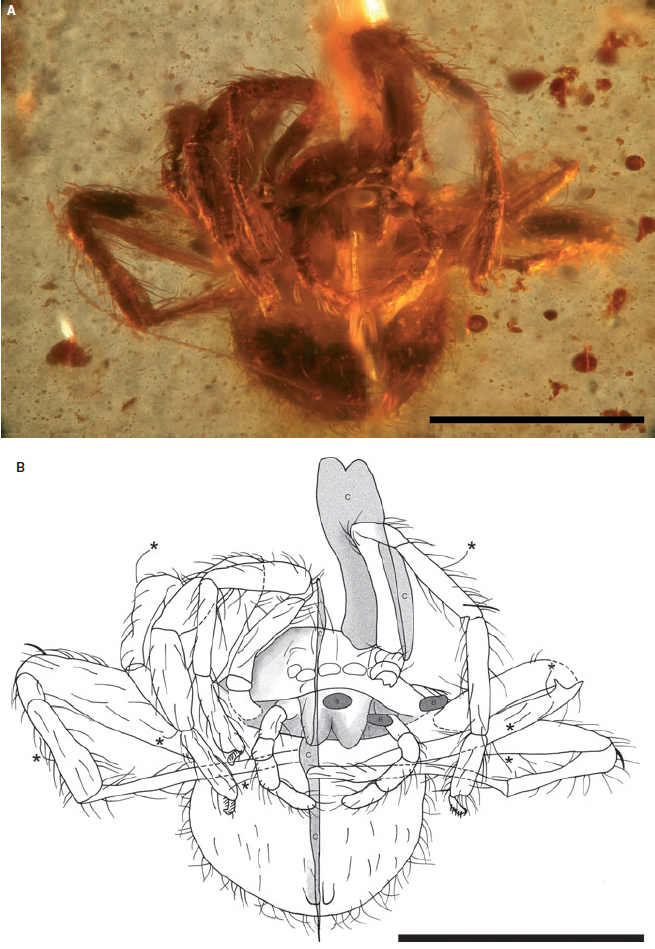
Orchestina ragagensis: (Top) Photograph and (Bottom) interpretive drawing. Stars indicate the locations of trichobothria, sensitive hairs capable of detecting air movements. Scale bars are 0.5 mm. Saupe et al. (2012).

The first unnamed specimen is a 1.11 mm female(?) Goblin Spider preserved in clear orange amber from the San Just Outcrop at Teruel in Spain. It is Middle Albian in age, or about 105 million years old.

Orchestina sp. from the San Just Outcrop. (Top) Photograph, scale bar is 0.5 mm. (Bottom) Synchrotron images, scale bar is 1 mm. Saupe et al. (2012).

The second unnamed specimen is a female over 1 mm in length from embedded in a piece of clear, dark orange amber, slightly clouded by organic debris. The specimen was found at the Peñacerrada Outcrop in Burgos, Spain. It is early Albian in age, or about 110-113 million years old.

Orchestina sp. from the Peñacerrada Outcrop. (Top) photograph, (Bottom) interpretive drawing. Stars indicate known trichobothria. C = crack, B = bubble. Scale bars represent 0.5 mm. Saupe et al. (2012).


Follow Sciency Thoughts on Facebook.

Wednesday, 13 June 2012

Three new species of Braconid Wasps from the Late Cretaceous of Magadan Province in the Russian Far East.

Braconid Wasps are parasitoid Wasps (Wasp's whose larvae grow inside the bodies of other insects) related to Ichneumon Wasps, but somewhat smaller. They have a fossil record dating back to the Early Cretaceous, though this is somewhat patchy.

In a paper published in the journal Acta Palaeontologica Polonica on 17 June 2012, Sergey Belokobylskij of the Museum and Institute of Zoology at the Polish Academy of Sciences describes three new species of Braconid Wasps from mudstones from the Late Cretaceous (Cenomanian, 99.6-93.5 million years old) Ola Formation of Obeshchayushchiy Spring in Magadan Province in the Russian Far East. 

All three new species are tentatively placed within the Subfamily Protorhyssalinae, previously erected to describe a single species from Late Cretaceous Amber. The new fossils are less complete, and preserved in a rather different way, which prevents confident assignment.

Two of the new species are placed in the new genus Magadanobracon, from Magadan Province and Bracon, the modern genus from which the group gets its name. These are Magadanobracon rasnitsyni, named after Alexandr Pavlovich Rasnitsyn, a noted Russian palaeoentomologist, and Magadanobracon zherikhini, named after Vladimir Vasilievich Zherikhin, another Russian palaeoentomologist and the discoverer of the fossils. The third species is placed in a second new genus, Cretorhyssalus, from Cretaceous and Rhyssalus, another modern genus of Braconids. This is named Cretorhyssalus brevis, 'brevis' meaning 'short' in Latin.

Magadanobracon rasnitsyni. Belokobylskij (2012).

Magadanobracon rasnitsyni is a 3.5 mm Wasp, preserved with a black body and brown limbs and wings. The single known specimen is female.

 Magadanobracon zherikhini. Belokobylskij (2012).

Magadanobracon zherikhini is a 6.4 mm Wasp, very similar to M. rasnitsyni, described from a single male specimen. It is preserved as black with brown thorax and wings.

Cretorhyssalus brevis. Belokobylskij (2012).

Cretorhyssalus brevis is a 2.2 mm wasp described from a single, poorly preserved, male, specimen. It is preserved as a brown Wasp with a black head.


Follow Sciency Thoughts on Facebook.