Showing posts with label Freshwater Stingrays. Show all posts

Thursday, 5 October 2017

Rhinebothrium reydai: A new species of Tapeworm from a Caribbean Stingray.

The Potamotrygonidae are a unique group of Freshwater Stingrays found in the rivers of South America. They were originally thought to have colonised the continent from the Atlantic, since they are found only in rivers that drain into that ocean. However genetic studies have suggested that these Rays are in fact more closely related to Pacific species, and that the species found furthest west (i.e. upstream) are more closely related to marine species than those further downstream, suggesting that the first colonists had come from the Pacific, and that the invasion of South America must therefore have occurred before the rise of the Andes Mountains. This was a surprising conclusion, and provoked scientists to look for more evidence. One place where this was found was in the Tapeworms (Cestoda) that infect the intestines of these Rays, which were found to follow the same genetic pattern, with species found furthest from the sea most closely related to their marine relatives.  Because these Rays appeared to have invaded the continent before the rise of the Andes, they were for a long time presumed to have no close relatives in the seas, however, recent studies of the Indo-Pacific Stingsay genus Himantura revealed that two species previously assigned to it were in fact more closely related to the Freshwater Stingrays of South America; so closely related, in fact, that they were placed in a new genus, Styracura within the family Potamotrygonidae, the first marine Rays assigned to this group.

In a paper published in the journal Zootaxa on 3 August 2017, Bruna Trevisan and Fernando Marques of the Laboratório de Helmintologia Evolutiva at the Universidade de São Paulo describe a new species of Cestode Tapeworm from the intestine of the Caribbean Whiptail Stingray, Styracura schmardae, one of the two species of marine Potamotrygonid.

Tapeworms are parasitic Flatworms that live in the digestive tracts of Vertebrate hosts, attaching themselves to the intestine wall and absorbing nutrients through their skins. Adult Tapeworms engage in sexual reproduction, producing eggs which are passed out of the host in its feces. Juvenile Tapeworms often inhabit one or more intermediate hosts before reaching their final adult stage, growing in the gut till they reach a certain size, then migrating to other tissues where they form cysts, becoming dormant till the animal dies and is eaten by the next host in the life-cycle. 

The new species is placed in the genus Rhinebothrium, which is found in a wide range of Batoids, and given the specific name reydai, in honour of Florian Reyda, an expert on Cestodes who took part in the expedition to the Caribbean coast of Panama that recovered the Stingrays from which this species was first discovered. The species was found living in five Stingrays caught off the coast of Almirante in Bocas Del Toro Province. The Worms were up to 7.4 mm in length with as many s 64 segmants, and were attached to the lining of the intestine by s scolex ('head') with four stalked, bilobed bothridia (suckers).

Scanning electron micrograph showing the scolex of Rhinebothrium reydai. Trevisan &Marques (2017).

See also...

http://sciencythoughts.blogspot.co.uk/2016/09/potamotrygon-albimaculata-potamotrygon.htmlhttp://sciencythoughts.blogspot.co.uk/2016/08/cratera-viridimaculata-new-species-of.html
http://sciencythoughts.blogspot.co.uk/2015/03/a-trematode-flatworm-from-intestines-of.htmlhttp://sciencythoughts.blogspot.co.uk/2014/07/a-new-species-of-liver-fluke-from.html
http://sciencythoughts.blogspot.co.uk/2014/01/deepwater-sharks-from-early-miocene-of.htmlhttp://sciencythoughts.blogspot.co.uk/2014/01/a-new-species-of-eagle-ray-from.html
Follow Sciency Thoughts on Facebook.

Thursday, 15 September 2016

Potamotrygon albimaculata & Potamotrygon jabuti: Two new species of Freshwater Stingray from the Rio Tapajós Basin of Brazil.

Freshwater Stingrays, Potamotrygonidae, are Batoid Fish found in South American river systems draining into the Caribbean and Atlantic, found as far south as the River Plate in Argentina, with their maximum diversity in the Amazon River system of Brazil. They are roughly disk-shaped, with an elongate tail with a venomous caudal sting, and range from about 25 cm to about 1.5 m in length. They are the only entirely freshwater-dwelling family of Batoid Fish, or Chondrichthians of any type. Many species are traded in the aquarium trade, often under the name 'Teacup Rays', which has raised concern with some conservationists, as these Rays are slow-breeding, leading dealers to rely on wild-caught, rather than captive-bred, Fish, and making over-harvested populations slow to recover.

In a paper published in the journal Zootaxa on 13 September 2016, Marcelo De Carvalho of the Departamento de Zoologia at the Universidade de São Paulo, describes two new species of Freshwater Stingray from the Rio Tapajós Basin of Brazil. Both species are placed in the genus Potamotrygon, and both have been known in the aquarium trade for some time, but this is the first time they have been formally described.

The first new species described is named Potamotrygon albimaculata, meaning 'white spots'; adults of the species are dark-brown to black in colour with numerous white spotes on their dorsal surface. The species is found in the upper and middle reaches of the Rio Tapajós in Amazonas, Pará and Mato Grosso states, where it is known locally as the Pretinha do Tapajós (Tapajós Freshwater Stingray); it is traded in the aquarium trade as the 'Itaituba Ray', or simply 'P14'. The species appears to live in the deeper parts of the center of the river during the daytime, foraging in the shallower waters around the shore at night.

Live adult female specimen of Potamotrygon albimaculata, in aquarium, shortly before giving birth to two pups. Richard Hardwick & G England in De Carvalho (2016).

This is quite a large species, reaching 790 mm in length. Juveniles have a distinctive reticulated pattern, with a dark background with tightly packed lighter brown areas with small white spots in the center. The dermal denticles on the body reach a maximum of 1 mm; on the tail many of these are modified to make larger, sharp thorns. As a defence mechanism they produce copious amounts of mucus, which is shed when they are grabbed. Young are born live, being 100-110 mm in length, in clutches of up to four, though two is much more common.

Live neonates of Potamotrygon albimaculata, shortly after birth; offspring of gravid female above. Richard Hardwick & G England in De Carvalho (2016).

The second new species is named Potamotrygon jabuti, where 'jabuti' is a local word for the species meaning 'Tortoise', a reference to the appearance of the adults, which have a torroiseshell patternation and a tendency to arch their backs. In the aquarium trade the species is marketed as the 'Pearl Freshwater Stingray'. The species was found in the middle and upper Rio Tapajós waterway as well as numerous smaller tributaries, being partucularly abundant in the Rio Jamanxim.

Live adult specimen of Potamotrygon jabuti, in aquarium. Richard Hardwick in De Carvalho (2016).

This is another large species, reaching 810 mm in length, and quite variable in colouration, having a marbled pattern that comes in a variety of greens, browns and yellows. Denticles on the body reach up to a mm in size, with larger denticles modified to form spines on the tail and hindpart of the body disk.

Live neonates of Potamotrygon jabuti, shortly after birth. Richard Hardwick in De Carvalho (2016).

See also...

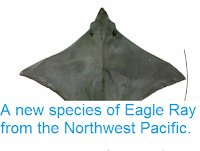
http://sciencythoughts.blogspot.co.uk/2014/01/a-new-species-of-eagle-ray-from.htmlA new species of Eagle Ray from the Northwest Pacific.                                     Eagle Rays (Myliobatidae) are large Batoid Fish (bilaterally symmetrical fish with cartilaginous skeletons descended from Sharks), that predominantly live as free swimming animals in the water column rather than on the sea bottom. They are strong swimmers, and some species have been observer to leap several...
http://sciencythoughts.blogspot.co.uk/2012/05/satellite-tracking-manta-rays-off-coast.htmlSatellite tracking Manta Rays off the coast of Mexico.                                                                      Manta Rays, or Devilfish (Manta birostris) are the worlds largest Batoid Fish (bilaterally symmetrical fish with cartilaginous skeletons descended from Sharks), reaching widths of up to 7.1 m. They are considered...
Follow Sciency Thoughts on Facebook.