Showing posts with label Equatorial Guinea. Show all posts

Tuesday, 13 June 2023

Tanzania and Equatorial Guinea declare end to Marburg Virus outbreaks.

On 2 June 2023, the Ministry of Health of the United Republic of Tanzania declared the end of its first documented outbreak of Marburg Virus Disease, according to a press release issued by the World Health Organization on 2 June 2023. Between 21 March and 31 May, a total of nine cases (eight laboratory-confirmed and one probable) were reported in Tanzania. All cases were reported from Bukoba district, Kagera region. A total of six deaths (a case fatality ratio of 67%) were reported during the outbreak. The declaration was made 42 days (twice the maximum incubation period for Marburg virus infection) after the last possible exposure to an Marburg Virus Disease probable or confirmed case, in accordance with World Health Organization recommendations.

On 8 June 2023, after two consecutive incubation periods (42 days) without a new confirmed case reported, the Ministry of Health of Equatorial Guinea declared the end of the Marburg Virus Disease outbreak, again as per the World Health Organization recommendations, according to a second press release, issued by the World Health Organization on 9 June 2023. A total of 17 confirmed and 23 probable cases were reported from five districts in four provinces; 12 of the 17 confirmed cases died and all the probable cases were reported deaths.  

The World Health Organization encourages countries to maintain most response activities for three months after the outbreak ends. This is to make sure that if the disease re-emerges, health authorities would be able to detect it immediately, prevent the disease from spreading again, and ultimately save lives.

On 21 March 2023, the Ministry of Health of the United Republic of Tanzania officially declared the first Marburg Virus Disease outbreak in the country. Between 21 March and 31 May, a total of nine cases, including eight laboratory-confirmed cases and one probable (the index case), were reported. The last confirmed case was reported on 11 April 2023 and the date of sample collection of the second negative polymerase chain reaction test was on 19 April 2023. All cases were reported from Bukoba District in Kagera Region, in the north of the country.

Map of district reporting Marburg Virus Disease confirmed and probable cases in the United Republic of Tanzania, as of 31 May 2023. World Health Organization.

In Tanzania cases ranged in age from 1 to 59 years old (median 35 years old), with males being the most affected (six cases, or 67% of the total). Six cases were close relatives of the index case, and two were healthcare workers who provided medical care to the patients.
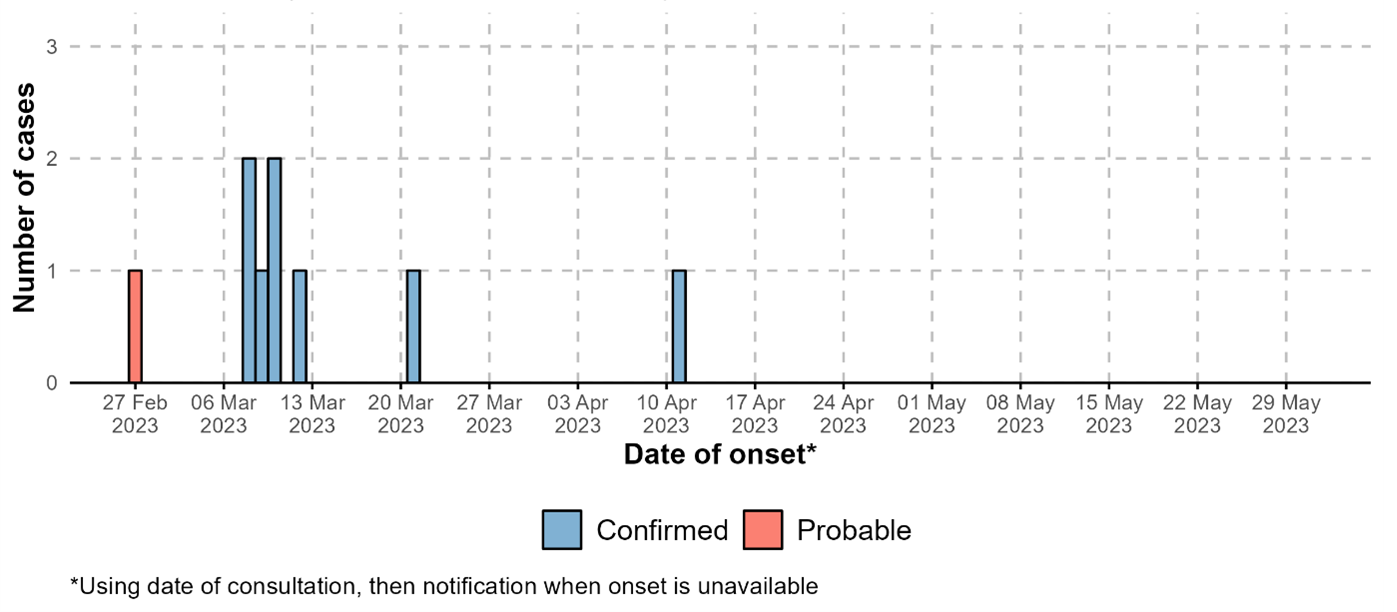
Distribution of Marburg Virus Disease cases (confirmed and probable) by date of symptom onset in the United Republic of Tanzania, as of 31 May 2023. World Health Organization.

From the outbreak declaration until 7 June 2023, 17 confirmed and 23 probable cases of Marburg Virus Disease were reported in the continental region of Equatorial Guinea. Twelve of the confirmed cases died and all the probable cases were reported deaths (the case fatality ratio among confirmed cases is 75%, excluding one confirmed case with an unknown outcome).

The last confirmed case admitted to a Marburg treatment centre in Bata District in Litoral Province was discharged on 26 April, after two consecutive negative polymerase chain reaction tests for Marburg Virus Disease. On 8 June 2023, after two consecutive incubation periods (42 days) without a new confirmed case reported, the Ministry of Health of Equatorial Guinea declared the end of the outbreak.

Confirmed or probable cases were reported in five districts (Bata, Ebebiyin, Evinayong, Nsok Nsomo and Nsork) in four of the country’s eight provinces (Centro Sur, Kié-Ntem, Litoral and Wele-Nzas). 

Map of districts reporting Marburg Virus Disease confirmed and probable cases during the outbreak, Equatorial Guinea. World Health Organization.

Five cases (31%) were identified among healthcare workers, of whom two died (a case fatality ratio of 40% among health care workers). Four patients recovered and were enrolled in a survivor care programme to receive psychosocial and other post-recovery support.

Marburg Virus Disease cases by week of symptoms onset* and case classification, Equatorial Guinea, as of 7 June 2023. World Health Organization.

Marburg Virus is a negative-strand RNA Virus belonging to the Family Filoviridae, which also includes the Ebola Virus. The Virus spreads between people via direct contact through broken skin or mucous membranes with the blood, secretions, organs or other bodily fluids of infected people, and with surfaces and materials such as bedding, and clothing contaminated with these fluids, although the natural reservoir of the Virus is thought to be Egyptian Fruit Bats, Rousettus aegyptiacus, with outbreaks often starting when people come into contact with colonies of these Bats in caves or mines. Healthcare workers have previously been infected while treating suspected or confirmed Marburg Virus Disease patients. Burial ceremonies that involve direct contact with the body of the deceased can also contribute to the transmission of Marburg Virus.

Negative stained transmission electron micrograph of a number of filamentous Marburg Virions, which had been cultured on Vero cell cultures, and purified on sucrose, rate-zonal gradients. Erskine Palmer/Russell Regnery/Centers for Disease Control and Prevention/Wikimedia Commons.

The incubation period varies from two to 21 days. Illness caused by Marburg Virus begins abruptly, with high fever, severe headache, and severe malaise. Severe haemorrhagic manifestations may appear between five and seven days from symptom onset, although not all cases have haemorrhagic signs, and fatal cases usually have some form of bleeding, often from multiple areas.

Early supportive care – rehydration with oral or intravenous fluids – and treatment of specific symptoms and co-infections can improve survival. A range of potential treatments are being evaluated, including blood products, immune therapies, and drug therapies.  

See also...


Follow Sciency Thoughts on Facebook.

Follow Sciency Thoughts on Twitter. 


Tuesday, 13 November 2018

Raphia gabonica & Raphia zamiana: Two new species of Palms from Gabon and Cameroon.

Palms are an important component of modern tropical ecosystems, with the majority of species (~90%) restricted to tropical rainforests, where they are important understory plants. Palms reach their maximum diversity today in Asia (over 1200 species) and the Americas (about 730 species), but are much less diverse in Africa (about 65 species, less than Madagascar, which has about 200), with only one species native to Europe. Despite Palm Tree being the most familiar form of Palms, there are also climbing, shrubby, and stemless forms. The genus Raphia contains about 20 species of economically significant Palms, noted for their fibrous leaves (the largest leaves of any known Plant) used in making thatch, furniture and matting, and edible fruit. Almost all species of Raffia are found in Africa, with one species found in Central and South America, and one in Madagascar. Despite their economic significance, Raphia Palms have been little studied by botanists, largely due to their preference for swampy tropical environments.

In a paper published in the journal PhytoKeys on 6 November 2018, Suzanne Mogue Kamga of the Plant Systematic and Ecology Laboratory at the University of Yaoundé, Raoul Niangadouma of the National Herbarium of Gabon, Fred Stauffer of the Conservatoire et Jardin botaniques de la Ville de Genève and the Laboratoire de systématique végétale et biodiversité at the Université de Genève, Bonaventure Sonké, also of the Plant Systematic and Ecology Laboratory at the University of Yaoundé, and Thomas Couvreur of the Université de Montpellier and the Naturalis Biodiversity Centre, describe two new species of Raphia from Gabon and Cameroon.

The first new species described is named Raphia  gabonica, in reference to the country Gabon where it was discovered. The Palm forms a tree with a trunk 3-7 m in height and 20-30 cm in diameter, surmounted by 7-8 leaves, 8-13 m in length. Old leaf sheaths persist and hang down around the trunk, protecting and largely obscuring it. Flowers and fruit are born on pendulous rachillae up to 1.8 m in length. This Palm was found at only two locations, on hill slopes near streams in lowland rainforest in northern Ngounié Province, in Gabon, with a total known area occupied of less than 8 km². For this reason the species is considered to be Endangered under the terms of the International Union for the Conservation of Nature's Red List of Threatened Species. 

 Raphia gabonica in natural habitat (Alèmbé, Gabon). Notice dry land habitat, not growing in colonies, single stem with curly fibres and long pendulous inflorescences. Thomas Couvreur in Mogue Kamga et al. (2018).

The second new species described is named Raphia zamiana, where 'zamiana' derives from 'Zam' the name for these Palms in Beti, a language spoken in southern Cameroon and northern Gabon. This Palm forms trees with trunks 3-8 m high and 30-40 cm in diameter, surmounted by 10-12 leaves, 12-21 m in length. Again old leaf sheaths persist and hang down around the trunk, protecting and largely obscuring it. Flowers and fruit are born on pendulous rachillae up to 2.8 m in length. This Palm is found in the Atlantic rainforests of central and southern Cameroon, Gabon and probably Equatorial Guinea. The species is extremely abundant and widely used by local populations for its leaves which are used as a construction material, as thatch, and to make furniture, baskets and mats. Its fruit are also harvested and sold as a treatment for hypertension and diabetes. The sap of this species is collected for Palm wine, and edible Grubs are collected from it.

Raphia zamiana. Habitat along the road, with Raoul Niangadouma for scale (Oyem, Gabon). Thomas Couvreur in Mogue Kamga et al. (2018).

See also...

https://sciencythoughts.blogspot.com/2017/01/endothermy-in-ivory-palms.htmlhttp://sciencythoughts.blogspot.co.uk/2015/05/pathogenic-oomycete-chromists-from-new.html
http://sciencythoughts.blogspot.co.uk/2014/11/fossil-coryphoid-palm-leaves-from.htmlhttp://sciencythoughts.blogspot.co.uk/2014/11/the-impact-of-yellow-crazy-ant-on.html
http://sciencythoughts.blogspot.co.uk/2014/10/the-conservation-status-of-madagascan.htmlhttp://sciencythoughts.blogspot.co.uk/2013/06/three-new-species-of-palm-weevil-from.html
Follow Sciency Thoughts on Facebook.

Sunday, 7 September 2014

Four new species of Forest Gecko from West and Central Africa.

The application of genetic studies to populations of widespread animals and plants in recent years has revealed that many widespread ‘species’ are in fact made up of several different cryptic species, which resemble one-another closely (or even completely) but are in fact genetically distinct and incapable of reproducing with one another. This has profound implications for the conservation of the species in question, as it often becomes apparent that ‘species’ thought to have widespread distributions and large population sizes are often made up of several smaller populations with much more limited distributions, which are much more vulnerable to extinction. 

In a paper published in the Bonn zoological Bulletin in June 2014, Philipp Wagner of the Department of Biology at Villanova University and Zoologisches Forschungsmuseum Alexander Koenig, Adam Leaché of the Department of Biology & Burke Museum of Natural History and Culture at the University of Washington and Matthew Fujita of the Department of Biology at the University of Texas at Arlington, describe four new species of Forest Geckos that had previously been assumed to be populations of the species Hemidactylus fasciatus, which has recently been found to be a cluster of cryptic species. While these species are very similar morphologically, they do show differences in size and colouration, which enables them to be distinguished.

The species Hemidactylus fasciatus was first described in 1842, based upon specimens from the collection of the British Museum (now the Natural History Museum), and it is unclear exactly where the holotype originated (in taxonomy a single specimen is designated as the holotype, against which any subsequent specimens can be compared; when species are split those specimens determined to be of the same species as the holotype retain the original species name, whilst those determined to be of a different species are assigned a new name). Wagner et al. conclude that this specimen belongs to a large population that includes all specimens west of the Dahomey Gap (a gap in continuous forest running from eastern Ghana to western Nigeria and reaching from the grasslands of the Sahel south to the Gulf of Guinea), including Geckos from Guinea, Liberia, Côte d’Ivoire and Ghana.

Living specimen of Hemidactylus fasciatus from Liberia. Wagner et al. (2014).

Hemidactylus fasciatus (as now defined) is a large Forest Gecko, reaching 172 mm in length. It is pale grey in colour, with dark crossbands on its dorsal side (back), and lacks any form of spots or coloured tubercles. It has a broad, dark band collecting its eyes to the dark stripe on the back of its neck, and a pale upper lip.

The first new species described is named Hemidactylus kyaboboensis, meaning ‘from Kyabobo’, in reference to the Kyabobo National Park in the Volta region of Ghana. This species is known only from patches of discontinuous moist semi-deciduous rainforest within the Dahomey Gap, in the Togo Hills of eastern Ghana and the Missahöhe forests of Togo. Hemidactylus kyaboboensis is a medium sized Forest Gecko, reaching about 140 mm in length. It is grey in colour with darker crossbands on its dorsal surface, though these are less distinct than in Hemidactylus fasciatus, and it has prominent whitish spots and stripes. It has a narrower band connecting its eyes to the stripe on its neck, and a darker upper lip.

Living specimen of Hemidactylus kyaboboensis from the Kyabobo National Park. Wagner et al. (2014).

The second new species described is named Hemidactylus eniangii, in honour of the Nigerian herpetologist and conservation biologist Edem Eniang, who helped to collect the specimens from which this species was described in Cross River National Park, Nigeria. Hemidactylus eniangii is a medium sized Forest Gecko reaching about 140 mm in length. It is grey in colour with distinct darker bands, a narrow band connecting the eye to the neck stripe and a dark upper lip.

The holotype of Hemidactylus eniangii. Wagner et al. (2014).

The third new species described is named Hemidactylus coalescens, in reference to the method used to determine the species within the group (coalescent-based Bayesian analysis of 1,087 single nucleotide polymorphisms). It is a medium sized Forest Gecko, reaching 174 mm in length, grey in colour with narrow darker crossbands on its dorsal surface, and a very fine line connecting the eye to the neck stripe. Hemidactylus coalescens is found in the Congolian rainforest south of the Sanaga River, including southern Cameroon, Gabon and Congo.

Living specimen of Hemidactylus coalescens from the Campo Region of Cameroon. Wagner et al. (2014).

The final new species is named Hemidactylus biokoensis, meaning ‘from Bioko’, in reference to Bioko Island, an Equatorial Guinean territory in the Gulf of Guinea, to which it is endemic. Hemidactylus biokoensis is a medium sized Forest Gecko reaching 166.7 mm in length. It is pale in colour with darker crossbands on its back, and ligher spots on these bands. The stripe connecting the eye to the neck stripe is narrow. 

Living specimen of Hemidactylus biokoensis from the Reserva científica de la Caldera de San Carlos on Bioko Island. Wagner et al. (2014).

The rainforests of West and Central Africa are not continuous in extent, being broken up by areas of savannah grassland and dry forest, that are thought to have expanded into areas of continuous wet forest during the last Pleistocene glaciation, and never completely retreated. These drier areas serve as barriers to moisture-loving species such as Forest Geckos, and are likely to have led to fragmentation of an original population into smaller groups, which then became genetically isolated. These African forests appear to be home to a large number of highly localized Reptile and Amphibian species, which probably have their roots in forest fragmentation during the Pleistocene.

See also


As with many other groups, studies of Australian Geckos have, in recent years, revealed the presence of many cryptic species; populations which resemble other species yet are genetically distinct and incapable of...


In 1853 Lieutenant Colonel Edward Frederick Kelaart...


Broad-headed Snakes (Hoplocephalus bungaroides)...

Follow Sciency Thoughts on Facebook.