Showing posts with label Footprints. Show all posts

Friday, 19 April 2019

Small Theropod tracks preserved in exquisite detail from the Early Cretaceous of South Korea.

Small Dinosaur tracks assigned to Minisauripus have been described from a number of locations in China and Korea since the ichnogenus was first described in 1995 (trackways and other animal traces are often placed in to ichnospecies and ichnogenera by scientists that study them, a form of taxonomy that follows the same form as the classification of living species, and which, if unable to record actual biological relationships, at least serves to group traces according to shared similarities). The first instances of these tracks were originally ascribed to a small Ornithopod Dinosaur, and were thought to be of Late Cretaceous age, but further examination of both the tracks and the local geology suggests that they were made by a small Theropod, and are of Early Cretaceous age, with all subsequently discovered examples being of similar age.

In a paper published in the journal Scientific Reports on 14 February 2019, Kyung Soo Kim of the Department of Science Education at Chinju National University of Education, Martin Lockley of the Dinosaur Trackers Research Group at the University of Colorado Denver, Jong Deock Lim of the Korean Cultural Heritage Administration, and Lida Xing of the School of the Earth Sciences and Resources at the China University of Geosciences, describe a new instance of Minisauripus from the Jinju Formation of South Korea, exposed during excavations at the Ppuri Industrial Complex in Jinju Innovation City.

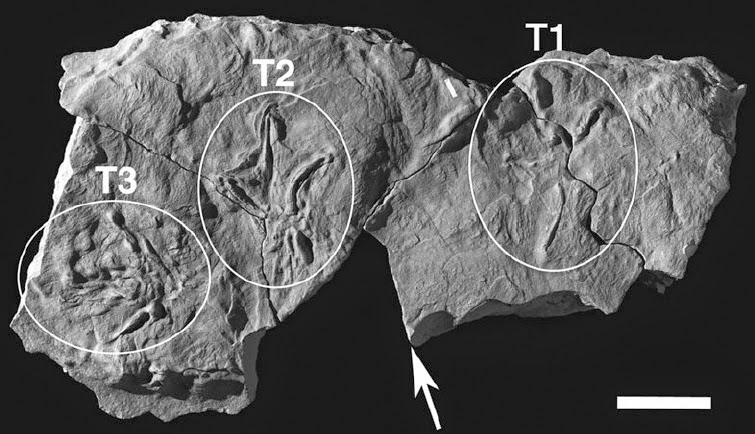
The Jinju Formation has already yielded a number of significant trackways from other, nearby, locations, which are housed in the nearby Jinju Pterosaur Footprint Museum. The new material comprises a thin slab of fine grey sandstone covered by a thin black mudstone drape, less than a millimetre thick, on which a pair of Minisauripus tracks are preserved as impressions, a larger counterpart slab in which these, plus two other similar tracks, making a four imprint trackway are preserved in negative epirelief, and a third slab with a single footprint impression, which was probably part of the same trackway. The counterpart slab also preserves two Pterosaur manus (hand) impressions, a number of invertebrate traces ascribed to large Nematode Worms, and some raindrop marks.

(A) Counterpart slab CUE JJ_M01 showing trackway with four consecutive Minisauripus track casts TL1-TR2. (B) Natural impression slab (CUE JJ_M02) showing tracks TL2 and TR2. (C) Isolated track specimen (CUE JJ_M03). Kyung Soo Kim in Kim et al. (2019).

The trackways are all very well preserved, with the exception of one of the negative relief tracks, which is partially obscured by an overlying Pterosaur track. The prints average 2.38 cm in length and 1.93 cm in width. The average step length (one footprint to the next) is 20.03 cm, while the average stride length (one footprint to the next made by the same foot) is 39.60 cm. All of the footprints preserve skin traces from the entire foot, something unknown on any other Dinosaur footprint of any size. This applies to both the impressions and the negative epirelief prints, which effectively form a mould of the foot of the living animal. The traces show evidence of skin between digits II and III, and II and IV, which may indicate evidence of skin between the digits, or of loose skin on the side of the digits that was pushed down between the toes when the foot was fully flat.

(A,B) Natural impression (A) and cast (B) of track TL2 showing area enlarged in frame (F). Note skin traces in hypex area between digits II and III. (C) Natural cast of track TR1, showing area enlarged in frame (E). Note narrow, digit II intersecting raindrop impressions. (D) Isolated track t. Note skin traces in hypex area between digits II and III. (E) and (F) details of skin trace ornament in 2.0 × 2.0 mm areas of digits IV and II respectively from tracks TL2 and TR1. Casts show in frames (B)-(F) are essentially replicas of the living foot. Kyung Soo Kim in Kim et al. (2019).

The Pterosaur tracks are larger than those of the Dinosaur, measuring 14 cm long and 7 cm wide, and 13 cm long and 8 cm wide. Both are manus (hand) prints, with no sign of marks made by the pes (foot); the prints are not orientated in the same direction, and are probably not part of a single trackway.

The size of the Minisauripus footprints (2.38 cm in length) is taken to indicate an animal with a hip height of about 10.71 mm, which again, assuming a fairly standard Theropod body shape would indicate an animal about 28.4 cm long, and weighing a few tens of grams (about the size of a Blackbird). The stride length is estimated to indicate a walking speed of between 2.27 and 2.57 m per second (8.19 and 9.27 km per hour). The presence of skin traces without any smudging suggests that the foot was placed firmly down on the ground and lifted without any sliding, either in one solid step or with a rolling movement in which the back of the foot hit the ground before the back, but no movement of the foot on the ground occurred.

The consistent small size of Minisauripus footprints across a wide area of China and Korea, with no similar larger footprints, strongly suggests they were made by a full-sized animal, rather than a juvenile member of a larger species. The small size might potentially represent a Bird rather than a non-Avian Theropod, but no Bird with a foot similar to Minisauripus is known from the Early Cretaceous.

See also...


http://sciencythoughts.blogspot.com/2018/12/anomalipes-zhaoi-new-species-of.htmlhttp://sciencythoughts.blogspot.com/2018/11/archaeopteryx-albersdoerferi-phantom.html
http://sciencythoughts.blogspot.com/2018/08/caihong-juji-new-species-of.htmlhttp://sciencythoughts.blogspot.com/2018/02/almas-ukhaa-new-species-of-troodontid.html
http://sciencythoughts.blogspot.com/2017/12/ostromia-crassipes-second-species-of.htmlhttp://sciencythoughts.blogspot.com/2016/12/tongtianlong-limosus-new-species-of.html
Follow Sciency Thoughts on Facebook.

Friday, 3 October 2014

A Hadrosaurid Dinosaur trackway from the Denali National Park in Alaska.

The preserved tracks of ancient animals such as Dinosaurs can provide insights into their lifestyles and biology that could not be determined by examination of bones alone, although such data needs to be interpreted carefully. Such studies can potentially provide data on herding or other social structures among extinct animals, as well as data on the movement of individual creatures.

In a paper published in the journal Geology on 30 June 2014, Anthony Fiorillo of the Perot Museum of Nature and Science, Stephen Hasiotis of the Department of Geology at the University of Kansas and Yoshitsugu Kobayashi of the Hokkaido University Museum describe a newly discovered Dinosaur trackway in the Denali National Park in Alaska.

The trackway appears to show the movements of a large number of Hadrosaurid Dinosaurs. It is found in the lower part of the Late Cretaceous Cantwell Formation, which comprises fluvial (riverine) deposits preserved in a highly seasonal environment. The site is thought to be close to the same position that it occupied during the Late Cretaceous, i.e. it would have been within the Arctic Circle at the time when the tracks were laid down. Arctic ecosystems during the Cretaceous are thought to have been unlike anything found in the modern world, as the greenhouse climate of the period prevented the formation of permanent ice caps, but within the Arctic Circle the winter would still have been marked by several months of complete darkness.

Polar projection of tectonic plates during the Late Cretaceous, with inset map of Alaska. NA—North America. Dots in both maps indicate location of Denali National Park. Fiorillo et al. (2014).

The tracks appear to have been laid down over a short period of time (based upon analysis of plant and invertebrate fossils in the deposits, which are thought to have been highly seasonal) leading Fiorillo et al. to conclude they represent the passage of a single herd of animals. This herd apparently contained individuals with a wide range of sizes, from mature individuals, to very young juveniles. This is interesting as Hadrosaurid tracks in more southerly locations have previously shown only individuals of a single size, suggesting that the animals moved in packs determined by age. In contrast the Denali Herd appears to have contained animals of different ages, suggesting that younger animals were incorporated into a multi-generation herd, which in turn implies that extended parental care may have been occurring.

(A–C) Size ranges of tracks found at Denali National Park, Alaska, tracksite. (D) Adult Hadrosaurid track with skin impressions. Scale bar for (C1) is 5 cm.Fiorillo et al. (2014).

Fiorillo et al. also observe that while there appear to have been Hadrosaurs of all sizes in the pack, the size distribution is skewed towards larger, presumably adult, specimens. They suggest that this may be indicative of rapid growth in juvenile Hadrosaurs, with a lifecycle that includes a short growing period followed by an extended adult phase (something that has been suggested for Hadrosaurs previously).

Relative frequencies of each growth stage as function of body mass in the Denali Hadrosaur herd. This curve independently corroborates hypothesised growth curve for Hadrosaurid dinosaurs proposed by others. Fiorillo et al. (2014).

It has been suggested that Dinosaurs living within the Arctic Circle may have migrated seasonally to escape the dark winter season, in a similar way to the long distance migrations of modern Caribou. Based upon our understanding of the location of the Dinali site during the Cretaceous, and the sizes of the Dinosaurs within this pack (which affects the distance an animal can migrate by walking), Fiorillo et al. suggest that it would have been impossible for the Dinali herd to migrate seasonally from the site to a location outside the Arctic Circle, suggesting that they were able to overwinter in the Arctic.

See also…


In 1940 palaeontologist Roland Bird of the American Museum of Natural History in New York described and partially excavated a...


Dinosaur footprints are well documented from a number of sites...


Follow Sciency Thoughts on Facebook.

Sunday, 18 August 2013

Early Cretaceous Dinosaur footprints from Sichuan Province, China.

Dinosaur footprints are well documented from a number of sites around the world, and a whole branch of palaeontology (Dinosaur ichnology) is dedicated to their study. This can provide a whole range of data about these animals that would not otherwise be available, particularly with regard to their behavior and environment (finding out where something ended up after it died is not the same as finding out where it lived when it was alive).

In a paper published in the Chinese Science Bulletin on 20 February 2013, a team of scientists led by Lida Xing of the School of the Earth Sciences and Resources at the China University of Geosciences in Beijing discuss a series of Early Cretaceous Dinosaur trackways exposed at the Sanbiluoga Copper Mine in Sichuan Province, China.

The site contains a series of tracks interpreted as Theropod swimming traces (Characichnos). These consist of scratch marks made in the sediments by the tips of the Dinosaur's claws, with only occasional  shallower marks from the rest of the foot, interpreted as marks left by a swimming or floating Theropod Dinosaur propelling itself forwards with footstrokes. This is the first time such traces have been (confidently) documented in China, though similar tracks have previously been described from England, Poland, Spain and Utah.

Theropod swim traces from the Sanbiluoga Copper Mine in Sichuan Province, China. Xing et al. (2013).

The site also contains a number of Theropod walking traces, footprints which imply the animal was putting its full weight on the foot, rather than simply using it to propel itself forwards. Interestingly the spacing of both sets of footprints suggests an animal with a hip joint approximately 90 cm above the ground, which Xing et al. suggest implies the depth of water was not constant at the site when the tracks were being laid down.

Theropod footprints from the Sanbiluoga Copper Mine in Sichuan Province, China. Xing et al. (2013).

The site also contains a set of Sauropod tracks, these apparently being made by a walking animal and running parallel to the Theropod swim traces. However the Sauropod was apparently a much larger animal, with a hip height of 1.7-2.5 m (i.e. an animal that could have walked in 90 cm of water), so little can be inferred from this.

Sauropod walking tracks (left) running parallel to the Theropod swimming traces (right) at the Sanbiluoga Copper Mine in Sichuan Province, China. Xing et al. (2013).

Finally the site contains a number of Ornithopod (Iguanodonts or Hadrosaurs) footprints. These are assigned to the ichnospecies Caririchnium lotus (while not true biological species, trace fossils are often given Latin binomial names in the same way) are interpreted as the hind footprints of animals that may have either walked on two or four feet. The tracks apparently represent a number of individuals of different sizes, interpreted as adult  (tracks 37–40 cm in length), subadult (25–30 cm in length), and tracks of young individuals (19–23 cm in length), which suggests a group of animals moving across the area together. However the tracks are not well preserved, and are largely on a high, steep slope making access difficult, so no further interpretation has been made.

Ornithopod footprints from the Sanbiluoga Copper Mine in Sichuan Province, China. Xing et al. (2013).


Follow Sciency Thoughts on Facebook.

Monday, 5 March 2012

Dinosaur footprints from the Early Cretaceous of Ganzu Province, China.

The Deinonychosaurs are the group of dinosaurs most closely related to the birds. They are divided into two groups, the Dromaeosaurs (popularly known as 'Raptors') and the Troodontids, which share a common hindlimb morphology, with two digits used to support weight during locomotion, and a third supporting a large, sickle-shaped claw, which was held clear of the ground.

In a forthcoming paper in the journal Acta Paleontologica Polonica, a team of scientists led by Lida Xing of the Department of Biological Sciences at the University of Alberta describe the discovery of a group of tracks made by dinosaurs with two walking toes, in the Liujiaxia Dinosaur National Geopark in Ganzu Province, China.

Liujiaxia Dinosaur National Geopark in Ganzu Province.

The tracks are located in fine sandstone/siltstone in the Early Cretaceous Yanguoxia Formation, on the southeastern edge of the Lanzhou-Minhe Basin. The site contains six dinosaur trackways, made by dinosaurs with two walking toes, with feet measuring approximately 14.8 cm in length and 6.4 cm wide and step lengths of 35.7-37.5 cm.

One of the prints. (A) Photograph. (B) Computerized Photogrammetry image with 0.2 mm contour lines. (C) Outline drawing with 10 cm scale bar. From Xing et al. (2012).

Deinonychosaurs are thought to have been capable of considerable speed when chasing prey, but none of the Liujiaxia track-makers appears to have been moving fast when making the tracks. This has no particular significance, since no modern predator runs all, or even most, of the time. There has been an ongoing debate over whether these dinosaurs were pack or solitary hunters; again this site is somewhat ambivalent, as most of the tracks are of solitary animals, but one track apparently shows six animals moving as a group.

Turning trackway. Left, photograph. Centre, outline drawing. Right, pace angulations. Scale bar is 50 cm. From Xing et al. (2012).

It is not possible to say with confidence what the actual track-maker was. The print are within the size range of a large Troodontid or a small-to-medium sized Dromaeosaur, though Xing et al. feel that the most likely track-maker was a Dromaeosaur.

Saturday, 8 October 2011

Dinosaur footprints discovered in Southwest Arkansas. October 2011.

This week scientists at the University of Arkansas revealed that they have discovered and been studying a large area of dinosaur footprints in the southwest of the state. They have not revealed the exact location as people have a nasty habit of digging up dinosaur footprints and selling them to private collectors, which destroys them as a resource for scientists; even if they can be recovered they are far less useful when out of position. The research is being lead by Stephen Boss of the Department of Geosciences at the William J. Fulbright College of Arts and Sciences and is funded by the National Science Foundation.

Some of the dinosaur footprints.

The prints so far exposed cover an area of over 10 000 m³, and date from the early Cretaceous between 115 and 120 million years ago. There are a large number of prints, which is slightly surprising as they were made in fairly hostile conditions, salt pans around a drying sea or lagoon, similar to those seen in the modern Persian Gulf. At first this seems slightly puzzling, but it is unlikely that the prints were all laid down at the same time; the field may well be showing accumulated trails built up over hundreds or even thousands of years.

A modern salt pan - few animals choose to spend much time here.

It is not considered possible to identify dinosaurs from their footprints alone, however in some cases it is possible to make an informed guess. The track field includes prints from both large therapod and sauropod dinosaurs, and there are unlikely to have been many different candidates for producing these.

A single large therapod dinosaur is well known from the Early Cretaceous of the Southwest United States, and analogy with modern ecosystems suggests that such an animal would have been unlikely to tolerate many rivals. This is Acrocanthosaurus atokensis, an 11 m allosauroid with a distinctive crest, thought to have weighed between 6000 and 7000 kg. Several sets of trackways in Texas have already been attributed to Acrocanthosaurus.

An artists impression of Acrocanthosaurus atokensis, by restoration artist Mineo Shiraishi.

There are two known sauropod dinosaurs from the region during the Early Cretaceous, and again this is likely to be the limit. No modern environment supports two species of elephants, and only one (the savanahs of eastern and southern Africa) two species of rhino. Thus it is likely that the sauropod prints belong to one or both of these dinosaur species. These are Plueurocoelus nana and Paluxysaurus jonesi two similar 15 m brachiosaur-like dinosaurs, which are the former and current official state dinosaurs of Texas respectively. The similarity, both in anatomy and distribution of these dinosaurs makes them hard to tell apart, though in certain features they are distinctive; it is possible that they represent an example of sexual dimophism in a dinosaur. It is also possible that Astrodon johnstoni, a similar dinosaur from the Early Cretaceous of the northwestern United States.

As well as making plaster casts of the footprints which can be taken back to the lab, the team have been making detailed 3D laser scanned images of the whole site, this not only gives an accurate three dimensional images of the footprints within a computer, it also maps the prints on the ground accurately enabling scientists to study the foot-spacing and therefore gait of the printmakers. Footprints do not always accurately represent the foot-shape of the printmaker. In muddy terrains footprints are often distorted by the viscosity of the mud, but on this sort of terrain this is less likely. More likely is that the prints are in fact underprints; when an animal steps on a layered terrain it crerates prints not just at the surface, but in the layers beneath, as sediments are pressed down through one-another. These underprints are often preserved while the overprints are destroyed at the surface, but they are less accurate representations of the footprint maker.

How underprints are formed, different prints from the same foot, and how tracks are measured.