Showing posts with label Formicidae. Show all posts

Friday, 1 November 2024

Pheidole praehistorica: A new species of Spiny Ant from Oligo–Miocene Chiapas Amber.

The genus Pheidole is currently considered to be the most diverse genus of Ants, with 1160 living and six fossil species. Although global in distribution, the genus is at its most diverse in the Neotropics, and is presumed to have originated in this region. This is supported by the locations from which the known fossils in the genus have been recovered, with the oldest known species coming from the Eocene of Colorado, and other fossils known from the Miocene of the Dominican Republic (three species), and the Oligo-Miocene of Chiapas State, Mexico (2 species).

In a paper published in the European Journal of Taxonomy on 25 October 2024, Fernando Varela-Hernández & Franciso Riquelme of the Laboratorio de Sistemática Molecular at the Universidad Autónoma del Estado de Morelos, describe a third species of Pheidole from Chiapas Amber.

Chiapas Amber comes from the Simojovel, Totolapa, and Estrella de Belén localities in the Chiapas Highlands of southern Mexico, with the Simojovel site being the main centre of commercial amber extraction. The amber comes from a series of limestone, sandstone, siltstone, shale, and lignite beds of Late Oligocene to Early Miocene age, referred to as either the Simojovel Formation or the La Quinta Formation. The amber here is thought to have derived from a type of Leguminous tree of the genus Hymenaea; resin-producing trees belonging to this genus are also thought to have been responsible for Dominican Amber, which is of approximately the same age as Chiapas Amber, and are still found today across the Neotropics. 

The new species is named Pheidole praehistorica, where 'praehistorica' means 'prehistoric' in reference to the nature of the material from which it is described, five fossil Ants trapped within a single species of amber.

Pheidole praehistorica. (A)–(C) Holotype (CPAL.464). (A) Profile view. (B) Frontal view. (C) Closer lateral view of the head and mesosoma. (D) Paratype (CPAL.465), latero-frontal view of the head. (E) Paratype (CPAL.468), profile view. Abbreviations: acl, antennal club; an, antenna; cly, clypeus; ey, eyes; fl, foreleg; ga, gaster; ha, hairs on clypeus; hd, head; hl, hind  leg; mn,  mandible; nck, neck; p, petiole; pn, pronotum; pns, pronotal spine; pp, postpetiole; pps, propodeal spine; sc, scape. Varela-Hernández & Riquelme (2024).

Pheidole praehistorica is smaller than other species from Chiapas Amber, an average length of 2.3 mm, and has shorter pronotal spines (spines on the forward part of the thorax, immediately behind the head) and straight propodeal spines (spines on the rear part of the thorax, immediately before the abdomen. 

See also...

Tuesday, 16 October 2018

Lasius tapinomoides: A new species of Ant from Crete.

Ants of the genus Lasius are found across Eurasia, with most species being wide-ranging and dominant members of the local Ant community. The genus contains very few endemic species (species with limited distributions), with these mostly found on islands or occasionally mountains. There are currently seven members of the genus reported on Crete, one of the largest islands in the Mediterranean, with a diverse, mountainous, landscape, though the Ant fauna of the island is not well studied.

In a paper published in the journal ZooKeys on 10 October 2018, Sebastian Salata and Lech Borowiec of the Department of Biodiversity and Evolutionary Taxonomy at the University of Wrocław, describe a new species of Lasius from Crete.

The new species is named Lasius tapinomoides, for its similarity to Ants of the genus Tapinoma. These Ants are dark brown in colour, with orange antennae and legs. The head is oval, and slightly longer than wide, the eyes also oval and 25% as long as the head. The species is covered in a dense coat of hairs and is believed to be endemic to Crete.

Lasius tapinomoides, worker in lateral view. Salata and Borowiec (2018). 

See also...

https://sciencythoughts.blogspot.com/2018/09/napakimyrma-paskapooensis-new-species.htmlhttps://sciencythoughts.blogspot.com/2018/07/platythyrea-janyai-new-species-of-ant.html
https://sciencythoughts.blogspot.com/2018/01/crematogaster-khmerensis-crematogaster.htmlhttp://sciencythoughts.blogspot.co.uk/2017/09/linguamyrmex-vladi-new-species-of-hell.html
http://sciencythoughts.blogspot.co.uk/2015/05/romblonella-coryae-new-species-of-ant.htmlhttp://sciencythoughts.blogspot.co.uk/2014/11/the-impact-of-yellow-crazy-ant-on.html
Follow Sciency Thoughts on Facebook.

Saturday, 29 September 2018

Napakimyrma paskapooensis: A new species of Relict Ant from the Palaeocene of Alberta, Canada.

Ants are a dominant group in almost all Insect communities today, but this does not appear to have been the case. Stem-group Ants (Ants not descended from the last common ancestor of all living Ants) are known in the fossil record from the Middle Cretaceous onwards, but Cretaceous Ants were rarer and less dominant members of the communities where they were found. Crown-group Ants (Ants descended from the last common ancestor of all living Ants) first appear in the Eocene, and rapidly rose to the ecological dominance we see today. Strangely there is a 23 million year gap between the last fossil Stem-group Ants, in amber from the 78-million-year-old Medicine Hat Formation of North America, and the appearance of the first Crown-group Ants in the 55-million-year-old Fur Formation of Denmark, a gap which encompasses the End Cretaceous Extinction and the entire Palaeocene Epoch. During this entire period only a single possible Ant fossil is known, a specimen from the Palaeocene of Menat in France, which might be an Ant or might be a Potter Wasp.

In a paper published in the journal Acta Palaeontologica Polonica on 27 July 2018, John Lapolla of the Department of Biological Sciences at Towson University and Phillip Barden of the Department of Biological Sciences at the New Jersey Institute of Technology, describe a new species of Relict Ant from the Palaeocene Paskapoo Formation in Alberta.

Relict Ants, Aneuretinae, are known only from a single species today, the Critically Endangered Sri Lankan Relict Ant, Aneuretus simoni, though nine fossil species have previously been described, leading entomologists to conclude that they were the last survivors of a group only distantly related to other Crown-group Ants, though modern DNA-based phylogenetic methods have shown them to be closely related to the much more widespread and diverse Dolichoderine Ants.

The Paskapoo Formation comprises a series of Middle-Late Palaeocene sandstones, gravels, mudstones and conglomerates, thought to have been laid down in a meandering river valley, with occasional palaeosols (fossil soils) and coal beds thought to have been laid down in wooded swamps on the river, which have produced numerous Insect and Plant fossils.

The new species is named Napakimyrma paskapooensis, where 'Napakimyrma' is a combination of the Cree 'Napaki', meaning 'flat' and the Greek 'Myrma', meaning 'Ant', to make 'Flat Ant', and 'paskapooensis' means 'from Paskapoo'. The species is described from a single worker Ant 6.8 mm in length, preserved as part and counterpart on a piece of split limestone. 

Relict Ant Napakimyrma paskapooensis from the Paleocene Paskapoo Formation at Dennis Wighton site 1 of Blackfalds Insect and Plant Site. Automontage generated photographs (A, B), line drawing (C). Lapolla & Barden (2018).

See also...

https://sciencythoughts.blogspot.com/2018/07/platythyrea-janyai-new-species-of-ant.htmlhttps://sciencythoughts.blogspot.com/2018/01/crematogaster-khmerensis-crematogaster.html
http://sciencythoughts.blogspot.co.uk/2017/09/linguamyrmex-vladi-new-species-of-hell.htmlhttp://sciencythoughts.blogspot.co.uk/2015/05/romblonella-coryae-new-species-of-ant.html
http://sciencythoughts.blogspot.co.uk/2014/11/the-impact-of-yellow-crazy-ant-on.htmlhttp://sciencythoughts.blogspot.co.uk/2014/10/interpreting-relationship-between-ants.html
Follow Sciency Thoughts on Facebook.

Thursday, 19 July 2018

Platythyrea janyai: A new species of Ant from southern Thailand and western Malaysia.

The genus Platythyrea currently contains 38 species of large stinging Ants from tropical regions of the Americas, Australia, Africa and East Asia, which nest in cavities in live or dead trees (or in the case of some African species, Termite mounds). In all species in this genus in which reproduction has been studied, the workers are able to reproduce parthogenically (i.e. workers can lay eggs which produce clones of themselves), with some species also producing sexual queens and males.

In a paper published in the journal ZooKeys on 16 January 2018, Natthaporn Phengsi of the Department of Biology at Burapha University, Weeyawat Jaitrong of the Natural History Museum in Khlong Luang, Jiraporn Ruangsittichai of the Department of Medical Entomology at Mahidol University, and Salinee Khachonpisitsak, also of the Department of Biology at Burapha University, describe a new species of Platythyrea from southern Thailand and western Malaysia.

The new species is named Platythyrea janyai, in honour of Janya Jareanrattawong of the Royal Forest Department of Thailand, for his help with collecting the specimens from which the species is described. The specie is described from four workers collected from dead wood on the forest floor in lowland rainforest in the Khao Pu Khao Ya National Park in Phatthalung Province in southern Thailand; the species was also observed in the Khao Chong Botanical Garden in Trang Province, also southern Thailand, and in the Ulu Gombak Forest Reserve in Selangor State, Malaysia. The described specimens are between 6.63 and 6.96 mm in length, and are dark brown in colour, with reddish and yellowish markings.

Platythyrea janyai, worker. (A) Body in profile view. (B) Head in full-face view. (C) Body in dorsal view. Phengsi et al. (2018).

See also...

https://sciencythoughts.blogspot.com/2018/01/crematogaster-khmerensis-crematogaster.htmlhttp://sciencythoughts.blogspot.co.uk/2017/09/linguamyrmex-vladi-new-species-of-hell.html
http://sciencythoughts.blogspot.co.uk/2015/05/romblonella-coryae-new-species-of-ant.htmlhttp://sciencythoughts.blogspot.co.uk/2014/11/the-impact-of-yellow-crazy-ant-on.html
http://sciencythoughts.blogspot.co.uk/2014/10/interpreting-relationship-between-ants.htmlhttp://sciencythoughts.blogspot.co.uk/2014/04/a-new-species-of-thief-ant-from-saudi.html
Follow Sciency Thoughts on Facebook.

Wednesday, 13 September 2017

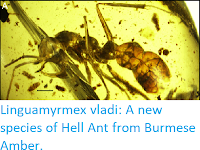
Linguamyrmex vladi: A new species of Hell Ant from Burmese Amber.

Ants first appeared in the Cretaceous, with fossil Ants known from deposits between 100 and 78 million years ago, from six locations across Laurasia (Eurasia plus North America) and one from Botswana in Southern Africa. None of the known Cretaceous fossil Ants can be placed within any living group, rather they are thought to be stem group Ants, more closely related to living Ants than any other group, but not descended from the most recent common ancestor of all living Ants, which is thought to have lived around the end of the Cretaceous. One distinctive group of Ants found in several different Cretaceous deposits are the Hell Ants, Haidomyrmecini, which have distinctive enlarged jaws, and are thought to be the sister group to all other Ants. 

In a paper published in the journal Systematic Entomology on 4 September 2017, Philip Barden of the Department of Biological Sciences at the New Jersey Institute of Technology, and the  Department of Invertebrate Zoology at the American Museum of Natural History, and Hollister Herhold and David Grimaldi, also of rhe Department of Invertebrate Zoology at the American Museum of Natural History, describe a new species of Hell Ant from Middle Cretaceous Burmese Amber.

Middle Cretaceous ‘Burmese Amber’ has been extensively worked at several sites across northern Myanmar (though mostly in Kachin State) in the last 20 years. The amber is fairly clear, and often found in large chunks, providing an exceptional window into the Middle Cretaceous Insect fauna. This amber is thought to have started out as the resin of a Coniferous Tree, possibly a Cypress or an Araucaria, growing in a moist tropical forest. This amber has been dated to between 105 and 95 million years old, based upon pollen inclusions, and to about 98.8 million years by uranium/lead dating of ash inclusions in the amber. 

The new species is named Linguamyrmex vladi, where 'Linguamyrmex' means 'tounged Ant' in reference to a tongue-shaped process on the Ant's head against which the Insect's mandible appear to be opposed, and 'vladi' refers to Vlad the Impaler (Vlad Dracula), in reference to its enlarged teeth, and presumed feeding habit, impaling soft bodied invertebrates and draining their bodily fluids. The species is described from a single specimen from Burmese Amber, with three other specimens referred to the genus but nor the species.

Photomicrographs of Linguamyrmex vladi. (A) Lateral view of specimen. (B) View of head capsule and mesosoma. Scale bars, 0.5 mm. Barden et al. (2017).

X-ray imaging of the specimen showed the presence of what appeared to be metal in the tongue-shaped process. This is not altogether surprising as a variety of Insects (including some Ants) and some other animals (including some Mammals) are known to be able to sequester metals in parts of their bodies, typically in the mouthparts where they can provide a degree of extra strength. This supports the idea that the process was part of a feeding system, with prey animals braced between the two mandibles and the process while they were drained of fluids.

See also...

http://sciencythoughts.blogspot.co.uk/2015/05/romblonella-coryae-new-species-of-ant.htmlhttp://sciencythoughts.blogspot.co.uk/2014/11/the-impact-of-yellow-crazy-ant-on.html
http://sciencythoughts.blogspot.co.uk/2014/10/interpreting-relationship-between-ants.htmlhttp://sciencythoughts.blogspot.co.uk/2014/04/a-new-species-of-thief-ant-from-saudi.html
http://sciencythoughts.blogspot.co.uk/2013/12/a-new-species-of-ant-from-late-eocene.htmlhttp://sciencythoughts.blogspot.co.uk/2013/07/a-new-species-of-early-ant-from.html
Follow Sciency Thoughts on Facebook.

Monday, 2 February 2015

First evidence of Human consumption by Katydids and Woodlice.

Modern forensic science typically involves the detailed examination of corpses where foul play is suspected, with the aim of identifying any marks on the body, and relating them to the cause of, and circumstances surrounding, the death of the person in question. Numerous Arthropods are known to feed on vertebrate carrion, including Human remains, and marks left by feeding Arthropods have in the past been mistaken for burns, evidence of intravenous drug use, bite marks, defensive wounds and a variety of other forms of evidence. As such forensic scientists in a number of areas have begun to experiment with Human remains left to decompose in the environment, in order to better understand how Arthropod feeding traces and other forms of environmental destruction affect a body after death.

In a paper published in the Journal of Medical Entomology in January 2015, a team of scientists led by Jennifer Pechal of the Department of Biology at the University of Dayton and the Department of Entomology at Michigan State University, discuss the results of an experiment in which a body was left exposed at the Forensic Anthropology Center at Texas State University, and subsequently targeted by a variety of Arthropods not previously associated with the consumption of Human remains.

Firstly the cadaver was targeted by a gravid female Katydid, Pediodectes haldemani, which began feeding on the lower right arm of the body, approximately 32 hours after it was placed in the field. Katydids, Tettigoniidae, are Orthopteran Insects related to Grasshoppers and Crickets, but unlike these plant-eating groups they are generally omnivorous in their dietary preferences, and the species Pediodectes haldemani is known to be almost totally carnivorous. While Katydid have previously been recorded consuming vertebrate carrion, this is the first recorded instance of the consumption of Human remains by a Katydid, and Pechal et al. suggest that this might be slightly atypical behaviour, fuelled by a need for extra protein in the gravid female.

A gravid, female Pediodectes haldemani (Orthoptera: Tettigoniidae) feeding on the right forearm of a set of human remains (top), and the resulting physical artifact (indicated by the black arrow) on the remains by the feeding Pediodectes haldemani (bottom). Pechal et al. (2015).

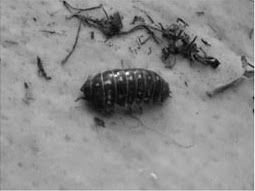
Secondly the remains were visited by a Common Woodlouse, Armadillidium cf. vulgare, this time feeding on the lower left arm. Woodlice are terrestrial Isopod Crustaceans, with a typicalldetritivorous diet; they are most commonly associated with plant remains, but are known to eat carrion, though once again this is the first time that a Woodlouse has been recorded eating Human remains.

Armadillidium cf. vulgare (Isopoda: Armadilidiidae) feeding on the left forearm of a human set of remains (top), and the resulting artifact (indicated by theblack arrow) on the remains from the isopod activity (bottom). Pechal et al. (2015).

Finally the body was visited by a colony of Red Fire Ants, Solenopsis invicta, an imported species in the US, but which has become common in grasslands; Ants, including Red Fire Ants, are common visitors to carrion. On this occasion it is unclear whether the Ants actually fed on the remains, rather they entered the body via the hole left by the Katydid’s feeding and appeared to build a shelter there, using soil and small pieces of woody debris, a structure which would have been difficult to interpret had its construction not been observed.

A structure consisting of soil, small organic woody debris, and other organic material by red imported Fire Ants, Solenopsis invicta (Hymenoptera: Formicidae), in the artifact resulting from Pediodectes haldemani feeding activity on the leftforearm of the descendent. The structure was re-constructed each time the remains were disturbed for sampling purposes. The small dots surrounding the debris pile are fly artifacts or speck. Pechal et al. (2015).

See also…

http://sciencythoughts.blogspot.co.uk/2015/01/two-new-species-of-katydids-from.htmlTwo new species of Katydids from Pakistan. Katydids (or Buschcrickets), Tettigonioidea, are Members of the Insect Order Orthoptera, which also includes Crickets and Grasshoppers. They are...


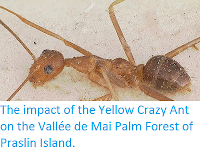
http://sciencythoughts.blogspot.co.uk/2014/11/the-impact-of-yellow-crazy-ant-on.htmlThe impact of the Yellow Crazy Ant on the Vallée de Mai Palm Forest of Praslin Island. Ants are often highly adaptable animals, and many species have proven to be highly invasive pests, able to reach new homes by hitching a ride on cargo moved by Humans, and often proceeding modify the ...
http://sciencythoughts.blogspot.co.uk/2014/10/three-new-species-of-katydid-from-china.htmlThree new species of Katydid from China. Katydids of the genus Xizicusand its close relatives are found across eastern Asia, though the taxonomy of the group is currently somewhat confused, in part due to publications being published in different languages...

Follow Sciency Thoughts on Facebook.

Saturday, 26 April 2014

A new species of Thief Ant from Saudi Arabia.

Thief Ants of the genus Solenopsis are one of the most numerous and widespread Ant groups, particularly in the tropics. However they are not greatly studied or understood, despite the fact that some species are invasive pests, due largely to their small size, pale colouration and cryptic habits, which can make species hard to differentiate even for experts. Thief Ants have two separate worker casts, known as Major and Minor Workers, differentiated by their size.

In a paper published in the journal PLoS One on 30 November 2012, Mostafa Sharaf and Abdulrahman Aldawood of the Plant Protection Department at the College of Food and Agriculture Sciences at King Saud University in Riyadh describe a new species of Thief Ant from Al Baha Province, Saudi Arabia.

The new species is named Solenopsis elhawagryi, after Magdi El-Hawagry of Cairo University and Al Baha University. It is described from a colony found living under a rock in Elqamh Park in Al Baha Province, an of area of Acacia and Juniper forest with numerous pools of water and a significant level of soil humidity, particularly in the rainy season. However, despite an extensive search effort, no further colonies could be found either in the park or the surrounding Asir Mountains, so it is unclear if the species is native to the area.

The workers of Solenopsis elhawagryi are  sandy yellow in colour. Minor Workers reach 1.55-1.82 mm in length, while Major Workers reach 1.87-2.62 mm. The Queen is a darker brown colour, the sole known specimen being 4.30 mm in length. Major Workers can be differentiated from other species in the area by a darker brownish yellow patch between the eyes and scattered yellowish spots on the body. Minor Workers can only be differentiated from other species by the structure of the mouthparts.

Solenopsis elhawagryi specimens in lateral view. (Top) Minor Worker, (middle) Major Worker, (bottom) Queen. Sharaf & Aldawood (2012).

See also…


Follow Sciency Thoughts on Facebook.