Showing posts with label Harvestmen. Show all posts

Tuesday, 1 September 2020

Devonopilio hutchinsoni: Isolated penis represents a second species of Harvestman from the Early Devonian Rhynie Chert of Aberdeenshire, Scotland.

Harvestmen, Opiliones, represent an ancient and morphologically diverse lineage of Arachnids and probably were among the first terrestrial Animals. Over 6600 living species have been described to date from across the world, highlighting their status as one of the most successful Arachnid orders. Opiliones exhibit a wide diversity of body plans but most species, at least in the northern hemisphere, can be recognised by a rounded body with a fused prosoma and opisthosoma, and very long legs that gave these charismatic Arachnids their name in many of the world’s languages. Unlike other Arachnids, Harvestmen produce a repugnatorial substance from their prosomatic glands, lack book lungs, have tracheae opening on the genital area, feed by ingesting their food whole without the use of pre-oral digestion, and most taxa transfer spermatozoa through an eversible penis that can be extended by specialised protractor muscles or haemolymph pressure. They are an important component of virtually all terrestrial biomes inhabiting spaces under rocks and in bark, dense vegetation, soil, leaf litter, and even subterrestrial habitats such as caves. Most species are generalist predators and scavengers feeding on other Arthropods, Vertebrate carcasses, Fungi, and fruit. The fossil record of Opiliones is very sparse with only a handful of extinct species known since the Palaeozoic. The exceptional rarity of Harvestmen fossils may be in part due to their terrestrial lifestyle and delicate bodies with a poorly mineralised exoskeleton. Consequently, most fossil species are known from various Cainozoic amber deposits. Only seven Palaeozoic Opiliones have been described to date and, with the exception of one species, all originate from the Carboniferous Coal Measures. The earliest known Harvestman, Eophalangium sheari, was described based on remarkably well-preserved fragments of three individuals in Lower Devonian Rhynie Chert. These fossils preserve the oldest Arthropod trachea which indicate that Eophalangium sheari lived on land. Given the strikingly modern body plan of Devonian and Carboniferous Opiliones, it has been suggested that Harvestmen may have originated in the Silurian or even earlier. Recent calibrated phylogenies placed the origin of Opiliones into the Silurian (about 425 million years ago) or even as far back as the Ordovician (470–420 million years ago).

In a paper published in the Bulletin of Geosciences on 25 July 2020, Erik Tihelka of the Department of Animal Science at Hartpury College, Li Tian of the State Key Laboratory of Biogeology and Environmental Geology at the China University of Geosciences, and Chenyang Cai of the State Key Laboratory of Palaeobiology and Stratigraphy at the Nanjing Institute of Geology and Palaeontology, and the Center for Excellence in Life and Paleoenvironment of the Chinese Academy of Sciences, describe a second species of Harvestman from the Early Devonian Rhynie Chert.

 
Schematic representation of a penis of the extant Harvestmen Leiobunum verrucosum (Sclerosomatidae) in ventral view in retracted and extended positions. Abbreviations: f, fultura; h, hematodocha; p, penis; s, nuptial gift sac; ppm, penis protractor muscle. Tihelka et al. (2020).

The Rhynie Chert Lagerstätte is an exceptional Early Devonian deposit of world-wide significance that preserves probably the oldest terrestrial ecosystem. In addition to its age, many Rhynie chert fossils exhibit an extraordinary level of detail including soft tissue preservation down to the cellular level, offering a unique insight into the morphology and palaeoecology of the earliest organisms to colonise land. The cherts originate from near the village of Rhynie in Aberdeenshire, Scotland and a second unit known as Windyfield Chert is located within a kilometre distance. Radiometric analyses indicate that the chert formed approximately 407 million years ago, a finding consistent with palynomorph evidence. The organisms were preserved by silica-rich waters in the proximity of ancient hot springs. Rhynie palaeoenvironment surrounding the hot springs has been characterised as an 'alluvial plain with shallow ephemeral pools which bordered a river'. The Rhynie Chert was discovered more than a hundred years ago, and since then has yielded diverse Bacteria, Algae, Fungi, Plants, and Animals including the earliest Nematodes and Mites, and the earliest fossil record of herbivory and fungal symbiosis. 

The new species is named Devonopilio hutchinsoni, where 'Devonopilio' is derived from the age of the fossil and the Latin 'opilio', the root word of Opiliones, and 'hutchinsoni' honours Deborah Hutchinson, palaeontologist and curator of the Geological Collections of the Bristol Museum and Art Gallery. It is described from a single specimen preserved on a slide-mounted thin section prepared by the palaeontological preparator Walter Hemingway in 1924 and currently deposited in the Geological Collections of the Bristol Museum and Art Gallery.

While the specimen is fragmentary, most named Rhynie Arthropods, including Rhyniognatha, are likewise known only from incomplete specimens, which is somewhat unavoidable given the nature of the chert. In each case, a formal taxon name is practical for separating the specimens from other clearly morphologically distinct individuals. Because the fossil clearly differs from the previously described Eophalangium sheari, Tihelka et al. choose to propose a new formal taxon name.

The specimen comprises a penis sheath elongate, 0.57 mm long, 0.14 mm wide at broadest point, 1.1 times longer than penis and 5.6 times wider than penis at broadest point. Base and apex somewhat rounded and darkened, sclerotised. Base with a small circular hole.

Holotype of Devonopilio hutchinsoni. (A) Penis with sheath and protractor muscle under a transmitted light microscope. (B) Interpretative line drawing. Scale bar is 200 μm. Abbreviations: gl, glans; pt, penis tendon; sh, sheath; tr, truncus. Tihelka et al. (2020).

Penis slender, lanceolate, not curved, 0.47 mm long and 0.05 mm wide at broadest point. The basal part of the penis consists of a slender truncus (length 3.39 mm, width 0.01 mm) narrowest apically and attached medially to the sheath by a thin expansion, then equally wide. The truncus is sclerotised basally. A darkened band present anteromedially is herein interpreted as a tendon. The apical part of the penis is lanceolate, the glans narrows sharply towards the apex. The apex is darkened, most likely indicating sclerotization, similarly to modern Harvestmen.

The species is represented by just a single penis associated with several unidentifiable fragments. The interpretation of part of the structure as the penis sheath is supported by it being connected to the penis truncus. Although the penis sheath in modern Harvestmen is not heavily sclerotised, the structure in the present specimen is similar in outline to the penis sheaths in some extant Harvestmen.

An indeterminate bundled structure is present to the left of the penis sheath. An approximately semi-circular structure is also present above the penis. It is unlikely that this structure represents muscle tissue associated with the penis as Rhynie Chert only preserves cuticle-lined structures such as appendages, tendons, lungs, and trachea. It is more probable that these fragments represent the remains of the Arachnid’s body wall sectioned during the preparation of the specimen or perhaps muscle insertion plaques that were involved in movement of the legs.

The cylindrical elongate structure preserved on slide Db7365 and consisting of a wider basal part and a narrower apical part connected by a narrow joint is interpreted by Tihelka et al.  as an Opilione penis and penis sheath. The structure of the Harvestmen penis is rather unique among Arthropods and no other Arachnid possesses a similar reproductive organ. The specimen clearly does not represent an Opilione ovipositor, as these tend to be apically bifurcate and those in Cyphophthalmi and the majority of Eupnoi are composed of segment-like rings. The specimen likewise is not a limb as indicated by the
characteristic glans and narrow joint connecting the sheath and the penis. A potentially significant feature of Devonopilio hutchinsoni is the basally very thin penis which appears to be rare in Opiliones. The specimen can be easily differentiated from the penis of Eophalangium sheari, the only other Devonian Harvestmen, by the truncus slender and equally wide throughout, the presence of a single penis tendon, and apex with an acute lateral expansion, lending it a spearlike appearance.

When described, Eophalangium sheari was tentatively placed into the suborder Eupnoi A phylogenetically significant character discernible in the Eophalangium sheari penis is the presence of two lateral darkened bands in the penis shaft that were interpreted as tendons, as a result of which the species was treated as a crown-Eupnoi by subsequent workers. A later phylogenetic study placed Eophalangium sheari was in a polytomy with members of Phalangida, leading to it being identified as a stem-group Cyphophthalmid and placed in the extinct suborder Tetrophthalmi.

The penis of Devonopilio hutchinsoni is clearly divided into a truncus and a glans. This suggests that it could not have belonged to a member of Cyphophthalmi as these Harvestmen have an undivided spermatopositor. The penis also has a darkened anteromedial portion which likely represents a tendon. This would further exclude Troguloidea, which have a penis with two muscles; Laniatores, Gonyleptoidea and Oncopodoidea have a hydraulic-operated glans and completely lack male genital musculature. A single penis tendon is present in the extant superfamilies Ischyropsalidoidea, Phalangioidea, and Travunioidea. The precise affinity of Devonopilio hutchinsoni with any of these taxa cannot be affirmed until other more informative body remains are discovered in the future. As such, Devonopilio hutchinsoni is provisionally treated as Opiliones incertae sedis. However, the penis morphology suggests that Devonopilio hutchinsoni and Eophalangium sheari were not closely related and would be placed into two different superfamilies if they were treated as extant taxa. As such, the erection of a new genus for the present fossil is clearly justified. The wide disparity in penis morphologies in the only two known Early Devonian Harvestmen suggests that the order began to diversify well before this time.

The Chelicerata probably originated in the Cambrian as a group of aquatic Arthropods, perhaps similar to modern Sea Spiders and Horseshoe Crabs. In basal Chelicerates, reproduction likely took place externally as is the case in modern marine Arachnids. In extant terrestrial Scorpions and Pseudoscorpions a fertilisation is also achieved by the male laying a spermatophore on the substrate. The discovery of preserved intromittent organs in Rhynie chert Opiliones suggests that harvestmen in the Early Devonian were capable of internal fertilization on land without the need to lay spermatophores in water or on the substrate, implying that they were terrestrial.

Some recent Harvestmen employ a 'solicitous' mating strategy whereby the distal portion of the penis bears a sac that delivers a nuptial gift to the female’s mouth prior to copulation. The precise role of this behaviour is unknown, but the female appears to feed on the nuptial secretion and in some cases rejects the male by running away after feeding on the substance. In contrary, Harvestmen employing 'antagonistic' mating strategies evolved penises without nuptial gift sacs and apparently penetrate the females by force. Correspondingly, females of these 'antagonistic' species often possess sclerotized pregenital defences. A phylogenetic analysis of Leiobunine Harvestmen showed that the presence of a sac is the ancestral condition in this lineage. Devonopilio hutchinsoni lacks a penile sac suggesting that a nuptial gift was probably not delivered to the female, but given our still very incomplete understanding of Harvestmen reproductive behaviours inferences for this extinct species are difficult to make.

Alongside Eophalangium sheari, Devonopilio hutchinsoni, from the 407-million-year-old Rhynie chert from Aberdeenshire, Scotland, is the oldest Harvestmen in the fossil record. Tihelka et al.'s study thus adds a second Harvestman to the Rhynie Chert fauna, indicating that at least two reproductively isolated Harvestman species co-occurred in the Rhynie hot spring palaeoenvironment in a relatively short geological time interval. If the two fossils were treated as modern taxa, they would be placed into two different superfamilies or suborders on the basis of penis musculature. Tihelka et al.'s findings indicates a higher morphological disparity in Devonian Harvestmen than previously thought.

See also...


Online courses in Palaeontology.

Follow Sciency Thoughts on Facebook.

Monday, 23 April 2018

Cladolasma ailaoshan: A new species of Harvestman from Yunnan Province, China.

Harvestmen, Opiliones, are carnivorous Arachnids resembling Spiders, though they are not closely related and are incapable of producing silk. The Family Nemastomatidae comprises around 170 described species of small Harvestmen, reaching a maximum of about 6 mm. The family is divided into two subfamilies, the Ortholasmatinae, which is found in North America and East Asia, and the Nemastomatinae, found in Europe, North Africa and the Middle East.

In a paper published in the journal ZooKeys on 4 April 2018, Feng Zhang, Likun Zhao and Chao Zhang of The Key Laboratory of Invertebrate Systematics and Application at Hebei University, describe a new species of Ortholasmatine Harvestman from Yunnan Province in China.

The new species is placed in the genus Cladolasma, which contains previously described species from China, Thailand and Japan, and given the specific name ailaoshan, in reference to the Ailaoshan Natural Reserve in Zhenyuan County, where the species was discovered. These Hervestmen are heavily sclerotized (have hardened skins) yellowish brown in colour, with females larger than the males, reaching 4.6 mm, compared to 2.8 mm.

Cladolasma ailaoshan. Photographs of male and female. (19) Body and parts of appendages, male, dorsal view. (20) Male ventral view. (21) Hood, male, dorsal view. (22) Hood, female, dorsal view. (23) Body and parts of appendages, female, dorsal view (24) Female ventral view. Scale bars: 1 mm (23)–(24); 0.5 mm (19)–(20); 0.2 mm (21)–(22). Zhang et al. (2018).

See also...

http://sciencythoughts.blogspot.co.uk/2017/04/platymessa-victoriae-new-species-of.htmlhttp://sciencythoughts.blogspot.co.uk/2016/07/cryptomaster-behemoth-new-species-of.html
http://sciencythoughts.blogspot.co.uk/2015/12/cyphophthalmus-solentiensis-new-species.htmlhttp://sciencythoughts.blogspot.co.uk/2015/11/iandumoema-smeagol-new-species-of.html
Follow Sciency Thoughts on Facebook.

Saturday, 8 April 2017

Platymessa victoriae: A new species of Harvestman from Colombia.

Harvestmen, Opiliones, of the suborder Laniatores are an extremely diverse group of small predatory Arachnids noted for a high level of endemism (i.e. most species have extremely limited ranges). There are currently around 4100 described species, but this is likely to be a severe underestimate, as the group are not well studied and populations of similar Harvestmen at even nearby locations often turn out to be different species. The Family Cosmetidae contains about 700 species of Harvestmen ranging from the southern US to Argentina, being one of the most abundant groups of Harvestmen in the tropical forests of Central and South America.

In a paper published in the journal ZooKeys on 3 April 2017, Conchita Pinzón-Morales of the Departamento de Biología at the Universidad del Atlántico, Victor Townsend of the Department of Biology at Virginia Wesleyan College and Neis Martínez-Hernández, also of the Departamento de Biología at the Universidad del Atlántico, describe a new species of Cosmetid Harvestman from the Municipality of Manaure Balcón del Cesar in Cesar Departament, Colombia.

The new species is placed in the genus Platymessa, and given the specific name victoriae, in honour of the late María Victoria Pinzón. It is described from 44 specimens, 16 male and 28 females, collected from the Municipality of Manaure Balcón del Cesar in October 2015 and March 2016. Males are more variable in size than the females, ranging from 4.60 to 5.66 mm in length, compared to 4.85-5.45 mm in the females. These are yellowish orange in colour, with white markings.

Platymessa victoriae. (A) Dorsal view (male). (B) Dorsal view (female). (C) Lateral view (male). (D) Ventral view (male). Scale bar: 1mm. Pinzón-Morales et al. (2017).

See also...

http://sciencythoughts.blogspot.co.uk/2016/07/cryptomaster-behemoth-new-species-of.htmlhttp://sciencythoughts.blogspot.co.uk/2015/12/cyphophthalmus-solentiensis-new-species.html
http://sciencythoughts.blogspot.co.uk/2015/11/iandumoema-smeagol-new-species-of.html
Follow Sciency Thoughts on Facebook.

Wednesday, 13 July 2016

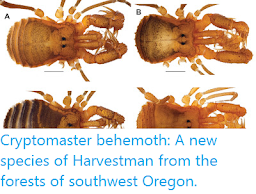
Cryptomaster behemoth: A new species of Harvestman from the forests of southwest Oregon.

Harvestmen, Opiliones, of the suborder Laniatores are an extremely diverse group of small predatory Arachnids noted for a high level of endemism (i.e. most species have extremely limited ranges). There are currently around 4100 described species, but this is likely to be a severe underestimate, as the group are not well studied and populations of similar Harvestmen at even nearby locations often turn out to be different species. The genus Cryptomaster was erected in 1969 to describe a single large species of Harvestman from the forests of southwest Oregon, Cryptomaster leviathan, which was found dwelling under spruce bark in virgin forest to the south of the town of Gold Beach in Curry County.

In a paper published in the journal ZooKeys on 20 January 2016, James Starrett of the Department of Biology at San Diego State University, Shahan Derkarabetian and Casey Richart of the Department of Biology at San Diego State University and the Department of Biology at the University of California, Riverside, and Allan Cabrero and Marshal Hedin also of the Department of Biology at San Diego State University, describe a new species of Cryptomaster from Oregon.

The new species is named Cryptomaster behemoth, in reference to Behemoth, a large monster mentioned in the Book of Job (the single previously decscribed species in the genus was named Cryptomaster leviathan, in reference to another such moster from the Book of Job). This species was found at a number of locations, though all were within Lane County, to the east of Eugene in the Cascade Mountains, from Brice Creek in the south to the Mckenzie River in the north. This is to the northeast of the known distribution of Cryptomaster leviathan, with no known specimen of either species found at a site producing the other. This suggests a very limited range for both species (typical of Laniatorine Harvestmen), though both species seemed to be fairly abundant within their ranges.

 
Cryptomaster dorsal coloration. (A) Male Cryptomaster leviathan. (B) Male Cryptomastern behemoth. (C) Female Cryptomaster leviathan. (D) Female Cryptomaster behemoth. Scale bars are 1 mm. Starrett et al. (2016).  

See also...


http://sciencythoughts.blogspot.co.uk/2015/11/iandumoema-smeagol-new-species-of.htmlIandumoema smeagol: A new species of Harvestman from caves in Minas Gerais State, Brazil.                                                          Harvestmen, Opiliones, are carnivorous Arachnids resembling Spiders, though they are not closely related and are incapable of producing silk...


Follow Sciency Thoughts on Facebook.
 

Monday, 7 December 2015

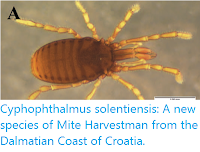
Cyphophthalmus solentiensis: A new species of Mite Harvestman from the Dalmatian Coast of Croatia.

Mite Harvestmen, Cyphophthalmi, are a distinctive group of Harvestmen, Opiliones, which are thought to form a sister group to all other Harvestmen. They are typically very small, no more than 6 mm in length, with very short legs compared to other Harvestmen, and are typically found living in soil, leaf litter or caves. Consequently they have very low distribution rates, making them particularly interesting to biogeographers. Mite Harvestmen are not found on oceanic islands, but are found on all continents except Antarctica (where they were probably present in the past), they have a fossil record dating back to the Cretaceous, with the oldest known members of the group being found in Burmese Amber.

In a paper published in the journal Brevoria on 9 February 2015, Taras Dreszer of the Museum of Comparative Zoology and Department of Organismic and Evolutionary Biology at Harvard University, Tonći Raða of the Spiljar Speleological Society and Gonzalo Giribet, also of the Museum of Comparative Zoology and Department of Organismic and Evolutionary Biology at Harvard University, describe a new species of Mite Harvestman from the Dalmatian Coast of Croatia.

The new species is placed in the genus Cyphophthalmus, which is found from Austria to Turkey, and is thought to have originated on the Adriatic Microplate, when this was a separate island between Europe and Africa, and is given the specific name solentiensis, meaning 'from Šolta' (Solent is the Latin name for Šolta Island on the Dalmatian coast, as the species was first discovered in Bratska jama cave on Šolta Island, though it was subsequently found at Podaspilje village on the Dalmatian mainland. Cyphophthalmus solentiensis is a small Harvestman, males reaching 2.09 mm and females 2.22 mm, brown-orange in colour with a granular texture to its cuticle (skin) and short, slender legs.


Cyphophthalmus solentiensis, male specimen in dorsal view. Dreszer et al. (2015).

A genetic analysis of the genus suggests that Cyphophthalmus solentiensis is closely related to Cyphophthalmus gjorgjevici, a species known from Skopje in Macedonia, 500 km southeast of the Dalmatian Coast, though the species are clearly distinct with Cyphophthalmus gjorgjevici having much coarser granulation of its cuticle among other features. Modern taxonomists use careful examination of the genitalia when describing species of Harvestmen (and many other invertebrate groups), as these tend to be distinctive at the species level. This was not the case when Cyphophthalmus gjorgjevici was described in 1933, and such a description is not available for the species, leaving an avenue for future research,

See also...

http://sciencythoughts.blogspot.co.uk/2015/11/iandumoema-smeagol-new-species-of.htmlIandumoema smeagol: A new species of Harvestman from caves in Minas Gerais State, Brazil.                                        Harvestmen, Opiliones, are carnivorous Arachnids resembling Spiders, though they are not closely related and are incapable of producing silk...
Follow Sciency Thoughts on Facebook.

Saturday, 21 November 2015

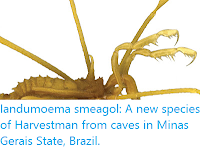
Iandumoema smeagol: A new species of Harvestman from caves in Minas Gerais State, Brazil.

Harvestmen, Opiliones, are carnivorous Arachnids resembling Spiders, though they are not closely related and are incapable of producing silk. They are found across the globe, but reach their maximum diversity in the tropics of Central and South America. The genus Iandumoema currently contains two species from cave systems in northern Minas Gerais State, Brazil. Iandumoema setimapocu is found in a single cave in the municipality of Coração de Jesus, while Iandumoema uai is found in two caves in the municipality of Itacarambi.

In a paper published in the journal ZooKeys on 18 November 2015, RicardoPinto-da-Rocha of the Departamento de Zoologia at the Universidade de São Paulo, Rafael da Fonseca-Ferreira of the Departamento de Ecologia e Biologia Evolutiva at the Universidade Federal de São Carlos and the Programa dePós-graduação em Biologia Comparada at the Universidade de São Paulo, and Maria Elina Bichuette, also of the Departamento de Ecologia e Biologia Evolutiva at the Universidade Federal de São Carlos, describe a new species of Iandumoema from two caves in the Monjolos Region of Minas Gerais State.

The new species is named Iandumoema smeagol, in reference to the cave dwelling creature Gollum/Smeagle from the writings of JRR Tolkein. It is an entirely cave-dwelling species, lacking in pigmentation and, unlike the previously described species in the genus, having completely lost its eyes.

Iandumoema smeagol, male specimen in right lateral view. Pinto-da-Rocha et al. (2015).

Iandumoema smeagol is known only from two caves, both within limestone rocks of the Bambuí Group at the edge of the Serra do Espinhaço Plateau. These caves are home to a large Bat colony, with extensive guano deposits that support a diverse assemblage of invertebrates. This population presumably provides a food source for the Harvestmen, though none was ever seen to approach the guano deposits.

Iandumoema smeagol has a known geographical distribution of 4.6 km2, which is fairly typical for a cave-dwelling invertebrate species, which tend to have high levels of endemism (very limited distributions). The area where it was found enjoys no legal protection, and deforestation and limestone extraction, as well as possible future hydroelectric projects, present a potential threat to the survival of the species. For this reason Pinto-da-Rocha et al. recommend that Iandumoema smeagol be regarded as Vulnerable under the terms of the  International Union for the Conservation of Nature's Red List of Threatened Species, and an effective conservation plan be developed to protect the area.

See also...

http://sciencythoughts.blogspot.co.uk/2015/08/tityus-apozonalli-new-species-of.htmlTityus apozonalli: A new species of Scorpion from Miocene Chiapas Amber.                              The ambers of Chiapas State, Mexico, were laid down in the Miocene (and possibly Oligocene) in shallow marine environments. The amber is thought to be derived from resin secreted from a Leguminous tree of the genus Hymenaea, which lived in mangrove...
http://sciencythoughts.blogspot.co.uk/2015/04/maratus-elephans-new-species-of-peacock.htmlMaratus elephans, a new species of Peacock Spider from New South Wales.                       Peacock Spiders of the genus Maratus are a group of Jumping Spiders, Salticidae, found only in Australia. They are small in size, typically less than 5 mm in length, though the males are brightly coloured and engage in elaborate courtship dances, which give...
http://sciencythoughts.blogspot.co.uk/2015/01/a-new-species-of-ixodid-tick-from.htmlA new species of Ixodid Tick from southern Brazil.                                                                               Ixodid Ticks of the genus Amblyommaare parasites of Mammals found on all continents except Europe and Antarctica, but at their most diverse in South America, with 31 species described from Brazil alone (46% of all known Tick species from Brazil). These Ticks...
Follow Sciency Thoughts on Facebook.