Showing posts with label Henan Province. Show all posts

Wednesday, 28 January 2026

Parafaveoloolithus xixiaensis: A new oospecies of Dinosaur eggs from the Upper Cretaceous of HenanProvince, China.

The Xixia Basin lies in Henan Province, China, to the east of the Qinling Mountains of southern Shaanxi Province, and extends roughly 100 km east-to-west, covering an area of about 518 km². Within this basin a series of Upper Cretaceous fluvial deposits overlie a Devonian basement. These deposits have been divided into three formations, the middle one of which, known as the Zhaoying (or sometimes Majiacun) Formation, comprises a 2120 m thick sequence beginning with motley argillaceous siltstones, sandstones and mudstones at the base, and grading into an upper layer comprising reddish mudstones and sandstones. This sequence, considered to have been laid down in a fluvio-lacustrine basin in an area with a generally arid climate, is noted for its production of preserved Dinosaur eggs, with at least seven described oospecies (because eggs are a record of a part of the life-cycle of an animal, can seldom be related to a species defined from body fossils, they are described under a parataxonomic system as oospecies, which are then organised into oogenera and oofamilies) from the Zhaoying and underlying Zoumagang (or Gaogou) formation, as well as ichnofossils (trace fossils), Dinosaur bones, Turtle eggs, and fossil Bivalves, Gastropods, Ostracods, Spinicaudatans, and Plants.

In a paper published in the journal Acta Palaeontologica Polonica on 17 December 2025, Qing He and Shutong Li of the School of Resources and Environmental Engineering at Anhui University, Shukang Zhang of the Institute of Vertebrate Paleontology and Paleoanthropology of the Chinese Academy of Sciences, Yifan Huang of the Prevention and Control Center for Geological Disasters at the Henan Geological Bureau, Xiqiang Cao of the Henan Scientific Academy of Land and Resources, and Hongqing Li and Mengyuan Zhu, also of the School of Resources and Environmental Engineering at Anhui University, describe a new oospecies of Dinosaur eggs from the Zhaoying Formation of Xixia County.

The new species is placed in the oogenus Parafaveoloolithus, and given the specific name 'xixiaensis' meaning 'from Xixia'. The species is described from a clutch of 13 subspherical eggs arranged in a radial pattern. The individual eggs are 123.3–142.6 mm by 97.2–127.2 mm, with shells 123.3–142.6 mm and 97.2–127.2 mm thick. The shells have a single structural layer with no visible growth lines and a honeycomb structure with straight pore canals. 

A clutch of Dinosaur egg oospecies Parafaveoloolithus xixiaensis. YJYM-01–13 (each egg has unique repository number), from the Upper Cretaceous of the Xixia Basin, Henan Province, China. He et al. (2025).

The oogenus Parafaveoloolithus belongs to the oofamily Faveoloolithidae, which includes six genera from the Late Cretaceous of China, Mongolia, and South Korea. No fossil eggs from outside East Asia have been assigned to the oofamily (some 'Titanosaur eggs' from the Late Cretaceous of Argentina have been suggested as possible members of the family, but this is doubtful), suggesting that the egg-layers had a limited geographical distribution, although they are found in a variety of different palaeoenvironments.

Thin sections (SREE X13-01) of Dinosaur eggshell Parafaveoloolithus xixiaensis, (YJYM-13) from the Upper Cretaceous of the Xixia Basin, Henan Province, China. (A₁) A single structural layer composed of loosely arranged eggshell units and the straight pore canals between eggshell units; arrows indicate the secondary eggshell units. (A₂) A line drawing showing the eggshell units in radial section. (A₃) Enlargement of the gathered egg￾shell units; arrow points to the single eggshell unit. (A₄) Growth centres of the gathered eggshell units; arrows point to the six growth centres. He et al. (2025).

Very few eggs belonging to the Faveoloolithidae have been found in clutches to date, and Parafaveoloolithus xixiaensis is probably the best known example to date. The radial pattern in which the eggs are arranged suggests that this is a true representation of how they were deposited, rather than a result of transportation and redeposition. He et al. suggest that the pattern and porosity of the eggs implies the female Dinosaur would have deposited the eggs in a roughly circular arrangement, before covering them over with sand - something which would also have aided there preservation. 

See also...


Tuesday, 16 January 2024

Thirteen confirmed fatalities following explosion at coal mine in Henan Province, China.

Thirteen people have now been confirmed dead, and another three are still missing following an explosion at a coal mine in Henan Province, China, on Saturday 13 January 2023. The incident happened at 2.55 pm local time, when 425 people were below ground at the Pingdingshan Tian'an Coal Mining Co's No 12 Mine in the city of Pingdingshan, and is reported to have been caused by a gas outburst. A group of miners rescued from a refuge close to the site of the explosion some hours after the explosion were treated for mild oxygen starvation, but all are expected to make a full recovery.

A group of rescue workers entering the Pingdingshan No 12 Mine on Saturday 13 January 2024. Hao Yuan/Xinhua.

Coal is formed when buried organic material, principally wood, in heated and pressurised, forcing off hydrogen and oxygen (i.e. water) and leaving more-or-less pure carbon. Methane is formed by the decay of organic material within the coal. There is typically little pore-space within coal, but the methane can be trapped in a liquid form under pressure. Some countries have started to extract this gas as a fuel in its own right. When this pressure is released suddenly, as by mining activity, then the methane turns back to a gas, expanding rapidly causing, an explosion. This is a bit like the pressure being released on a carbonated drink; the term 'explosion' does not necessarily imply fire in this context, although as methane is flammable this is quite likely.

Fire is much feared in coal mines due to this combination of flammable gas and solids, with methane and coal dust both potentially explosive when they come into contact with naked flames. To make matters worse, the limited oxygen supply in mines often means that such fires will involve incomplete combustion, in which all the oxygen is used up, but instead of forming carbon dioxide forms the much more deadly carbon dioxide, with potentially lethal consequences for anyone in the mine.

As coal is comprised more-or-less of pure carbon, and therefore reacts freely with oxygen (particularly when in dust form), to create carbon dioxide and (more-deadly) carbon monoxide, while at the same time depleting the supply of oxygen. This means that subterranean coal mines need good ventilation systems, and that fatalities can occur if these break down. 

Despite attempts to modernise its energy network, China is still reliant on coal for much of its energy, with 400 000 tonnes of coal mined in China in July 2023, and over 200 million tonnes of coal imported each year, most of it from Indonesia, Australia, South Africa, the United States, and Russia. China has been trying to reduce its dependence on foreign coal by expanding its own coal industry with new mines, but this has come at the cost of more accidents within the industry. 

China gains 70% of its energy from coal-burning power stations, which places the country under great pressure to maintain coal supplies. This has led to a poor safety record within the mining sector, particularly in the private sector, where there is a culture of seeking quick profits in poorly regulated (and sometimes officially non-existent) mines.  However, the Chinese authorities have been making efforts to remedy this situation, introducing safety regulations and closing (or at least attempting to close) mines that fail to comply. Annual deaths in Chinese mines have steadily fallen from 6995 in 2002 to 245 in 2022 (the latest year for which statistics are available).

Rescue attempts at the Pingdingshan No 12 mine are being co-ordinated by local authorities, with operations at all Pingdingshan Tian'an Coal mines having been suspended due to the high number of accidents which have happened at mines run by the company recently.

See also...

Monday, 28 June 2021

Homatula guanheensis: A new species of Stone Loach from Henan Province, China

The Stone Loach genus Homatula includes a number of small, benthic Fish, which live in the drainage basins of the Yellow, Yangtze, Pearl, Lancang, Nujiang and Red rivers. They are sometimes considered to be a part of the genus Paracobitis, which is morphologically similar, but the two are generally considered separate, due to their different distributions, with Homatula known only from China, and Paracobitis found only in western Asia. Studies based on the morphology of Homatula have suggested that there is more diversity that the current number of species (19-20), but to what extent this reflects variation within species rather than the presence of undescribed species remained unclear, until scientists began to apply genetic identifications to the genus.

In a paper published in the Biodiversity Data Journal on 16 June 2021, Chuanjiang Zhou, Wenwen Ma, Xi Wang, Yongtao Tang, Xiaoling Meng, and Guoxing Nie of the Engineering Technology Research Center of Henan Province for Aquatic Animal Cultivation at Henan Normal University, describe a new species of Homatula from the Guanhe River, in the HanJiang River drainage (a tributary of the Yangtze River),  in Xixia County, Henan Province.

The new species is named Homatula guanheensis, where 'guanheensis' means 'coming from Guanhe', in reference to the Guanhe River where it was found living in cave environments. Like other Stone Loaches, the new species is an elongate, slender Fish. The known specimens range from 76.9 to 109.26 mm in length, and are cylindrical, and flattened towards the rear. The head is short and flattened, and lacks scales. The snout is short, with nostrils closer to the eye than the tip. The eyes are oval, and located towards the top of the head. The lips are thick, and cover the jaw; there are three pairs of barbels. 

 
Homatula guanheensis (holotype, HNU 010048, 99.6 mm SL). (A) Lateral view; (B) Dorsal view; (C) Ventral view; (D) Mouth characters; (E) Intestine form; (F) X–ray (lateral view). Zhou et al. (2021).

See also...


Follow Sciency Thoughts on Facebook.

Follow Sciency Thoughts on Twitter.


Monday, 19 October 2020

Amynodontopsis jiyuanensis: A new species of Amynodont Rhinocerotoid from the Middle Eocene of Henan Province, China.

The Amynodontidae is an extinct family of Rhinocerotoidea (Mammalia, Perissodactyla), ranging from the Middle Eocene to the Late Oligocene in North America and Eurasia. The relationship between Amynodontids and other Rhinocerotoids remains obscure. Traditionally, Amynodontids were thought to be a separate family divergent from other Rhinocerotoids at early stage of Rhinocerotoid evolution. It has been proposed that Amynodontids are closely related to Paraceratheriids and Uintaceras. Recent phylogenetic work, however, has suggested that Amynodonts, Paraceratheriids and 'Pappaceras' meiomenus comprise monophyletic clade. Amynodontids are abundant in the Middle and Late Eocene of Asia and North America, but relatively rare in Europe. Twelve genera and 32 species of Amynodontidae have been named from Asia, however, some genera were considered to be invalid and their phylogenetic relationships remained controversial. The most primitive and oldest known Amynodontid is Rostriamynodon grangeri, which was discovered from the Middle Eocene Irdin Manha Formation of the Erlian Basin in China. Thus, Asia is the most probable place of the origin of Amynodontidae.

In a paper published in the journal Vertebrata PalAsiatica on 16 July 2020, Wang Xiao-Yang of the Key Laboratory of Vertebrate Evolution and Human Origins at the Institute of Vertebrate Paleontology and Paleoanthropology of the Chinese Academy of Sciences, and the College of Earth and Planetary Sciences at the University of Chinese Academy of Sciences, Wang Yuan-Qing, also of the Key Laboratory of Vertebrate Evolution and Human Origins at the Institute of Vertebrate Paleontology and Paleoanthropology of the Chinese Academy of Sciences, and the College of Earth and Planetary Sciences at the University of Chinese Academy of Sciences, and of the Center for Excellence in Life and Paleoenvironment, Zhang Rui of the Fourth Geological Exploration Institute of the Bureau of Geology and Mineral Resource of Henan Province, Zhang Zhong-Hui of the Henan Institute of Geological Survey, Liu Xiao-Ling of the Wangwushan-Daimeishan Global Geopark Administration, and Ren Li-Ping, also of the Henan Institute of Geological Survey, report a relatively well-preserved amynodontid skull collected in 2005 from the Middle Eocene Niezhuang Formation in the Jiyuan Basin, Henan Province, China.

The new specimen shows some primitive features and represents a new species of the genus Amynodontopsis, which improves our knowledge of the craniodental morphology and the geographical distribution of Amynodontids. In addition, it is also informative for understanding the origin of Amynodontopsis, as well as its phylogenetic relationship with other Amynodontids.

The new species is named Amynodontopsis jiyuanensis, where 'jiyuanensis' means 'from Jiyuan', in reference to the city where the specimen was found. The species is described from a single specimen, IVPP V 26305, a relatively well-preserved skull of an adult individual, housed in the Institute of Vertebrate Paleontology and Paleoanthropology, Chinese Academy of Sciences, Beijing. The right M2–3 are preserved in relatively good condition, and the left P4–M3 and the right P4–M1 are damaged to some extent. Only roots remain for C–P3 of both sides.

 
Skull of Amynodontopsis jiyuanensis (IVPP V 26305) from Jiyuan, Henan (A) lateral view; (B) dorsal view. Abbreviations: fr. frontal; ju. jugal; lac. lacrimal; mx. maxilla; na. nasal; oc. occipital condyle; pa. parietal; pf. preorbital fossa; pgp. postglenoid process; pmx. premaxilla; pocp. paroccipital process; ptp. posttympanic process; sc. sagittal crest; sq. squamosal. Wang et al. (2020).

The skull was preserved in a relatively good condition, but it was slightly laterally compressed and the nasals, premaxillae, maxillae, left zygomatic arch and occiput were partially broken off at different extent. In lateral view, the dorsal profile of the skull is slightly convex, with the highest point located at the anterior portion of the frontal. The nasal slopes anteriorly to some extent and a shallow depression appears at the fronto-parietal suture. The premaxilla is partially damaged, and only the nasal process is preserved. It extends far back along the maxilla, and contacts the nasal dorsally, excluding the maxilla from the border of the external nares. The nasal notch is shallow, and probably ends above the post-canine diastema. The anterior tip of nasal is slightly damaged, but it can be determined that the nasals are over the external nares. The maxilla forms most of the facial portion of the skull with some nutrient foramina present anterior to the orbit. A well-developed preorbital fossa is slightly concave in its anterior part, and becomes deeper posteriorly, extending far back medial to the orbit and forms a deep recess medial to the anterior rim of the orbit. The maxilla contacts the jugal and lacrimal posteriorly. The orbit is relatively low on the skull, and its anterior border is above the M2. The orbit is moderately large (around 40 mm in diameter) and well-defined. The postorbital process of the frontal is distinctly developed, situated approximately above the posterior portion of the M3. The lacrimal forms the anterodorsal rim of the orbit and contacts with the frontal on the dorsal side. The orbital surface of the lacrimal extends posteriorly to the level of the postorbital process. The surface of the lacrimal is rugose, with a prominent lacrimal tuberosity present along the anterior margin of orbit. A lacrimal foramen is present below the tuberostiy. The jugal forms the ventral border of the orbit. The zygomatic arch is comparatively thin (particularly at the zygomatic process of the squamosal) with a flat lateral surface, and its anterior root is located above M2. The cranial foramina are poorly preserved, and only a strip-shaped fissure filled by matrix is discernable. This fissure, posterodorsal to the pterygoid crest, contains probably the foramen orbitale and the foramen rotundum. The squamosal bears a broad glenoid fossa and a blunt postglenoid process ventrally. The posttympanic process is separated from postglenoid process by the wide external auditory meatus. The paroccipital process is fused with the posttympanic process. The paroccipital or posttympanic process slightly extends anteroventrally and reaches approximately the same level as the postglenoid process. The ventral part of the paroccipital process is slightly damaged, and the paroccipital process tends to be longer than the posttympanic process. There is a shallow temporal fossa bounded by the nuchal crest and a high and thin sagittal crest. The top of supraoccipital extends posteriorly and overhangs the occipital condyles.

In dorsal view, the skull presents the dolichocephalic character. Nasals are narrow and long, their profile is straight and smooth without any rugosity. The posterior ends of the nasals are pointed and separated from each other by an intruded frontal, which makes the naso-frontal suture into a 'W' shape. The suture is located above the middle of the orbit. The frontals expand laterally, with the widest part of the cranium at the level of the postorbital process. The deep preorbital fossae extend medial to the orbit in dorsal view, forming a constriction at the preorbital portion of the skull roof. The fronto-parietal suture is faint, and situated at the level of the most constricting part of the braincase. The sagittal crest is prominent and bifurcates posteriorly into two branches being continuous with the nuchal crest.

 
Skull and cheek teeth of Amynodontopsis jiyuanensis (IVPP V 26305) from Jiyuan, Henan (A) skull in ventral view; (B) right cheek teeth in occlusal view; (C) skull in occipital view. Abbreviations: bo. basioccipital; bs. basisphenoid; fm. foramen magnum; nc. nuchal crest; ofo. oval foramen; pac. posterior opening of the alisphenoid canal; pal. palatine; ppa. pterygoid process of alisphenoid. Scale bars are 5 cm. Wang et al. (2020).

The incisors are missing and canines are broken. The occlusal surfaces of P2–M1 are heavily worn. The right M2 and M3 are less worn, with both the protoloph and metaloph slightly broken. Moderate wear on molars shows that the skull was from a mature adult.

The canines are enlarged, inferred based on the vestige of the teeth, and situated anterior to the nasal notch. The heavily damaged right P4 is rectangular in outline with distinct and blunt paracone and metacone ribs on the labial wall. A well-developed crista on the lingual side of the ectoloph is preserved. A swollen antecrochet is present on the posterior side of the M1 protoloph. The M2 is trapezoidal in outline, and it is the longest in the upper tooth series. The labial length (38.2 mm) of the M2 is greater than the lingual length, and maximum width of the tooth is at the protoloph (37.2 mm). Thus, the ratio of the width and length of the M2 is nearly 0.98. The ectoloph of the M2 is elongate, extending posterolingually and slightly depressed lingually. The paracone rib is prominent and positioned relatively far anteriorly on the ectoloph, while the metacone rib is absent. Thus, the labial wall of ectoloph apparently straight and flat behind the protocone rib. Both the protoloph and metaloph are slightly inclined posterolingually and relatively long. The protoloph is strong with a faint antecrochet at base of the central valley, and there is no crochet or crista. The M3 is similar to the M2 in general morphology. The M3 is nearly quadrate and the protoloph and metaloph are well developed. The ectoloph is labially concave. The paracone rib is blunt and prominent. The metastyle is strongly deflected labially with a sharp posterior edge. The M3 metaloph and protoloph are nearly equal in length, relatively long, and widely separated; thus, the U-shaped central valley of the M3 is wider than that of the M2. The M3 lacks the crochet, antecrochet and crista. The upper molars have anterior and posterior cingula at base, while the labial cingula are absent and the weak lingual cingulum is only present at the central valley of the M1. The length of premolar series is estimated to be about half that of the molar series.

The new specimen has a well-developed preorbital fossa, a pronounced sagittal crest, a somewhat enlarged canine, a quadrangular M3 with deflected labially metastyle and simple upper molars without crista and crochet. The combination of these morphological features suggests the similarity of the new specimen to the Amynodontids. Thus, this animal is referred to the family Amynodontidae.

IVPP V 26305 shares a number of characters with Amynodontopsis, such as a dolichocephalic skull, prominent sagittal crest, presence of premaxilla-nasal contact, orbit located low on skull and its anterior border positioned above the M2 protoloph, antecrochet presented on the M1, and the M3 metastyle is strongly deflected labially. Particularly, the large preorbital fossa extending behind the anterior borders of the orbits presents a noticeable difference from other genera. The combination of these morphological features indicates that V 26305 is referable to Amynodontopsis, which contains three previously named species: Amynodontopsis bodei, Amynodontopsis parvidens, Amynodontopsis tholos.

The new specimen is clearly distinguishable from the known species of Amynodontopsis in its craniodental morphology and smaller size. The type species Amynodontopsis bodei, from the Duchesnean North American Land Mammal Age, is clearly distinguishable from V 26305 in the following aspects: (1) the nasal notch extending back to a point of the anterior edge of the M1 in Amynodontopsis bodei, which is situated above the post-canine diastema in V 26305; (2) the nasals of Amynodontopsis bodei are shorter than thoseof V 26305; (3) the nasal process of the premaxilla is reduced and contacts with the nasal slightly by a downward extension of the nasals in Amynodontopsis bodei, whereas in V 26305, it is considerably longer and very broad laterally below the nasals, excluding the maxilla from the border of the external nares; (4) the zygomatic arch is relatively large in vertical dimension and angles sharply upward posteriorly in Amynodontopsis bodei, while in V 26305 the zygomatic arch is slender, passing upward gradually; (5) the postorbital process of jugal is absent in Amynodontopsis bodei, but present in V 26305; (6) the posttympanic process is further separated from the postglenoid process both in Amynodontopsis bodei and V 26305, but the external meatus of the former is more opening ventrally than that of the latter; (7) the profile is flat in Amynodontopsis bodei, while V 26305 has a convex dorsal profile, a lower occiput and the supraoccipital extending more posteriorly over the occipital condyles; (8) the protocone rib of the P4 is less prominent in Amynodontopsis bodei than in V 26305; (9) relative to M1, the M2 and M3 in Amynodontopsis bodei are proportionally larger than those in V 26305; (10) the metastyle is deflected labially on the M2 in Amynodontopsis bodei, while V 26305 has a metastyle of the M2 warped inward slightly; (11) the M2 of Amynodontopsis bodei lacks antecrochet, but V 26305 has a faint antecrochet on the M2; (12) the presence of wrinkles on inner side of the ectoloph of M2 and on the anterior side of the metaloph of the M3 is more specialized in Amynodontopsis bodei.

William Wall assigned a number of specimens, collected by the Central Asiatic Expeditions in the Erlian Basin, to the genus Amynodontopsis, and named two new species, Amynodontopsis parvidens and Amynodontopsis tholos. V 26305 obviously differs from Amynodontopsis parvidens in several craniodental features. The nasal of Amynodontopsis parvidens is more reduced than that of V 26305. The anterior tip of the nasal The nasal process of premaxilla in Amynodontopsis parvidens is greatly reduced laterally, causing the maxilla to become part of the border of the external nares in V 26305 is probably rounded, whereas it is generally squared off in Amynodontopsis parvidens, while in V 26305 the premaxilla is well developed in lateral extent, forming a distinct premaxilla-nasal contact in lateral view and restricting the maxilla from the border of the external nares. The nasal notch in Amynodontopsis parvidens extends to a point above the front of the P4, whereas it is situated above the post-canine diastema in V 26305.

Amynodontopsis tholos, from the Erlian Basin, is the largest species of Amynodontopsis and displays some derived characters. The facial region in Amynodontopsis tholos differs from that of V 26305 in having an extremely reduced nasal with its anterior border squared off, a premaxilla ending approximately two thirds the way up the external nares where it contacts the nasal and a nasal notch extending back to a point above the M1. The most distinctive difference between them is that the skull of Amynodontopsis tholos expands into a wide dome above the orbit. The antecrochet on the M1 of A. tholos is not as stout as in V 26305. The protoloph and metaloph of the M2 and M3 are oriented more posteriorly in Amynodontopsis tholos, whereas they are more developed and nearly perpendicular to the ectoloph in V 26305.

In 2018 Jérémy Tissier, Damien Becker, Vlad Codrea, Loïc Costeur,  Cristina FărcaÅŸ, Alexandru Solomon, Marton Venczel,  and Olivier Maridet, referred three specimens, two maxillary fragments and a lower jaw fragment, to Amynodontopsis aff. Amynodontopsis bodei. The specimens were found from the Upper Eocene Valea Nadăşului Formation of Romania and the Middle Eocene Dorog Coal Formation of Hungary. They referred the specimens to Amynodontopsis mainly based on the moderate angle of the zygomatic process of the maxilla in ventral view, the absence of cement on upper molars and a weak paracone rib on the M3. However, the first two characters are not derived characters, and Amynodontopsis does not show the reduction of the paracone rib on the M3. In addition, the Romanian maxillary fragment with M1–3 differs from Amynodontopsis in the absence of an antecrochet on the M1, having a very small metastyle on the M2 and a metastyle directed more posterolingually on the M3. The Hungarian maxillary fragment with M2–3 differs from Amynodontopsis in having protocones constricted anteriorly and a continuous labial cingulum on the M1. The Romanian mandibular fragment with m1/2, differs from Amynodontopsis in having narrower cheek teeth with a better developed external groove. Therefore, the assignation of the European specimens needs reexamination. A mandible fragment with p4 and roots of m1–3, from southern Mexico, was identified as Amynodontopsis cf. bode, cannot be directly compared with V 26305.

Consequently, the skull of V 26305 is evidently characteristic of Amynodontopsis in its morphology. However, the new specimen differs from all three previously named species of Amynodontopsis and has unique characters. Therefore, Wang et al. name a new species, Amynodontopsis jiyuanensis, for V 26305.

Previous study has suggested some evolutionary trends in Amynodontid skull morphological features, such as the decrease of the nasal length, reduction of the nasal process of the premaxilla, the contact between nasal and premaxilla going from shortened to absent, and the nasal notch being located more posteriorly. In addition, the cheek teeth of Amynodontids are thought to have undergone evolutionary changes in being narrower, corresponding to the protoloph and metaloph being shorter and more obliquely orientated. Some characters of Amynodontopsis jiyuanensis are more primitive than those of the three other species. For instance, the P4 has nearly the same transverse width as the M1; the protoloph and metaloph on the upper molars are approximately equal in length, proportionally longer relative to the ectoloph, and closer to being perpendicular to the ectoloph; the nasal process of the premaxilla is long and very broad laterally below the nasals, excluding the maxilla from the border of the external nares; the nasal bone is not reduced; the nasal notch situates above the post-canine diastema. It is reliable to consider that Amynodontopsis jiyuanensis probably represents the most primitive taxon within the genus Amynodontopsis. 

The Niezhuang Formation of the Jiyuan Basin is not very rich in Mammal fossils. Fossil Mammals reported from the formation include the Rodent Yuomys cavioides, the Amynodont Rhinocerotoids Lushiamynodon obesus, Sianodon chiyuanensis, Sianodon sinensis, and Sianodon sp. and an unidentified Hyracodontid Rhinocerotoid. Yuomys cavioides, one of the diagnostic taxa common in different sites and restricted to the Sharamurunian Asian Land Mammal Age, was found in Ula Usu, west side of the Shara Murun River. The Sharamurunian is currently correlated with the late Uintan North American Land Mammal Age that is earlier than the Duchesnean. Amynodontopsis jiyuanensis is thus the earliest fossil record of the genus.

The primitive characters and earlier occurrence of Amynodontopsis jiyuanensis suggest that Amynodontopsis originated in Asia no later than the Middle Eocene Sharamurunian Asian Land Mammal Age and migrated from Asia to North America later as ancestral form of Amynodontopsis bodei.

See also...


Online courses in Palaeontology. 

Follow Sciency Thoughts on Facebook.

Follow Sciency Thoughts on Twitter. 


Friday, 1 September 2017

Rana luanchuanensis: A new species of Brown Frog from Henan Province, China.

Brown Frogs, Rana spp., are found across much of Eurasia and the Americas, with over a hundred species currently recognised. They tend to be small and dull coloured, which can make them difficult to tell apart, and tend to have slim waists, smooth skin, and slender legs. These Frogs typically breed early in spring in temperate regions, and throughout the year in the tropics and subtropics, with females laying large bundles of eggs in standing or slow-moving water, and under the right circumstances can undergo rapid population explosions.

In a paper published in the journal ZooKeys on 29 August 2017, Haipeng Zhao of the Kunming Institute of Zoology of the Chinese Academy of Sciences, the Kunming College of Life Science at the University of Chinese Academy of Sciences, and the School of Life Science at Henan University, Junxiao Yang, also of the Kunming Institute of Zoology of the Chinese Academy of Sciences, and the Kunming College of Life Science at the University of Chinese Academy of Sciences, Chunping Wang of the Henan Forestry Survey and Planning Institute, Pipeng Li of the Center for Chinese Endemic Herp-breeding and Conservation Research, and Liaoning Key Laboratory of Evolution and Biodiversity at Shenyang Normal University, Robert Murphy, again of the Kunming College of Life Science at the University of Chinese Academy of Sciences, and also of the Centre for Biodiversity and Conservation Biology at the Royal Ontario Museum, Jing Che, again of the Kunming Institute of Zoology of the Chinese Academy of Sciences, and Zhiyong Yuan of the College of Forestry at the Southwest Forestry University, describe a new species of Brown Frog from Luanchuan County in western Henan Province in central China.

The new species is named Rana luanchuanensis, meaning 'from Luanchuan'. It is a small species, with males reaching 27.2-33.0 mm and females 23.7-41.2 mm. The Frogs are greyish brown in colour, with black, brown and grey markings, and a white belly. They have a distinctive black stripe that runs from the nose back through the line of the eyelids. The species was found living in slow, shallow streams with extensive gravel beds.

Rana luanchuanensis, live specimen. Zhao et al. (2017).

See also...

http://sciencythoughts.blogspot.co.uk/2017/05/hyperolius-ruvuensis-new-species-of.htmlhttp://sciencythoughts.blogspot.co.uk/2017/01/pristimantis-ashaninka-new-species-of.html
http://sciencythoughts.blogspot.co.uk/2016/08/leptobrachella-itiokai-new-species-of.htmlhttp://sciencythoughts.blogspot.co.uk/2016/07/pristimantis-prometeii-new-species-of.html
http://sciencythoughts.blogspot.co.uk/2016/03/microhyla-laterite-new-species-of.htmlhttp://sciencythoughts.blogspot.co.uk/2015/12/painted-frogs-from-middle-miocen-of.html
Follow Sciency Thoughts on Facebook.

Monday, 5 January 2015

The sources of the Xixia and Zhangpu Ambers.


Amber is the mineralized remnants of resins secreted by ancient plants. It is valued by palaeontologists due to the frequent presence of preserved insects, pollen and soft-bodied micro-organisms within amber clasts; it is also widely used in the jewellery industry, and in Chinese medicine. The resins which form amber are known to have originated from a number of different plant groups, including Pines, Dipterocarps, Sciadopityas (Japanese Umbrela Pines), Araucarias, Cypresses, Yews, Legumes and other Conifer and Angiosperm (Flowering Plant) groups. Amber is traditionally collected from three sites in China, Fushun in Northeast China, Xixia in Central China, and Zhangpu in Southeast China. The Early Eocene Fushan Amber has been extensively studied, due to its frequent Insect and Plant inclusions, and is considered to have been produced by a form of Cypress, however the other two sources have not to date produced any fossil inclusions, and therefore have been largely overlooked in other studies.

In a paper published in the journal PLoS One on 29 October 2014, Gongle Shi of the State Key Laboratory of Palaeobiology and Stratigraphy at the Nanjing Institute of Geology and Palaeontology of the Chinese Academy of Sciences, SuryenduDutta and Swagata Paul of the Department of Earth Sciences at the IndianInstitute of Technology Bombay, Bo Wang, also of the State Key Laboratory of Palaeobiology and Stratigraphy at the Nanjing Institute of Geology and Palaeontology and of the Steinmann Institute at the University of Bonn, and Frédéric Jacques of the Key Laboratory of Tropical Forest Ecology at the Xishuangbanna TropicalBotanical Garden of the Chinese Academy of Sciences, discuss the chemical composition of the Xixia and Zhangpu Ambers, as determined by gas chromatography-mass spectrometry, and the implications of this for the botanical origins of the amber.

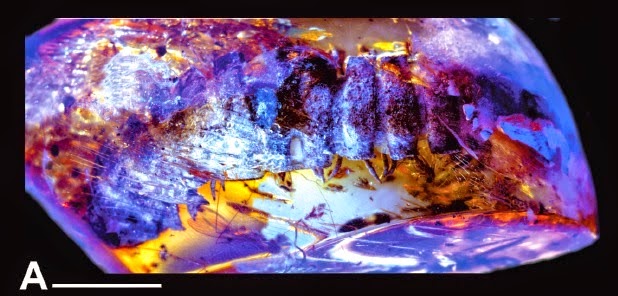
The Xixia Amber originates from the Late Cretaceous Gaogou Formation in Henan Province in Central China. The beds which produce it are best known for their production of well-preserved Dinosaur eggs, and have also produced Bivalve and Ostracod assemblages, but neither plant macrofossils nor pollen. They are interpreted as non-marine sedimentary deposits, with layers of mudstones, siltstones, sandstones and conglomerates. Xixia Amber is extremely abundant, but typically comes in tiny opaque lenses in yellow, brown, brownish yellow or brownish red. To date no fossils have been reported from Xixia Amber.

Late Cretaceous Xixia Amber. Shi et al. (2014).

The Xixia Amber proved to be rich in abietanediterpenoids, which is taken to be diagnostic of a Coniferous rather than Flowering Plant origin, as they are derived from abietic acid, which is produced by almost all Conifers, but not Angiosperms. The amber does not contain labdanedericatives, which are produced by Pines, and does contain tetracyclic diterpenoids, which are not, so Pines are therefore ruled out as the origin of this amber. Neither were cedrane and cuparane, produced by Cypresses, nor totarol, ferruginol orsugiol, produced by Cypresses and Podocarps, found in the samples, making it highly unlikely that the amber was of Cypress origin. The amber did contain tricyclic rimuane, which is produced by Podocarps and Araucarias, and phyllocladane, which is produced by Podocarps, Araucarias and Cypresses, from which Shi et al. conclude that the amber is most likely to have originated from a form of Araucaria.

Araucarias today are mainly restricted to the Southern Hemisphere, being found in Malaysia, Indonesia, Philippines, New Guinea, Australia, New Zealand, New Caledonia, Vanuatu, Fiji, Norfolk Island and southern South America, as well as being introduced in other areas as ornamental plants. However they are known to have been widespread in the Northern Hemisphere during the Mesozoic, and have been previously linked to amber deposits from the Early Cretaceous of Spain and Jurassic of Thailand. Shi et al. also note that while amber is found throughout the Mesozoic, it becomes much more widespread from the Early Cretaceous onwards, a timescale which also coincides with a major radiation of the Araucarias, making it possible that many Mesozoic ambers originate from these trees.

A modern Araucaria, the Paraná Pine, Araucaria angustifolia. Ricardo Frantz/Wikimedia Commons.

Podocarps are today found in tropical and subtropical upland forests in both hemispheres, reaching their northernmost distribution in southern China, Japan, Mexico and the Caribbean Islands. However modern members of the group produce much less resin than Araucarias, making them a less likely source of origin for ancient ambers, and the group is not thought to have been present in China during the Cretaceous.

Shi et al. also note that an extinct group of Conifers, the Cheirolepidiaceae, which appeared in the Late Triassic and persisted till the Late Cretaceous, has been liked to some ambers in southern Europe. This group were a dominant Conifer family globally in the Jurassic and Early Cretaceous, and are also likely to have contributed to amber deposits in other areas. Studies of amber associated with Cheirolepidiaceaen macrofossils from the Early Cretaceous of Spain have shown high levels of phenolic abietane, a chemical absent from the Xixia Amber samples, but given our limited understanding of this group, it cannot be completely ruled out as an origin for the Xixia Amber.

The Zhangpu Amber derives from the Middle Miocene Fotan Group in Fujian Province in Southeast China. The Fotan Group is noted for its Plant macrofossils, including leaves and fruits and lignified wood, some of which contains amber in situ. The fossils are interpreted as having originated in a Diptocarp-dominated tropical rainforest. The area currently has a warm subtropical climate with a seasonal climate, with distinct monsoon and dry seasons, and a flora dominated by subtropical evergreen broadleaved forests, however the Fotan deposits have been dated to14.7–14.9 million years ago, close to the Mid-Miocene Climatic Optimum, using pollen assemblages and Argon isotope dating (expand). Diptocarp forests are today found in lowland areas across much of Southeast Asia.

Middle Miocene Zhangpu Amber. Shi et al. (2014).

The Zhangpu Amber contains amyrin and amyrone-based triterpenoids, indicating an Angiosperm origin, and polymers of bicyclic sesquiterpenoid and triterpenoids hydrocarbons, which are typical of ambers produced by Diptocarps, though they are also produced by trees of the genus Mastixia, a type of Dogwood. Given the dominance of Diptocarp macrofossils in the deposits producing the amber, Shi et al. conclude this group is the more likely origin.

Diptocarps are thought to be of Gondwanan origin, and today are found in South and Southeast Asia, South America, Africa, Madagascar and the Seychelles. The group is thought to have reached Asia with the collision of the India and Eurasian Plates, with the earliest known Asian fossils dating from the Early Eocene of India. There are three subfamilies within the Dipterocarpaceae, only one of which, the Dipterocarpoideae, which is found in South and Southeast Asia and the Seychelles; the Diptocarps of South America, Africa and Madagascar lack resin ducts and do not produce resin. Diptocarps have previously been linked to amber deposits from the Eocene and Miocene of India and the Eocene of Vietnam; the Zhangpu Amber is the most northerly amber linked to this plant group, though given the presence of Diptocarp macrofossils in the same deposits, this is not remarkable.

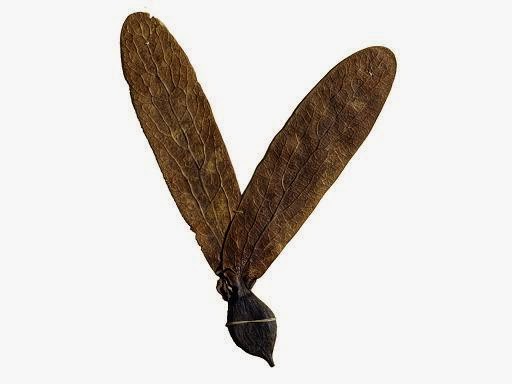
A modern Diptocarp wing fruit. Shi & Li (2010).

See also…

http://sciencythoughts.blogspot.co.uk/2014/12/a-polypore-fungus-beetle-from-early.htmlA Polypore Fungus Beetle from the Early Cretaceous of France.                                              Beetles first appear in the fossil record in the Early Permian. And by the Triassic were already beginning to dominate Insect faunas, with many modern groups in existence by the end of the Cretaceous. However...
http://sciencythoughts.blogspot.co.uk/2014/11/two-new-species-of-flat-backed.html Two new species of Flat-backed Millipede from Miocene Mexican amber.                   Millipedes, Diplopoda, are highly successful soil dwelling Arthropods found in soil in all temperate and tropical...
http://sciencythoughts.blogspot.co.uk/2014/09/two-new-species-of-froghopper-from.html Two new species of Froghopper from Dominican amber.                                              Froghoppers (Cercopoidea) are small members of the True Bug order (Hemiptera), related to Cicadas (Cicadoidea), Leafhoppers and Treehoppers...

Follow Sciency Thoughts on Facebook.