Showing posts with label Eggs. Show all posts

Thursday, 14 May 2026

An embryonic Synapsid from the Early Triassic of South Africa.

 The persistence of egg-laying in modern Monotremes has led evolutionary biologists to conclude that this is likely to have been the ancestral state in the Synapsids, the group from which the Mammals arose. However, fossil evidence for this has been surprisingly absent. The earliest known potential fossil amniotic egg comes from the Permian of South America, and has been attributed to a Mesosaurid Sauropsid (a group not closely related to Synapsids of Mammals). This specimen preserves an immature skeleton curled in a position consistent with having been in an egg at the time of death, but no actual eggshell (not altogether surprising, as the earliest amniote eggs are not predicted to have been mineralised). The earliest amniotic egg fossils with both embryonic remains and eggshell come from Sauropodomorph dinosaurs from the Early Jurassic of Gondwana. Some potential eggs associated with Synapsid Pelycosaurs from the Early Permian of North America are not considered to be reliable, as neither embryos nor shell structures are preserved.

The Late Triassic-Early Jurassic Elliot Formation of South Africa's Karoo Basin has produced numerous Dinosaur egg fossils with embryos, as well as the skeletal remains of many non-Mammalian Cynodonts, something which has led to questions about whether Permo-Triassic Synapsids laid eggs at all. This is a serious consideration; Synapsids, particularly groups such as Lystrosaurus and Diictodon, are extremely common in the Permian and Triassic of the Karoo, with perinate specimens (specimens thought to have died around the time of birth or hatching) being found here and elsewhere, but no eggs are known. The preservation of Dinosaur eggs in the Karoo suggests there was no taphonomic process here producing a bias against the preservation of eggs, and palaeontologists have been active in the Karoo Basin for over 180 years, suggesting that if such eggs were present, there should have been a good chance of their being found. Egg-laying and bearing live young are found in closely related Snakes and Lizards, and it appears that this group has been able to switch back-and-forth between these conditions fairly easily. It is therefore conceivably possible that Synapsids developed the ability to bear live young very early in their history, and that Monotremes have secondarily switched back to egg-laying.

However, this has wider implications than Synapsid palaeontology. Current theories on the origin of lactation in Mammals have been built on the assumption that this preceeded the switch to live-birth (largely because Monotremes produce both eggs and milk). It is now generally accepted that the purpose of lactation was not originally to feed the young, but rather started as skin secretions used to either moisturise the eggs, provide nutrients, protect them against fungi and bacterial infections, or for hormonal signalling through the egg membrane. Should it be found that the Synapsids from which Mammals evolved bore live young, then these theories would have to be abandoned.

In a paper published in the journal PLoS One on 9 April 2026, Julien Benoit of the Evolutionary Studies Institute at the University of the Witwatersrand, Vincent Fernandez of the European Synchrotron Radiation Facility, and Jennifer Botha of the Evolutionary Studies Institute and Centre of Excellence in Palaeosciences at the University of the Witwatersrand, describe three perinate specimens of the Dicynodont Synapsid Lystrosaurus from the Early Triassic of Xhariep Municipal District in Free State Province, South Africa, one of which appears to have been preserved within an egg.

The specimens examined are the three smallest specimens attributed to Lystrosaurus. They include BP/1/4011, an isolated skull measuring 43.0 mm, discovered by James Kitching in the upper Palingkloof Member of the Balfour Formation at Orangia on Tweefontein 508, BP/1/9332, an almost complete articulated skeleton with a skull length of 44.0 mm, discovered by Brandon Stuart in the upper Palingkloof Member of the Balfour Formation at Nooitgedacht 68 Farm near Spitskop, and NMQR 3636, a complete skeleton with a skull length of 34.5 mm, found by John Nyaphuli at Rheeboksfontein 5 Farm in 2008, probably from the upper Palingkloof Member of the Balfour Formation or the lower Katberg Formation.Each of these fossils was a scanned at the European Synchrotron Radiation Facility in Grenoble, France, with three dimensional models being reconstructed with the Avizo Software Package.

The isolated skull BP/1/4011 was described by Kitching as the smallest known skull attributed to Lystrosaurus in 1964, and attributed to either Lystrosaurus murrayi or Lystrosaurus curvatus by a study in 2006. Benoit et al. are more cautious, attributing it to Lystrosaurus sp. but suggesting it shows affinities to Lystrosaurus curvatus.

The first of the articulated skeletons, BP/1/9332, is considered to be an early juvenile of Lystrosaurus sp., with affinities to Lystrosaurus murrayi. It is preserved in a splayed out position, similar to that of most larger Lystrosaurus specimens from the Karoo Basin, with most bones perfectly articulated, and synchrotron images show that no loose elements are preserved in the surrounding matrix. It appears to be the most developmentally advanced of the three specimens, because its splenials are co-ossified at the mandibular symphysis, although its occipital and basicranial bones remain loose. From the splayed out position in which it was found, Benoit et al. determine that it had hatched before dying, probably moving some distance from its hatching site before death.

Photograph of BP/1/9332 in dorsal view. Benoit et al. (2026).

The final specimen, NMQR 3636, is also considered by Benoit et al. to be an early juvenile of Lystrosaurus sp., with affinities to Lystrosaurus murrayi. However, unlike BP/1/9332, this specimen is curled into a fetal position, consistent with having been within an egg at the time of death. It also appears to be the most developmentally immature of the specimens, lacking tusk buds in its maxillary alveolae, something present in both the other specimens, or a mesethmoid bone, the structure that supports the olfactory bulbs in life, which is again present in the other two specimens. 

Most notably, the lower jaw of NMQR 3636 has an incompletely co-ossified symphyseal suture between the two paired bones in the lower jaw. This is completely co-ossified in both the other specimens, as well as in modern beaked Amniotes such as Turtles and Birds at the time of hatching. Modern Monotremes do hatch with an unfinished intermandibular symphysis, but these feed on milk provided by their mothers for some time after hatching, something Lystrosaurus is not thought likely to have been able to produce. 

Based upon this, Benoit et al. conclude that the early developmental stage of the skeleton, combined with a posture which would be expected of a perinate prior to hatching and a jaw which had not developed to the stage where it could feed on the hard foodstuffs likely to have been consumed by juvenile Lystrosaurus. is indicative of an Animal which died within the egg and was subsequently preserved, albeit without preservation of the egg itself.

Specimen NMQR 3636 in left lateral view. (a) Photograph of the specimen; (b) 3D digital reconstruction of the segmented bones; (c) live reconstruction by artist Sophie Vrard. Colour code for (b): vertebral elements in shades of green, ribs in blue, forelimb elements in red, femur in yellow, pelvic girdle elements in grey, skull in light red, mandible in light orange. Benoit et al. (2026).

Based upon the position of the embryo, it is estimated that the original egg was 3.65 cm long and 2.75 cm in diameter, with an internal mass of 115 cm³ and a mass of 115 g. While size estimates for adult Lystrosaurus vary, this is clearly larger compared to the size of an adult than either living Monotremes or most non-Avian Reptiles, although comparatively smaller than the eggs of Birds. This is probably indicative of a large yolk, which can feed the embryonic Animal for longer, allowing it to develop further within the egg. 

Modern Monotremes produce small eggs compared to the size of an adult, which contain comparatively little yolk material. This is possible because the young hatch at an early developmental stage, and are then nourished with milk. Interestingly, the Jurassic Tritylodontid Cynodont Kayentatherium produced eggs which were even smaller compared to the size of an adult. While Kayentatherium has been reconstructed as being quite Reptile-like in physiology, the small egg size could be a sign that it was capable of a form of lactation. It has also been suggested that Kayentatherium probably had hair, something which is known to be linked genetically to the formation of mammary glands (which produce milk), and it has also been shown that there is a genetic link between the reduction in egg yolk production and the ability to produce milk. All of which suggests that Kayentatherium may have been more Mammal-like than previously reconstructed, and that the appearance of the ability to produce milk may have been closely linked to the emergence of the Mammaliamorpha.

See also...

Wednesday, 28 January 2026

Parafaveoloolithus xixiaensis: A new oospecies of Dinosaur eggs from the Upper Cretaceous of HenanProvince, China.

The Xixia Basin lies in Henan Province, China, to the east of the Qinling Mountains of southern Shaanxi Province, and extends roughly 100 km east-to-west, covering an area of about 518 km². Within this basin a series of Upper Cretaceous fluvial deposits overlie a Devonian basement. These deposits have been divided into three formations, the middle one of which, known as the Zhaoying (or sometimes Majiacun) Formation, comprises a 2120 m thick sequence beginning with motley argillaceous siltstones, sandstones and mudstones at the base, and grading into an upper layer comprising reddish mudstones and sandstones. This sequence, considered to have been laid down in a fluvio-lacustrine basin in an area with a generally arid climate, is noted for its production of preserved Dinosaur eggs, with at least seven described oospecies (because eggs are a record of a part of the life-cycle of an animal, can seldom be related to a species defined from body fossils, they are described under a parataxonomic system as oospecies, which are then organised into oogenera and oofamilies) from the Zhaoying and underlying Zoumagang (or Gaogou) formation, as well as ichnofossils (trace fossils), Dinosaur bones, Turtle eggs, and fossil Bivalves, Gastropods, Ostracods, Spinicaudatans, and Plants.

In a paper published in the journal Acta Palaeontologica Polonica on 17 December 2025, Qing He and Shutong Li of the School of Resources and Environmental Engineering at Anhui University, Shukang Zhang of the Institute of Vertebrate Paleontology and Paleoanthropology of the Chinese Academy of Sciences, Yifan Huang of the Prevention and Control Center for Geological Disasters at the Henan Geological Bureau, Xiqiang Cao of the Henan Scientific Academy of Land and Resources, and Hongqing Li and Mengyuan Zhu, also of the School of Resources and Environmental Engineering at Anhui University, describe a new oospecies of Dinosaur eggs from the Zhaoying Formation of Xixia County.

The new species is placed in the oogenus Parafaveoloolithus, and given the specific name 'xixiaensis' meaning 'from Xixia'. The species is described from a clutch of 13 subspherical eggs arranged in a radial pattern. The individual eggs are 123.3–142.6 mm by 97.2–127.2 mm, with shells 123.3–142.6 mm and 97.2–127.2 mm thick. The shells have a single structural layer with no visible growth lines and a honeycomb structure with straight pore canals. 

A clutch of Dinosaur egg oospecies Parafaveoloolithus xixiaensis. YJYM-01–13 (each egg has unique repository number), from the Upper Cretaceous of the Xixia Basin, Henan Province, China. He et al. (2025).

The oogenus Parafaveoloolithus belongs to the oofamily Faveoloolithidae, which includes six genera from the Late Cretaceous of China, Mongolia, and South Korea. No fossil eggs from outside East Asia have been assigned to the oofamily (some 'Titanosaur eggs' from the Late Cretaceous of Argentina have been suggested as possible members of the family, but this is doubtful), suggesting that the egg-layers had a limited geographical distribution, although they are found in a variety of different palaeoenvironments.

Thin sections (SREE X13-01) of Dinosaur eggshell Parafaveoloolithus xixiaensis, (YJYM-13) from the Upper Cretaceous of the Xixia Basin, Henan Province, China. (A₁) A single structural layer composed of loosely arranged eggshell units and the straight pore canals between eggshell units; arrows indicate the secondary eggshell units. (A₂) A line drawing showing the eggshell units in radial section. (A₃) Enlargement of the gathered egg￾shell units; arrow points to the single eggshell unit. (A₄) Growth centres of the gathered eggshell units; arrows point to the six growth centres. He et al. (2025).

Very few eggs belonging to the Faveoloolithidae have been found in clutches to date, and Parafaveoloolithus xixiaensis is probably the best known example to date. The radial pattern in which the eggs are arranged suggests that this is a true representation of how they were deposited, rather than a result of transportation and redeposition. He et al. suggest that the pattern and porosity of the eggs implies the female Dinosaur would have deposited the eggs in a roughly circular arrangement, before covering them over with sand - something which would also have aided there preservation. 

See also...


Sunday, 26 November 2023

Dinosaur eggs from the Late Cretaceous Moxia Formation of Jiangxi Province, China.

The Moxia Formation of southern Jiangxi Province in southeast China forms part of the Wuning Group redbeds, with a mixture of sandstones and conglomerates, thought to have been laid down in a pluvial fan environment (i.e. an environment in which sediments are laid down after being washed out of hills or uplands in periodic, rain driven floods). These beds have not been dated precisely, and are thought to be Late Cretaceous or Palaeogene in origin.

In a paper published in the journal Vertebrata PalAsiatica in October 2023, Zhou Ming-Xiao of the Institute of Vertebrate Paleontology and Paleoanthropology of the Chinese Academy of Sciences, and the University of the Chinese Academy of Sciences, Yan Yun of the Wuning County Museum, Qui Wen-Jiang of the Basic Geological Survey Institute of the Jiangxi Geological Survey and Exploration Institute, Fang Kai-Yong, also of the Institute of Vertebrate Paleontology and Paleoanthropology of the Chinese Academy of Sciences, Zhu Xu-Feng of the National Natural History Museum of China, Wang Qiang, again of the Institute of Vertebrate Paleontology and Paleoanthropology of the Chinese Academy of Sciences, and Wang Xiao-Lin, once again of the Institute of Vertebrate Paleontology and Paleoanthropology of the Chinese Academy of Sciences, the University of the Chinese Academy of Sciences, and of the Centre for Research and Education on Biological Evolution and Environment at Nanjing University, describe a clutch of Dinosaur eggs from the Moxia Formation, uncovered during construction work in the town of Luoping in Wuning County, southern Jiangxi Province, and the implications of this for the age of the deposits.

The clutch comprises three broken eggs, as well as seven impressions of similar shape, some of which contain fragments of eggshell. The eggs are almost spherical in shape, with the least crushed measuring 106 mm by 86 mm. They have a rough outer surface, weathered, and covered with sediment.

The incomplete clutch of eggs (WNCM-V1) from Wuning, Jiangxi, China. (A) Three broken eggs (No. 2, 3, 5) and seven prints with a few eggshell remnants, eggs were arranged tightly and irregularly; (B)–(D) Magnification figures of the egg, No. 2 (B), No. 3 (C) and No. 5 (D). Zhou et al. (2023).

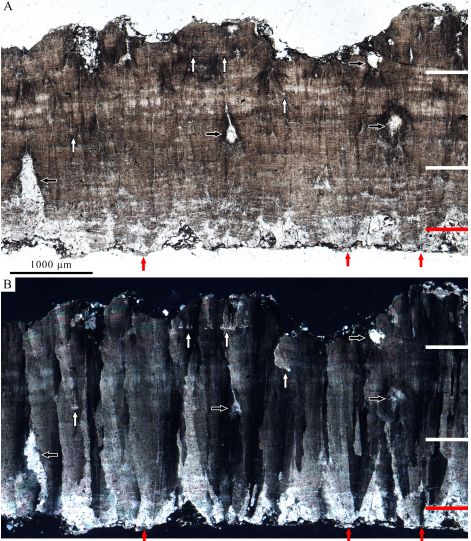
Sections of eggshell were selected for microscopic sections were cleaned by ultrasonic and embedded in resin for examination under a polarising light microscope. This revealed that the shells were between 2.76 and 2.97 mm, although this is probably less than the original thickness, due to weathering. They have a two-layered structure, with an outer cone layer 0.22–0.32 mm thick (roughly 10% total thickness) and an inner columnar layer 2.38 to 2.72 mm in thickness, which is typical of Dinosaur eggs. The inner columnar layer can in turn be divided into inner, medial and outer zones. The inner zone is 0.78 to 0.92 mm thick, which corresponds to about a third of the eggshell thickness. Areas of secondary growth can be found in the mdial and outer layers. The whole thickness is penetrated by worm-like pores.

Microstructure of the eggs in radial section (S221008-1②) under ordinary light (A) and cross-polarized light (B). White lines show the boundaries between the inner, medial and outer zones. (A) the boundary between the cone layer and columnar layer (red line) is not clear, accretion lines distribute through the shell, pore canals (black arrows) are irregular and worm-like, and the secondary eggshell units (white arrows) grow in the medial zone and the outer zone. (B) The eggshell units show radial extinction through the nucleation centres (red arrows) to the outer surface, and secondary eggshell units (white arrows) show independent radial extinction. Zhou et al. (2023).

Based upon this morphology, the eggs are assigned to the ichnospecies Coralloidoolithus shizuiwanensis, which has previously been described from the Xixia and Xichuan localities in Henan Province, and the Shanggao locality in Jiangxi Province, although the new specimens are slightly thicker than those previously assigned to this species. Although the egg-layer for Coralloidoolithus shizuiwanensis is unknown, the eggs are clearly Dinosaurian in origin, establishing the Moxia Formation as a Late Cretaceous rather than a Palaeogene deposit.

See also...

Online courses in Palaeontology

Follow Sciency Thoughts on Facebook.

Follow Sciency Thoughts on Twitter.


Wednesday, 7 December 2022

Fossil eggshells from the Early Cretaceous Okurodani Formation of Gifu Prefecture, Japan.

The past three decades have seen the discovery of a large quantity of fossil eggs from several Lower Cretaceous deposits in Japan, notably the Yezo Group of Hokkaido, the Kuwajima Formation of Ishikawa Prefecture, and the Ohyamashimo Formation in Hyōgo Prefecture. These include eggs which are thought to have come from Ornithopod and Theropod Dinosaurs (including Oviraptosaurs, Troodontids, and Birds). These findings add to the known palaeobiodiversity of these areas, by indicating the presence of groups not known from the skeltal fossil record. However, the majority are of Aptian or Albian age (121.4-100.5 million years old), with earlier examples being much rarer.

The Okurodani Formation outcrops in the Shokawa area of northwestern Gifu Prefecture, and is considered to be of Hauterivian age (i.e. between 132.9 and 129.4 million years old). This formation has produced a variety of Vertebrate remains, including Dinosaurs, aquatic Tetrapods and Fish, as well as a number of fragmentary egg pieces, which have been assumed to have been of Dinosaurian origin, but never formally investigated.

In a paper published in the journal Historical Biology on 24 November 2022, Rina Uematsu of the Graduate School of Science and Technology at the University of TsukubaKohei Tanaka of the Faculty of Life and Environmental Sciences at the University of Tsukuba, Shohei Kozu of the Gifu Prefectural Museum, Shinji Isaji of the Natural History Museum and Institute of Chiba, and Shizuo Shimojima of Takayama City, describe the known egg material from the Okurodani Formation, and discuss the implications this has for the known biodiversity of the environment which produced these strata.

All the fossils examined in the study were collected between 1988 and 2009 by Shizuo Shimojima, Masatoshi Okura and Satoru Sakamoto, from the Okurodani Formation, a 220 m thick sequence of shale, alternating sandstone and mudstone, and sandstone beds, which forms part of the Itoshiro Subgroup of the Middle Jurassic to Lower Cretaceous Tetori Group, which has been dated to between 133 and 129 million years old, based upon uranium-lead dates obtained from layers of volcanic tuff within the formation.

Map of the eggshell locality. (A) Distribution of the Tetori Group in Japan formed of three subgroups. (B) Stratigraphic position of the Okurodani Formation in the Shokawa area. (C) Detail of the boxed area in (A), showing the distribution and the stratigraphic sequence of the Okurodani Formation with the locations where eggshell materials were collected. GPM-Fo-1923, 09/Cr/89/01 and 09/Cr/88/07 were found in debris of fallen rocks and their location is not specified in the stratigraphy. Uematsu et al. (2022).

Sevem fragments of eggshell and two eggshell impressions were found within black mudstone layers within the Okurodani Formation. These mudstone layers are also rich in Plant fossils and freshwater Molluscs, and are interpretted as having been laid down in a network of stagnant pools or oxbow lakes within a floodplain environment. Vertebrate remains, predominantly Fish scales and Turtle shells, but also including Frogs, small Lizards, and Choristoderes (Crocodile-like Diapsids of uncertain affinities) are typically preserved in three dimensions (i.e. not compressed),  which implies rapid burial with minimal movement. Dinosaur fossils are rare in these layers, but the teeth of Ornithopods, Sauropods, and Verociraptorines have been found, as well as the tarsometatarsus of an Enantiornithine Bird.

The first two eggshell fragments discussed, GPM-Fo-1923 and 09/Cr/89/01, are assigned to the Oofamily Testudoolithidae (i.e. Turtle Eggs). These fragments are approximately 5 x 6 mm and 3 x 3 mm, respectively, and are assumed to have come from the same egg, based upon cross-sections of the joint and the overall  shape of the fragments when jointed. However their precise origin is unclear, because they were collected by Masatoshi Okura, who has since passed away, and are now housed in separate museums. The outer surfaces of both shells are strongly abraded and show nodular patterns composed of tightly packed shell units. Based upon the curvature of the eggshell, the original egg would have been about 22 mm in diameter.

Eggshell assigned to Testudoolithidae. (GPM-Fo-1923). (A) Nodular outer surface with exposed shell units. (B) Radial thin section under normal light, showing discrete shell units (bracket), tubular pore canals (white arrowheads) and cratered bases (black arrowhead). The shell appears two-layered with an undulating boundary (arrow). (C) The same view as (B) under polarised light, exhibiting irregular extinction patterns. (D) Radial view, scanning electron microscope, showing discrete shell units (bracket) with ill-preserved ultrastructure. Uematsu et al. (2022).

These shells show two separate layers, separated by an undulating horizontal boundary. In the upper layer, needle-like crystals radiate outward from the boundary. Although less prominent, such acicular crystals are also found in the lower layer; the crystals develop concentrically from the organic cores, making the basal parts of the shell units rounded in shape. Under polarised light, the eggshell exhibits irregular extinction patterns. 

Turtle eggs typically have only a single layer, so the structure of the these eggshells, with two distinct layers, each with a different type of crystals, is distinctly unTestudine. Apparently double-layered Turtle eggshells can be produced taphonomically, by when two shell fragments happen to come to rest with one sitting inside the other, or as a result of a pathology - gravid female Turtles, suffering from some king of environmental stress, can retain eggs instead of laying them, depositing additional layers of minerals on the surface of the egg during the process. Neither of these appears to be the case in this instance, rather the eggs appear to have been altered diagenetically, with the outer portion of the shell having been recrystalised as a result of contact with external chemistry.

Based upon the morphology of these eggshell fragments, it is estimated that they were laid by a small Cryptodiran Turtle, with a carapace length of less than 200 mm.

The next five specimens, GPM-Fo-1294, 1295, 1296, 1297, and 1298 are placed within the Oofamily Prismatoolithidae, which is typified by a two-layered structure and an ornamented shell surface. They are assigned to a new oospecies, with GPM-Fo-1925 as the holotype, and given the name Ramoprismatoolithus okurai, where 'Ramoprismatoolithus' derives from 'Ramo-' from the Latin 'ramus', meaning branch, plus '-prismatoolithus', from the oofamily name, in reference to the reticulate ridges on the other surface of the eggshell, and 'okurai', honours the late Masatoshi Okura who pioneered the discovery of fossil eggshells and other Vertebrate remains in Shokawa.

All of these specimens are fragmentary; no intact examples of this new oospecies are known. The outer surface of these shells is distinctly sculpted, with low ridges arranged in elaborate reticulated patterns. The shells range from 0.31 to 0.61 mm in thickness, with the average being 0.46 mm. Seen under a scanning electron microscope, a near-vertical, unbranching, pore canal could be observed, increasing slightly in width towards the surface of the egg.

Ramoprismatoolithus. (A), (B) Eggshell outer surfaces showing the well-sculpted reticulation: (A) holotype: GPM-Fo-1925 and (B) a cast of GPM-Fo-1924 made of  silicone rubber. (C) Radial thin section under normal light, showing a mammillary layer (ML) and a prismatic layer (PL) with a gradual boundary (horizontal bar on the left side) (holotype: GPM-Fo-1925). (D) the same view as (C) under PLM, showing columnar extinction patterns. (E)–(G) Radial view under Scanning Electron Microscope (holotype: GPM-Fo-1925), displaying (E) ML and PL, (F) numerous vesicles (arrowhead) over the eggshell and (G) acicular crystals at the base of mammillae. (H) Straight pore canal under Scanning Electron Microscope (GPM￾Fo-1928). Uematsu et al. (2022).

These eggshells show two layers, which appears to be an original feature rather than something produced by diagenetic alteration, with a lower mammillary layer (the inner layer of many eggs, which is made up of small calcium carbonate crystals, which are easily disolved and provide a source of calcium for the growing embryo) and the upper prismatic layer (made up of larger crystals, which provides structural strength to the egg) observable. These are separated by a gradual boundary. The mammillary layer makes up about one fifth to one sixth of the shell's thickness, and is comprised of  acicular crystals radiating from what were presumably organic cores. The base of this layer is abraded, probably due to absorption of calcium by the growing embryo. The prismatic layer is made up of narrow, columnular crystals, visible under polarised light. Vesicles can be seen in this layer under the scanning electron microscope.

Based upon the thickness of the shell fragments, the original Ramoprismatoolithus okurai eggs are calculated to have had an average mass of 99.39 g, which assuming an egg twice as long as it is wide, would give an original size of about 57 x 133 mm.

Prismatoolithid eggs are generally accepted to have been laid by Troodontid Dinosaurs, as intact eggs assigned to the oofamily have been found with Troodontid embryos inside. However, it has been suggested that some eggs assigned to this oofamily might have been laid by early Birds.

The small estimated size of the Ramoprismatoolithus okurai eggs leads Uematsu et al. to conclude the Animal which laid them weighed somewhere between twelve and seventeen kilograms, small for a Theropod Dinosaur, but not implausible for a non-Avian Maniraptoran.

The final two specimens described are GPM-Fo-1929, an impression of part of an outer eggshell surface measuring 6 × 7 mm, and 09/Cr/88/07, a possible impression of part of an inner eggshell surface, measuring 2 x 2 mm. Neither of these specimens preserves any of the original eggshell material. The outer surface impression GPM-Fo-1929 bears a strong resemblance to the outer surface of the Ramoprismatoolithus okurai egg fragments, with reticulate ornamentation and the remains of several pore openings. The inner shell fragment impression, 09/Cr/88/07, is smooth, with no discerning features which would allow it to be associated with any known egg fossil.

Indeterminate eggshell impressions. (A) Outer surface impression (GPM-Fo-1929). (B) Cast of (A) made of silicone rubber, showing reticulate ornamentation similar to Ramoprismatoolithus and remains of pore openings (arrowheads) between the ridges. (C) Inner? surface impression with a smooth appearance (09/Cr/88/07). Uematsu et al. (2022).

The specimens described by Uematsu et al. are the oldest known fossil eggshells from Japan, and provide additional information on biodiversity within the Early Cretaceous Tetori Group, within which skeletal material is scarce, demonstrating that Turtles and small Dinosaurs were nesting in the area. 

The eggs assigned to Ramoprismatoolithus okurai are likely to have been laid by a Troodontid, or closely related Maniraptoran Theropod. Okurodani Formation yields teeth of possible Velociraptorinae, and other strata within the Tetori Group (likely to be roughly co-eval, but laid down in different environments within the same landscape) have produced possible Oviraptorosauria and Dromaeosauridae, as well as the Therizinosaur-related Fukuivenator paradoxus. However, all of these groups are known to produce non-prismatic shells with microstructures unlike that of the Oofamily Prismatoolithidae. This strongly suggests that the Ramoprismatoolithus okurai eggs were produced by a small Maniraptoran Theropod not represented in the skeletal fossil record of the Tetori Group. 

Troodontids, and basal Paravians (the group that includes Troodontids, Birds, and Dromaeosaurs) in general are scarce in Early Cretaceous deposits, both as skeletal and egg remains. Examples are known from the US, Spain, and China, and all Early Cretaceous small non-Avian Theropods known from East Asia come from two formations in northeastern China, the Yixian and Huajiying. Thus the discovery of the Ramoprismatoolithus okurai eggs in Japan is a significant contribution to our understanding of the distribution of mall non-Avian Theropods from the early Early Cretaceous of East Asia.

See also...

Online courses in Palaeontology

Follow Sciency Thoughts on Facebook.

Follow Sciency Thoughts on Twitter.


Saturday, 23 July 2022

Hadrosauroid eggs with embryos from the Late Cretaceous of Jiangxi Province, China.

A wide variety of Dinosaur eggs are now known from sites around the world, although eggs with embryos within remain relatively rare. For example, the Hadrosauroids, a large and diverse group of Dinosaurs, have embryonic forms assigned to only three species, Hypacrosaurus stebingeriMaiasaura peeblesorum, and Saurolophus angustirostris. As a consequence of this, the earliest stages of Dinosaur development are nor well understood, and any new material of great interest to Dinosaur palaeontologists.

In a paper published in the journal BMC Ecology and Evolution on 9 May 2022, Lida Xing of the  State Key Laboratory of Biogeology and Environmental Geology, and School of the Earth Sciences and Resources at the China University of Geosciences, and the Yingliang Stone Natural History Museum,  Kecheng Niu, also of the Yingliang Stone Natural History Museum, Tzu‑Ruei Yang of the Institute of Vertebrate Paleontology and Paleoanthropology of the Chinese Academy of Sciences, and the Taiwan National Museum of Natural ScienceDonghao Wang, also of the School of the Earth Sciences and Resources at the China University of Geosciences, Tetsuto Miyashita of the Beaty Centre for Species Discovery and Palaeobiology Section at the Canadian Museum of Nature, and Jordan Mallon, also of the Beaty Centre for Species Discovery and Palaeobiology Section at the Canadian Museum of Nature, and of the Department of Earth Sciences at Carleton University, describe two Hadrosauroid embryos from the Late Cretaceous Hekou Formation red beds of the Ganzhou Basin in Jiangxi Province, China.

Hadrosaurs have traditionally been divided into two groups, the Hadrosaurines, with solid crests, and the Lambeosaurines, with hollow crests. However, a revision of the taxonomy of the group in 2010 suggested that the species Hadrosaurus foulkii, from which the group takes its name, in fact lies outside the Hadrosaurinae, forming a sister group to the (Hadrosaurinae + Lambeosaurinae). If this is the case, then it is inappropriate for the Hadrosaurinae to be named after a species which falls outside the group, which has led to it being renamed the Saurolophinae. Since 2010 there have been several further attempts at resolving the phylogeny of the Hadrosauridae, some of which have recovered Hadrosaurus foulkii as falling outside the Hadrosaurinae (or Saurolophinae), while others have returned it to this group. In the absence of any clarity on this issue at this time, Xing et al. favour the term Hadrosaurine to describe Hadrosaurs with solid crests, without placing any phylogenetic implications on this usage.

Both embryos described came from a clutch which is recorded as having comprised 13 eggs at the time of discovery (the actual number may have been larger). The eggs themselves are not well preserved, but appear to have originally had a prolate spheroid shape (i.e a slightly lemon-shaped sphere), consistent with eggs of the oofamily Spheroolithidae, which is otherwise known from the Hekou Formation. However Xing et al. do not attempt to assign the eggs to a more specific taxon, as their shells are too poorly preserved to allow examination of their microstructure.

Eggshell of Spheroolithidae sp. (YLSNHM 01373). (A) Overview of egg containing embryonic Hadrosauroid; (B) cross‑section of the YLSNHM 01373 eggshell under transmitted, unpolarized light. The dotted line marks the boundary between the mammillary (ML) and continuous (CL) layers. The white arrows indicate the locations of organic cores. Xing et al. (2022).

The first egg examined, (YLSNHM 01328) contains a partial articulated skeleton comprising the posterior part of the cranium, the complete series of cervical vertebrae, plus the forward part of the dorsal vertebral column and the associated ribs. Unfortunately the missing part of the skull includes the site where the palatal process of the maxilla, if present, would be found. This is unfortunate, as this is a reliable taxonomic trait within the Hadrosauridae, being present in the Hadrosaurinae and absent in the Lambeosaurinae. 

Hadrosauroid partial embryonic skeleton (YLSNHM 01328). (A) Photograph, (B) interpretive drawing. Xing et al. (2022).

The squamosal of YLSNHM 01328 is most similar to that of Tanius sinensis,  Levnesovia transoxiana,  and Nanningosaurus dashiensis (Nanningosaurus dashiensis is considered a Lambeosaurine, while the other two are known only from partial remains and cannot be assigned with confidence to the Hadrosaurinae or Lambeosaurinae), although the postorbital process of this bone is longer than in most Hadrosaurs of any type.

Hadrosauriform squamosals in left lateral view. Xing et al. (2022).

The second specimen, YLSNHM 01373 comprises a partial skeleton lacking parts of the skull, the tail, and the ends of the limbs. This specimen has a well preserved parietal bone, which can be seen to be elongate, as in Hadrosaurine, but not Lambeosaurine, Hadrosaurs. The specimen also has a well preserved tooth row, which has become detached from the its original position, although it is unclear whether that was on the upper or lower jaw. Assuming the first rib is attached to the first dorsal vertebra, YLSNHM 01373 has eleven cervical vertebrae, but it is unclear whether the first two visible cervical vertebrae are the atlas and axis (first two vertebrae) or whether these are hidden, so this number might be higher. 

Hadrosauroid partial embryonic skeleton (YLSNHM 01373). (A) Photograph, (B) interpretive drawing. Xing et al. (2022).

Both sets of embryonic remains can be confidently assigned to the Hadrosauridae, but lack sufficient diagnostic features to assign them to either the Hadrosaurinae or the Lambeosaurinae. One feature not dependent on morphology which has been suggested for differentiating these groups is size; it has been observed that, in Montana at least, Hadrosaurine eggs and embryos tend to be smaller than those of Lambeosaurs. Based upon femur lengths, the Hekou Formation embryos are closer to the Montana Hadrosaurines than the Montana Lambeosaurines (in fact they are slightly smaller). However, the Hekou Formation embryos do not fill their eggs, making it highly likely that they were some way short of hatching when they died, so this cannot realistically be used as a diagnostic feature in this case.

Reconstruction of a Hadrosauroid embryo, based on YLSNHM 01373. Ren W.‑Y.  in Xing et al. (2022).

See also...

Online courses in Palaeontology

Follow Sciency Thoughts on Facebook.

Follow Sciency Thoughts on Twitter.