Showing posts with label Diptocarps. Show all posts

Monday, 16 October 2023

A new population of the Critically Endangered rainforest tree Dipterocarpus littoralis discovered on Social Media.

Social media has become a surprisingly valuable tool for wildlife biologists, with a variety of new species described following posts by curious members of the public seeking to identify unknown organisms. 

In a letter to the journal Oryx published on 8 September 2023, Enggal Primananda and Iyan Robiansyah of the Research Center for Plant Conservation of the Indonesian National Research and Innovation Agency, report the discovery of a new population of the Critically Endangered rainforest tree Dipterocarpus littoralis based upon posts on the social media sites Facebook and Instagram.

Dipterocarpus littoralis had been thought to be restricted to the West Nusakambangan Nature Reserve on the western tip of Nusakambangan Island, which lies of the south coast of Central Java, where the known trees are found in a hilly forest at an altitude of about 100 m above sealevel.

The social media posts show a group of fruits and leaves which Primananda and Robiansyah believe clearly belong to Dipterocarpus littoralis, which were found in Tasikmalaya in West Java, about 70 km to the west of the West Nusakambangan Nature Reserve.

Image of an unknown Diptocarp fruit which Primananda and Robiansyah have identified as Dipterocarpus littoralis. Facebook.

If this identification is correct, then it indicates a significant range extension for Dipterocarpus littoralis, which may require a revision of its conservation status. Primananda and Robiansyah recommend that this new population be investigated as a matter of some urgency, and that specimens from the new location be added to the collection at Bogor Botanic Gardens. 

See also...


Follow Sciency Thoughts on Facebook.

Follow Sciency Thoughts on Twitter


Monday, 5 January 2015

The sources of the Xixia and Zhangpu Ambers.


Amber is the mineralized remnants of resins secreted by ancient plants. It is valued by palaeontologists due to the frequent presence of preserved insects, pollen and soft-bodied micro-organisms within amber clasts; it is also widely used in the jewellery industry, and in Chinese medicine. The resins which form amber are known to have originated from a number of different plant groups, including Pines, Dipterocarps, Sciadopityas (Japanese Umbrela Pines), Araucarias, Cypresses, Yews, Legumes and other Conifer and Angiosperm (Flowering Plant) groups. Amber is traditionally collected from three sites in China, Fushun in Northeast China, Xixia in Central China, and Zhangpu in Southeast China. The Early Eocene Fushan Amber has been extensively studied, due to its frequent Insect and Plant inclusions, and is considered to have been produced by a form of Cypress, however the other two sources have not to date produced any fossil inclusions, and therefore have been largely overlooked in other studies.

In a paper published in the journal PLoS One on 29 October 2014, Gongle Shi of the State Key Laboratory of Palaeobiology and Stratigraphy at the Nanjing Institute of Geology and Palaeontology of the Chinese Academy of Sciences, SuryenduDutta and Swagata Paul of the Department of Earth Sciences at the IndianInstitute of Technology Bombay, Bo Wang, also of the State Key Laboratory of Palaeobiology and Stratigraphy at the Nanjing Institute of Geology and Palaeontology and of the Steinmann Institute at the University of Bonn, and Frédéric Jacques of the Key Laboratory of Tropical Forest Ecology at the Xishuangbanna TropicalBotanical Garden of the Chinese Academy of Sciences, discuss the chemical composition of the Xixia and Zhangpu Ambers, as determined by gas chromatography-mass spectrometry, and the implications of this for the botanical origins of the amber.

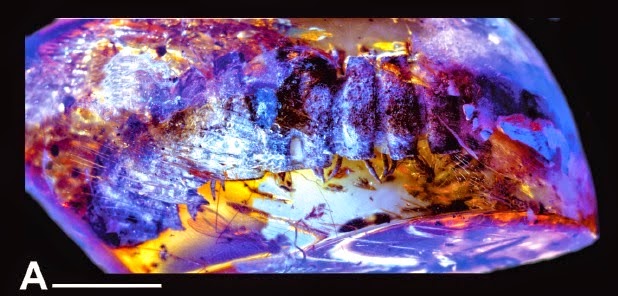
The Xixia Amber originates from the Late Cretaceous Gaogou Formation in Henan Province in Central China. The beds which produce it are best known for their production of well-preserved Dinosaur eggs, and have also produced Bivalve and Ostracod assemblages, but neither plant macrofossils nor pollen. They are interpreted as non-marine sedimentary deposits, with layers of mudstones, siltstones, sandstones and conglomerates. Xixia Amber is extremely abundant, but typically comes in tiny opaque lenses in yellow, brown, brownish yellow or brownish red. To date no fossils have been reported from Xixia Amber.

Late Cretaceous Xixia Amber. Shi et al. (2014).

The Xixia Amber proved to be rich in abietanediterpenoids, which is taken to be diagnostic of a Coniferous rather than Flowering Plant origin, as they are derived from abietic acid, which is produced by almost all Conifers, but not Angiosperms. The amber does not contain labdanedericatives, which are produced by Pines, and does contain tetracyclic diterpenoids, which are not, so Pines are therefore ruled out as the origin of this amber. Neither were cedrane and cuparane, produced by Cypresses, nor totarol, ferruginol orsugiol, produced by Cypresses and Podocarps, found in the samples, making it highly unlikely that the amber was of Cypress origin. The amber did contain tricyclic rimuane, which is produced by Podocarps and Araucarias, and phyllocladane, which is produced by Podocarps, Araucarias and Cypresses, from which Shi et al. conclude that the amber is most likely to have originated from a form of Araucaria.

Araucarias today are mainly restricted to the Southern Hemisphere, being found in Malaysia, Indonesia, Philippines, New Guinea, Australia, New Zealand, New Caledonia, Vanuatu, Fiji, Norfolk Island and southern South America, as well as being introduced in other areas as ornamental plants. However they are known to have been widespread in the Northern Hemisphere during the Mesozoic, and have been previously linked to amber deposits from the Early Cretaceous of Spain and Jurassic of Thailand. Shi et al. also note that while amber is found throughout the Mesozoic, it becomes much more widespread from the Early Cretaceous onwards, a timescale which also coincides with a major radiation of the Araucarias, making it possible that many Mesozoic ambers originate from these trees.

A modern Araucaria, the Paraná Pine, Araucaria angustifolia. Ricardo Frantz/Wikimedia Commons.

Podocarps are today found in tropical and subtropical upland forests in both hemispheres, reaching their northernmost distribution in southern China, Japan, Mexico and the Caribbean Islands. However modern members of the group produce much less resin than Araucarias, making them a less likely source of origin for ancient ambers, and the group is not thought to have been present in China during the Cretaceous.

Shi et al. also note that an extinct group of Conifers, the Cheirolepidiaceae, which appeared in the Late Triassic and persisted till the Late Cretaceous, has been liked to some ambers in southern Europe. This group were a dominant Conifer family globally in the Jurassic and Early Cretaceous, and are also likely to have contributed to amber deposits in other areas. Studies of amber associated with Cheirolepidiaceaen macrofossils from the Early Cretaceous of Spain have shown high levels of phenolic abietane, a chemical absent from the Xixia Amber samples, but given our limited understanding of this group, it cannot be completely ruled out as an origin for the Xixia Amber.

The Zhangpu Amber derives from the Middle Miocene Fotan Group in Fujian Province in Southeast China. The Fotan Group is noted for its Plant macrofossils, including leaves and fruits and lignified wood, some of which contains amber in situ. The fossils are interpreted as having originated in a Diptocarp-dominated tropical rainforest. The area currently has a warm subtropical climate with a seasonal climate, with distinct monsoon and dry seasons, and a flora dominated by subtropical evergreen broadleaved forests, however the Fotan deposits have been dated to14.7–14.9 million years ago, close to the Mid-Miocene Climatic Optimum, using pollen assemblages and Argon isotope dating (expand). Diptocarp forests are today found in lowland areas across much of Southeast Asia.

Middle Miocene Zhangpu Amber. Shi et al. (2014).

The Zhangpu Amber contains amyrin and amyrone-based triterpenoids, indicating an Angiosperm origin, and polymers of bicyclic sesquiterpenoid and triterpenoids hydrocarbons, which are typical of ambers produced by Diptocarps, though they are also produced by trees of the genus Mastixia, a type of Dogwood. Given the dominance of Diptocarp macrofossils in the deposits producing the amber, Shi et al. conclude this group is the more likely origin.

Diptocarps are thought to be of Gondwanan origin, and today are found in South and Southeast Asia, South America, Africa, Madagascar and the Seychelles. The group is thought to have reached Asia with the collision of the India and Eurasian Plates, with the earliest known Asian fossils dating from the Early Eocene of India. There are three subfamilies within the Dipterocarpaceae, only one of which, the Dipterocarpoideae, which is found in South and Southeast Asia and the Seychelles; the Diptocarps of South America, Africa and Madagascar lack resin ducts and do not produce resin. Diptocarps have previously been linked to amber deposits from the Eocene and Miocene of India and the Eocene of Vietnam; the Zhangpu Amber is the most northerly amber linked to this plant group, though given the presence of Diptocarp macrofossils in the same deposits, this is not remarkable.

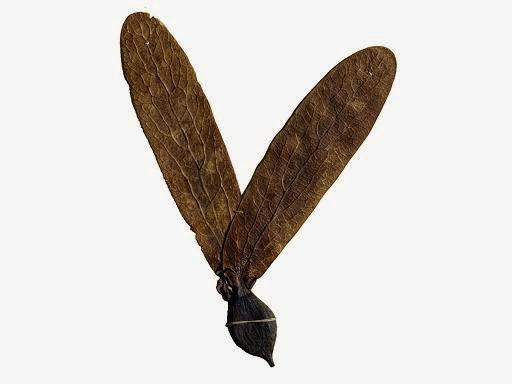
A modern Diptocarp wing fruit. Shi & Li (2010).

See also…

http://sciencythoughts.blogspot.co.uk/2014/12/a-polypore-fungus-beetle-from-early.htmlA Polypore Fungus Beetle from the Early Cretaceous of France.                                              Beetles first appear in the fossil record in the Early Permian. And by the Triassic were already beginning to dominate Insect faunas, with many modern groups in existence by the end of the Cretaceous. However...
http://sciencythoughts.blogspot.co.uk/2014/11/two-new-species-of-flat-backed.html Two new species of Flat-backed Millipede from Miocene Mexican amber.                   Millipedes, Diplopoda, are highly successful soil dwelling Arthropods found in soil in all temperate and tropical...
http://sciencythoughts.blogspot.co.uk/2014/09/two-new-species-of-froghopper-from.html Two new species of Froghopper from Dominican amber.                                              Froghoppers (Cercopoidea) are small members of the True Bug order (Hemiptera), related to Cicadas (Cicadoidea), Leafhoppers and Treehoppers...

Follow Sciency Thoughts on Facebook.

Thursday, 13 November 2014

Diptocarp wood from the northwest of India.


Diptocarps, Dipterocarpaceae, are the dominant trees of modern South and Southeast Asian rainforests, and are also found in South America, Africa and Madagascar. The group reach their maximum diversity today on the island of Bornea, where there are over 280 described species of Diptocarp, but the earliest fossil Diptocarps from Southeast Asia date back only as far as the Oligocene, whereas fossil Diptocarps appear in western India in the Early Eocene.

Modern Diptocarps are now found only in the south and east of India, though they have a fossil record in the north and west of the country. This is thought to be due to the relatively narrow climate tolerance of Diptocarps, which strongly favour areas with high rainfall year round, while many areas of modern India have a monsoonal climate, with a long dry season and a shorter wet season. This monsoon climate is thought to have evolved as a result of uplift in the Himalayas, which in turn has been driven be the collision between the Indian and Eurasian continental plates. The narrow climatic tolerance of Diptocarps makes them very useful in palaeoclimatic reconstructions, which is particularly useful when trying to understand the evolution of the modern monsoonal climate.
 
In a paper published in the Journal of Earth System Science in October 2013, Anumeha Shukla, RC Mehrotra and JS Gularia of the Birbal Sahni Institute ofPalaeobotany describe a series of Diptocarp wood specimens from the Oligocene and Plio-Pleisctocene of northwest India.

The first specimen described is assigned to the species Dipterocarpoxylon jammuense, and comes from the Plio-Pleistocene Raja Shumar Formation near Habur Village in the Jaisalmer District of Rajasthan. Fossil woods of the genus Dipterocarpoxylon are thought to resemble woods of the extant genus Dipterocarpus, which is currently found in the Western Ghats of southern India and Assam in the northeast, as well as in the Andaman Islands, and Southeast Asia as far east as the Philippines, reaching its maximum diversity on the Malaysian Peninsula, Sumatra and Borneo. The species Dipterocarpoxylon jammuense, which has previously been recorded from Late Tertiary and Miocene deposits in the Himalayan region, is thought to resemble the modern Dipterocarpus lowii, which is now found in the Malaysian region.

Dipterocarpoxylon jammuense (a), (b) transverse sections (T.S.) of the fossil showing exclusively solitary vessels and scattered gum canals (marked by arrow), (c) tangential longitudinal section(T.L.S.) of the fossil showing multiseriate rays with long tails (marked by arrow), (d) T.L.S. showing sheath cells onthe flanks of a multiseraite ray (marked by arrows) and (e) radial longitudinal section (R.L.S.) showing heterogeneousray tissue. Shukla et al. (2014).

The second specimen described is assigned to the species Hopenium pondicherriense, and comes from the Miocene Bhumbli Conglomerate at Lakhanka-Mithi-Viri on the east coast of Bhavnagar District in Gujarat. Fossil woods of the genus Hopenium are thought to resemble those of members of the modern genus Hopea, and Hopenium pondicherriense is thought to particularly resemble the wood of Hopea glabra, a medium-sized tree found today in southern India, and Hopea helferi, a large tree found today in the Andaman Islands, Myanmar, Malaysia, Thailand and Cambodia.

Hopenium pondicherriense (a) T.S. of the fossil showing solitary as well as grouping of vessels, (b) T.S. showing tangentially arranged gum canals (marked by arrows), (c) T.S. showing gum canals enclosed in parenchyma bands(marked by arrows), (d), (e) T.L.S. of the fossil showing 3–4 seriate rays with crystalliferous upright cells interspersed amongthe procumbent cells (marked by arrows), and (f) R.L.S. of the fossil showing heterogeneous ray tissues with crystalliferousupright cells (marked by arrows). Shukla et al. (2014).

The third specimen described is assigned to the species Shoreoxylon burmense, and comes from the Early Miocene Kand Formation on the Ratanpurniriver bed at Ratanpor in the Bharuch District of Gujarat. Fossil woods of the genus Shoreoxylon are thought to resemble those of the modern genus Shorea, which is largely confined to rainforests today, and Shoreoxylon burmenseis thought to particularly resemble the wood of the modern Shorea ovalis, which is found in Malaysia. Shoreoxylon burmense has previously been reported from Tertiary deposits in Myanmar and northeast India.

Shoreoxylon burmense (a) T.S. of the fossil showing predominantly solitary vessels and tangentiallyarranged gum canals (marked by arrows), (b) T.S. showing paratracheal parenchyma around the vessels (marked by arrow),(c), (d) T.L.S. of the fossil showing 2–3 seriate rays, (e) R.L.S. showing weakly heterogeneous ray tissue, and (f) R.L.S.showing alternate intervessel pits. Shukla et al. (2014).

See also…

India separated from Africa about 130 million years ago, and was effectively an island continent until its collision with Eurasia in the Middle Cenozoic. Nevertheless the modern flora and fauna of India show strong affinities with that of Africa, and while there was probably some...


Industrial scale timber extraction began on Borneo in the 1970s and during the period 1980 to 2000 more timber was harvested from Borneo than from Africa and the Amazon Basin combined. In addition much forest has been cleared to make way for monoculture plantations, for the palm oil, rubber and timber industries, as well as being burned in forest fires.  For this reason the island is often assumed to be a hopeless case environmentally...


Kimberlite pipes are produced by rapid volcanic intrusions carrying magma from the Earth’s mantle rapidly to the surface, often resulting in explosive phreatomagmatic eruptions (explosions caused by hot magma coming into contact with water). These pipes are considered high value economic resources due to the common occurrence of diamonds within them. Surprisingly kimberlite pipes also often contain fossil...


Follow Sciency Thoughts on Facebook.