Showing posts with label Honshū Island. Show all posts

Monday, 20 April 2026

Magnitude 7.5 Earthquake off the coast of the Sanriku Coast of Japan.

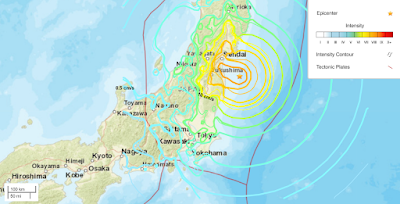
The Japan Meteorological Agency recorded a Magnitude 7.5 Earthquake at a depth of about 10 km, about 100 km off the Sanriku Coast, which lies on the northeastern part of Honshū Island, slightly before 4.55 pm Japan Standard Time (slightly before 7.55 am GMT) on Monday 20 April 2026. 

A tsunami warning was issued in the immediate aftermath of the event, with about 170 000 advised to seek shelter, but in the event, no major tsunami occurred, with a wave 80 cm high being observed in places.  Rail services were temporarily suspended. A number of aftershocks have followed the initial event.

The approximate location of the 20 April 2026 Sanriku Coast Earthquake. USGS.

Japan has a complex tectonic situation, with parts of the country on four different tectonic plates. Aomori Prefecture lies on the convergent margin where the Okhotsk Plate is pushed against the Eurasian Plate, with the Pacific Plate being subducted beneath the Okhotsk Plate to the east. This is not a smooth process; the rocks of the two plates constantly stick together, only to break apart again as the pressure builds up, causing Earthquakes in the process.

The movement of the tectonic plates beneath Japan. University of Wisconsin Eau Claire.

See also...

Thursday, 11 December 2025

Magnitude 7.6 Earthquake off the coast of Aomori Prefecture, Japan.

The Japan Meteorological Agency recorded a Magnitude 7.6 Earthquake at a depth of about 50 km, about 80 km off the east coast of Aomori Prefecture, which lies on the northern tip of Honshū Island, at about 11.15 pm Japan Standard Time (about 2.15 pm GMT) on Monday 8 December 2025. Thirty four people were injured as a result of the event, with some damage to buildings and roads. A tsunami warning was issued in the immediate aftermath of the event, causing about 90 000 people to evacuate from low lying areas, but in the event, no major tsunami occurred.  Power supplies were also disrupted, leaving 2700 homes without power, and rail services were temporarily suspended. A number of aftershocks have followed the initial event.

The approximate location of the 8 December 2025 Aomori Prefecture Earthquake. USGS.

Japan has a complex tectonic situation, with parts of the country on four different tectonic plates. Aomori Prefecture lies on the convergent margin where the Okhotsk Plate is pushed against the Eurasian Plate, with the Pacific Plate being subducted beneath the Okhotsk Plate to the east. This is not a smooth process; the rocks of the two plates constantly stick together, only to break apart again as the pressure builds up, causing Earthquakes in the process.

The movement of the tectonic plates beneath Japan. University of Wisconsin Eau Claire.

See also...

Tuesday, 2 January 2024

Fifty five confirmed deaths following Magnitude 7.6 Earthquake on the Noto Peninsula, Japan.

The Japan Meteorological Agency recorded a Magnitude 7.6 Earthquake at a depth of about 20 km, beneath the Noto Peninsula, part of Ishikawa Prefecture on the north coast of Honshū Island, at about 4.10 pm Japan Standard Time (about 7.10 am GMT) on Monday 1 January 2024. Tens of thousands of buildings are reported to have been damaged or destroyed following the event, with fifty five people confirmed dead at the time of writing, and many more thought to be trapped beneath collapsed buildings. 

The approximate location of the 1 January 2023 Noto Peninsula Earthquake. USGS.

A tsunami warning was issued following the Earthquake, as large tsunami waves triggered such events often add to the problems caused by large Earthquakes in Japan, although on this occasion the largest waves recorded were only about a metre high. Several large aftershocks have been recorded following the initial event, and local officials have warned that these are likely to continue for some time, hampering rescue attempts. A number of fires broke out in the aftermath of the initial Earthquake, adding to the problems. Temperatures in the area typically fall below zero at night at this time of year, adding to concerns about how long people trapped beneath the rubble can survive.

Damage in the city of Wajima on the Noto Peninsula, following a Magnitude 7.6 Earthquake on 1 January 2024. Kyodo/Reuters.

Japan has a complex tectonic situation, with parts of the country on four different tectonic plates. Ishikawa Prefecture lies on the convergent margin where the the Okhotsk Plate is pushed against the Eurasian Plate, with the Pacific Plate being subducted beneath the Okhotsk Plate to the east. This is not a smooth process; the rocks of the two plates constantly stick together, only to break apart again as the pressure builds up, causing Earthquakes in the process.

The movement of the tectonic plates beneath Japan. University of Wisconsin Eau Claire.

See also...

Follow Sciency Thoughts on Facebook.

Follow Sciency Thoughts on Twitter. 


Saturday, 4 June 2022

Ameronothrus retweet: A second species of Japanese Marine-associated Oribatid Mite discovered on Twitter.

Most Arachnids are associated with terrestrial or freshwater ecosystems (Sea Spiders, Pycnogonida, and Horseshoe Crabs, Xiphosura, are generally viewed as Chelicerate Arthropods closely related to, but outside the Arachnida), although some species have colonised inter-tidal zones, notably the Marine Spider, Desis marina, of New Zealand, and a variety of Oribatid Mites from the Superfamily Ameronothriodae. 

Four separate families of Ameronothriod Mites are considered to have colonised the inter-tidal zones, the Fortuyniidae and Selenoribatidae, which are found in tropical and subtropical zones, the Podacaridae, found in the southern temperate and polar zones, and the Ameronothridae, found in northern temperate and polar zones, although some experts consider the Ameronothridae and Podacaridae should be treated as a single family.

The Ameronothridae as it is currently defined comprises a single genus, Ameronothrus, which currently contains 14 valid species, the most recently identified of which Ameronothrus twitter, was described in 2021 after pictures of an unknown Mite from the inter-tidal zone of the Chiba Peninsula on Honshu Island, Japan, were posted on the social media platform Twitter.

In a paper published in the International Journal of Aracology on 19 May 2022, Tobias Pfingstl of the Department for Biodiversity and Evolution at the University of Graz, Shimpei Hiruta of the Center for Molecular Biodiversity Research at the National Museum of Nature and Science, Iris Bardel-Kahr, also of the Department for Biodiversity and Evolution at the University of Graz, Yuito Obae of the Graduate School of Sustainability Science at Tottori University, and Satoshi Shimano of the Science Research Center at Hosei University, describe a new species of Ameronothrus discovered as a result of the discovery of Ameronothrus twitter being discussed on the social media platform after which it was named.

The new species is named Ameronothrus retweet, due to the way in which it was discovered, on the basis of photographs posted in response to a tweet (Twitter post) announcing the discovery of Ameronothrus twitter. The photographs were taken by Yuito Obae of of some mites he discovered on Iwado Rock Beach on the Japan Sea (north) coast of Honshu, which he thought might be another population of Ameronothrus twitter, but were subsequently recognised as another new species.

Specimens of Ameronothrus retweet range from 641 to 859 µm in length, and are dark brown or black in colour, with a densely granulated cuticle, the granules being larger on the lateral sides of the body. As with other Ameronothriod Mites, Ameronothrus retweet appears to feed on Algae, Fungi, or Lichen found in the inter-tidal zone.
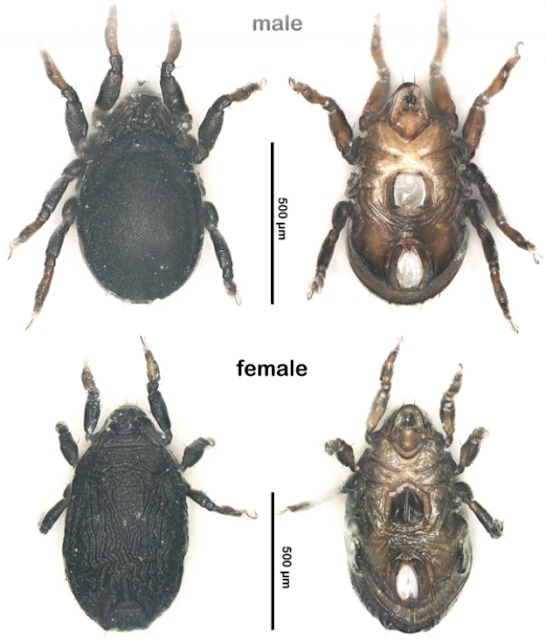
Photographs of male (upper row) and female (lower row) Ameronothrus retweet specimens in dorsal (left side) and ventral view (right side). Pfingstl et al. (2022).

Unusually for an Oribatid Mite, Ameronothrus retweet shows sexual dimorphism, with the females showing strongly folded gastronotic integument and considerably shorter epimeral, genital, and aggenital setae than seen in the males. While sexual dimorphism has not previously been recorded in an Ameronothriod Mite, it has been recorded in a number of other Oribatid Mite species associated with aquatic or intermittently wet environments, so the presence of such a trait in a species of Ameronothrus should not be seen as a complete surprise. The purpose of sexual dimorphism in Oribatid Mites found in aquatic environments remains unknown, although increasing the number of species in which this is known may help to solve this mystery.

See also...

Follow Sciency Thoughts on Facebook.

Follow Sciency Thoughts on Twitter. 


Friday, 18 March 2022

Magnitude 7.3 Earthquake off the coast of Fukushima Prefecture, Japan.

The Japan Meteorological Agency recorded a Magnitude 7.3 Earthquake at a depth of about 60 km, about 60 km off the east coast of Fukyshima Prefecture, on Honshū Island, slightly after 11.35 pm Japan Standard Time (slightly after 2.35 pm GMT) on Wednesday 16 March 2022. The event was felt across much of eastern Japan and triggered a small tsunami, which was about 30 cm high when it reached the shore. Four people have been reported dead following this event, with a further 107 injured, and serious damage to a number of buildings. About 2 million people lost their electricity following this Earthquake, with over 4000 also losing water supplies.

 
The approximate location of the 16 March 2022 Fukashima Prefecture Earthquake. USGS.

Japan has a complex tectonic situation, with parts of the country on four different tectonic plates. Eastern Honshū area lies on the boundary between the Pacific, Eurasian and Philippine Plates, where the Pacific Plate is passing beneath the Eurasian and Philippine Plates as it is subducted into the Earth. This is not a smooth process; the rocks of the two plates constantly stick together, only to break apart again as the pressure builds up, causing Earthquakes in the process.

 
The movement of the Pacific and Philippine Plates beneath eastern Honshū. Laurent Jolivet/Institut des Sciences de la Terre d'Orléans/Sciences de la Terre et de l'Environnement.

See also...


Follow Sciency Thoughts on Facebook.

Follow Sciency Thoughts on Twitter. 


Monday, 3 May 2021

Magnitude 6.6 Earthquake off the coast of Miyagi Prefecture, Japan.

The Japan Meteorological Agency recorded a Magnitude 6.8 Earthquake at a depth of about 60 km, about 40 km off the east coast of Miyagi Prefecture, on Honshū Island, slightly before 10.30 am Japan Standard Time (slightly before 1.30 am GMT) on Saturday 1 May 2021. The event was felt across much of eastern Japan, and though there are no reports of any serious damage or casualties, train services were suspended for several hours following the quake, and seismologists are warning there is a risk of large aftershocks occurring over the next few weeks.

The approximate location of the 1 May 2021 Miyagi Prefecture Earthquake. USGS.

Japan has a complex tectonic situation, with parts of the country on four different tectonic plates. Eastern Honshū area lies on the boundary between the Pacific, Eurasian and Philippine Plates, where the Pacific Plate is passing beneath the Eurasian and Philippine Plates as it is subducted into the Earth. This is not a smooth process; the rocks of the two plates constantly stick together, only to break apart again as the pressure builds up, causing Earthquakes in the process.

 
The movement of the Pacific and Philippine Plates beneath eastern Honshū. Laurent Jolivet/Institut des Sciences de la Terre d'Orléans/Sciences de la Terre et de l'Environnement.

See also...


Follow Sciency Thoughts on Facebook.

Follow Sciency Thoughts on Twitter.