Showing posts with label Social Media. Show all posts

Monday, 16 October 2023

A new population of the Critically Endangered rainforest tree Dipterocarpus littoralis discovered on Social Media.

Social media has become a surprisingly valuable tool for wildlife biologists, with a variety of new species described following posts by curious members of the public seeking to identify unknown organisms. 

In a letter to the journal Oryx published on 8 September 2023, Enggal Primananda and Iyan Robiansyah of the Research Center for Plant Conservation of the Indonesian National Research and Innovation Agency, report the discovery of a new population of the Critically Endangered rainforest tree Dipterocarpus littoralis based upon posts on the social media sites Facebook and Instagram.

Dipterocarpus littoralis had been thought to be restricted to the West Nusakambangan Nature Reserve on the western tip of Nusakambangan Island, which lies of the south coast of Central Java, where the known trees are found in a hilly forest at an altitude of about 100 m above sealevel.

The social media posts show a group of fruits and leaves which Primananda and Robiansyah believe clearly belong to Dipterocarpus littoralis, which were found in Tasikmalaya in West Java, about 70 km to the west of the West Nusakambangan Nature Reserve.

Image of an unknown Diptocarp fruit which Primananda and Robiansyah have identified as Dipterocarpus littoralis. Facebook.

If this identification is correct, then it indicates a significant range extension for Dipterocarpus littoralis, which may require a revision of its conservation status. Primananda and Robiansyah recommend that this new population be investigated as a matter of some urgency, and that specimens from the new location be added to the collection at Bogor Botanic Gardens. 

See also...


Follow Sciency Thoughts on Facebook.

Follow Sciency Thoughts on Twitter


Saturday, 4 June 2022

Ameronothrus retweet: A second species of Japanese Marine-associated Oribatid Mite discovered on Twitter.

Most Arachnids are associated with terrestrial or freshwater ecosystems (Sea Spiders, Pycnogonida, and Horseshoe Crabs, Xiphosura, are generally viewed as Chelicerate Arthropods closely related to, but outside the Arachnida), although some species have colonised inter-tidal zones, notably the Marine Spider, Desis marina, of New Zealand, and a variety of Oribatid Mites from the Superfamily Ameronothriodae. 

Four separate families of Ameronothriod Mites are considered to have colonised the inter-tidal zones, the Fortuyniidae and Selenoribatidae, which are found in tropical and subtropical zones, the Podacaridae, found in the southern temperate and polar zones, and the Ameronothridae, found in northern temperate and polar zones, although some experts consider the Ameronothridae and Podacaridae should be treated as a single family.

The Ameronothridae as it is currently defined comprises a single genus, Ameronothrus, which currently contains 14 valid species, the most recently identified of which Ameronothrus twitter, was described in 2021 after pictures of an unknown Mite from the inter-tidal zone of the Chiba Peninsula on Honshu Island, Japan, were posted on the social media platform Twitter.

In a paper published in the International Journal of Aracology on 19 May 2022, Tobias Pfingstl of the Department for Biodiversity and Evolution at the University of GrazShimpei Hiruta of the Center for Molecular Biodiversity Research at the National Museum of Nature and ScienceIris Bardel-Kahr, also of the Department for Biodiversity and Evolution at the University of Graz, Yuito Obae of the Graduate School of Sustainability Science at Tottori Universityand Satoshi Shimano of the Science Research Center at Hosei University, describe a new species of Ameronothrus discovered as a result of the discovery of Ameronothrus twitter being discussed on the social media platform after which it was named.

The new species is named Ameronothrus retweet, due to the way in which it was discovered, on the basis of photographs posted in response to a tweet (Twitter post) announcing the discovery of Ameronothrus twitter. The photographs were taken by Yuito Obae of of some mites he discovered on Iwado Rock Beach on the Japan Sea (north) coast of Honshu, which he thought might be another population of Ameronothrus twitter, but were subsequently recognised as another new species.

Specimens of Ameronothrus retweet range from 641 to 859 µm in length, and are dark brown or black in colour, with a densely granulated cuticle, the granules being larger on the lateral sides of the body. As with other Ameronothriod Mites, Ameronothrus retweet appears to feed on Algae, Fungi, or Lichen found in the inter-tidal zone.
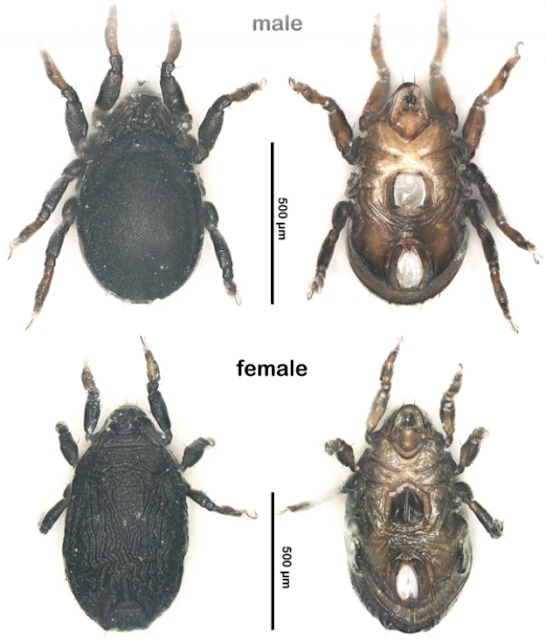
Photographs of male (upper row) and female (lower row) Ameronothrus retweet specimens in dorsal (left side) and ventral view (right side). Pfingstl et al. (2022).

Unusually for an Oribatid Mite, Ameronothrus retweet shows sexual dimorphism, with the females showing strongly folded gastronotic integument and considerably shorter epimeral, genital, and aggenital setae than seen in the males. While sexual dimorphism has not previously been recorded in an Ameronothriod Mite, it has been recorded in a number of other Oribatid Mite species associated with aquatic or intermittently wet environments, so the presence of such a trait in a species of Ameronothrus should not be seen as a complete surprise. The purpose of sexual dimorphism in Oribatid Mites found in aquatic environments remains unknown, although increasing the number of species in which this is known may help to solve this mystery.

See also...

Follow Sciency Thoughts on Facebook.

Follow Sciency Thoughts on Twitter


Saturday, 23 January 2016

Arulenus miae: A new species of Pygmy Devil from Mindanao Island (& Facebook).

Pygmy Devils, Discotettiginae, are small members of the Tetrigidae (Dwarf Grasshoppers) from South and East Asia. They are generally terrestrial, feeding on Algae and Bryophytes (Non-vascular Plants), though some species are semi-aquatic and feed on aquatic Algae and Plants.

In a paper published in the journal Zootaxa on 22 January 2016, Josep Skejo of the Special Interest Group Tetrigidae of the Biology Students Association at the Department of Biology at University of Zagreb and Joy Caballero of the Department of Biology at Central Mindanao University describe a new species of Pygmy Devil from Mindanao Island in the Philippines.

The new species was first recognized by Josep Skejo from a photograph posted on the Orthoptera Facebook group, with specimens later found for sale on the LesColeopteres webpage. The species was subsequently located in the wild by a team led by Alma Mohagan of the Central Mindanao University. It is placed in the genus Arulenus, and given the specific name miae, in honour of Miae Jurić, a student of Fashion and Textile Design at the Faculty of Textile Technology at the University of Zagreb, and friend of Josep Skejo. 

Original Facebook image of the first specimen of Arulenus maiae. Leif Gabrielsen in Skejo & Caballero (2016).

The species is large for a Pygmy Devil, with the largest specimens reaching about 13 mm in length. Its body has a generally smooth texture, covered in small granulations. They are predominantly black in colour, with a black or dark brown head, with yellow eyes and a number of yellow tubercles and dorsal spines with red tips.

 Skejo and Caballero further note that social media present a great deal of potential for natural historians in general and entomologists in particular, with images being shared on a variety of platforms, such as EBay and Flikr, and in particular Facebook, where there are a number of specialist groups for entomologists and orthopterists, such as Entomology, Insect Identification, InsectIndia, Orthoptera, The Orthopterists Society and Orthotera of Thailand.

See also...

http://sciencythoughts.blogspot.co.uk/2014/08/a-new-species-of-pygmy-grasshopper-from.htmlA new species of Pygmy Grasshopper from Miocene Dominican amber.                      Pygmy Grasshoppers (Tetrigidae) are small Orthopteran Insects related to True Grasshoppers, Crickets and Katydids, found across much of the globe but most numerous and diverse in the tropics...
http://sciencythoughts.blogspot.co.uk/2014/06/a-new-species-of-cockroach-wasp-from.htmlA new species of Cockroach Wasp from Thailand.                                               Cockroach Wasps (Ampulicidae) are a group of Digger Wasps (Aculeata) which specialize in the hunting of Cockroach prey. Some of these Wasps are...
http://sciencythoughts.blogspot.co.uk/2012/08/a-new-species-of-green-lacewing.htmlA new species of Green Lacewing discovered on Flikr®.                                                   Green Lacewings (Chrysopidae) are a globally distributed group of carnivorous flying Insects, ranging from 6 to 65 mm in length (though the larger... 
Follow Sciency Thoughts on Facebook.