Showing posts with label Kem Kem Compound Assemblage. Show all posts

Monday, 8 April 2019

The partial ilium of an Abelisaurid Dinosaur from the Late Cretaceous Kem Kem Beds of Morocco.

The Abelisaurids were a curious group of large Theropod Dinosaurs that diverged away from the main Theropod lineage, that went on to produce forms such as the Allosaurids, Tyranosaurids and Maniraptors, early in the group’s history. Abelisaurids tended to be short faced, with some species having horns of uncertain purpose. Many Abelisaurids followed the common Theropod evolutionary path of having forelimbs reduced in size, though some species also appeared to have had shortened hindlimbs. Despite these curiosities Abelisaurids appear to have been the dominant group of predatory Dinosaurs in the Cretaceous of South America, India and Madagascar, with occasional specimens being found in North America and Asia. The presence of Abelisaurids in Africa is less well understood, though there have been several recent discoveries of Abalisaurid specimens in North Africa, particularly Morocco.

In a paper published in the journal PLoS One on 2 April 2019, Slimane Zitouni of the Département de Géologie at the Université Cadi Ayyad, and the Muséum d’Histoire Naturelle de Marrakech, Christian Laurent of the National Oceanography Centre, and the Department of Geology at Babes-Bolyai University, Gareth Dyke, also of the Department of Geology at Babes-Bolyai University, and of the Department for Evolutionary Zoology at the University of Debrecen, and Nour-Eddine Jalil, also of the Département de Géologie at the Université Cadi Ayyad, and of the Muséum national d’Histoire naturelle, describe a partial ilium of an Abelisaurid Dinosaur from the Late Cretaceous Kem Kem Beds of Morocco.

The Kem Kem Beds of southeastern Morocco and neighbouring areas of Algeria are noted for the production of numerous Late Cretaceous Vertebrate fossils, including Fish, Crocodylomorphs, Turtles, and Dinosaurs, particularly large Theropods. These fossils appear to have come from a wide range of environments, and are poorly sorted stratigraphically (i.e. not arranged in time related order), and are generally thought to be the result of geological mixing.

Commercial fossil collecting has become a significant industry in Morocco in recent decades, with commercial collectors highly variable in the level of care they employ in retrieving fossils. Some are extremely careful in how they remove fossils from the sediment, and carefully record the strata from which the fossils were obtained. Others take a more haphazard approach, seeking to obtain as much material as quickly as possible, making few records, frequently damaging specimens, and often abandoning finds thought to have insufficient commercial value.

The specimen described by Zitouni et al., MHNM KK04, was found by a commercial fossil collector in 2007 and later sold to Gareth Dyke and Nour-Eddine Jalil, who deposited it in the collection of the Natural History Museum of Marrakech. At the time when it was found the specimen had already been excavated by an earlier, unknown collector, and was free of any matrix (surrounding rock) and fractured into several pieces.

The specimen comprises the ilium of a Theropod Dinosaur, with an incomplete iliac blade, a damaged anterior process, and further damage to the underside of the pubic peduncle, all of which damage appears to have been caused during the extraction process, with fresh surfaces exposed where the damage was caused. The absence much of the pubic peduncle, the anterior process and the anterior side of the iliac blade means that a lot of the material that would generally be used to classify a bone of this type is missing, but the fact that the iliac blade is elongate and sub-rounded, rather than truncated or tapered, the fact that the brevis fossa is deep and broadens towards the posterior, and the shape of the dorsal margin of the illium are together taken to indicate that the specimen is an Abelisaurid.

Abelisaur (indeterminate), right ilium (MHNM KK 04). A lateral view; B medial view; C Anterior; D dorsal and E Posterior view. Abbreviations: Csa, supra-acetabular abutment; Pi, ischial peduncle; P.ps posterior process. Scale bar is 10 cm. Zitouni et al. (2019). 

See also...

https://sciencythoughts.blogspot.com/2018/08/juvenile-pedal-ungual-of-juvenile.htmlhttps://sciencythoughts.blogspot.com/2016/10/jeddaherdan-aleadonta-agamid-lizard.html
https://sciencythoughts.blogspot.com/2016/03/fragmentary-abelisaurid-remains-from.htmlhttps://sciencythoughts.blogspot.com/2012/01/fore-limbs-of-majungasaurus.html
Follow Sciency Thoughts on Facebook.

Monday, 20 August 2018

Juvenile pedal ungual of a juvenile Spinosaur from the Cretaceous Kem Kem Beds of Morocco.

The Kem Kem Beds of southeastern Morocco and neighbouring areas of Algeria are noted for the production of numerous Late Cretaceous Vertebrate fossils, including Fish, Crocodylomorphs, Turtles, and Dinosaurs, particularly large Theropods. These fossils appear to have come from a wide range of environments, and are poorly sorted stratigraphically (i.e. not arranged in time related order), and are generally thought to be the result of geological mixing.

In a paper published in the journal PeerJ on 30 May 2018, Simone Maganuco and Cristiano Dal Sasso of the Museo di Storia Naturale di Milano describe a pedal ungual (toe claw) from the Kem Kem Beds, which they interpret as having come from a juvenile Spinosaur.

Spinosaurs were exceptionally large Theropod Dinosaurs (the biggest species, Spinosaurus aegyptiacus is thought to have exceeded Tyrannosaurus, Giganotosaurus and Carcharodontosaurus in size, reaching about 11 m in length) with a distinctive morphology, including a long, Crocodile-like snout and a sail on the lower back and tail. The Spinosaurs are divided into two groups, the Baryonychines from Laurasia (North America, Europe and Asia) and the Spinosaurines in Gondwana (Africa, South America, India, Madagascar, Antarctica, Australia and New Zealand, though the group is not known from all these areas). However while the closely related Megalosaurs are well established in the Middle Jurassic, almost all known Spinosaur specimens come from the Cretaceous, making the origins of the group somewhat obscure. 

The specimen described by Maganuco and Dal Sasso is a 18.2 mm in length, though it is thought to have lost about 2 mm from its tip, and closely resembles the pedal ungual of Spinosaurus aegyptiacus, with a flattened profile, a slightly convex upper surface and a porous structure. The specimen is, of course considerably smaller than the pedal ungual of Spinosaurus aegyptiacus, with the holotype for this species (i.e. specimen from which the species was named) having toe claws between 87 and 130 mm in length, however Spinosaurs were Tetanurans, a group which is thought to have changed little in morphology as they grew and developed, and isolated uguals of intermediate size have been referred to the genus Spinosaurus on this basis. Maganuco and Dal Sasso suggest that if the proportions did remain constant in life, then this specimen would have come from a Spinosaur about 1.78 m in length, the smallest known member of the group.

Pedal ungual phalanx of Spinosaurus. Specimen MSNM V6894 in right lateral (A), left lateral (B), dorsal (C), plantar (D), proximal (E), and distal (F) views. Abbreviations: as, articular surface; co, cortex; et, extensor tubercle; sb, spongy bone; vf, vascular furrow. Scale bar equals 5 mm. Michele Zilioli in Maganuco & Dal Sasso (2018).

See also...

https://sciencythoughts.blogspot.com/2017/07/neovenator-salerii-neuroanatomy-of.htmlhttps://sciencythoughts.blogspot.com/2017/06/understanding-integument-of.html
https://sciencythoughts.blogspot.com/2017/06/megalosaurus-bucklandii-understanding.htmlhttps://sciencythoughts.blogspot.com/2017/03/daspletosaurus-horneri-new-species-of.html
https://sciencythoughts.blogspot.com/2016/03/fragmentary-abelisaurid-remains-from.htmlhttps://sciencythoughts.blogspot.com/2015/08/isolated-theropod-teeth-from-middle.html


Follow Sciency Thoughts on Facebook.

Monday, 3 October 2016

Jeddaherdan aleadonta: An Agamid Lizard from the Late Cretaceous of Morocco.

Acrodontan Lizards (Chameleons, Agamas, Iguanas and New World Lizards such as Anoles) first appear in the fossil record in the Middle Jurassic of India, and have spead to China, Myanmar and Brazil by the End of rhe Cretaceous. They are a highly distinctive group, and have long been thought, on the basis of morphological evidence, to be the earliest group of Lizards to have branched off from the rest of the famiy, though more recent molecular studies suggest that they are closely related to Snakes and Anguimorph Lizards (Monitors etc.). Africa is one of the modern biodiversity hotspots for this group, and is thought likely to have hosted a major evolutionary radiation of them, but to date there has been only a very limited number of fossil Acrodontans discovered on the continent, including specimens from the Palaeocene of Morocco, Algeria and Tunisia.

In a paper published in the journal Royal Society Open Science on 21 September 2016, Sebastián Apesteguía of the Fundación de Historia Natural‘Félix de Azara’ at the Universidad Maimónides, Juan Daza of the Department of Biological Sciences at Sam Houston StateUniversity, Tiago Simões of the Department of Biological Sciences at the University of Alberta, and Jean Claude Rage of the MuséumNational d’Histoire Naturelle, describe a new species of Agamid Lizard from the Late Cretaceous Kem Kem Beds of northern Morocco.

The new species is named Jeddaherdan aleadonta, where 'Jeddaherdan' derives from the Amazigh Berber words for grandfather (Jeddi) and Spiny-tailed Lizard (Aherdan), and 'aleadonta' means 'dice-toothed' in reference to the roughly cubic shape of the teeth. The species is described from a single fragment of dentary (lower jaw) collected by the French palaeontologist René Lavocat (1909–2007) from the Kem Kem Beds of Gara Tabroumit in southern Morocco between 1948 and 1951 and stored in the collection of the Muséum National d’Histoire Naturelle, where it was mistakenly identified as the jaw of a Fish. Exact collection details for the specimen are missing, but it is likely to be between 90 and 100.5 million years old.


Jeddaherdan aleadonta (MNHN.F.MRS51.1) in (a) dorsal; (b) lateral; (c)medial; (d) ventral views. Scale bar equals 5 mm. Abbreviations: An.ft, angular facet;A.pr, alveolar process; Co.ft, coronoid facet; Co.pr, coronoid process;D.su, dentary sulcus; m.f, mental foramen; Mk.g, Meckel’s groove; pv.pr, posteroventral process; San.ft, surangular facet; sd.cr, sub-dental crest; sd.sh, sub-dental shelf; si.cr, sinusoidal crest; tt.w, tooth wear; Part.ft, prearticular facet. Apesteguía et al. (2016).
 
Most Lizards replace their teeth continuously throughout their lives, however in Acrodontans this tooth replacement is very limited, occurring only at the front of the jaw and only in growing juveniles. The teeth at the side of the mouth are replaced serially during life, with new teeth erupting behind (i.e. further back on the jaw) the old as these are worn down. In the Moroccan Agamid specimen the teeth are worn at the front of the jaw fragment, and there are no signs of further eruptions at the back of the jaw, suggesting that this was an individual appoaching the end of its natural life-span.

 The estimated silhouette of the skull of MNHN.F.MRS51.1 is based on Uromastyx aegyptia (FMNH78661). Scale bar equals 5 mm. Apesteguía et al. (2016).

See also...

http://sciencythoughts.blogspot.co.uk/2016/08/anolis-landestoyi-chameleon-like-anole.htmlAnolis landestoyi: A Chameleon-Like Anole Lizard from Hispaniola.                                 The Anole Lizards of the Greater Antilles islands are considered a classic example of island biogeography. Easch Island has its own set of Lizards, which tend to be most closely related...

http://sciencythoughts.blogspot.co.uk/2016/04/tropidurus-sertanejo-new-species-of.htmlTropidurus sertanejo: A new species of Ground Lizard from Bahia State, Brazil.   Ground Lizards of the genus Tropidurus are found across tropical and subtropical South America. They are ground dwelling Iguanas, favouring open habitats, closely related to the Marine Iguanas...

http://sciencythoughts.blogspot.co.uk/2015/12/albanerpetontids-frogs-and-lizards-from.htmlAlbanerpetontids, Frogs and Lizards from the Late Cretaceous of northeast Spain.             During the Late Cretaceous high sea levels split Europe up into a series of islands, each with its...

Follow Sciency Thoughts on Facebook.

Saturday, 12 March 2016

Fragmentary Abelisaurid remains from the early Late Cretaceous of Morocco.

Cretaceous deposits in Morocco and at other sites across North Africa have produced a large assemblage of Dinosaur remains, with the most abundant finds being medium-to-large Theropods, particulary Abelisaurids, Carcharodontosaurids, and Spinosaurids. No known modern terrestrial environment is dominated by large predators in this way, suggesting that either North Africa had a very strange ecological network in the Middle Cretaceous, or that the known fossil assemblage has been influenced by either taphonomic or collecting bias (i.e. either the bones of large Theropods have been preferentially preserved for some reason, or collectors are overlooking bones from other groups).

In a paper published in the journal Peer J on 29 February 2016, Alfio Alessandro Chiarenza of the Department of Earth Science and Engineering at Imperial College London and Andrea Cau of Earth, Life and Environmental Sciences at the University of Bologna and the Giovanni Capellini Geological and Palaeontological Museum, describe a partial femur of a large Theropod from the Late Cretaceous of Morocco.

The specimen was collected by local artisanal fossil collectors, and sold by a Moroccan trader to a buyer who donated it to the Gaetano Giorgio Gemmellaro Geological and Palaeontological Museum in Palermo. As such it does not come with complete location and horizon information, however the matrix in which the fossil is preserved is consistent with sediments from the Kem Kem Compound Assemblage in the Taouz Region of Errachidia Province, close to the border with Algeria. This would make the specimen Cenomanian in age, i.e. between 100.5 and 93.9 million years old, dating from the earliest Late Cretaceous.

The specimen comprises the proximal end of a right femur (i.e. the part of the upper leg bone closest to the trunk) including the head, neck and trochanteric region. This is assigned to an Abelisaurid, but not described to species level due to its fragmentary nature, indeed Chiarenza and Cau argue strongly against the describing of new North African Theropod taxa from fragmentary remains, and note that many named species have been described from such limited remains that no further specimens could ever be confidently identified as having come from the same species.

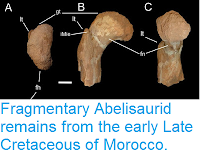
Abelisaurid femur from the Kem Kem Compound Assemblage of Morocco. (A) proximal view, (B) anterior view, (C) medial view, (D) posterior view, (E) lateral view, (F) distal view (not at same scale as other views). Scale bars are 5 cm. Abbreviations: gt, greater trochanter; iMie, insertion for the M. iliofemoralis externus; fn, femoral neck; s, shallow sulcus. Chiarenza & Cau (2016).

The specimen is reconstructed to have been at least 776-924 mm in length, and possibly as long as 1200 m. Even the most conservative estimate of the complete size of this bone suggests an animal weighing around 1850 kg, suggesting an animal towards the upper end of the known range for Abelisuarids (or any closely related group), suggesting that these Dinosaurs were already reaching very large sizes by the Cenomanian, somewhat earlier than has previously been suggested.

See also...

http://sciencythoughts.blogspot.co.uk/2015/08/isolated-theropod-teeth-from-middle.htmlIsolated Theropod teeth from the Middle Jurassic of Niger.                                                         Unlike Mammals, Dinosaurs replaced their teeth throughout their lives, continuously growing new teeth and shedding older, worn ones. This, combined with the hard enamel coating found on all vertebrate teeth, makes isolated teeth the most commonly...
http://sciencythoughts.blogspot.co.uk/2014/03/dinosaur-remains-from-northwestern.htmlDinosaur remains from northwestern Saudi Arabia.                                                   Dinosaurs are the most distinctive element of Mesozoic Vertebrate faunas, arising in the Triassic, and coming to dominate all known terrestrial ecosystems during the Jurassic and Cretaceous, before disappearing abruptly (other than the still extant Birds) at the end of that period. Despite this widespread distribution, very...
http://sciencythoughts.blogspot.co.uk/2014/03/a-new-species-of-theropod-dinosaur-from.htmlA new species of Theropod Dinosaur from the Late Jurassic of Portugal.                       The Late Jurassic Megalosaurid Theropod Dinosaur...

Follow Sciency Thoughts on Facebook.