Showing posts with label Michigan. Show all posts

Wednesday, 20 May 2020

Thousands forced to flee their homes as two dams fail in MIchigan.

Around 10 000 people have been forced to flee their homes in parts of central Michigan following the failure of two dams on the Tittabawassee River. The eastern part of the Edenville Dam in Gladwin County collapsed at about 5.45 pm local time on Tuesday 19 May 2020 following days of heavy rain in the area, causing thousands of people to be evacuated from homes in the city of Edenville, about 6 km downstream, as water levers three metres above normal surged towards the town. Shortly after the Sanford Dam, 4km downstream of Edenville and 10 km downstream of the Edenville dam overtopped, sending floodwaters towards the city of Midland, another 9.7 km downstream, where mass evacuations are again underway.

The failure of the Edenville Dam on the Tittabawassee River in Gladwin County, Michigan, on Tuesday 19 May 2020. Dave Petley/Landslide Blog/American Geophysical Union/MLive/Youtube.

The Edenville Dam, a hydroelectric project built in the 1920s, had its licence revoked by the Federal Energy Regulatory Commission in October 2018, following the failure of it's owners Boyce Hydro Power to comply with an order to rectify multiple breaches of safety regulations, including an inability to cope with a potential maximum flood. The dam was subsequently purchased, along with three other hydro-electric projects, including the Sanford Dam, by the Four Lakes Task Force, a 'Delegated Authority' formally created by resolutions passed in Midland and Gladwin counties to administer and oversee the maintenance and operations of the projects.

Flooding on the Tittabawassee River in Michigan following the failure of the Edenville Dam on 19 May 2020. WXYZ Detroit.

Many parts of the eastern United States have suffered extremely high levels of rainfall this week due to the passage of Tropical Storm Arthur, which swept up the eastern coast of the United States without making landfall, and eventually turned east and headed out into the central Atlantic.

Flooding in Sanford, Michigan, following the failure of the Edenville and Sanford dams on 19 May 2020. Michael Connell/TC Vortex.

Tropical storms are caused by solar energy heating the air above the oceans, which causes the air to rise leading to an inrush of air. If this happens over a large enough area the inrushing air will start to circulate, as the rotation of the Earth causes the winds closer to the equator to move eastwards compared to those further away (the Coriolis Effect). This leads to tropical storms rotating clockwise in the southern hemisphere and anticlockwise in the northern hemisphere. These storms tend to grow in strength as they move across the ocean and lose it as they pass over land (this is not completely true: many tropical storms peter out without reaching land due to wider atmospheric patterns), since the land tends to absorb solar energy while the sea reflects it.

 The failure of the Sanford Dam in Midland County, Michigan, on 19 May 2020. CitadelofRick/Twitter.

Despite the obvious danger of winds of this speed, which can physically blow people, and other large objects, away as well as damaging buildings and uprooting trees, the real danger from these storms comes from the flooding they bring. Each drop millibar drop in air-pressure leads to an approximate 1 cm rise in sea level, with big tropical storms capable of causing a storm surge of several meters. This is always accompanied by heavy rainfall, since warm air over the ocean leads to evaporation of sea water, which is then carried with the storm. These combined often lead to catastrophic flooding in areas hit by tropical storms.

See also...

https://sciencythoughts.blogspot.com/2020/05/four-dead-over-100-000-displaced.htmlhttps://sciencythoughts.blogspot.com/2018/11/explaining-failure-of-xe-pian-xe-namnoy.html
https://sciencythoughts.blogspot.com/2018/08/evacuations-as-city-of-lynchburg.htmlhttps://sciencythoughts.blogspot.com/2018/07/collapse-of-dam-is-feared-to-have.html
https://sciencythoughts.blogspot.com/2018/05/thousands-evacuated-after-landslide.htmlhttps://sciencythoughts.blogspot.com/2017/07/flooding-kills-ten-in-west-bengal-after.html
Follow Sciency Thoughts on Facebook.

Sunday, 29 December 2019

Water spilling onto Detroit freeway shown to contain high levels of hexavalent chromium.

A water leak that began spouting from a freeway in Detroit, Michigan, has been shown to contain high levels of hexavalent chromium Chromium (VI). The leak, which is poring onto the I-696 in Madison Heights, and which has prompted local authorities to close one lane of the freeway, is producing water with a distinctive bright green colour, to the alarm of local communities. Now tests by the Michigan Department of Environment, Great Lakes, and Energy have shown that water samples taken from the leak contain 140 μg per litre of hexavalent chromium, higher than the U.S. Environmental Protection Agency's recommended maximum of 100 μg per litre total chromium, which is generally assumed to be mostly the less toxic trivalent chromium (Chromium III). The World Health Organisation recommends total chromium should not exceed 50 μg per litre. A maximum Chromium (VI) level of 10 μg per litre has been legislated for in the State of California (the only state to specifically address the issue to date) and has adopted a long term public health goal of reducing levels to 0.02 μg per litre in all drinking water in the state.

A greenish-yellow liquid flows through a retaining wall on I-696, triggering a lane closure and haz-mat clean-up on the afternoon of Friday 20 December 2019. Michigan Department of Transportation.

The site of the leak is beneath a former metal-plating factory, which is thought highly likely to be responsible for the liquid that migrated onto the freeway. The U.S. Environmental Protection Agency now plans to carry out extensive testing at the site, with a view to determining the extent of the contamination and environmental remediation needed, and is highly likely to take legal action against the site's owners, Electro-Plating Services.

Chromium is a moderately common transition metal; that is to say an elemental metal with atoms that can have different electrical configurations (valencies) enabling it to exhibit different chemical properties when forming bonds with other atoms. The most common form of chromium in the environment is trivalent chromium, however the rarer hexavalent chromium, or is sometimes found in water, which is a cause for concern as this form of chromium is recognised to be carcinogenic to Humans (that is to say it can cause cancer in Humans).

See also...

https://sciencythoughts.blogspot.com/2019/10/outbreak-of-eastern-equine-encephalitis.htmlhttps://sciencythoughts.blogspot.com/2018/10/unusual-inickel-iron-meteorite.html
https://sciencythoughts.blogspot.com/2018/04/electrical-cable-leaks-dielectric-fluid.htmlhttps://sciencythoughts.blogspot.com/2017/02/investigating-cause-of-water-crisis-in.html
https://sciencythoughts.blogspot.com/2016/12/evacuations-as-house-collapses-into.htmlhttps://sciencythoughts.blogspot.com/2015/12/widespread-lead-poisonng-prompts-city.html
Follow Sciency Thoughts on Facebook.

Tuesday, 15 October 2019

Outbreak of Eastern Equine Encephalitis kills at least thirteen people in the United States.

At least thirteen people have died in an outbreak of Eastern Equine Encephalitis in the United States since August 2019. Outbreaks of the disease are expected in the US at this time of year, but this year's epidemic is exceptional both in terms of the number of cases reported and the number of fatalities. Five people have died in Michigan alone, out of a total of ten cases reported in the state, with three fatalities each in Massachusetts and Connecticut, and one each in Rhode Island and Indiana.  Only a single fatality was reported from the disease in 2018, out of 23 cases reported across the US, with 2 deaths in 2017 out of a total of 45 cases.

Eastern Equine Encephalitis is caused by the Eastern Equine Encephalitis Alphavirus, a form of Togavirus closely related to the Venezuelan Equine Encephalitis Alphavirus, and the Western Equine Encephalitis Alphavirus. These are single stranded positive-sense RNA Viruses. 

Colourised TEM micrograph of a mosquito salivary gland: The virus particles (virions) are coloured red. Fred Murphy and Sylvia Whitfield/Centers for Disease Control and Prevention/Public Health Image Library/Wikimedia Commons.

Eastern Equine Encephalitis is a Mosquito-born disease which primarily infects Birds, but is occasionally passed to Mammals through Mosquito bites. It gets the name 'Equine Encephalitis' because it is much more virulent in Horses than Humans, having first been discovered after an outbreak in Massachusetts killed 75 Horses in 1831. 

About 95% of people infected by the disease develop no symptoms, and are only detected if screening programs are introduced during an epidemic. Those who do develop symptoms suffer chills, fever, malaise, arthralgia, and myalgia for about two weeks, with about a quarter developing encephalitis (swelling of the brain), which can cause symptoms such as fever, headache, irritability, restlessness, drowsiness, anorexia, vomiting, diarrhea, cyanosis, convulsions, and coma. Around a third of patients that develop encephalitis die of the illness, with many others suffering permanent brain damage.

A vaccine against Eastern Equine Encephalitis is available for Horses, but none has been developed for Human use, nor is any specific treatment available, though fluid replacement, plus treatment with anticonvulsants (drugs to reduce convulsions) and antipyretics (drugs to reduce fever) have been shown to help.

See also...

https://sciencythoughts.blogspot.com/2019/10/measles-outbreak-kills-over-4000-in.htmlhttps://sciencythoughts.blogspot.com/2019/09/african-swine-fever-reported-in-south.html
https://sciencythoughts.blogspot.com/2019/09/seven-cofirmed-deaths-from-yellow-fever.htmlhttps://sciencythoughts.blogspot.com/2019/09/understanding-wild-ecology-of-ebola.html
https://sciencythoughts.blogspot.com/2019/09/number-of-measles-cases-reported-in-new.htmlhttps://sciencythoughts.blogspot.com/2018/11/british-citizen-dies-after-contracting.html
Follow Sciency Thoughts on Facebook.

Wednesday, 10 October 2018

Unusual inickel-iron meteorite discovered on Michgan farm.

A Michigan man has discovered he is in possession of a highly unusual meteorite after taking the object to a specialist to have it checked. David Mazurek from Edmore near Mount Pleasant obtained the rock with a farm he bought in 1988, and had been using it as a doorstop since, but contacted scientist Mona Sirbescu of the Department of Earth and Atmospheric Sciences at Central Michigan University, after seeing similar rocks being diagnosed as meteorites in news reports. The rock was in a barn on the property when he obtained it, with the previous owner claiming his father has seen it fall from the sky in the 1930s, and that it was still hot to the touch when found in a crater. 

The Edmore Meteorite. Central Michigan University. 

The part of the story about the discovery of the rock is probably apocryphal; meteorites are not usually hot to the touch when found, as the fragments that fall to Earth are typically from the inside of larger bodies that have exploded higher in the atmosphere. The friction between an object falling through the atmosphere and the molecules that make up the atmosphere is not enough to cause significant heating, but an object that enters the Earth’s atmosphere from space will generally be travelling at a far higher speed, due to the momentum from its own orbital path, which is enough to cause frictional heating. This friction will cause the outer layers of the object to become superheated, while the interior remains at the temperature that it was at in space, typically a few degrees above absolute zero. This temperature difference typically causes the object to burn then explode as a bright meteor, with left over pieces of the object’s interior falling to the ground as meteorites (bright lights in the sky are meteors, lumps of rock of extra-terrestrial origin are meteorites), which start out very cold and are not warmed significantly by their decent.

Sirbescu quickly concluded that the object was an nickel-iron meteorite (the first actual meteorite brought to her by a member of the public in 18 years), weighing about 10 kg, making it the sixth largest meteorite ever discovered in Michigan. Interestingly the meteorite appears to be about 88% iron and about 12% nickel, a higher proportion of nickel than most such objects (which are typically 90-95% iron and 5-10% nickel), which has aroused interest among meteorite collectors, with both the Smithsonian Institution and an independent mineral museum in Maine reportedly interested in obtaining the object (though the figure of US$100 000 widely quoted in the media is probably a little higher than the true value of the object).

Nickel-iron meteorites, or octahedrites, are the most common class of meteorite, being comprised largely of iron with a substantial amount of nickel, leading to the formation of the mineral kamacite, which has an octahedral form, giving these meteorites their name. Strictly speaking iron meteorites are less common than stony meteorites, but they are much more commonly found as they are resilient both to atmospheric entry and terrestrial weathering, and relatively easy to recognise. Only about 5.7% of objects entering the atmosphere are thought to be iron meteorites, but they comprise about 90% of objects in collections. Nickel-iron meteorites are the most common form of iron meteorite, though low-nickel meteorites hexahedrites, are also found. Both are thought to have formed within the interior of large planetesimals in the early Solar System. These bodies were large enough to develop differentiated iron cores (as is seen in the Earth today), but which were subsequently torn apart by tidal forces generated by the larger planets.

See also...

https://sciencythoughts.blogspot.com/2018/09/using-mineral-inclusions-from-almahata.htmlhttps://sciencythoughts.blogspot.com/2018/07/fragment-of-asteroid-2018-la-found-in.html
https://sciencythoughts.blogspot.com/2018/06/meteorites-found-in-yunnan-province.htmlhttps://sciencythoughts.blogspot.com/2018/04/microtektites-from-transantarctic.html
https://sciencythoughts.blogspot.com/2018/03/meteorite-stolen-from-virginia-museum.htmlhttps://sciencythoughts.blogspot.com/2018/01/micrometerites-from-late-cretaceous.html
Follow Sciency Thoughts on Facebook.

Friday, 6 April 2018

Electrical cable leaks dielectric fluid into Lake Michigan.

Around 2250 litres of dielectric fluid has leaked from a power line beneath the western end of the Straits of Mackinac, on Sunday 1-Monday 2 April 2018. The pipeline, which is operated by the American Transmission Co. and connects Point La Barbe to the north to the McGulpin Riser Station on the south side of the Straits, is thought to have been struck by a marine vessel passing through the channel. The leak was detected due to a drop in pressure in the line, which prompted the operators to shut the cable off and reduce the fluid pressure in it, but the poor weather in the region hampered efforts to locate the actual leak.

Scientists from the US Coast Guard, the Michigan Department of Environmental Quality, and the American Transmission Co., during the search for a leak from a damaged power cable beneath the Straits of Mackinac, earlier this week. US Coast Guard.

Dielectric fluids are used to insulate power cables by quenching electrical discharges. A variety of liquids can be used for this purpose, though in this case the substance is understood to be DF 45, a mixture of benzene and alkyl derivatives, considered to be toxic and harmful to the environment, though as the main danger is considered to be presented come from inhaling concentrated fumes, it is likely that the substance will disperse without causing serious problems in this instance.

See also...

http://sciencythoughts.blogspot.co.uk/2018/01/fireball-meteor-over-michigan-causes.htmlhttp://sciencythoughts.blogspot.co.uk/2017/12/possible-metoerite-impact-near-thunder.html
http://sciencythoughts.blogspot.co.uk/2017/10/algal-bloom-covers-much-of-western-lake.htmlhttp://sciencythoughts.blogspot.co.uk/2017/02/investigating-cause-of-water-crisis-in.html
http://sciencythoughts.blogspot.co.uk/2016/12/evacuations-as-house-collapses-into.htmlhttp://sciencythoughts.blogspot.co.uk/2016/02/truck-swallowed-by-sinkhole-in.html
Follow Sciency Thoughts on Facebook.

Wednesday, 17 January 2018

Fireball meteor over Michigan causes Earthquake.

The American Meteor Society has received reports of a bright fireball meteor being seen over the Great Lakes region of North America at about 8.10 am local time (about 1.10 am GMT) on Tuesday 16 January 2018. People have reported seeing the event from Iowa, Illinois, Indiana, Ohio, Michigan, Pennsylvania, and Ontario (Canada), with the majority of sightings coming from Michgan and Ohio. A fireball is defined as a meteor (shooting star) brighter than the planet Venus. These are typically caused by pieces of rock burning up in the atmosphere, but can be the result of man-made space-junk burning up on re-entry. The object was seen moving from northeast  to southwest over the eastern part of the state. 

The 16 January 2018 meteor seen from Michigan. Zack Lawler/WWMT.

The Object has been calculated to have been moving from east to west over the southeastern part of Michigan, and produced a loud booming noise that was recorded as a Magnitude 2.0 Earthquake by the United States Geological Survey. This has been interpretted as being indicative of a large, slow moving (about 45 000 km per hour) object, and it is thought likely that a number of meteorites will have reached the ground.

Map showing areas in southeast Michigan where sightings of the meteor were reported, and the route of the object (blue arrow). American Meteor Society.

Objects of this size probably enter the Earth's atmosphere several times a year, though unless they do so over populated areas they are unlikely to be noticed. They are officially described as fireballs if they produce a light brighter than the planet Venus. The brightness of a meteor is caused by friction with the Earth's atmosphere, which is typically far greater than that caused by simple falling, due to the initial trajectory of the object. Such objects typically eventually explode in an airburst called by the friction, causing them to vanish as an luminous object. However this is not the end of the story as such explosions result in the production of a number of smaller objects, which fall to the ground under the influence of gravity (which does not cause the luminescence associated with friction-induced heating).
 
 The recorded epicenter of the 16 January Michigan fireball-induced Earthquake (gold star) and areas where it was felt (blue and white squares). USGS.
 
These 'dark objects' do not continue along the path of the original bolide, but neither do they fall directly to the ground, but rather follow a course determined by the atmospheric currents (winds) through which the objects pass. Scientists are able to calculate potential trajectories for hypothetical dark objects derived from meteors using data from weather monitoring services.
 
Witness reports can help astronomers to understand these events. If you witness a fireball-type meteor over the UK you can report it to the American Meteor Society here.

See also...

http://sciencythoughts.blogspot.co.uk/2018/01/the-quadrantid-meteor-shower.htmlhttp://sciencythoughts.blogspot.co.uk/2018/01/micrometerites-from-late-cretaceous.html
http://sciencythoughts.blogspot.co.uk/2018/01/fireball-meteor-over-northern-england.htmlhttp://sciencythoughts.blogspot.co.uk/2017/12/fireball-over-southern-california.html
http://sciencythoughts.blogspot.co.uk/2017/12/the-ursid-meteors.htmlhttp://sciencythoughts.blogspot.co.uk/2017/12/fireball-over-colorado.html
Follow Sciency Thoughts on Facebook.

Friday, 10 February 2017

Investigating the cause of the water crisis in Flint Michigan.

In April 2014 the city of Flint, Michigan changed the source of its water from the Detroit River to the Flint River, the first stage of a project eventually intended to source water from Lake Huron via a new pipeline. However almost immediately people began to complain of a reduction in water quality, reporting that the water was cloudy in colour and gave off a foul odour. Cases of lead poisoning began to be reported in the city in February 2015, with tests showing dangerously high levels of lead in the blood of 15% of children in parts of the city. Shortly thereafter state officials found water in the city also contained dangerously high levels of trihalomethanes.

In a paper published in the journal Environmental Science & Technology on 1 February 2017, Kelsey Pieper, Min Tang, and Marc Edwards of the Department of Civil and Environmental Engineering at Virginia Tech present the results into the cause of the Flint water crisis.

Until 25 April 2014 Flint obtianed treated water from the Detroit Water and Sewer Department, however from that date water supplies were changed to a treatment plant on the Flint River, as part of a long-term plan to switch supplier to the Karegnondi Water Authority in 2016. This Flint River water was known to be more corrosive than the Detroit water, but no corrosion control measures were put in place, and, to make matters worse ferric chloride (FeCl₃) was added to the water as a coagulant to control total trihalomethanes, which further raised the corrosivity of the water.

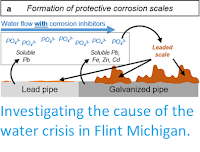
Corrosive chemicals in water can dissolve lead and other metals (such as copper and iron) from pipes releasing them into the water supply as contaminants. The addition of corrosion inhibitors such as orthophosphate (PO₄³⁻) removes this dissolved metal from the water, forming insoluble scaling on the inside of metal pipes. However if such corrosion control is stopped, then the corrosive chemicals not just resume corroding the metal pipes, but also any scaling on the interior of the pipes, leading to higher levels of metal contamination in the water.

 Formation and destabilisation of protective scales: (a) corrosion inhibitors (e.g., PO₄³⁻) control the release of metals from plumbing through the formation of protective scales and (b) without corrosion inhibitors previously formed protective scales can become unstable and deteriorate resulting in high lead and iron in water. Pb = lead; Fe = iron; Zn = zinc; and Cd = cadmium. Pieper et al. (2017).

The U.S. Environmental Protection Agency's Lead and Copper Rule, water from a selection of households should regularly be tested for the presence of these metals. However the majority of tested homes in Flint did not receive their water via any route that involved lead service pipes, and therefore did not show significant signs of raised lead, which led officials within the town to conclude that the water supply was safe, though a subsequent report by the Flint Water Advisory Task Force set up by Governor Rick Snyder concluded that a large number of test results were excluded from the study 'conveniently and without adequate investigation'.

One resident that did find signs of problems with their water supply (referred to as 'Resident Zero' since the property was 'Ground Zero' for the lead pollution incident in Flint), reported problems with discoloured and foul tasting water in January 2015, collecting a series of water samples which showed raised lead levels when tested, with subsequent tests on water collected from the property in February, March and April showing that lead levels had continued to rise. During the same period a child in the home was shown to have a sharp rise in blood lead levels. However this was treated as an anomalous result by city officials, who cut the water supply to the property in the belief that this was a localised problem.

Association between water discolouration and lead concentrations for water samples collected in January 2015. A photo of the original sample bottles is overlaid with a bar chart of lead in water concentrations. Pieper et al. (2017).

Inspection of the home later in the month by officials from the Environmental Protection Agency could find no source of lead contamination within the home, at which point Resident Zero contacted the scientists at Virginia Tech for help.

The Virginia Tech team were able to arrange for the water supply to the property to be reconnected in order to run a series of tests on 28 April 2015. They collected a series of samples at low (1.3 L/min), moderate (4.2 L/min), and high flow rates (7.5 L/min) from a cold water tap within the property.

All of the samples had lead levels considerably above the Environmental Protection Agency's action level of 15 μg/L, with the lowest measurement at 217 μg/L, and several exceeded the 5000 μg/L limit above which the agency classifies contaminated water as hazardous waste, with the highest sample reaching 13 200 μg/L lead. All of the samples also contained iron in excess of the Environmental Protection Agency's safe limit of 0.3 mg/L, with the lowest sample having an iron content of 0.7 mg/L and the highest 6.5 mg/L. There was a strong correlation between lead and iron levels in the waters, which the Virginia Tech team interpreted as indicative of the breakdown of lead-bearing iron rust layers within supply pipes.

Next the scientists obtained samples of the piping supplying the property, finding that they were galvanised (zinc-coated) iron pipes with a significant level of scaling, and that this scaling contained significant levels of zinc, iron, lead, cadmium and tin, all of which were being released into the water as a result of the raised corrosivity of the supply.
Pieper et al. conclude that the water contamination experienced by Flint, Michigan came about largely as a result of the cessation of of corrosion control measures following the change in water supplier in 2014, and that this would probably have gone undetected without the scientific and investigative work of Resident Zero. The levels of lead found at the property were so high as to present an immediate danger to health, with a single 250 mL glass of water with a lead concentration of 217 μg/L (the lowest recorded concentration in any sample from the property) able to raise a child's blood level significantly and such a glass with a concentration of 2500 μg/L or above able to raise the blood lead level in a child with no previous exposure to lead above the Centers for Disease Control and Prevention’s level of concern immediately (lead is a cumulative toxin that builds up in the body rather than something to which an immunity can be developed).

Based upon this conclusion they note that, even if Resident Zero was receiving the most contaminated water in the city of Flint, something that they have no reason to suspect, then there would be good reason to have serious concerns about the quality of the water supply being received by other residents of the city (as it was, a state of emergency was declared in Flint after a spike in blood lead levels was recorded in children across the city in September 2015).

See also...

http://sciencythoughts.blogspot.co.uk/2016/12/tracing-origin-of-hexavalent-chromium.htmlhttp://sciencythoughts.blogspot.co.uk/2016/12/chemical-spill-leaves-corpus-christi.html
http://sciencythoughts.blogspot.co.uk/2016/10/selenium-arsenic-and-molybdenum-in.htmlhttp://sciencythoughts.blogspot.co.uk/2016/07/saskatchewan-city-forced-to-cut-water.html
http://sciencythoughts.blogspot.co.uk/2015/12/widespread-lead-poisonng-prompts-city.htmlhttp://sciencythoughts.blogspot.co.uk/2015/08/cryptosporidium-discovery-at-water.html
Follow Sciency Thoughts on Facebook.