Showing posts with label Mysticetes. Show all posts

Friday, 10 January 2025

Cochimicetus convexus: A new species of Eomysticetid Whale from the Late Oligocene of Baja California Sur, Mexico.

Baleen Whales, Mysticetes, are the largest Animals alive today, and, as far as we can tell, the largest Animals ever to have lived. They are able to achieve this huge size by a unique feeding mechanism; using a system of keratinaceous baleen plates  to filter food items (such as Crustaceans of small Fish) from the water. The largest Baleen Whales are lunge feeders, capable of engulfing whole shoals of prey-items, then  trapping them on the baleen plates as the accompanying water is pushed out through. The earliest Mysticetes appeared in the Late Eocene, though these were still Toothed Whales, little different from the ancestors of today's Odontocetes. The first true Baleen Whales were the Eomysticetids, a group which appeared in the Early Oligocene. Eomysticetids had baleen plates similar to those of modern Baleen Whales, but appear to have lacked the ability to lunge-feed in the same way, and were not capable of reaching the same sizes.

In a paper published in the journal Palaeontologica  Electronica in January 2025, Cielo Cedillo-Avila and Gerardo González-Barba of the Museo de Historia Natural at the Universidad Autónoma de Baja California Sur,  and Azucena Solis-Añorve, also of the  Museo de Historia Natural, and of Posgrado of Ciencias Marinas and Costeras at the Universidad Autónoma de Baja California Sur, describe a new species of Eomysticetid Whale from the Late Oligocene San Gregorio Formation of Baja California Sur.

The new species is described from a single specimen comprisng a partially complete skull with a length of 147 cm, along with both mandibles and tympanic bulla. It is named Cochimicetus convexus, where 'Cochimicetus' refers to the indigenous Cochimi people, a nomadic group who once inhabited the northern part of Baja California Sur, and 'convexus' refers to the convex shape of the anterior tip of the tympanic bulla, which tends to be pointed in other Eomysticetid Whales.

Dorsal view of the holotype of Cochimicetus convexus. (A) Image showing the identified structures. (B) photography with scale 10 cm. Cedillo-Avila et al. (2025).

Cochimicetus convexus is the fourth species of Eomysticetid Whale from the Oligocene of Baja California Sur, demonstrating the importance of the area for our understanding of the early evolution of the Mysticetes. 

See also...

Monday, 1 April 2024

Fucaia humilis: A Mysticete Whale from the Latest Eocene of Washington State.

Modern Mysticete Whales are noteworthy for the presence of a keratinous baleen, which they use as a filter feeding device, having lost all conventional dentition. The earliest members of the group, which retained teeth, first appeared in the Late Eocene, with the group undergoing a significant diversification event in the Oligocene. To date, only two species of Mysticete Whales are known from the Eocene, both from the Southern Hemisphere (one from Peru and one from Antarctica). This has led to the hypothesis that the Mysticetes are of Southern Hemisphere origin, and that the Oligocene radiation within the group is likely to have been driven by the End Eocene opening of a seaway between Antarctica and South America, and the subsequent formation of the Antarctic Circumpolar Current, which in turn led to a Southern Ocean with superabundant and highly-concentrated nutrients, an environment which could have favoured the evolution of the baleen filter-feeding system. 

In a paper published in the journal Current Biology on 28 March 2024, Cheng-Hsiu Tsai of the Department of Life Science and Institute of Ecology and Evolutionary Biology at the National Taiwan University, and the Department of Geology at the Japanese National Museum of Nature and Science, James Goedert of the Burke Museum of Natural History and Culture at the University of Washington, and  Robert Boessenecker, formerly of the Charleston Center for Paleontology*, describe a third species of Eocene Mysticete Whale, from the Lincoln Creek Formation of Washington State, the first known Mysticete Whale from the Eocene of the Northern Hemisphere.

The new species is placed in the genus Fucaia, which contains two previously described species from the Oligocene of the northwest coast of North America, and given the specific name humilis, meaning 'humble', in reference to the apparent minor role of Mysticete Whales in Eocene ecosystems. The new species is described from a single specimen (UWBM  109363), comprising posterior portion of a skull with right periotic and bulla attached, partial mandible, and the hyoid apparatus.

Geological column and species of Fucaia.  (A) Geological occurrences of Fucaia spp. in Washington State, USA. (B) Dorsal view of Fucaia goedertorum (NTUM-VP 240224, cast of the holotype); (C) dorsal view of Fucaia humilis (UWBM 109363); (D) ventral view of Fucaia goedertorum (NTUM-VP 240224, cast of the holotype); (E) and ventral view of Fucaia humilis (UWBM 109363). Tsai et al. (2024).

The precise location that the specimen was collected from is not given, but is described as being a site on the Middle Fork of the Satsop River, Mason County, dated to 34.5 million years before the present, which is 600 000 years before the Eocene/Oligocene boundary.

(A) The stratigraphic and geological interpretations of the Fucaia humilis discovery site, and (B) field photo, August 2023. Tsai et al. (2024).

Based upon the size of the specimen, the living Whale is estimated to have been between 286 and 206 cm in length, which is fairly typical for small Aetiocetid Whales (the group of toothed Mysticete Whales to which the genus Fucaia belongs).

The discovery of Fucaia humilis in deposits dated to the Latest Eocene of North America has serious implications for our understanding of the evolution of Mysticete Whales. Both previously described Eocene Mysticete Whales came from the Southern Hemisphere, which led palaeontologists to the conclusion that the group came from that part of the world, and that the subsequent Oligocene radiation of Mysticete Whales was driven by events there, notably the formation of the Antarctic Circumpolar Current.

Phylogenetic relationships of Fucaia humilis. Tsai et al. (2024).

The presence of a member of the genus Fucaia, which has been found nowhere else, on the Pacific Northwest of North America in the Latest Eocene suggests a presence of Aetiocetid Whales in this region for around 10 million years, whereas the occurrence of toothed Mysticete Whales in other parts of the world appears to have been somewhat sporadic, with Whales only present some of the time, gaps in the record, and a high turnover of genera, implying unstable environments intermittently colonised by Whales. Notably, the appearance of Fucaia humilis appears to coincide with the development of a Kelp forest ecosystem in this area, something which persists to this day. Kelp forests provide a stable, nutrient rich environment, which was apparently favourable to small Aetiocetid Whales. 


*Robert Boessenecker was arrested on 14 March 2024 along with his wife, the former museum collection manager at the Mace Brown Natural History Museum, accused of stealing fossils with a value of US$8634 from the collection of the Mace Brown Museum when both were employed there.

See also...

Tuesday, 8 October 2019

Humpback Whale spotted im the Thames Estuary.

A Humpback Whale has been seen in the waters of the Thames Estuary close to Dartford in Kent, according to the Port of London Authority. The animal was spotted numerous times at the weekend (5-6 October 2019), with estimates of its size ranging from five to ten metres. The Whale is being monitored by observers from British Divers Marine Life Rescue, who have confirmed that it appears ro be healthy and behaving in a normal way, though there are concerns that it may be at risk if it remains within the estuary too long, as the waters are tidal, have heavy river traffic, and probably offers little in the way of food for a large Baleen Whale.

A Humpback Whale close to the Dartford Crossing in the Thames Estuary this week. David Callahan/Kent Online.

Humpback Whales were nearly exterminated by commercial Whaling in the first part of the twentieth century. The species has been protected since 1946, and in recent years their population has appeared to be recovering in many areas, now being seen as being of Least Concern  under the terms of the International Union for the Conservation of Nature's Red List of Threatened Species. These Whales are becoming increasingly common in waters around the UK, but are also increasingly coming into rivers and other areas where they are more at risk from Human activities, as well as being stranded on beaches and becoming entangled in fishing gear.

See also...
https://sciencythoughts.blogspot.com/2019/09/humpback-whale-washes-up-on.htmlhttps://sciencythoughts.blogspot.com/2019/09/grampus-griseus-rissos-dolphins-in.html
https://sciencythoughts.blogspot.com/2019/09/immature-blue-whale-washes-up-dead-on.htmlhttps://sciencythoughts.blogspot.com/2019/09/megaptera-novaeangliae-how-kermadec.html
https://sciencythoughts.blogspot.com/2019/09/casatia-thermophila-new-species-of.htmlhttps://sciencythoughts.blogspot.com/2019/09/cetacean-sightings-within-great-pacific.html
Follow Sciency Thoughts on Facebook.

Wednesday, 25 September 2019

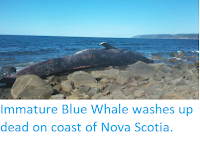
Immature Blue Whale washes up dead on coast of Nova Scotia.

A juvenile Blue Whale, Balaenoptera musculus, has been found on the coast of Nova Scotia. The Whale, judged to be a juvenile as it is only 18.8 m in length (compared to around 30 m for adults of the species) was first sighted Sutherland's Cove, about six kilometres north of Port Hawkesbury on Wednesday 18 September 2019. It was originally hoped that a necropsy (animal autopsy) could be performed on the Whale, as there have been concerns about Whales in the area being injured or killed by ship strikes or after becoming entangled in abandoned fishing nets, but Fisheries and Oceans Canada have now ruled this out, due to the remote location of the corpse and its advanced state of decay.

The body of an immature Blue Whale found at Sutherland's Cove on the coast of Nova Scotia on 18 September 2019. Carol Morris/The Chronicle Herald.

Blue Whales are the largest animals living on Earth today, and are larger than any known animal in the fossil record, with adults reaching around 30 m in length (some Sauropod Dinosaurs are thought to have been slightly longer, but much less bulky). The species was hunted to the brink of extinction during the twentieth century, before a moratorium on hunting the species was introduced in 1966, since when the species has begun to recover. There are currently thought to be somewhere between 10 000 and 25 000 Blue Wales living today, with the species being classified as Endangered under the terms of the International Union for the Conservation of Nature’s Red List of Threatened Species

See also...
https://sciencythoughts.blogspot.com/2019/09/megaptera-novaeangliae-how-kermadec.htmlhttps://sciencythoughts.blogspot.com/2019/09/cetacean-sightings-within-great-pacific.html
https://sciencythoughts.blogspot.com/2019/08/humpback-whales-seen-off-coast-of.htmlhttps://sciencythoughts.blogspot.com/2018/11/humpback-whale-washes-up-on-californian.html
https://sciencythoughts.blogspot.com/2018/09/humpback-whale-seen-floating-dead-off.htmlhttps://sciencythoughts.blogspot.com/2018/08/megaptera-novaeangliae-breeding-rates.html

Follow Sciency Thoughts on Facebook.

Thursday, 19 September 2019

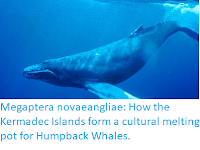
Megaptera novaeangliae: How the Kermadec Islands form a cultural melting pot for Humpback Whales.

Male humpback Whales, Megaptera novaeangliae, perform complex songs, both to attract potential mates and to communicate with other males within the group. These songs constantly evolve as the Whales improvise, but common themes are retained by the males within a group, so that each group of males has a distinctive song, which can be used to identify them. However, occasionally a Whale will come up with a particular variant on a song, which will not just be adopted by other members of the group, but by Whales from other groups, often across a very wide area. How this occurs is unclear, as the song can only be heard over a range of a few tens of kilometres, and it is performed in the mating season, when the males will return to the area where their mothers birthed them each winter, and each of these mating and birthing grounds is geographically distinct. One theory that has been put forward is that males also sing out of season, when they are migrating across the wider ocean, and may encounter males from other groups.

In a paper published in the journal Royal Society Open Science on 4 September 2019, a team of scientists led by Claire Owen of the Sea Mammal Research Unit at the University of St Andrews present the results of a study of the songs of male Humpback Whales around the Kermedoc Islands, which they visit each spring on their way from their winter breeding grounds to their summer feeding areas around Antarctica.

A Humpback Whale, Megaptera novaeangliae. NOAA/Flikr/Wikimedia Commons.

The Humpback Whales of the western South Pacific can be divided into three distinct populations, one found around the northeast coast of Australia (the Australian Population), one found around New Caledonia, Tonga and American Samoa (the Western South Pacific Population), and one found around the Cook Islands and French Polynesia (the Central South Pacific Population). New songs will typically take around two years to cross the entire region, so that each population will typically be singing a different song at any given time.

Previous studies of Humpback Whales passing through the Kermedoc Islands on the way to their summer feeding grounds, using both photo-identification and generic marker techniques, have identified Whales from multiple wintering grounds, with Whales staying in the area for an average of 4.6 days.

Owen et al. theorised that if Whales from different populations are passing through the Kermedoc Islands at the same time, then the area could potentially serve as a site where new songs are passed from one group to another. To this end Whale song was recorded in the Kermedoc Islands and each of the winter breeding grounds in the southern winter and spring of 2015 order to make a comparison.

Three distinct song types were found at the winter breeding grounds, Song 1, found in the Central South Pacific Population around the Cook Islands and French Polynesia,  Song 2 found in the Western South Pacific Population around New Caledonia, Tonga and American Samoa, and Song 3 found in the Australian Population around the northeast coast of Australia. Both Song 1 and Song 2 were recorded in the Kermedoc Islands, as well as one Whale that appeared to be singing a hybrid of the two, strongly supporting the idea that songs are transmitted from group-to-group in this area, and probably other areas visited during the annual migration

See also...

http://sciencythoughts.blogspot.com/2019/09/casatia-thermophila-new-species-of.htmlhttps://sciencythoughts.blogspot.com/2019/09/cetacean-sightings-within-great-pacific.html
https://sciencythoughts.blogspot.com/2019/09/phocoena-sinus-vaquita-porpoise-in.htmlhttps://sciencythoughts.blogspot.com/2019/09/berardius-minimus-new-species-of-beaked.html
http://sciencythoughts.blogspot.com/2019/08/humpback-whales-seen-off-coast-of.htmlhttp://sciencythoughts.blogspot.com/2019/07/communities-gather-meat-after-whale.html
Follow Sciency Thoughts on Facebook.

Saturday, 8 September 2018

Humpback Whale seen floating dead off the coast of Brier Island, Nova Scotia.

The Marine Animal Response Society and Canadian Coast Guard are investigating after a dead Humpback Whale, Megaptera novaeangliae, was seen floating off the coast of Brier Island, Nova Scotia, on Friday 7 September 2018. The dead animal is believed to be an adult female well known to Whale watchers under the name of Peajack, who has lived in the area since 1995 and raised two calves during that time. The cause of the death has not yet been established, but the carcass appeared to be entangled in some sort of rope or net.

A female Humpback Whale floating off the coast of Brier Island, Nova Scotia, on 7 September 2018. The ballooning in is the tongue of the animal, which becomes swollen in the decomposition process. Brier Island Whale and Seabird Cruises.

Humpback Whales were nearly exterminated by commercial Whaling in the first part of the twentieth century. The species has been protected since 1946, and in recent years their population has appeared to be recovering in many areas, however they are still considered to be a species of special concern under the Canadian Species at Risk Act. This is the third report of a dead Humpback on the east Canadian coast this year, with two other deaths reported in the Bay of Fundy and off the Magdalen Islands, in the Gulf of St. Lawrence. There have also been many reports of Whales appearing to be underweight, raising concerns that they may be impacted by the Herring fishing industry.

See also...
https://sciencythoughts.blogspot.com/2018/08/megaptera-novaeangliae-breeding-rates.htmlhttps://sciencythoughts.blogspot.com/2018/08/immature-blue-whale-washes-up-dead-on.html
https://sciencythoughts.blogspot.com/2018/04/massive-ghost-net-seen-with-thousands.htmlhttps://sciencythoughts.blogspot.com/2018/03/juvenile-gray-whale-washes-up-dead-on.html
https://sciencythoughts.blogspot.com/2015/09/evidence-for-feeding-on-schooling.htmlhttps://sciencythoughts.blogspot.com/2015/09/isthminia-panamensis-south-american.html
Follow Sciency Thoughts on Facebook.

Saturday, 25 August 2018

Megaptera novaeangliae: Breeding rates in Humpback Whales around the Western Antarctic Peninsula.

Humpback Whales, Megaptera novaeangliae, were nearly exterminated around the Western Antarctic Peninsula by commercial Whaling in the first part of the twentieth century. The species has been protected since 1946, and in recent years their population has appeared to be recovering in many areas, including the Western Antarctic, where populations have risen rapidly in recent years. However, these Whales are living in a very different environment to their ancestors, with average annual sea temperatures in the region having risen by 7°C since 1950, and a much shorter seasonal sea ice coverage. The Whales migrate annually between winter feeding grounds on the Atlantic coast of South America, where mating occurs, and the Western Antarctic, where calves are born and spend the first months of their lives, though while this basic pattern is understood and the population can be observed to be recovering, little is understood about their breeding behaviour, due to the difficulty of studying the species.

In a paper published in the journal Royal Society Open Science on 2 May 2018, Logan Pallin of the Fisheries and Wildlife Department at Oregon State University, and the Department of Ecology and Evolutionary Biology at the University of California Santa Cruz, Scott Baker and Debbie Steel, also of the Fisheries and Wildlife Department at Oregon State University, Nicholas Kellar, of the Marine Mammal and Turtle Division of the National Oceanic and Atmospheric Administration, Jooke Robbins of the Center for Coastal Studies, David Johnston of the Division of Marine Science and Conservation at Duke University, Doug Nowacek, also of the Division of Marine Science and Conservation, and of the Pratt School of Engineering at Duke University, Andrew Read, again of the Division of Marine Science and Conservation at Duke University, and Ari Friedlaender, again of the Fisheries and Wildlife Department at Oregon State University, and the Institute for Marine Science and Department of Ecology and Evolutionary Biology at the University of California Santa Cruz, publish the results of a study into pregnancy rates among Humpback Whales around the Western Antarctic Peninsula between 2010 and 2016.

A Humpback Whale off the coast of Antarctica. Ari Friedlander/The Antarctic Sun.

A range of methods have been developed to detect pregnancy in Marine Mammals in recent years, including testing for hormones and steroids in the milk, urine, blood and other bodily fluids of the animals, and even ultrasound evaluations. Such techniques typically involve close sampling or capture and release of the study subjects, suitable for use on Seals, Dolphins and even small Whales, but difficult to apply to large Baleen Whales such as Humpbacks.

Instead Pallin et al. looked for pregnancy (and sex) in Humpback Whales by testing for progesterone in skin and blubber samples obtained from biopsies of Whales, which can be obtained using sampling devices launched from crossbows or similar devices, a method not thought to cause any harm to the Whales, which seldom notice the sample being taken.

A Humpback Whale off the Antarctic Peninsula. Robert Brears/Oceanwide Expeditions.

Using this method Pallin et al. obtained biopsy samples from 583 Whales between 2010 and 2016, of which it was possible to identify the sex of 507 individuals (239 males and 268 females). During the study 54 individuals were resampled two or more times during the same year, and 11 were resampled on more than one year. Excluding samples from females who were resampled the same year, a total of 265 samples were available for pregnancy testing, from 244 females. Of these 166 were determined to be from pregnant females, 99 from females that were not pregnant, and one was inconclusive.

These results indicate that on average 63.5% of the females sampled were pregnant; this figure was the same for females accompanied by yearling calves as it was for females without calves, though it did vary  significantly from year-to-year, with a high pregnancy rate of 86.27 in 2014 and a low pregnancy rate of 36.36 in 2010.

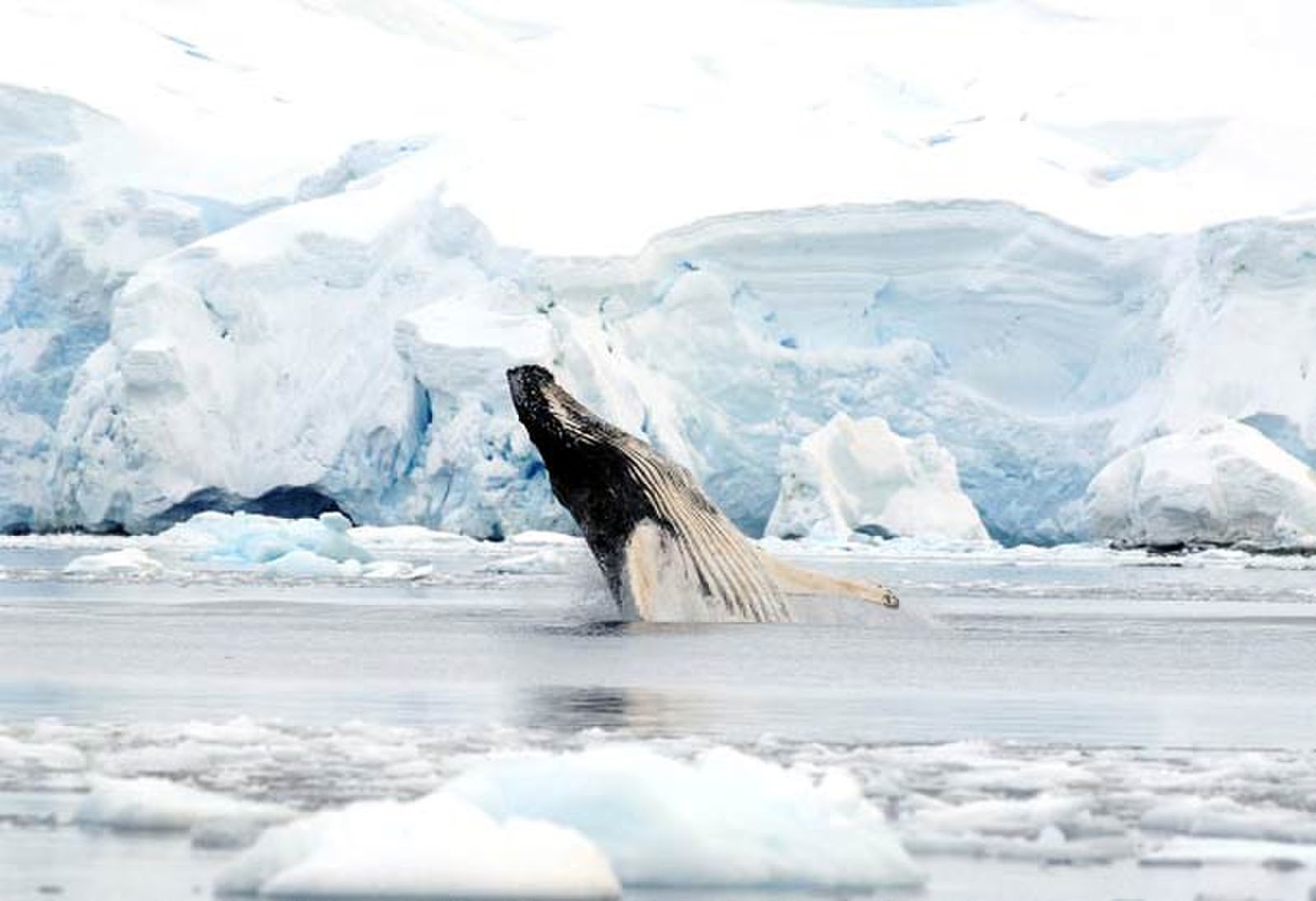
A Humpback Whale breaches in Wilhelmina Bay, on the Western Antarctic Peninsula. Ari Friedlander.

A rising population requires two factors, a high birthrate and a low infant/juvenile mortality rate. The Humpback Whales of the Western Antarctic Peninsula. clearly have a high birthrate, and Pallin et al. do not believe they are being hampered by a high infant/juvenile mortality rate either. The two reasons why the mortality rate could be high are a shortage of food and a high level of attacks by predators. Humpback Whales are among the largest Whale species, reaching 12-16 m and weighing 20-30 tonnes. As such they have very few natural predators, with few hunters willing to risk attacking even a calf guarded by such a large mother, a factor which helped make the Whales vulnerable to Human predation, but which is now counting in their favour again. Nor do they appear to be suffering from food shortages, as their favoured food, Krill, is highly abundant in these region, and other Baleen Whales, which might compete for food, have not recovered and recolonised Antarctic waters as quickly.

See also...

https://sciencythoughts.blogspot.com/2018/08/immature-blue-whale-washes-up-dead-on.htmlhttps://sciencythoughts.blogspot.com/2018/03/juvenile-gray-whale-washes-up-dead-on.html
https://sciencythoughts.blogspot.com/2015/09/evidence-for-feeding-on-schooling.htmlhttps://sciencythoughts.blogspot.com/2015/09/isthminia-panamensis-south-american.html
https://sciencythoughts.blogspot.com/2015/02/trying-to-understand-hearing-in-eocene.htmlhttps://sciencythoughts.blogspot.com/2015/01/a-fossil-porpoise-from-early-pliocene.html
Follow Sciency Thoughts on Facebook.