Showing posts with label Nubian Plare. Show all posts

Sunday, 25 January 2026

Magnitude 5.4 Earthquake on the coast of Tanzania.

The United States Geological Survey recorded a Magnitude 5.4 Earthquake at a depth of 10 km, on the coast of Tanzania, roughly 200 km to the south of Dar es Salaam, slightly after 8.10 pm local time (slightly after 5.10 pm GMT) on Tuesday 20 January 2026. There are no reports of any damage or casualties associated with this event, although it is likely to have been felt locally.

The approximate location of the 20 January 2026 Tanzania Earthquake. USGS.

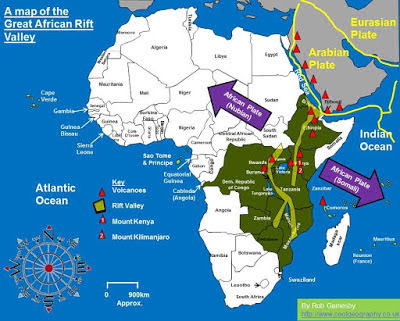
The western Tanzania lies within the the of the Great Rift Valley, which is slowly splitting the African Plate in two along a line from the Red Sea through Ethiopia, and which includes the great lakes and volcanoes of east-central Africa. This has the potential to open into a new ocean over the next few tens of millions of years, splitting Africa into two new, smaller, continents; Nubia to the west and Somalia to the east.

Movement on the African Rift Valley, with associated volcanoes. Rob Gamesby/Cool Geography.

To the southeast, the island of Madagascar has been moving away from Africa since the Jurassic, forming a series of spreading centres across the Mozambique Channel, which both continue to push the island to the east and exert pressure on the southeastern coast of Africa, contributing to Earthquake activity in the region. 

See also...

Wednesday, 2 August 2023

Magnitude 5.6 Earthquake to the south of Massawa, Eritrea.

The United States Geological Survey recorded a Magnitude 5.6 Earthquake at a depth of 10.0 km, roughly 42 km to the south of the city of Massawa in central Eritrea, at about 8.15 pm local time (about 5.15 pm GMT) on Tuesday 1 August 2023. There are no reports of any damage or injuries from this quake, but people have reported feeling the event in Asmara, the capitol of Eritrea, as well as in Tigray Province, Ethiopia.

The approximate location of the 1 August 2023 Eritrea Earthquake. USGS.

The deserts of Northern Ethiopia and Eritrea are extremely volcanically active, with dozens of volcanoes fed by an emerging divergent margin along the East African Rift; the volcano Erta Ale is on the Ethiopian Rift, the boundary between the Nubian Plate and the Danakil Microplate. The African Plate is slowly splitting apart along the Ethiopian Rift and the East African Rift to the south (which is splitting the Nubian Plate to the West from the Somali Plate to the East). Arabia was a part of Africa till about thirty million years ago, when it was split away by the opening of the Red Sea Rift (part of the same rift system), and in time the Ethiopian and East African Rifts are likely to split Africa into a number of new landmasses. This rifting exerts pressure on the rocks around the margin of the sea, slowly pushing them apart, not smoothly but in fits and starts as the pressure overcomes the tendency of the rocks to stick together, creating shocks that we experience as Earthquakes.

Rifting in East Africa. The Danakil Microplate is the red triangle to the east of the Afar depression at the southern end of the Red Sea. Università degli Studi di Firenze.

See also...

Follow Sciency Thoughts on Facebook.

Follow Sciency Thoughts on Twitter.


Monday, 20 March 2023

Possible eruption on Mount Nyamulagira, Democratic Republic of Congo.

Scientists at the Goma Volcanological Observatory have reported seeing bright lights consistent with an eruption on the summit of Mount Nyamulagira, a 3058 m high shield volcano in the Virungu Mountains of eastern Democratic Republic of Congo, about 25 km to the north of Lake Kivu. This was accompanied by seismic activity beneath the volcano, which is often indicative of magma moving into chambers prior to an eruption. Mount Nyamalugira, which lies in North Kivu Province, is often considered to be Central Africa's most active volcano, having erupted more than 40 times since 1885. Due to the highly active nature of the volcano it presents little threat to human life, because nobody chooses to live near it, though concerns have occasionally been raised about the threat it presents to wildlife in the Viruga National Park.

The approximate location of Mount Nyamulagira. Google Maps.

Mount Nyamulagira lies on the Eastern Branch of the East African Rift, which is slowly splitting the African Plate in two along a line from the Red Sea through Ethiopia, and which includes the great lakes and volcanoes of east-central Africa. This has the potential to open into a new ocean over the next few tens of millions of years, splitting Africa into two new, smaller, continents; Nubia to the west and Somalia to the east.

Movement on the African Rift Valley, with associated volcanoes. Rob Gamesby/Cool Geography.

See also...

Follow Sciency Thoughts on Facebook.

Follow Sciency Thoughts on Twitter.


Wednesday, 28 December 2022

Magnitude 5.5 Earthquake in southern Eritrea.

The United States Geological Survey recorded a Magnitude 5.5 Earthquake at a depth of 10.0 km, in southern Eritrea, roughly 64 km to the north of the city of Ādīgrat in the Tigray Region of Ethiopia, slightly after 3.20 pm local time (slightly after 12.20 pm GMT) on Monday 26 December 2022. There are no reports of any damage or injuries from this quake, but people may have felt it locally.

The approximate location of the 26 December 2022 Eritrea Earthquake. USGS.

The deserts of Northern Ethiopia and Eritrea are extremely volcanically active, with dozens of volcanoes fed by an emerging divergent margin along the East African Rift; the volcano Erta Ale is on the Ethiopian Rift, the boundary between the Nubian Plate and the Danakil Microplate. The African Plate is slowly splitting apart along the Ethiopian Rift and the East African Rift to the south (which is splitting the Nubian Plate to the West from the Somali Plate to the East). Arabia was a part of Africa till about thirty million years ago, when it was split away by the opening of the Red Sea Rift (part of the same rift system), and in time the Ethiopian and East African Rifts are likely to split Africa into a number of new landmasses. This rifting exerts pressure on the rocks around the margin of the sea, slowly pushing them apart, not smoothly but in fits and starts as the pressure overcomes the tendency of the rocks to stick together, creating shocks that we experience as Earthquakes.

Rifting in East Africa. The Danakil Microplate is the red triangle to the east of the Afar depression at the southern end of the Red Sea. Università degli Studi di Firenze.

See also...


Follow Sciency Thoughts on Facebook.

Follow Sciency Thoughts on Twitter.


Friday, 25 December 2020

Magnitude 4.4 Earthquake in northeast Eritrea.

The United States Geological Survey recorded a Magnitude 4.4 Earthquake at a depth of 10.0 km, roughly 91 km to the north of the city of Ak'ordat in the Gash-Barka Region of Eritrea, slightly after 1.20 am local time on Friday 25 December 2020 (slightly after 10.20 pm on Thursday 24 December GMT). There are no reports of any damage or injuries from this quake, but people may have felt it locally.

 
The approximate location of the 25 December 2020 Eritrea Earthquake. USGS.

The deserts of Northern Ethiopia and Eritrea are extremely volcanically active, with dozens of volcanoes fed by an emerging divergent margin along the East African Rift; the volcano Erta Ale is on the Ethiopian Rift, the boundary between the Nubian Plate and the Danakil Microplate. The African Plate is slowly splitting apart along the Ethiopian Rift and the East African Rift to the south (which is splitting the Nubian Plate to the West from the Somali Plate to the East). Arabia was a part of Africa till about thirty million years ago, when it was split away by the opening of the Red Sea Rift (part of the same rift system), and in time the Ethiopian and East African Rifts are likely to split Africa into a number of new landmasses. This rifting exerts pressure on the rocks around the margin of the sea, slowly pushing them apart, not smoothly but in fits and starts as the pressure overcomes the tendency of the rocks to stick together, creating shocks that we experience as Earthquakes.

 
Rifting in East Africa. The Danakil Microplate is the red triangle to the east of the Afar depression at the southern end of the Red Sea. Università degli Studi di Firenze.

See also...


Follow Sciency Thoughts on Facebook.

Follow Sciency Thoughts on Twitter.