Showing posts with label Paraves. Show all posts

Wednesday, 7 December 2022

Fossil eggshells from the Early Cretaceous Okurodani Formation of Gifu Prefecture, Japan.

The past three decades have seen the discovery of a large quantity of fossil eggs from several Lower Cretaceous deposits in Japan, notably the Yezo Group of Hokkaido, the Kuwajima Formation of Ishikawa Prefecture, and the Ohyamashimo Formation in Hyōgo Prefecture. These include eggs which are thought to have come from Ornithopod and Theropod Dinosaurs (including Oviraptosaurs, Troodontids, and Birds). These findings add to the known palaeobiodiversity of these areas, by indicating the presence of groups not known from the skeltal fossil record. However, the majority are of Aptian or Albian age (121.4-100.5 million years old), with earlier examples being much rarer.

The Okurodani Formation outcrops in the Shokawa area of northwestern Gifu Prefecture, and is considered to be of Hauterivian age (i.e. between 132.9 and 129.4 million years old). This formation has produced a variety of Vertebrate remains, including Dinosaurs, aquatic Tetrapods and Fish, as well as a number of fragmentary egg pieces, which have been assumed to have been of Dinosaurian origin, but never formally investigated.

In a paper published in the journal Historical Biology on 24 November 2022, Rina Uematsu of the Graduate School of Science and Technology at the University of Tsukuba, Kohei Tanaka of the Faculty of Life and Environmental Sciences at the University of Tsukuba, Shohei Kozu of the Gifu Prefectural Museum, Shinji Isaji of the Natural History Museum and Institute of Chiba, and Shizuo Shimojima of Takayama City, describe the known egg material from the Okurodani Formation, and discuss the implications this has for the known biodiversity of the environment which produced these strata.

All the fossils examined in the study were collected between 1988 and 2009 by Shizuo Shimojima, Masatoshi Okura and Satoru Sakamoto, from the Okurodani Formation, a 220 m thick sequence of shale, alternating sandstone and mudstone, and sandstone beds, which forms part of the Itoshiro Subgroup of the Middle Jurassic to Lower Cretaceous Tetori Group, which has been dated to between 133 and 129 million years old, based upon uranium-lead dates obtained from layers of volcanic tuff within the formation.

Map of the eggshell locality. (A) Distribution of the Tetori Group in Japan formed of three subgroups. (B) Stratigraphic position of the Okurodani Formation in the Shokawa area. (C) Detail of the boxed area in (A), showing the distribution and the stratigraphic sequence of the Okurodani Formation with the locations where eggshell materials were collected. GPM-Fo-1923, 09/Cr/89/01 and 09/Cr/88/07 were found in debris of fallen rocks and their location is not specified in the stratigraphy. Uematsu et al. (2022).

Sevem fragments of eggshell and two eggshell impressions were found within black mudstone layers within the Okurodani Formation. These mudstone layers are also rich in Plant fossils and freshwater Molluscs, and are interpretted as having been laid down in a network of stagnant pools or oxbow lakes within a floodplain environment. Vertebrate remains, predominantly Fish scales and Turtle shells, but also including Frogs, small Lizards, and Choristoderes (Crocodile-like Diapsids of uncertain affinities) are typically preserved in three dimensions (i.e. not compressed),  which implies rapid burial with minimal movement. Dinosaur fossils are rare in these layers, but the teeth of Ornithopods, Sauropods, and Verociraptorines have been found, as well as the tarsometatarsus of an Enantiornithine Bird.

The first two eggshell fragments discussed, GPM-Fo-1923 and 09/Cr/89/01, are assigned to the Oofamily Testudoolithidae (i.e. Turtle Eggs). These fragments are approximately 5 x 6 mm and 3 x 3 mm, respectively, and are assumed to have come from the same egg, based upon cross-sections of the joint and the overall  shape of the fragments when jointed. However their precise origin is unclear, because they were collected by Masatoshi Okura, who has since passed away, and are now housed in separate museums. The outer surfaces of both shells are strongly abraded and show nodular patterns composed of tightly packed shell units. Based upon the curvature of the eggshell, the original egg would have been about 22 mm in diameter.

Eggshell assigned to Testudoolithidae. (GPM-Fo-1923). (A) Nodular outer surface with exposed shell units. (B) Radial thin section under normal light, showing discrete shell units (bracket), tubular pore canals (white arrowheads) and cratered bases (black arrowhead). The shell appears two-layered with an undulating boundary (arrow). (C) The same view as (B) under polarised light, exhibiting irregular extinction patterns. (D) Radial view, scanning electron microscope, showing discrete shell units (bracket) with ill-preserved ultrastructure. Uematsu et al. (2022).

These shells show two separate layers, separated by an undulating horizontal boundary. In the upper layer, needle-like crystals radiate outward from the boundary. Although less prominent, such acicular crystals are also found in the lower layer; the crystals develop concentrically from the organic cores, making the basal parts of the shell units rounded in shape. Under polarised light, the eggshell exhibits irregular extinction patterns. 

Turtle eggs typically have only a single layer, so the structure of the these eggshells, with two distinct layers, each with a different type of crystals, is distinctly unTestudine. Apparently double-layered Turtle eggshells can be produced taphonomically, by when two shell fragments happen to come to rest with one sitting inside the other, or as a result of a pathology - gravid female Turtles, suffering from some king of environmental stress, can retain eggs instead of laying them, depositing additional layers of minerals on the surface of the egg during the process. Neither of these appears to be the case in this instance, rather the eggs appear to have been altered diagenetically, with the outer portion of the shell having been recrystalised as a result of contact with external chemistry.

Based upon the morphology of these eggshell fragments, it is estimated that they were laid by a small Cryptodiran Turtle, with a carapace length of less than 200 mm.

The next five specimens, GPM-Fo-1294, 1295, 1296, 1297, and 1298 are placed within the Oofamily Prismatoolithidae, which is typified by a two-layered structure and an ornamented shell surface. They are assigned to a new oospecies, with GPM-Fo-1925 as the holotype, and given the name Ramoprismatoolithus okurai, where 'Ramoprismatoolithus' derives from 'Ramo-' from the Latin 'ramus', meaning branch, plus '-prismatoolithus', from the oofamily name, in reference to the reticulate ridges on the other surface of the eggshell, and 'okurai', honours the late Masatoshi Okura who pioneered the discovery of fossil eggshells and other Vertebrate remains in Shokawa.

All of these specimens are fragmentary; no intact examples of this new oospecies are known. The outer surface of these shells is distinctly sculpted, with low ridges arranged in elaborate reticulated patterns. The shells range from 0.31 to 0.61 mm in thickness, with the average being 0.46 mm. Seen under a scanning electron microscope, a near-vertical, unbranching, pore canal could be observed, increasing slightly in width towards the surface of the egg.

Ramoprismatoolithus. (A), (B) Eggshell outer surfaces showing the well-sculpted reticulation: (A) holotype: GPM-Fo-1925 and (B) a cast of GPM-Fo-1924 made of  silicone rubber. (C) Radial thin section under normal light, showing a mammillary layer (ML) and a prismatic layer (PL) with a gradual boundary (horizontal bar on the left side) (holotype: GPM-Fo-1925). (D) the same view as (C) under PLM, showing columnar extinction patterns. (E)–(G) Radial view under Scanning Electron Microscope (holotype: GPM-Fo-1925), displaying (E) ML and PL, (F) numerous vesicles (arrowhead) over the eggshell and (G) acicular crystals at the base of mammillae. (H) Straight pore canal under Scanning Electron Microscope (GPM￾Fo-1928). Uematsu et al. (2022).

These eggshells show two layers, which appears to be an original feature rather than something produced by diagenetic alteration, with a lower mammillary layer (the inner layer of many eggs, which is made up of small calcium carbonate crystals, which are easily disolved and provide a source of calcium for the growing embryo) and the upper prismatic layer (made up of larger crystals, which provides structural strength to the egg) observable. These are separated by a gradual boundary. The mammillary layer makes up about one fifth to one sixth of the shell's thickness, and is comprised of  acicular crystals radiating from what were presumably organic cores. The base of this layer is abraded, probably due to absorption of calcium by the growing embryo. The prismatic layer is made up of narrow, columnular crystals, visible under polarised light. Vesicles can be seen in this layer under the scanning electron microscope.

Based upon the thickness of the shell fragments, the original Ramoprismatoolithus okurai eggs are calculated to have had an average mass of 99.39 g, which assuming an egg twice as long as it is wide, would give an original size of about 57 x 133 mm.

Prismatoolithid eggs are generally accepted to have been laid by Troodontid Dinosaurs, as intact eggs assigned to the oofamily have been found with Troodontid embryos inside. However, it has been suggested that some eggs assigned to this oofamily might have been laid by early Birds.

The small estimated size of the Ramoprismatoolithus okurai eggs leads Uematsu et al. to conclude the Animal which laid them weighed somewhere between twelve and seventeen kilograms, small for a Theropod Dinosaur, but not implausible for a non-Avian Maniraptoran.

The final two specimens described are GPM-Fo-1929, an impression of part of an outer eggshell surface measuring 6 × 7 mm, and 09/Cr/88/07, a possible impression of part of an inner eggshell surface, measuring 2 x 2 mm. Neither of these specimens preserves any of the original eggshell material. The outer surface impression GPM-Fo-1929 bears a strong resemblance to the outer surface of the Ramoprismatoolithus okurai egg fragments, with reticulate ornamentation and the remains of several pore openings. The inner shell fragment impression, 09/Cr/88/07, is smooth, with no discerning features which would allow it to be associated with any known egg fossil.

Indeterminate eggshell impressions. (A) Outer surface impression (GPM-Fo-1929). (B) Cast of (A) made of silicone rubber, showing reticulate ornamentation similar to Ramoprismatoolithus and remains of pore openings (arrowheads) between the ridges. (C) Inner? surface impression with a smooth appearance (09/Cr/88/07). Uematsu et al. (2022).

The specimens described by Uematsu et al. are the oldest known fossil eggshells from Japan, and provide additional information on biodiversity within the Early Cretaceous Tetori Group, within which skeletal material is scarce, demonstrating that Turtles and small Dinosaurs were nesting in the area. 

The eggs assigned to Ramoprismatoolithus okurai are likely to have been laid by a Troodontid, or closely related Maniraptoran Theropod. Okurodani Formation yields teeth of possible Velociraptorinae, and other strata within the Tetori Group (likely to be roughly co-eval, but laid down in different environments within the same landscape) have produced possible Oviraptorosauria and Dromaeosauridae, as well as the Therizinosaur-related Fukuivenator paradoxus. However, all of these groups are known to produce non-prismatic shells with microstructures unlike that of the Oofamily Prismatoolithidae. This strongly suggests that the Ramoprismatoolithus okurai eggs were produced by a small Maniraptoran Theropod not represented in the skeletal fossil record of the Tetori Group. 

Troodontids, and basal Paravians (the group that includes Troodontids, Birds, and Dromaeosaurs) in general are scarce in Early Cretaceous deposits, both as skeletal and egg remains. Examples are known from the US, Spain, and China, and all Early Cretaceous small non-Avian Theropods known from East Asia come from two formations in northeastern China, the Yixian and Huajiying. Thus the discovery of the Ramoprismatoolithus okurai eggs in Japan is a significant contribution to our understanding of the distribution of mall non-Avian Theropods from the early Early Cretaceous of East Asia.

See also...

Online courses in Palaeontology. 

Follow Sciency Thoughts on Facebook.

Follow Sciency Thoughts on Twitter.


Sunday, 12 August 2018

Caihong juji: A new species of Deinonychosaur from the Middle-to-Late Jurassic Yanliao Biota of Hebei Province, China.

The Yanliao Biota of northeastern China outcrops across much of  western Liaoning, northern Hebei, and southeastern Inner Mongolia provinces, providing a series of deposits with exceptional preservation laid down over a period of about 10 million years in terrestrial settings. These deposits include the Daohugou phase (about 168–164 million years ago) and the Oxfordian Linglongta phase (164–159 million years ago). These fossils provide a valuable insight into a variety of emerging taxa in across the boundary between the Middle and Late Jurassic, including Insects, Mammals and Paravian Dinosaurs, the group which includes Dromaeosaurs, Troodontids and Birds.

In a paper published in the journal Nature Communications on 15 January 2018, Dongyu Hu of the Paleontological Museum of Liaoning at Shenyang Normal University, Julia Clarke of the Department of Geological Sciences and Integrated Bioscience at the University of Texas at Austin, Chad Eliason, also of the Department of Geological Sciences and Integrated Bioscience at the University of Texas at Austin, and of the Integrative Research Center at the Field Museum of Natural History, Rui Qiu, also of the Paleontological Museum of Liaoning at Shenyang Normal University, Quanguo Li of the State Key Laboratory of Biogeology and Environmental Geology at the China University of Geosciences, Matthew Shawkey of the Evolution and Optics of Nanostructures Group at the University of Ghent, Cuilin Zhao, again of the Paleontological Museum of Liaoning at Shenyang Normal University, Liliana D’Alba also of the Evolution and Optics of Nanostructures Group at the University of Ghent, Jinkai Jiang, once again of the Paleontological Museum of Liaoning at Shenyang Normal University, and Xing Xu of the Key Laboratory of Vertebrate Evolution and Human Origins at the Institute of Vertebrate Paleontology and Paleoanthropology of the Chinese Academy of Sciences, describe a new species of Paravian Dinosaur from the Late Jurassic Tiaojishan Formation of northern Hebei.

The new species is named Caihong juji, where 'Caihong' means 'rainbow' and 'juji' means 'big crest'. It is described from a single, almost complete skeleton and associated plumage preserved as part and counterpart on a split slab. The specimen is estimated to have been about 400 mm in length, and to have weighed about 475 g when it was alive, and is thought to have been an adult. It had a pair of prominent crests on its lacrimal bones (the bone that joins the nose to the eye-socket in Humans, and the hind-part of the snout in Theropod Dinosaurs), something very unusual in Paravians. Caihong juji is assessed to have been a Deinonychosaur on the basis of its anatomy (i.e. the sub-group of Paravians that includes Dromaeosaurs ans Troodontids, but not Birds.

Caihong juji. Photographs of the slab (a) and counter slab (b) and line drawing (c) of the specimen based on both slabs. Photograph (d) and line drawing (e) of a composite of the rostrum of the skull and mandible exposed on the counter slab and the post-rostrum cranium exposed on the slab. Arrows indicate lacrimal crests. Question mark indicates uncertain identification. Scale bars: 10 cm in (a)–(c), 1 cm in (d) and (e). Abreviations aof, antorbital fenestra; cav, caudal vertebra; cev, cervical vertebra; dr, dorsal rib; dv, dorsal vertebra; ect, ectopterygoid; emf, external mandibular fenestra; en, external naris; f, feather; fu, furcula; ga, gastralia; hy, hyoid; il, ilium; is, ischium; la, left angular; lar, left articular; lc, left coracoid; lcr, lacrimal crest; ld, left dentary; lf, left frontal; lfe, left femur; lh, left humerus; lj, left jugal; ll, left lacrimal; lma, left maxilla; lm, left manus; ln, left nasal; lp, left pes; lpa, left palatine; lpo, left postorbital; lq, left quadrate; lqj, left quadratojugal; lr, left radius; ls, left scapula; lsp, left splenial; lsa, left surangular; lsq, left squamosal; lt, left tibiotarsus; lu, left ulna; ma, mandible; mf, maxillary fenestra; o, orbit; p, parietal; pm, premaxilla; pt, pterygoid; pu, pubis; rar, right articular; rc, right coracoid; rd, right dentary; rfe, right femur; rh, right humerus; rm, right manus; rp, right pes; rpra, right prearticular; rq, right quadrate; rr, right radius; rs, right scapula; rt, right tibiotarsus; ru, right ulna; scl, sclerotic bones; sk, skull; sy, synsacrum. Hu et al. (2018).

Much of the plumage of Caihong juji is exceptionally well preserved, retaining the microstructure of the melanosomes (pigment cells). Comparison of these cells to those of modern Birds leads Hu et al. to conclude that this Jurassic Dinosaur had brightly coloured iridescent plumage.

Platelet-like nanostructures in Caihong juji and melanosomes in iridescent extant feathers. (a)–(d) Fossilized nanostructures from Caihong feathers preserved as molds in a neck feather (a) and three-dimensional preservation in a neck feather, with SEM stage rotated 45° to show 3D platelet morphology; (b) a back feather with SEM stage at 0° (c) and a neck feather showing nanostructure packing; (d), (e) Anna’s Hummingbird, Calypte anna, showing overlapping melanosomes within a feather barbule; (f) White-tailed Starfrontlet, Coeligena phalerata, showing stacking and interior morphology (air bubbles) of melanosomes in a feather barbule; (g) Black-tailed Trainbearer, Lesbia victoriae, showing exterior surface and morphology of isolated melanosomes in a feather barb; (h) Moustached Treeswift, Hemiprocne mystacea, showing densely packed melanosomes in the barbule of a crown feather. Inset in (d) illustrates 3D stacking of platelet-shaped nanostructures. All scale bars are 1000 nm. Hu et al. (2018).

See also...

https://sciencythoughts.blogspot.com/2018/02/almas-ukhaa-new-species-of-troodontid.htmlhttps://sciencythoughts.blogspot.com/2017/12/ostromia-crassipes-second-species-of.html
https://sciencythoughts.blogspot.com/2016/02/boreonykus-certekorum-new-species-of.htmlhttps://sciencythoughts.blogspot.com/2015/12/partial-dromaeosaur-remains-from-early.html
https://sciencythoughts.blogspot.com/2015/10/dakotaraptor-steini-giant-feathered.htmlhttps://sciencythoughts.blogspot.com/2015/07/zhenyuanlong-suni-large-feathered.html
Follow Sciency Thoughts on Facebook.

Sunday, 4 February 2018

Almas ukhaa: A new species of Troodontid Dinosaur from the Late Cretaceous of Mongolia.

The Troodontids were a group of small-to-medium sized Maniraptoran Theropod Dinosaurs known from the Cretaceous of Asia and North America. They were closely related to the Birds and Dromeosaurs, with the three groups being classified together as the Paraves. They had large brains and large forward pointing eyes, traits that would generally be associated with predatory behaviour, but their dentition implies a more complex story, with several species having small serrated teeth that would be on their own be taken as indicative of a browsing herbivorous diet, with the two together probably indicating some measure of omnivory.

In a paper published in the American Museum Novitates on 15 December 2017, Rui Pei of the Department of Earth Sciences at the University of Hong Kong, and the Division of Paleontology at the American Museum of Natural History, Mark Norell, also of the Division of Paleontology at the American Museum of Natural History, Daniel Barta of the Richard Gilder Graduate School and Division of Paleontology at the American Museum of Natural History, Gabriel Bever, again of the Division of Paleontology at the American Museum of Natural History, and of the Center for Functional Anatomy & Evolution at the Johns Hopkins University School of Medicine, Michael Pittman of the Vertebrate Palaeontology Laboratory at the University of Hong Kong, and Xing Xu of the Institute of Vertebrate Paleontology and Paleoanthropology of the Chinese Academy of Sciences, describe a new species of Troodontid Dinosaur from the Late Cretaceous Djadokhta Formation of Ukhaa Tolgod in the Ömnögovi Province of southern Mongolia.

The new species is named Almas ukhaa, where 'Almas' refers to a Yeti-like creature from Mongolian folklore and 'ukhaa' to the locality where the specimen was found. The species is described from a single specimen comprising a nearly complete skull and partial post-cranial skeleton, probably that of an almost mature sub-adult. The skull is about 82 mm in length, with four premaxilary (upper front) a teeth, a row of 16 maxilary teeth, smaller at the front and lacking serrations, and 23 dentary (lower) teeth, closer packed at the front.

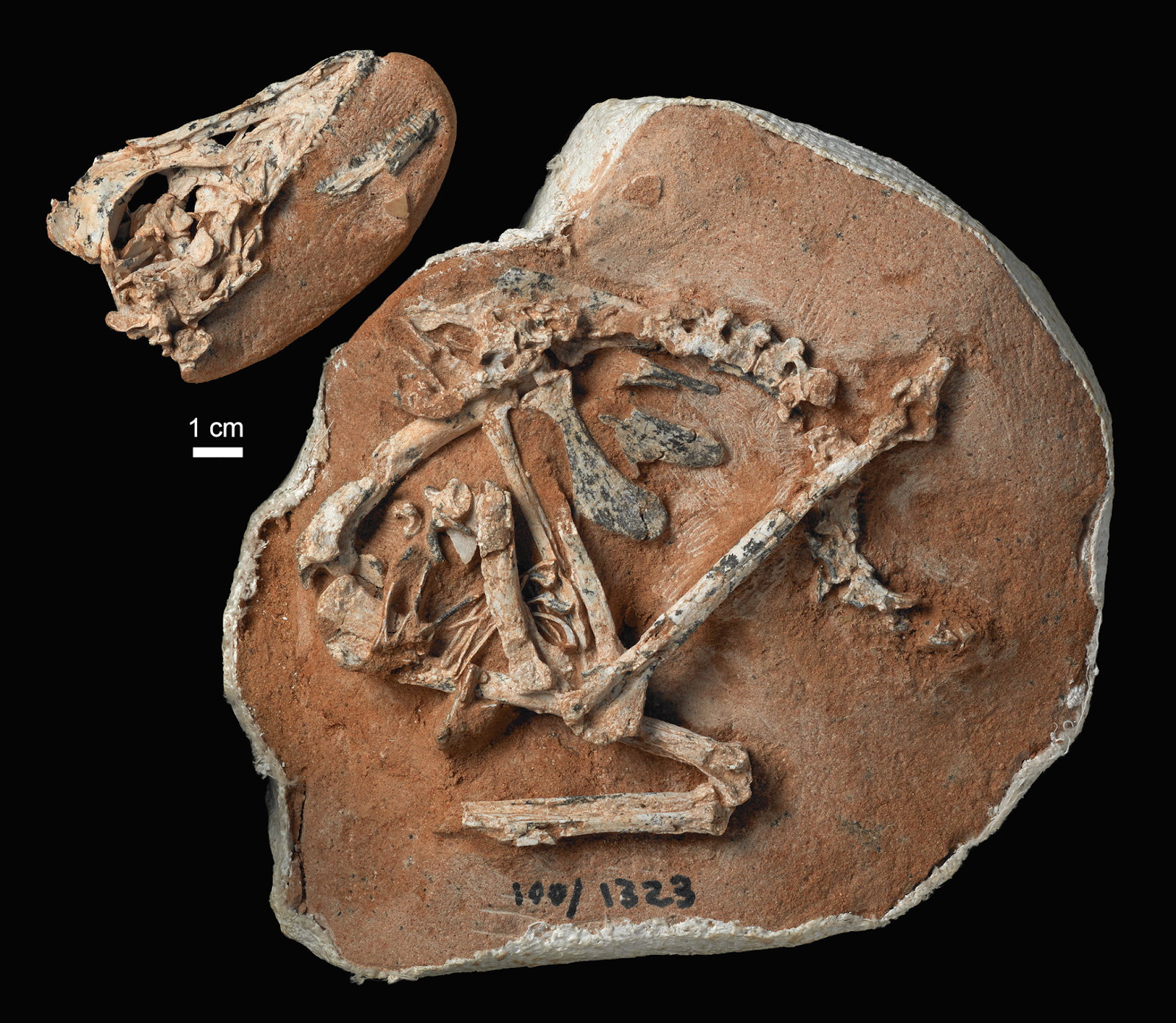
The specimen of Almas ukhaa. Pei et al. (2017).

The specimen was found associated with a number of eggshell fragments, which almost certainly came from a non-Avian Dinosaur, and quite possibly a Troodontid, though it is impossible to say what the actual relationship of these to the specimen is.

See also...

http://sciencythoughts.blogspot.co.uk/2018/01/caihong-juji-new-species-of-paravian.htmlhttp://sciencythoughts.blogspot.co.uk/2017/12/ostromia-crassipes-second-species-of.html
http://sciencythoughts.blogspot.co.uk/2017/06/an-enantiornithine-bird-hatchling.htmlhttp://sciencythoughts.blogspot.co.uk/2016/12/tongtianlong-limosus-new-species-of.html
http://sciencythoughts.blogspot.co.uk/2016/03/fukuivenator-paradoxus-maniraptoran.htmlhttp://sciencythoughts.blogspot.co.uk/2016/02/boreonykus-certekorum-new-species-of.html
Follow Sciency Thoughts on Facebook.

Tuesday, 20 December 2011

How did raptors use their claws? (and did it help them learn to fly?)

The Dromaeosaurs were a group of small, feathered dinosaurs closely related to the birds. They are commonly referred to as 'raptors' on account of an enlarged claw on each foot which was held clear of the ground when walking and is generally assumed to have been a weapon; this claw resembles that of a bird of prey, which are also referred to as 'raptors'. This claw was also present in the other group closely related to birds, the Troodontids, though in these it was not as prominent. The Troodontids were apparently adapted for pursuit of prey, placing additional demands upon their limbs that the Dromaeosaurs, thought to have been ambush predators, lacked. Thus the foot of a Troodontid is a compromise, that of a Dromaeosaur a more specialized tool.
A graphite drawing of Velociraptor, a typical Dromaeosaur, by artist Matt Martyniuk. (Note: this is probably a more realistic interpretation of this pheasant-sized dinosaur than the things in Jurassic Park).

The Dromaeosaurs, Troodontids and Birds together are referred to as the Paraves; all three groups show certain similarities, that were presumably present in the common ancestor, including advanced plumage, wings with flight feathers and prominent hooked claws on their feet. The presence of wings with flight feathers in Dromaeosaurs and Troodontids is interesting, as neither of these groups appears to have been able to fly, implying that these strictures predated that ability in birds. Unraveling what these structures were used for in Dromaeosaurs and Troodontids would therefore provide useful insight into the evolution of the first birds.

The use of the enlarged claw by Dromaeosaurs and Troodontids has been a subject of discussion for decades. It has been widely speculated that this was used as a slashing weapon, enabling the dinosaurs to dispatch prey with one or more lethal kicks. Another theory was that the claws were used to leap onto and even climb up much larger prey in pack attacks by the small dinosaurs.

A paper by a team lead by Denver Fowler of the Musuem of the Rockies and the Department of Earth Sciences at Montana State University, published in the journal PLoS ONE on 14 December 2011, examines the use of the raptorial claw in the small Dromeosaur Dienonychus, using modern Raptors as an ecological model.

Modern Raptors do not use their claws to slash at their prey (some do kick, but they hold their claws clear when they do so), nor do they use their claws to overcome prey larger than themselves; they do not generally attack animals larger than themselves at all. The preferred method of attack by birds of prey is to hit it very hard with either their feet (not their claws) or their beak, killing it straight away, then use the claws to carry it off. Where this is not possible they hold prey down with their claws, while they dispatch it with their beaks. This is the strategy that Fowler et al. believe was adopted by Dienonychus. When holding down struggling prey, modern Raptors use their wings to stabilize themselves, flapping vigorously to maintain their balance. Many also 'mantle' their prey, using their wings to cover it while they eat it, so that it is hidden from rivals or larger predators; some do this with still living prey, which is believed to deprive the prey of sight, making it harder to escape.

Both of these tactics would have worked perfectly well with wings that were not capable of flying, which provides a plausible explanation for the evolution of wings, flight feathers and flapping muscles in early Paravians, prior to the evolution of flight. Thus Fowler et al. believe that birds were pre-adapted to flight before they took to the air.

Illustration from Fowler et al. (2011) showing feeding in Dienonychus as they interpret it. (A) Grasping foot holds onto prey. (B) Large claws used to maintain grip on prey. (C) Predators bodyweight pins down victim. (D) Elongated tail acts as balance. (E) Rear of foot held low to help restrain victim. (F) Wings flapped to maintain stable posture. (G) Arms encircle ('mantle') prey to prevent prey seeking escape route. (H) Head reaches between feet, tearing of strips of flesh.