Showing posts with label Peacock Spiders. Show all posts

Sunday, 5 September 2021

Maratus nemo: A new species of wetland Peacock Spider from South Australia.

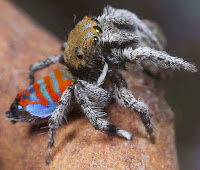
Peacock Spiders, Maratus spp., are a unique group of Jumping Spiders (Salticidae) from Australia, noted for the bright colours and elaborate mating displays of the males. This behaviour, combined with the development of relatively cheap digital cameras capable of recording the activities of small spiders, has made them stars on social media, which in turn has led to more study time being focused on the group by arachnologists; of the 91 currently recognised species in the genus, 76 have been described in the last decade. Males of the genus have a distinctive, and often brightly coloured, plate on their opisthosoma (rear body section), which can be erected during mating displays, as well as an elongated third pair of legs used for signalling. 

In a paper published in the journal Evolutionary Systematics on 25 March 2021, Joseph Schubert of Museums Victoria, and the Harry Butler Institute at Murdoch University, describes a new species of Peacock Spider from the wetlands of South Australia.

The new species is named Maratus nemo, in reference to the character Nemo in the Disney film Finding Nemo, the colouration of the males resembling that of this character. The species was first observed by Sheryl Holliday of Nature Glenelg Trust, who posted pictures of the Spiders on social media. The species was discovered living in the Mount Burr Swamp, about 9.5 km to the southeast of Mount McIntyre, and subsequently also found close to the Topperwein Native Forest Reserve, about 14 km to the east of Nangwarry.

The males of Maratus nemo resemble those of the 'Maratus personatus' species group, however, it is currently unclear if this is a true clade (group of organisms including all the descendants of a shared common ancestor), or an example of convergent evolution. Like these species, males of Maratus nemo lack distinctive colouration or flaps on the opisthosoma, but instead has a brightly coloured mask of scales surrounding the eyes, in the case of Maratus nemo these being bright orange with white markings. The remainder of the body is dark brown, and thickly covered with white hairs. Females are light brown in colour, with a lighter covering of off-white hairs. Males range from 4.10 to 4.25 mm in length, females are slightly larger at 5.12 mm.

 
Living male Maratus nemo. (A) Anterolateral view, (B) lateral view, (C) dorsal view, (D) anterior view, (E) anterolateral view, and (F) anterior view. Schubert (2021).

During courtship the male sits on a leaf, where he raises one of his third legs and waves it slowly. If a female approaches, he raises both third legs and waves them more vigorously, while at the same time bobbing his opisthosoma up and down, causing the leaf to vibrate and generating an audible noise. This courtship has only been observed in captivity, and may be more complex in the wild.

 
Living female Maratus nemo. (A) Dorsolateral view, (B) dorsal view, (C) anterolateral view, (D) lateral view, (E) posterolateral view, and (F) anterior view. Schubert (2021).

The species has only been found at two locations in South Australia to date. Both locations are ephemeral wetlands, an environment in which Peacock Spiders have not previously been recorded, with the Spiders being found on the leaves of marsh vegetation sitting in shallow water.

 
Habitat of Maratus nemo in the vicinity of Mount McIntyre, South Australia. (A) Ephemeral wetland complex habitat at Mount Burr Swamp. (B) Marshy vegetation from Mount Burr Swamp. (C) Maratus nemo nov. male in situ. (D) Maratus nemo female in situ. Sheryl Holliday in Schubert (2021).

See also...


Follow Sciency Thoughts on Facebook.

Follow Sciency Thoughts on Twitter


Thursday, 21 April 2016

Maratus fimbriatus: A new species of Peacock Spider from New South Wales.

Peacock Spiders, Maratus spp., are a distinctive group of Jumping Spiders, Salticidae, found only in Australia. They are small Spiders, generally under half a centimeter in length, but are highly distinctive, particularly the males, which are often brightly coloured and which perform eleborate courtship dances to attract the females.

In a paper published in the journal Peckhamia on 10 February 2016, Jürgen Otto of St. Ives, New South Wales and David Hill of Simpsonville, South Carolina, describe a new species of Peacock Spider from the Darling Riverine Plains of New South Wales.

The new species is named Maratus fimbriatus, meaning 'fringed' in reference to a fringe of bristles around the opisthosoma (abdomen) of the males, which is elevated during courtship displays. The species is described from two male and two female specimens collected from near Nyngan in central New South Wales, plus another 24 males and five females found in the collection of the Australian Museum.

Male specimen of Maratus fimbriatus with fringe extended during courtship dance. Otto & Hill (2016).

Males of Maratus fimbriatus range from 3.8 to 4.3 mm and are black in colour, with a covering of brown hairs, lighter on the sides than on the back. The opisthososma is covered with black scales with two white stripes and a distinctive fringe of white-tipped hairs. The pedipalps are brown, with a dense covering of white hairs, forming 'pom-pom' like structures used in courtship displays. The front two pairs of legs are short, with the foremost having white markings, also used in courtship displays. while the back to pairs of lengs are longer.

Female specimen of Maratus fimbriatus. Otto & Hill (2016).

Females of Maratus fimbriatus range from 3.6 to 4.9 mm in length, and are covered in light brown hairs, with a scattering of darker spots.

Male specimen of Maratus fimbriatus courting a female. Otto & Hill (2016).

All of the specimens of Maratus fimbriatus collected by the authors were found living on cracked clay ground in open woodland on the semi-arid Darling Riverine Plain; specimens from the Australian museum had less precise habitat information, but were all from the same river plains.

The habitat of Maratus fimbriatus. Otto & Hill (2016).

See also...

http://sciencythoughts.blogspot.co.uk/2015/04/maratus-elephans-new-species-of-peacock.htmlMaratus elephans, a new species of Peacock Spider from New South Wales.                      Peacock Spiders of the genus Maratus are a group of Jumping Spiders, Salticidae, found only in Australia. They are small in size, typically less than 5 mm in length, though the males are brightly coloured and engage in elaborate courtship dances, which give...

Peacock Spiders, Maratus spp., are a group of small Jumping Spiders, Salticidae, found only in Australia. The group gets its name from the bright colours...

Peacock Spiders, Maratus, are Jumping Spiders, Salticidae, endemic to Australia and distinguished by the bright colours and elaborate courtship dances of the males. The calcitrans group of Peacock Spiders currently comprises three members of the genus...


Follow Sciency Thoughts on Facebook. 

Thursday, 9 April 2015

Maratus elephans, a new species of Peacock Spider from New South Wales.


Peacock Spiders of the genus Maratus are a group of Jumping Spiders, Salticidae, found only in Australia. They are small in size, typically less than 5 mm in length, though the males are brightly coloured and engage in elaborate courtship dances, which give the group their name. The males have flaps on the sides of their abdomens which are extended during these display dances to form a ‘fan’, which adds to their resemblance to Peacocks.

In a paper published in the journal Peckhamia on 19 March 2015, Jürgen Otto of St. Ives, New South Wales and David Hill of Simpsonville, South Carolina, describe a new species of Peacock Spider from northeast New South Wales. The species was originally recognised from museum specimens collected at Andersons Flat and the area north of Tamworth, and further investigations were able to locate living specimens at Andersons Flat.

The new species is named Maratus elephans, due to the resemblance of the markings on the fan of the males, which resembles the face of an Elephant. The two male specimens examined were 4.46 and 4.74 mm in length respectively. They were black in colour with white hairs on the limbs and coloured hairs on the head and abdomen. The heads are blue with broken orange-red bands behind the eyes. The abdomens are blue with large, hair-rimmed flaps and an orange-red pattern resembling an outline of the head of an Elephant.

The male of Maratus elephans during a courtship dance with its fan extended and raised. Otto & Hill (2015).

The females of Maratus elephans are light brown in colour with darker hair on their heads and abdomens; they resemble closely the females of other Peacock Spides, which are very hard to tell apart in the absence of the males. The specimen examined was 4.66 mm in length.

Female Maratus elephans. Otto & Hill (2015).

Maratus elephans closely resembles two previously described species of Peacock Spiders, Maratus pardus, from the south coast of Western Australia and Maratus volans, which is found along the east coast of Australia from Victoria in the south to Queensland in the north. All three species have iridescent purple-blue background colours on their fans, which are fringed with white hairs, and patches of white hair on the tarsuses of their third legs, which are apparently used to make their fans look larger during parts of their courtship dance. Otto and Hill believe these three species to be closely related, and refer to them as the ‘volans-group’.

Displaying males of the three species associated with the volans group of the genus Maratus. (1-3) Maratus elephans from Andersons Flat near Chaffey Dam, New South Wales. (4-6) Three different Maratus pardus from Cape Le Grand National Park, Western Australia. (7-9) Three different Maratus volans from Ku-ring-gai Chase National Park, New South Wales. The position of legs III relative to the fan varies in the three species from (2) one leg in front and one behind in Maratus elephans, to (5) both legs in front in Maratus pardus, to (8) both legs behind in Maratus volans. All three species are vividly and distinctly coloured. Otto & Hill (2015).

Known localities for the three members of the volans group (Maratus elephans, Maratus pardus and Maratus volans). Numbered localities are associated with records that have been verified from photographs (many posted on FLICKRTM), by the examination of specimens, or listed in previous publications. For each listed locality, the respective collector and/or photographer and/or examiner is given. Unverified records of Maratus volans from the Atlas of Living Australia are not numbered, and some of these posted records (e.g., west of Melbourne, or Tasmania) are not shown here as they are now known to represent other species. Otto & Hill (2015).

See also…

Peacock Spiders, Maratus spp., are a group of small Jumping Spiders, Salticidae, found only in Australia. The group gets its name from the bright colours and elaborate courtship dances of the male Spiders...


Peacock Spiders, Maratus, are Jumping Spiders, Salticidae, endemic to Australia and distinguished by the bright colours and elaborate courtship dances of the males. The calcitrans group of Peacock Spiders currently comprises three members of the genus...


Jumping Spiders (Salticidae) are specialists who actively hunt their prey, rather than trapping it in webs as most Spiders do. They have extremely well developed vision, with large, forward facing eyes, and an enhanced respiratory system, which enables them to keep their tissues well oxygenated. Jumping...


Follow Sciency Thoughts on Facebook.

Friday, 27 March 2015

A new species of Peacock Spider from Western Australia.


Peacock Spiders, Maratus spp., are a group of small Jumping Spiders, Salticidae, found only in Australia. The group gets its name from the bright colours and elaborate courtship dances of the male Spiders. The males have flaps on the sides of their abdomens which they open to increase the area of body used in the display, further increasing their resemblance to Peacocks.

In a paper published in the journal Peckhamia on 8 June 2014, Jürgen Otto of St. Ives, New South Wales, and David Hill of Simpsonville, South Carolina, describe a new species of Peacock Spider from the Warwick Open Space and Gnangara Mound areas to the north of Perth in Western Australia.

The new species is named Maratus clupeatus, meaning ‘shield-bearing’, a reference to the shape of the male’s fan (abdomen with opened flaps) which resembles a medieval shield when raised during the mating display. Only the male of the species is described, these reach about 4.1 mm in length, and are black or dark brown in colour, with white hairs on the limbs and an area of brown scales on the head. The abdomen is brightly coloured, being light blue or blue-green to purple with orange or red-orange patterning.

Courtship display of a male Maratus clupeatus Peacock Spider. Otto & Hill (2014).

See also…

Peacock Spiders, Maratus, are Jumping Spiders, Salticidae, endemic to Australia and distinguished by the bright colours and elaborate courtship dances of the males. The calcitrans group of Peacock Spiders currently comprises three members of the genus...


In 1938 Jean-Louis Fage of the Muséum National d’Histoire Naturelle de Paris described a new species of Goblin Spider (tiny Spiders generally found living in soil or leaf litter) from a single male specimen from the collection of the Natural History Museum of Vienna...

The Canary Islands are a group of volcanic islands in the northeast Atlantic, approximately 110 km off the coast of Morocco. They are true oceanic islands, never having been connected to a continent, and started to form in the Miocene about 22 million years ago...


Follow Sciency Thoughts on Facebook.

Tuesday, 10 March 2015

Two new species of Peacock Spider from southern Queensland.

Peacock Spiders, Maratus, are Jumping Spiders, Salticidae, endemic to Australia and distinguished by the bright colours and elaborate courtship dances of the males. The calcitrans group of Peacock Spiders currently comprises three members of the genus from eastern Australia which perform an elaborate dance in which the either the spinarets are inflated during the male courtship dance, or have elaborate plumes which can be erected, and the abdomen has bold transverse stripes. The male rotates its abdomen during the courtship dance, at the same time holding one third leg extended.

In a paper published in the journal Peckhamia on 20 January 2015, Jürgen Otto of St. Ives in New South Wales and David Hill of Simpsonville, South Carolina, describe two new species of Peacock Spiders in the calcitrans group from the Wondul Range National Park in southern Queensland.

The first new species is named Maratus jactatus, meaning ‘rocking’ or ‘jolting’ in reference to its courtship dance, which involves the male rocking rapidly from side to side. Adult males range from 4.5-4.6 mm in length, and have a black base colour with numerous white hairs, red and grey markings on the head and bands on the abdomen in blue-green or iridescent blue and red-orange or orange.

Male Maratus jactatus in lateral view. Otto & Hill (2015).

Adult females range from 5.0-5.3 mm in length, and are dark brown in colour with numerous grey hairs. Juveniles are similar in colour to the females, but with bolder markings, the males developing dark bands on their abdomen during the penultimate instar.

Female Maratus jactatus, with one of her recently emerged second instar offspring. Otto & Hill (2015).

The second new species described is named Maratus sceletus, in reference to the skeleton-like colouration of the male. Adult males range from 3.7-4.2 mm in length, and have a distinctive black colouration with white bands, resembling a cartoon skeleton.

Male Maratus sceletus in lateral view. Otto & Hill (2015).

Adult females range from 5.0-5.3 mm in length, and are light brown to translucent brown with darker markings. Juveniles resemble females, though the pigmentation develops first on the eye region, with the rest of the body being translucent in younger instars.

Female Maratus sceletus in lateral view. Otto & Hill (2015).

See also…

In 1938 Jean-Louis Fage of the Muséum National d’Histoire Naturelle de Paris described a new species of Goblin Spider (tiny Spiders generally found living in soil or leaf litter) from a single male specimen from the collection of the Natural History Museum of Vienna...

The Canary Islands are a group of volcanic islands in the northeast Atlantic, approximately 110 km off the coast of Morocco. They are true oceanic islands, never having been connected to a continent, and started to form in the Miocene about 22 million years ago...

Crab Spiders of the genus Mystaria are found in Africa from Guinea in the west to Ethiopia in the east and south to Cape Province in South Africa. They are ambush hunters, lying in wait for prey on plants in a wide variety of environments, from forest canopies...


Follow Sciency Thoughts on Facebook.