Showing posts with label Salticidae. Show all posts

Sunday, 5 September 2021

Maratus nemo: A new species of wetland Peacock Spider from South Australia.

Peacock Spiders, Maratus spp., are a unique group of Jumping Spiders (Salticidae) from Australia, noted for the bright colours and elaborate mating displays of the males. This behaviour, combined with the development of relatively cheap digital cameras capable of recording the activities of small spiders, has made them stars on social media, which in turn has led to more study time being focused on the group by arachnologists; of the 91 currently recognised species in the genus, 76 have been described in the last decade. Males of the genus have a distinctive, and often brightly coloured, plate on their opisthosoma (rear body section), which can be erected during mating displays, as well as an elongated third pair of legs used for signalling. 

In a paper published in the journal Evolutionary Systematics on 25 March 2021, Joseph Schubert of Museums Victoria, and the Harry Butler Institute at Murdoch University, describes a new species of Peacock Spider from the wetlands of South Australia.

The new species is named Maratus nemo, in reference to the character Nemo in the Disney film Finding Nemo, the colouration of the males resembling that of this character. The species was first observed by Sheryl Holliday of Nature Glenelg Trust, who posted pictures of the Spiders on social media. The species was discovered living in the Mount Burr Swamp, about 9.5 km to the southeast of Mount McIntyre, and subsequently also found close to the Topperwein Native Forest Reserve, about 14 km to the east of Nangwarry.

The males of Maratus nemo resemble those of the 'Maratus personatus' species group, however, it is currently unclear if this is a true clade (group of organisms including all the descendants of a shared common ancestor), or an example of convergent evolution. Like these species, males of Maratus nemo lack distinctive colouration or flaps on the opisthosoma, but instead has a brightly coloured mask of scales surrounding the eyes, in the case of Maratus nemo these being bright orange with white markings. The remainder of the body is dark brown, and thickly covered with white hairs. Females are light brown in colour, with a lighter covering of off-white hairs. Males range from 4.10 to 4.25 mm in length, females are slightly larger at 5.12 mm.

 
Living male Maratus nemo. (A) Anterolateral view, (B) lateral view, (C) dorsal view, (D) anterior view, (E) anterolateral view, and (F) anterior view. Schubert (2021).

During courtship the male sits on a leaf, where he raises one of his third legs and waves it slowly. If a female approaches, he raises both third legs and waves them more vigorously, while at the same time bobbing his opisthosoma up and down, causing the leaf to vibrate and generating an audible noise. This courtship has only been observed in captivity, and may be more complex in the wild.

 
Living female Maratus nemo. (A) Dorsolateral view, (B) dorsal view, (C) anterolateral view, (D) lateral view, (E) posterolateral view, and (F) anterior view. Schubert (2021).

The species has only been found at two locations in South Australia to date. Both locations are ephemeral wetlands, an environment in which Peacock Spiders have not previously been recorded, with the Spiders being found on the leaves of marsh vegetation sitting in shallow water.

 
Habitat of Maratus nemo in the vicinity of Mount McIntyre, South Australia. (A) Ephemeral wetland complex habitat at Mount Burr Swamp. (B) Marshy vegetation from Mount Burr Swamp. (C) Maratus nemo nov. male in situ. (D) Maratus nemo female in situ. Sheryl Holliday in Schubert (2021).

See also...


Follow Sciency Thoughts on Facebook.

Follow Sciency Thoughts on Twitter


Monday, 31 August 2020

Belippo eburnensis: A new species of Ant-like Jumping Spider from Côte d'Ivoire.

Belippo is a small, Afrotropical genus of Ant-mimicking Jumping Spiders, Salticidae, currently containing 12 species. It is a well-defined genus, which was last revised by Fred Wanless of the Museum of Natural History in 1978. At this time Wanless listed seven species of Belippo. Since 2013 a further five species have been described by Charles Haddad of the Department of Zoology and Entomology at the Univeristy of the Free State, Wanda Wesołowska of the Department of Biodiversity and Evolutionary Taxonomy at the University of Wrocław, and Konrad Wiśniewski of the Institute of Biology and Earth Sciences at the Pomeranian University in Słupsk. Almost all Belippo species are rarely collected, probably due to their small sizes and preferrence for concealed or hardly accessible habitats; and also due to an overall undersampling of the African Salticid fauna. Biology of the majority of Belippo species remains unknown. The available data suggest that members of this genus can occur in leaf litter or on shrubs in the forest understorey and are usually found in association with Ants.

In a paper published in the journal Arthropoda Selecta on 30 March 2020, Wanda Wesołowska  and Konrad Wiśniewski describe a new species of Belippo from Côte d'Ivoire.

The new species is named Belippo eburnensis, which is derived from the Latin name of the country of origin (Litus Eburneum). The species is described from five male and two female specimeWesołowskans collected from the vicinity of Man, Mont Toukoui, about 1200 m above sealevel, in July 2017 by Yves Braet and Arsène Gué, and housed in the collection of the Royal Museum for Centra Africa in Tervuren.

Males of Belippo eburnensis are small Ant-like Spider, with slender bodies. The cephalic and thoracic part of carapace is separated by fissure. Cephalic part higher and broader than thoracic part. Carapace black, slightly pitted, light brown streak in constriction, some white hairs at the anterior eye row, a few long dark bristles on sides of eye field and at fovea. Mouth parts and sternum brown. Chelicera dark brown, with distal prolateral spur and second minute spur on lateral keel, groove with three promarginal and six retromarginal teeth. Abdomen black, covered with short black hairs, dorsum covered with two shining scuta, constriction at one-third of abdominal length. Oblique whitish marks on lateral surface of abdomen, venter grey with large dark brown rectangular area. Spinnerets generally dark, posterior lighter. Coxae I and II yellowish, III brown, IV yellowish with dark sides. Leg I blackish, only apical end of tibia and tarsus light (in some specimens leg I lighter, yellowish with black femur only). Leg II whitish yellow, dark streaks along lateral sides of femur. Leg III: dark femur and slightly dimmed metatarsus, remaining segments light. Leg IV: blackish femur, darkened on dorsum of patella apically, two third of tibia dark, metatarsus light with dark streaks along sides. Patella I with two spines, tibia I with five pairs of long ventral spines, metatarsus with two pairs; spination of leg II similar, but on tibia only 3 pairs of ventral spines. Pedipalp blackish, tibial apophysis harpoon-shaped with three additional denticles at its base, tegulum rounded, embolus encircles bulb twice, with pars pendula.Embolic tip pincer-shaped, its two tips jointed by a membrane, viewed slightly from below it looks like a halberd. Two stout bristles on the cymbium tip.

 
Male of Belippo eburnensis: (1) dorsal view; (2) ventral view, (3) lateral view, (4) chelicerae, frontal view. Scale bars, 1 mm (1)–(3), 0.3 mm (4). Pierre Oger in Wesołowska & Wiśniewski (2020).

Females of Belippo eburnensis are similar to the males. Abdomen pyriform, wider behind constriction, covered with thin hairs. Colouration generally black, brighter at carapace furrow, lateral light marks in abdominal constriction, venter of abdomen grey. Chelicera with four teeth on promargin (one of them placed separately) and six on retromargin. Coxae light, except coxae III that are brown. Legs slender, generally blackish with dirty yellow patellae and distal segments, femora II yellowish with dark stripes along sides, similar streaks on tibia IV. Pedipalps oblate, black. Epigyne weakly sclerotized, with a large central depression, pockets placed at sides of the depression, the conformation is slightly changeable.  Seminal ducts membranous, thin, long, meandering; spermathecae composed of two spherical chambers connected with long ducts, second chamber surrounded by amorphous glandular tissue.

 
Female of Belippo eburnensis: (19) dorsal view; (20) ventral view; (21) lateral view. Scale bar 1 mm. Pierre Oger in Wesołowska & Wiśniewski (2020).

Three western African species of Belippo, namely Belippo cygniformis, Belippo ibadan and Belippo eburnensis, are closely related. Belippo ibadan has a slimmer body than in two related species. The female copulatory organs of Belippo eburnensis and Belippo ibadan are very similar and hardly distinguishable, whereas the female of Belippo cygniformis is yet unknown. Some epigynal features that can be used in distinguishing the species, such as the conformation of the extremely long and delicate seminal ducts, could be misleading, as they strongly vary depending on how the epigyne was
desiccated. The other problem concerns specimen colouration, which sometimes varies within some Myrmarachnini species. The male palpal organs in these species are rather similar and differ only in the shape of the embolic tip. It is pointed in Belippo ibadan, slightly broadened with a shallow notch in Belippo cygniformis, and clearly pincer-like in Belippo eburnensis Based on morphological characters, the two latter species are most similar to each other. In our opinion, it is very likely that these three species represent a single. phylogenetic lineage and can be united in the newly proposed cygniformis species group. Although the available data on the preferred microhabitats by Belippo species are very limited, the three related species seem to prefer slightly different microhabitats. Belippo eburnensis was collected by Malaise trap and is likely to occur on shrubs in the forest understorey, Belippo ibadan is known to occur in leaf litter, whereas Belippo cygniformis was reported as occurring in tree canopies.

 
Distribution of three Belippo species: circle, Belippo eburnensis; square, Belippo cygniformis; triangle, Belippo ibadan. Wesołowska & Wiśniewski (2020).

See also...


Follow Sciency Thoughts on Facebook.

Sunday, 17 September 2017

Maevia eureka: A new species of Jumping Spider from Miocene Chipas Amber.

Jumping Spiders, Salticidae, are the largest family of Spiders, with about 5800 described species in 600 genera, roughly 13% of all described species. They are noted for their exceptional vision, possibly the best of any Arthropods, which is used in hunting, with these Spiders being active hunters that stalk their prey before catching it with a final leap, as well as in mating, with many species having evolved elaborate courtship rituals. 

In a paper published in the journal Peer J on 25 July 2017, Francisco Riquelme of the Laboratorio de Sistemática Molecular at the Universidad Autónoma del Estado de Morelos, and Miguel Menéndez-Acuña of the Centro de Investigación en Biodiversidad y Conservación, also at the Universidad Autónoma del Estado de Morelos, describe a new species of Jumping Spider from a peace of Miocene amber from Chiapas State in Mexico.

The ambers of Chiapas State, Mexico, were laid down in the Miocene (and possibly Oligocene) in shallow marine environments. The amber is thought to be derived from resin secreted from a Leguminous tree of the genus Hymenaea, which lived in mangrove forests along the Caribbean shoreline. This amber is almost identical to amber produced in similar mangrove forests during the Miocene in the Dominican Republic and to a lesser extent other parts of the Caribbean, and a thriving, and sometimes illegal, trade in these fossils, combined with poor recording by commercial fossil collectors (particularly those acting illegally) means that fossils in Caribbean amber derived from private collections can be hard to connect to their point of origin.

The new species is placed in the extant genus Maevia, which contains a number of extant species from North America, and possibly South America and Australasia, but no previously described fossil species, and given the specific name eureka, refering to the 'eureka moment' that occured when the specimen was found, it having been dug out by habd during the excavation of a latrine for use during fieldwork. The species is described from a single female specimen, 3.6 mm in length and pale brown in colour, with white markings, preserved in a piece of almost clear amber.

Maevia eureka. Amber inclusion as seen in raw condition using regular light. (A) Dorsal view. (B) Ventral. Scale bar 2 mm. Riquelme & Menéndez-Acuña (2017).

See also...

http://sciencythoughts.blogspot.co.uk/2017/08/evarcha-dena-new-species-of-jumping.htmlhttp://sciencythoughts.blogspot.co.uk/2016/04/maratus-fimbriatus-new-species-of.html
http://sciencythoughts.blogspot.co.uk/2015/04/stenaelurillus-albus-new-species-of.htmlhttp://sciencythoughts.blogspot.co.uk/2015/04/maratus-elephans-new-species-of-peacock.html
http://sciencythoughts.blogspot.co.uk/2015/03/a-new-species-of-peacock-spider-from.htmlhttp://sciencythoughts.blogspot.co.uk/2015/03/two-new-species-of-peacock-spider-from.html
Follow Sciency Thoughts on Facebook.

Monday, 7 August 2017

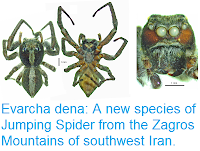
Evarcha dena: A new species of Jumping Spider from the Zagros Mountains of southwest Iran.

Jumping Spiders, Salticidae, are the largest family of Spiders, with about 5800 described species in 600 genera, roughly 13% of all described species. They are noted for their exceptional vision, possibly the best of any Arthropods, which is used in hunting, with these Spiders being active hunters that stalk their prey before catching it with a final leap, as well as in mating, with many species having evolved elaborate courtship rituals. The genus Evarcha currently contains 89 species from across the globe, though it may be paraphyletic (i.e. the members of the genus may not all be descended from a single common ancestor). These Spiders tend to be dull in colour, and favour low plants in moist areas.

In a paper published in the journal Peckhamia on 30 April 2017, Alireza Zamani of the Department of Animal Biology at the University of Tehran, Amin Hosseinpour of the Department of Medical Entomology and Vector Control at Shiraz University of Medical Sciences, and Koroush Azizi and Aboozar Soltani of the Research Center for Health Sciences at the Institute of Health and Department of Medical Entomology and Vector Control at Shiraz University of Medical Sciences, describe a new species of Evarcha from the Zagros Mountains of southwest Iran.

The new species is named Evarcha dena, in reference to Mount Dena, a prominent landmark in the area where the species was discovered. The species is described from two male specimens, one found close to the village of Rahmali in Kabgian District, and the other in the Park-e Jangali forest park, both in the province of Kohgiluyeh & Boyer-Ahmad. These are slightly over 8 mm in length, with oval abdomens, and are black in colour with a row of grey hair along their medial line.

Evarcha dena, male. (A) Dorsal view. (B) Ventral view. (C) Prosoma, frontal view. Zamani et al. (2017).

See also,..

http://sciencythoughts.blogspot.co.uk/2016/04/maratus-fimbriatus-new-species-of.htmlhttp://sciencythoughts.blogspot.co.uk/2015/04/stenaelurillus-albus-new-species-of.html
http://sciencythoughts.blogspot.co.uk/2015/04/maratus-elephans-new-species-of-peacock.htmlhttp://sciencythoughts.blogspot.co.uk/2015/03/a-new-species-of-peacock-spider-from.html
http://sciencythoughts.blogspot.co.uk/2015/03/two-new-species-of-peacock-spider-from.htmlhttp://sciencythoughts.blogspot.co.uk/2013/09/a-new-species-of-jumping-spider-from.html
Follow Sciency Thoughts on Facebook.

Thursday, 21 April 2016

Maratus fimbriatus: A new species of Peacock Spider from New South Wales.

Peacock Spiders, Maratus spp., are a distinctive group of Jumping Spiders, Salticidae, found only in Australia. They are small Spiders, generally under half a centimeter in length, but are highly distinctive, particularly the males, which are often brightly coloured and which perform eleborate courtship dances to attract the females.

In a paper published in the journal Peckhamia on 10 February 2016, Jürgen Otto of St. Ives, New South Wales and David Hill of Simpsonville, South Carolina, describe a new species of Peacock Spider from the Darling Riverine Plains of New South Wales.

The new species is named Maratus fimbriatus, meaning 'fringed' in reference to a fringe of bristles around the opisthosoma (abdomen) of the males, which is elevated during courtship displays. The species is described from two male and two female specimens collected from near Nyngan in central New South Wales, plus another 24 males and five females found in the collection of the Australian Museum.

Male specimen of Maratus fimbriatus with fringe extended during courtship dance. Otto & Hill (2016).

Males of Maratus fimbriatus range from 3.8 to 4.3 mm and are black in colour, with a covering of brown hairs, lighter on the sides than on the back. The opisthososma is covered with black scales with two white stripes and a distinctive fringe of white-tipped hairs. The pedipalps are brown, with a dense covering of white hairs, forming 'pom-pom' like structures used in courtship displays. The front two pairs of legs are short, with the foremost having white markings, also used in courtship displays. while the back to pairs of lengs are longer.

Female specimen of Maratus fimbriatus. Otto & Hill (2016).

Females of Maratus fimbriatus range from 3.6 to 4.9 mm in length, and are covered in light brown hairs, with a scattering of darker spots.

Male specimen of Maratus fimbriatus courting a female. Otto & Hill (2016).

All of the specimens of Maratus fimbriatus collected by the authors were found living on cracked clay ground in open woodland on the semi-arid Darling Riverine Plain; specimens from the Australian museum had less precise habitat information, but were all from the same river plains.

The habitat of Maratus fimbriatus. Otto & Hill (2016).

See also...

http://sciencythoughts.blogspot.co.uk/2015/04/maratus-elephans-new-species-of-peacock.htmlMaratus elephans, a new species of Peacock Spider from New South Wales.                      Peacock Spiders of the genus Maratus are a group of Jumping Spiders, Salticidae, found only in Australia. They are small in size, typically less than 5 mm in length, though the males are brightly coloured and engage in elaborate courtship dances, which give...

Peacock Spiders, Maratus spp., are a group of small Jumping Spiders, Salticidae, found only in Australia. The group gets its name from the bright colours...

Peacock Spiders, Maratus, are Jumping Spiders, Salticidae, endemic to Australia and distinguished by the bright colours and elaborate courtship dances of the males. The calcitrans group of Peacock Spiders currently comprises three members of the genus...


Follow Sciency Thoughts on Facebook. 

Thursday, 30 April 2015

Stenaelurillus albus: A new species of Jumping Spider from the Western Ghats of India.


Jumping Spiders, Salticidae, are active predatory Spiders which hunt down and leap on prey rather than lying in wait in a web or other trap. Members of the genus Stenaelurillus are Jumping Spiders, found predominantly in Africa, with a few species also described from Eurasia and the Indian Subcontinent. They are distinguished by the presence of a pair of white stripes on their prosoma (back) and by large bristles around their eyes.

In a paper published in the journal ZooKeys on 26 March 2015, Pothalil Sebastian, Pradeep Sankaran, Jobi Malamel and Mathew Joseph of the Division of Arachnology at Sacred Heart College in Thevara, Kerala, describe a new species of Stenaelurillus from the Western Ghats of India.

The new species is named Stenaelurillus albus, meaning ‘white’ in reference to the colour of the tegulum (part of the male reproductive equipment). The species is described from seven male and eight female specimens collected at Kurisumudi in Ernakulam District. Males were 4.61–5.89 mm in length and had a distinctive uniform black abdomen, a colouration not seen in any other known member of the genus. Females were 5.43–6.82 mm in length, and had a dark abdomen with yellow markings, similar to other known species. All were collected on the ground, in a rocky area covered by leaf litter within a deciduous forest.

Stenaelurillus albus, male (left) and female (right), both in dorsal view. Sebastian et al. (2015).

See also…

Peacock Spiders of the genus Maratus are a group of Jumping Spiders, Salticidae, found only in Australia. They are small in size, typically less than 5 mm in length, though the males are brightly coloured and engage in elaborate courtship dances, which give...

Peacock Spiders, Maratus spp., are a group of small Jumping Spiders, Salticidae, found only in Australia. The group gets its name from the bright colours and elaborate courtship dances of the male Spiders...


Peacock Spiders, Maratus, are Jumping Spiders, Salticidae, endemic to Australia and distinguished by the bright colours and elaborate courtship dances of the males. The calcitrans group of Peacock Spiders currently comprises three members of the genus...


Follow Sciency Thoughts on Facebook.

Thursday, 9 April 2015

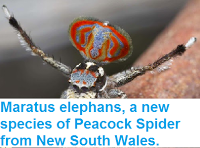
Maratus elephans, a new species of Peacock Spider from New South Wales.


Peacock Spiders of the genus Maratus are a group of Jumping Spiders, Salticidae, found only in Australia. They are small in size, typically less than 5 mm in length, though the males are brightly coloured and engage in elaborate courtship dances, which give the group their name. The males have flaps on the sides of their abdomens which are extended during these display dances to form a ‘fan’, which adds to their resemblance to Peacocks.

In a paper published in the journal Peckhamia on 19 March 2015, Jürgen Otto of St. Ives, New South Wales and David Hill of Simpsonville, South Carolina, describe a new species of Peacock Spider from northeast New South Wales. The species was originally recognised from museum specimens collected at Andersons Flat and the area north of Tamworth, and further investigations were able to locate living specimens at Andersons Flat.

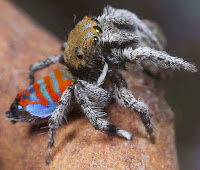
The new species is named Maratus elephans, due to the resemblance of the markings on the fan of the males, which resembles the face of an Elephant. The two male specimens examined were 4.46 and 4.74 mm in length respectively. They were black in colour with white hairs on the limbs and coloured hairs on the head and abdomen. The heads are blue with broken orange-red bands behind the eyes. The abdomens are blue with large, hair-rimmed flaps and an orange-red pattern resembling an outline of the head of an Elephant.

The male of Maratus elephans during a courtship dance with its fan extended and raised. Otto & Hill (2015).

The females of Maratus elephans are light brown in colour with darker hair on their heads and abdomens; they resemble closely the females of other Peacock Spides, which are very hard to tell apart in the absence of the males. The specimen examined was 4.66 mm in length.

Female Maratus elephans. Otto & Hill (2015).

Maratus elephans closely resembles two previously described species of Peacock Spiders, Maratus pardus, from the south coast of Western Australia and Maratus volans, which is found along the east coast of Australia from Victoria in the south to Queensland in the north. All three species have iridescent purple-blue background colours on their fans, which are fringed with white hairs, and patches of white hair on the tarsuses of their third legs, which are apparently used to make their fans look larger during parts of their courtship dance. Otto and Hill believe these three species to be closely related, and refer to them as the ‘volans-group’.

Displaying males of the three species associated with the volans group of the genus Maratus. (1-3) Maratus elephans from Andersons Flat near Chaffey Dam, New South Wales. (4-6) Three different Maratus pardus from Cape Le Grand National Park, Western Australia. (7-9) Three different Maratus volans from Ku-ring-gai Chase National Park, New South Wales. The position of legs III relative to the fan varies in the three species from (2) one leg in front and one behind in Maratus elephans, to (5) both legs in front in Maratus pardus, to (8) both legs behind in Maratus volans. All three species are vividly and distinctly coloured. Otto & Hill (2015).

Known localities for the three members of the volans group (Maratus elephans, Maratus pardus and Maratus volans). Numbered localities are associated with records that have been verified from photographs (many posted on FLICKRTM), by the examination of specimens, or listed in previous publications. For each listed locality, the respective collector and/or photographer and/or examiner is given. Unverified records of Maratus volans from the Atlas of Living Australia are not numbered, and some of these posted records (e.g., west of Melbourne, or Tasmania) are not shown here as they are now known to represent other species. Otto & Hill (2015).

See also…

Peacock Spiders, Maratus spp., are a group of small Jumping Spiders, Salticidae, found only in Australia. The group gets its name from the bright colours and elaborate courtship dances of the male Spiders...


Peacock Spiders, Maratus, are Jumping Spiders, Salticidae, endemic to Australia and distinguished by the bright colours and elaborate courtship dances of the males. The calcitrans group of Peacock Spiders currently comprises three members of the genus...


Jumping Spiders (Salticidae) are specialists who actively hunt their prey, rather than trapping it in webs as most Spiders do. They have extremely well developed vision, with large, forward facing eyes, and an enhanced respiratory system, which enables them to keep their tissues well oxygenated. Jumping...


Follow Sciency Thoughts on Facebook.

Friday, 27 March 2015

A new species of Peacock Spider from Western Australia.


Peacock Spiders, Maratus spp., are a group of small Jumping Spiders, Salticidae, found only in Australia. The group gets its name from the bright colours and elaborate courtship dances of the male Spiders. The males have flaps on the sides of their abdomens which they open to increase the area of body used in the display, further increasing their resemblance to Peacocks.

In a paper published in the journal Peckhamia on 8 June 2014, Jürgen Otto of St. Ives, New South Wales, and David Hill of Simpsonville, South Carolina, describe a new species of Peacock Spider from the Warwick Open Space and Gnangara Mound areas to the north of Perth in Western Australia.

The new species is named Maratus clupeatus, meaning ‘shield-bearing’, a reference to the shape of the male’s fan (abdomen with opened flaps) which resembles a medieval shield when raised during the mating display. Only the male of the species is described, these reach about 4.1 mm in length, and are black or dark brown in colour, with white hairs on the limbs and an area of brown scales on the head. The abdomen is brightly coloured, being light blue or blue-green to purple with orange or red-orange patterning.

Courtship display of a male Maratus clupeatus Peacock Spider. Otto & Hill (2014).

See also…

Peacock Spiders, Maratus, are Jumping Spiders, Salticidae, endemic to Australia and distinguished by the bright colours and elaborate courtship dances of the males. The calcitrans group of Peacock Spiders currently comprises three members of the genus...


In 1938 Jean-Louis Fage of the Muséum National d’Histoire Naturelle de Paris described a new species of Goblin Spider (tiny Spiders generally found living in soil or leaf litter) from a single male specimen from the collection of the Natural History Museum of Vienna...

The Canary Islands are a group of volcanic islands in the northeast Atlantic, approximately 110 km off the coast of Morocco. They are true oceanic islands, never having been connected to a continent, and started to form in the Miocene about 22 million years ago...


Follow Sciency Thoughts on Facebook.