Showing posts with label Phocoenidae. Show all posts

Thursday, 5 September 2019

Phocoena sinus: Vaquita Porpoise in imminent danger of extinction.

The Vaquita, Phocoena sinus, is a small species of Porpoise found only in the northern part of the Gulf of California. Since the extinction of the Yangtze River Dolphin, Lipotes vexillifer, in 2006 it is considered to be the world's most endangered species of Cetacean, with a population of less than 30 in 2016. The species is particularly threatened by the illegal gillnet fishery for the Totoaba, Totoaba macdonaldi, a large species of Drum also considered to be Critically Endangered under the terms of the International Union for the Conservation of Nature’s Red List of Threatened Species. This industry has been illegal since 2015, with the Mexican government paying out around US$74 million to former fishermen in compensation, though this ban has had limited success, with the Mexican government, Sea Shepherd Conservation Society, Museo de la Ballena y Ciencias del Mar and WWF-Mexico reporting a total of 400 Totoaba gillnets confiscated in 2018.

A Vaquita Porpoise, Phocoena sinus, caught as by-catch in a gillnet in the Gulf of Mexico. Flip Nicklin/Minden Pictures/WWF/Mongabay.

Since 2011 Vaquita numbers have been monitored using a network of C-POD acoustic detectors, which monitor the Vaquitas passively by listening to the clicks which they produce for echo-location. Based upon this monitoring the Vaquita population was calculated to have declined by 34% per year between 2011 and 2015 (when an official Vaquita Sanctuary was established in the northern Gulf of California was created and a moratorium on the use of gillnets in the area introduced). At this time the Vaquita population was estimated to be 60 individuals. The monitoring program recorded a further 49% decline in numbers over the next year, leading to an estimated population of 30.

In a paper published in the journal Royal Society Open Science on 31 July 2019, Armando Jaramillo-Legorreta, Gustavo Cardenas-Hinojosa, Edwyna Nieto-Garcia, and Lorenzo Rojas-Bracho of the Comisión Nacional para el Conocimiento y Uso de la Biodiversidad, Len Thomas of the Centre for Research into Ecological and Environmental Modelling at the University of St Andrews, Jay Ver Hoef of the Marine Mammal Laboratory of the National Oceanic and Atmospheric Administration, Jeffrey Moore, Barbara Taylor, and Jay Barlow of the Marine Mammal and Turtle Division of the National Oceanic and Atmospheric Administration, and Nicholas Tregenza of Chelonia Limited describe the results of the 2016-17 and 2017-18 Vaquita monitoring seasons, and the implications for the future of the species.

Historical distribution of Vaquitas (yellow hatched area) in the northern Gulf of California. The Vaquita Refuge (agreed in 2005 and enforced in 2008 as a no fishing zone) is outlined in blue. The gillnet exclusion zone (where fishing with gillnets is banned but other types of fishing is allowed) was given straight boundaries (dotted white) described by single latitude and longitude to facilitate enforcement. An enhanced enforcement zone (red) was recommended by Comité Internacional para la Recuperación de la Vaquita in the area where the remaining Vaquitas are thought to spend most of their time that also has high levels of Totoaba fishing effort. Landsat satellite composite imagery provided by United States Geological Survey, National Aeronautics and Space Administration (NASA) and Esri Inc. Jaramillo-Legorreta et al. (2019).

Jaramillo-Legorreta et al. found that the Vaquita population decreased by 62.3% from 2016 to 2017 and by 70.1% from 2017 to 2018, which would give an estimated surviving population of just 13 individuals in 2018. They also note that in 2017 an attempt to capture the surviving Vaquitas and relocate them to a safe sanctuary was able to capture two individuals, and that five other individuals were observed and identified photographically, giving a minimum of seven individuals alive in 2017 (the capture program was abandoned after one of the individuals captured, an adult female, died, and the other, a calf (not belonging to the female) became so stressed that it was released to prevent it too dying. A subsequent photographic survey of the Vaquitas, aimed at identifying all surviving members of the species so that they could be monitored individually, was able to identify six individuals in two different groups, giving a maximum number for 2018 of six.

Based upon this Jaramillo-Legorreta et al. estimate an absolute maximum of 19 Vaquitas are left alive, and that in the absence of any realistic possibility of ending gillnetting in their range, and apparent impossibility of relocating the surviving individuals, the species is in danger of imminent extinction.

See also...

https://sciencythoughts.blogspot.com/2019/09/berardius-minimus-new-species-of-beaked.htmlhttps://sciencythoughts.blogspot.com/2018/11/physeter-macrocephalus-sperm-whales.html
https://sciencythoughts.blogspot.com/2015/09/evidence-for-feeding-on-schooling.htmlhttps://sciencythoughts.blogspot.com/2015/09/isthminia-panamensis-south-american.html
https://sciencythoughts.blogspot.com/2015/02/trying-to-understand-hearing-in-eocene.htmlhttps://sciencythoughts.blogspot.com/2015/01/a-fossil-porpoise-from-early-pliocene.html
Follow Sciency Thoughts on Facebook.

Wednesday, 28 January 2015

A fossil Porpoise from the Early Pliocene of Antwerp Harbour.


Porpoises, Phocoenidae, are small Dolphins, Delphinida, found today across most of the world’s oceans, but with a fossil record restricted almost entirely to the North Pacific. Only a single fossil species from outside the Pacific Basin has been described, Septemtriocetus bosselaersi from Pliocene sediments at Verrebroek Dock in Antwerp Harbour, Belgium, with a few isolated bones tentatively assigned to the group from the Miocene of Malta and the Pliocene of Italy.

In a forthcoming paper in the journal Acta Palaeontologica Polonica available online from 14 December 2014, Wouter Colpaert of the Research UnitPalaeontology at the Universiteit Gent and Mark Bosselaers and Olivier Lambert of the Department of Terre et Histoire de la Vie at the Institut royal desSciences naturelles de Belgique, describe a second species of fossil Porpoise from Antwerp Harbour, collected from the slightly earlier Kattendijk Formation on the left bank of the River Scheldt at the entrance of the Beveren Tunnel.

The specimen was collected in several fragments by Robert Marquet, a volunteer palaeontologist at the Institut Royal des Sciences Naturelles de Belgique. It is named Brabocetus gigasei, where ‘Brabocetus’ means ‘Brabo’s Whale’, in reference to SilviusBrabo, the mythical hero who liberated the city of Antwerp from the giant Antigoon, and ‘gigasei’ honours Paul and Pierre Gigase, a father and son fossil collecting team who have for many years collected marine Mammal remains from the Antwerp area, and who donated the specimen to the Institut royal des Sciences naturelles de Belgique.

The specimen comprises a partial skull in three parts, lacking the tip of the snout as well as the the nasals, the pterygoids, and some elements of the cerebral cavity and basicranium as well as part of the left supraorbital process. The snout appears to have been more elongate than any extant Porpoise but similar to that seen in Septemtriocetus bosselaersi as well as in some other extinct Porpoises (Lomacetus, Piscolithax and probably Salumiphocaena), however unlike in these species (which are not all closely related) the snout in the two Belgian species is shorter than the cranium. However Colpaert et al. note that this analysis is based upon a reconstruction of the missing parts of the skull, and cannot be considered reliable without additional material being found.

Skull of Brabocetus gigasei,from the Pliocene of northern Belgium, in dorsal view.Photo (A) and corresponding line drawing (B). Dotted lines indicate reconstructed parts and poorly visible structures. Dark grey surfaces indicate fracture surfaces. Light grey surface indicates the original position of the lost right nasal. Scale bar is 50 mm. Colpaert et al. (2014).

A phylogenetic reconstruction of known members of the Phocoenidae suggests that while Brabocetus gigaseiis closely related to Septemtriocetus bosselaersi, both being members of an extinct group of Porpoises which also includes several Pacific species, it is not the closest relative of that species, which is more closely related to five North Pacific species than it is to the new member of the group. It is not closely related to the modern Harbour Porpoise, Phocoena phocoena, the only modern Porpoise found in the North Sea.

Consensus tree of the 27 most parsimonious trees, showing the phylogenetic relationships of Brabocetus gigasei with other extinct and extant Phocoenids. † indicates extinct taxon. IO, Indian Ocean; NA, North Atlantic; NP, North Pacific; NS, North Sea; SA, South Atlantic; SO, southern oceans; SP, South Pacific; 1, 1', and 1'' correspond to a first trans-Arctic migration scenario with three successive dispersals to the North Sea. 2, 2', and 2'' correspond to a second scenario with two dispersals to the North Sea (2, 2'') and a dispersal back to the North Pacific (2'). Colpaert et al. (2014).

This leads to two possible evolutionary scenarios, each of which are considered equally likely. Either Brabocetus gigasei and Septemtriocetus bosselaersi (or close ancestors of these species) migrated from the North Pacific to the North Sea via the Arctic Ocean separately, or the common ancestor of these two species made a similar migration, with the common ancestor of the more derived members of the group subsequently migrating back to the North Pacific.

The modern Phocoena phocoena is thought to have reached the North Sea much later, part of a recent global expansion which saw members of the group migrate from the North Pacific across the world’s oceans, and which coincides with a similar global expansion of other Dolphin groups.

See also…

http://sciencythoughts.blogspot.co.uk/2014/10/a-fossil-dolphin-from-late-miocene-of.htmlA fossil Dolphin from the Late Miocene of Hokkaido, Japan, which may be the oldest True Dolphin.                                                              Dolphins, Delphinidae, are the most diverse group of Whales (or indeed any form of Marine Mammals) alive today, with 36 described species including charismatic animals such as Bottlenose Dolphins and Killer Whales. Historically a large number of fossils have also been...

The Squalodelphinidae are a small group of small to medium-sized Toothed Whales known from the Miocene of Europe and North and South America. They are thought to be related to the modern Asian River Dolphin, Platanista gangetica, which lacks any close living relatives. The group is not well understood, with most described specimens being fragmentary in nature.
Porpoises (Phocoenidae) are small Whales, related to Dolphins (Delphinidae). They tend to have shorter snouts than Dolphins, with flattened, spade-shaped teeth, as opposed to the conical, pointed teeth of Dolphins. They are among the smallest and shortest lived Whales, ranging from 1.2 to 2.3 m in length and typically reaching sexual maturity at about eight...


Follow Sciency Thoughts on Facebook.

Thursday, 19 September 2013

A fossil Porpoise from the early Pliocene of northern Hokkaido Island, Japan.

Porpoises (Phocoenidae) are small Whales, related to Dolphins (Delphinidae). They tend to have shorter snouts than Dolphins, with flattened, spade-shaped teeth, as opposed to the conical, pointed teeth of Dolphins. They are among the smallest and shortest lived Whales, ranging from 1.2 to 2.3 m in length and typically reaching sexual maturity at about eight years, with some species doing this as young as six. The group has a fairly good fossil record and appear to have divulged from Dolphins in the early Miocene, around 15 million years ago.

In a forthcoming paper in the journal Acta Palaeontologica Polonica, available online since 16 August 2013, Mizuki Murakami of the Graduate School of Creative Science & Engineering at Waseda University, Chieko Shimada of the Mineral Industry Museum at Akita University, Yoshinori Hikida of the Nakagawa Museum of Natural History and Hiromichi Hirano of the Department of Earth Sciences at the Faculty of Education and Integrated Arts and Sciences at Waseda University, describe a fossil Porpoise from the Lower Pliocene Koetoi Formation of Tempoku Basin of northern Hokkaido.

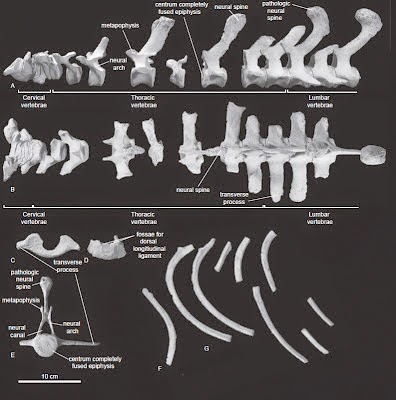
The specimen is described from a premaxilla, maxilla, the anteriormost portions of the palatines, a partial mandible, two isolated teeth, seven cervical vertebrae, eight thoracic vertebrae, three lumbar vertebrae and at least eight ribs. It is not assigned to a species because of its fragmentary nature, but shows some interesting traits.

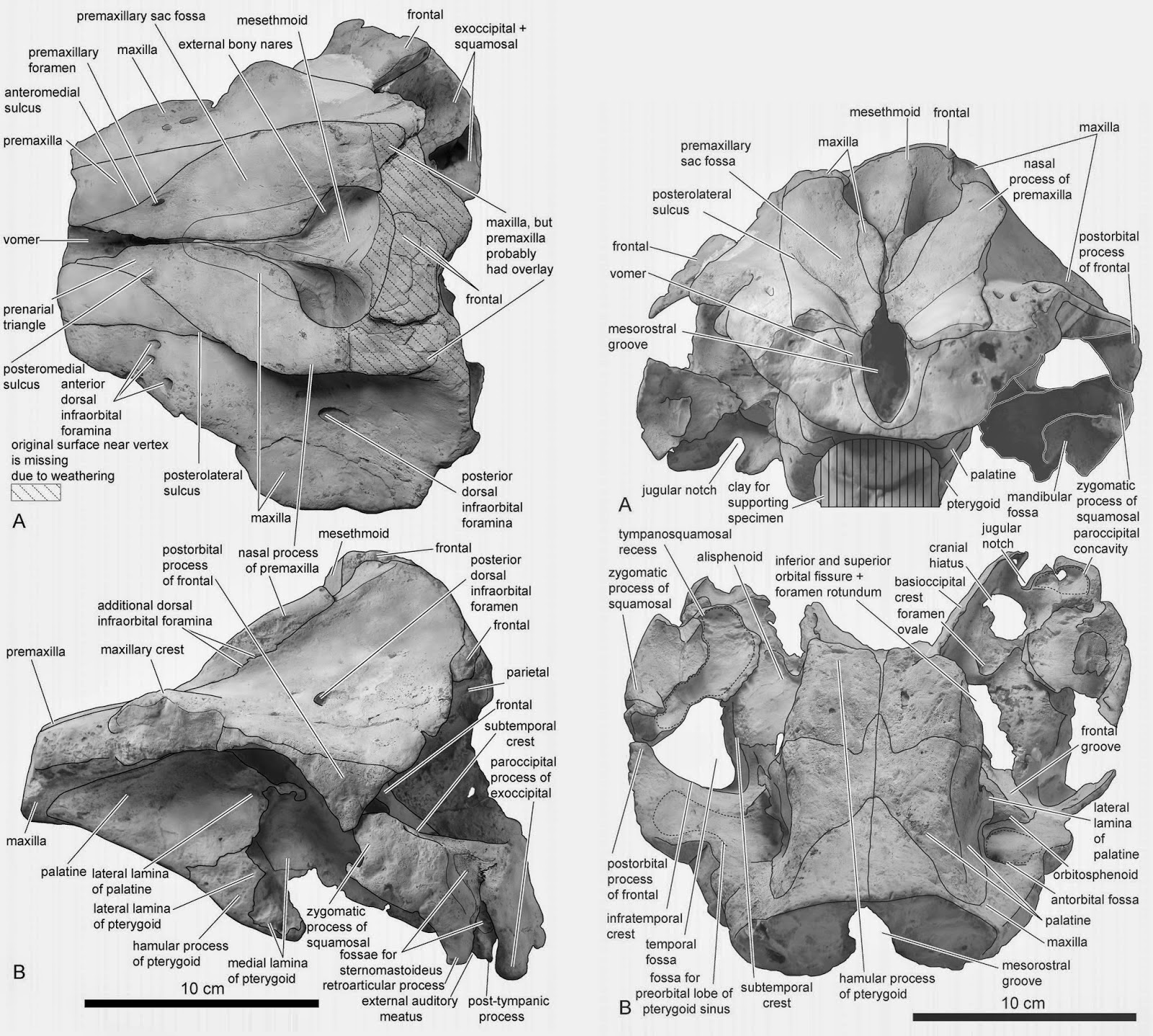
The rostrum of the new Porpoise in (A) dorsal, (B) lateral, (C) ventral and (D) anterior views, and the mandible in (E) lateral and (F) dorsal views. Murakami et al. (2013).

Most notably the specimen is considered to be a sexually mature animal aged about four years. This is younger than maturity is reached in any modern Porpoise, suggesting that the evolutionary history of Porpoises has been more complex than simply Whales getting smaller and maturing earlier.

Vertebrae (A-E) and ribs (F, G) of the porpoise. Murakami et al. (2013).

See also A fossil Neobalaenine Whale from the Late Miocene of Argentina, A Baleen Whale from the Late Miocene of southern Ukraine, Choking on Fish is a significant cause of death for Dolphins in Indian River Lagoon, Florida, Genetic diversity in Grey Whales and Bowhead Whales in the Northwest Passage.

Follow Sciency Thoughts on Facebook.