
Palaemonid Shrimps are one of the most numerous and diverse of the Decapod Shrimp groups. The family is split into two subfamilies, the free-living Palaemoninae, which are active carnivores found in almost all marine environments, and the Pontoniinae, which form a variety of associations with other invertebrates, living on Sponges, Cnidarians, Molluscs and Echinoderms as Cleaner Shrimps, parasites, or commensals.
In a paper published in the Raffles Bulletin of Zoology on 26 August 2016, Qi Kou and Xinzheng Li of the Institute of Oceanology of the Chinese Academy of Sciences, describe a new species of Palaemonid Shrimp from off the coast of Houhai Beach on Hainan Island.
The new species is paced in the genus Philarius, which contains a number of Coral-dwelling species, and given the specific name venustus, meaning elegant, in reference to the pale, hairless body of the Shrimp. The species is described from a single male specimen. pale in colour and 9.2 mm in length collected from an unidentified slender-branched Scleractinian Stony Coral of the genus Acropora found growing at a depth of 2-8 m.

 Ghost Shrimps from the Oligocene and Miocene of Central Europe. Ghost Shrimps (Callianassidae) are Decapod Crustaceans noted for the
large, complex burrows they build. They excavate their burrow systems in
intertidal or shallow subtidal waters in the tropics and...
 A new species of Cleaner Shrimp from the western Atlantic. Cleaner Shrimps (Stenopodidea) are Decapod Crustaceans more closely
related to Crabs and Lobsters than true Shrimps (Caridea). They are a
small group, with 71 known extant species and to known fossil species
from the Late Cretaceous. They are...
 A new species of Sponge dwelling Pontoniine Shrimp from Sabah State, Malaysia. The Pontoniine Shrimps are an unusual group of Decapod Crustaceans (the
group that also includes Crabs, Lobsters and most 'Shrimps') noted for...
The new species is paced in the genus Philarius, which contains a number of Coral-dwelling species, and given the specific name venustus, meaning elegant, in reference to the pale, hairless body of the Shrimp. The species is described from a single male specimen. pale in colour and 9.2 mm in length collected from an unidentified slender-branched Scleractinian Stony Coral of the genus Acropora found growing at a depth of 2-8 m.

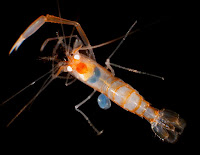
Male specimen of Philarius venustus. Yueyun Wang in Kou & Li (2016).
See also...
Ghost Shrimps from the Oligocene and Miocene of Central Europe. Ghost Shrimps (Callianassidae) are Decapod Crustaceans noted for the
large, complex burrows they build. They excavate their burrow systems in
intertidal or shallow subtidal waters in the tropics and... A new species of Cleaner Shrimp from the western Atlantic. Cleaner Shrimps (Stenopodidea) are Decapod Crustaceans more closely
related to Crabs and Lobsters than true Shrimps (Caridea). They are a
small group, with 71 known extant species and to known fossil species
from the Late Cretaceous. They are...A new species of Sponge dwelling Pontoniine Shrimp from Sabah State, Malaysia. The Pontoniine Shrimps are an unusual group of Decapod Crustaceans (the
group that also includes Crabs, Lobsters and most 'Shrimps') noted for...
Follow Sciency Thoughts on Facebook.


