Showing posts with label Rajasthan. Show all posts

Sunday, 15 December 2024

Florissantia sp.: A fossil flower from the Early Eocene of Rajasthan.

The Malvaceae first appeared in the Cretaceous in North America, and have achieved a global distribution today, most notably as a significant component of almost all tropical forests. The genus Florissantia shows a number of features associated with different extant subfamilies of the Malvaceae, and is known from the Middle Eocene till the Miocene of western North America, with specimens known from British Colombia, Colorado, Montana, Oregon, and Washington, as well as a single specimen being known from the Sikhote Alin mountains of the Russian Far East.

In a paper published in the journal Botany Letters on 21 October 2024, Ashif Ali and Mahasin Ali Khan of the Palaeobotany, Palynology, and Plant Evolution Laboratory at Sidho-Kanho-Birsha University, and Raman Patel and Rajendra Singh Rana of the Department of Geology at Rauthan Hemvati Nandan Bahuguna Garhwal University, describe a specimen of Florissantia from the Early Eocene Palana Formation of Rajasthan, India.

The specimen comes from the Laminate Maroon Shale Bed of the Palana Formation, which is exposed at the Gurha Open-cast Lignite Mine at Bikaner in northwest Rajasthan. It is preserved as part and counterpart on a piece of a piece of split- laminated shale, which has been further exposed by micro excavation of successive layers of the rock with fine needles under a dissection microscope. 

(a) Map of Rajasthan showing the location of the Gurha opencast lignite mine (red star) Bikaner Rajasthan, India; (b) view of the fossil locality. Ali et al. (2024).

The preserved fossil is a star-shaped flower about 13 mm in diameter (sgnificantly smaller than any other member of the genus), with a calyx made up of five fused and rounded sepals of roughly equal length; the petals are missing. Importantly, the sepals each show numerous prominent veins, the pattern of which is used by Ali et al. as a diagnostic tool to place the specimen in the genus Florissantia.

(a) Transversely impressed, radially symmetric, pentamerous fossil flower of Florissantia sp. (SKBU/PPL/R/F/01A, part); (b) magnified image of the specimen showing thick filaments (marked by red arrows) surrounding the compressed, carbonaceous central area; (c) enlarged view of a single calyx lobe showing prominent parallel (marked by blue arrows) and radiating reticulate (marked by white arrows) venation; (d) counterpart of fossil flower of Florissantia sp. (SKBU/PPL/R/F/01B); (e) central area of figured in higher magnification; (f) line drawing of (c) showing parallel (marked by blue arrows) and reticulate (marked by red arrows) venation, Scale bars are 2.5 mm for (a), (b), (d), and (e) and 500 μm for (c) and (f). Ali et al. (2024).

The Palana Formation of Rajasthan has been dated to between about 55 and 52 million years before the present on the basis of palynological data (fossil pollen). This Early Eocene date makes the Bikanar specimen the oldest representative of the genus Florissantia, which together with its unexpected location, potentially makes the specimen highly significant. 

Line drawings of the Bikanar specimen and earlier reported extinct fossil flower species: (a) Bikanar fossil flower of Florissantia sp.; (b )fossil flower of Florissantia ashwillii from the Oligocene of Oregon; (c) fossil flower of Chaneya membranosa from the Miocene of Poland; this appears similar to Florissantia spp, but has unequal sepals. Scale bars are 5 mm. Ali et al. (2024).

The Palana Formation was laid down on the shores of an ancient lake, which is consistent with other locations where members of the genus Florissantia have been found. Other members of the genus are known from lake-associated Floras in tropical, subtropical, and temperate environments, often with some volcanic input; although the presence of volcanic ashes helps to preserve fine structures such as flowers, so it is possible that this connection with volcanic input reflects preservation bias rather than an environmental preference of the living plants.

See also...

Tuesday, 3 September 2024

Outbreak of Chandipura Virus causes at least 82 deaths in India.

Between 1 June and 15 August 2024, the Indian Ministry of Health and Family Welfare recorded 245 cases of suspected Chandipura Virus infection in Gujarat and Rajasthan states, with 45 districts affected and 82 known deaths, a case fatality rate of 33%, according to a press release issued by the World Health Organization on 23 August 2024. Sixty four of the cases have been confirmed as Chandipura Virus by either immunoglobulin M enzyme-linked immunosorbent assay or reverse transcription polymerase chain reaction, sixty one of these in Gujarat and three in Rajasthan. The number of new cases being reported has been declining since 19 July 2024.

Chandipura Virus, or Chandipura vesiculovirus, is endemic to western, central, and southern India, with sporadic outbreaks occurring across this region,  typically during the monsoon season. In 2023 an outbreak of the Virus in Andhra Pradesh led to 183 deaths among 329 reported cases, a case fatality rate of 55.6%. Other recent outbreaks have led to case fatality rates of between 56 and 75%. In Gujarat there appears to be a spike in cases every four-to-five years. 

Chandipura vesiculovirus is a negative-sense single-stranded RNA Virus in the family Rhabdoviridae. Like many Viruses in this family, it is a zoonotic disease which can be spread by a number of Arthropod vectors, including Sandflies, Mosquitoes, and Ticks, although its main vector appears to be the Sandfly, Phlebotomus papatasi. Notably, although Human infections with Chandipura vesiculovirus have been reported only from India, the Sandfly, Phlebotomus papatasi, has a much wider distribution, and the Virus has been extracted from Sandflies in Senegal, as well as a range of Mammals in Senegal, Nigeria, Bhutan, and Nepal, suggesting a much wider, undetected, range.

Transmission electron micrographs of primary Chandipura Virus isolates from culture. Rao et al. (2004).

Chandipura Virus infection can lead to the development of a febrile disease, predominantly in children under 15, which can lead rapidly to convulsions, coma, and in the worst cases, death. In children, where fatality occurs, it typically happens within 48-72 hours of the first symptoms being detected.

The Indian Ministry of Health and Social Welfare has deployed specialist teams to Gujarat State to help implement control measures, including fumigating dwellings with insecticide to control the vectors of the disease and an education campaign aimed at raising awareness of the Virus, symptoms, and preventive measures.

See also...

Sunday, 2 June 2024

More than sixty dead in Indian heatwave.

More than sixty people have died in a heatwave affecting northern and central India this week. Sustained temperatures in excess of 45°C have been recorded across much of the region, with some areas experiencing peaks in excess of 50°C, although a record-breaking 52.9°C temperature recorded in Delhi on Wednesday 29 May 2024 has now been confirmed to have been erroneous; the correct temperature should have been a comparatively 'mild' 49.9°C.

A patient being treated for heatstroke in a hospital in Ahmedabad, Gujarat State, this week. Reuters.

At least 23 of the people who have died are reported to have been election officials, obliged to remain at their posts, often outdoors in direct sunlight, throughout the day while polls are carried out. In Odisha State twenty-six people have died of suspected heat-related conditions, many of them truck-drivers who remained in hot vehicles. In Bihar State fourteen people are reported to have died of heat-related conditions, including ten polling officials. In Uttar Pradesh thirteen people have died of heat related conditions. Eight people have been confirmed to have died of heat-related conditions in Jharkhand, with more than 1300 others hospitalised. Four people are reported to have died of heat-related conditions in Rajasthan. 

Residents of Delhi queueing to collect water from a tanker this week. Getty Images.

Many areas of India, including Delhi are also suffering from extreme water-shortages at the moment, hampering people's efforts to keep hydrated in the extreme heat. The combination of extreme heat and drought has led to forest fires raging across parts of northern India and neighbouring Pakistan (where temperatures in excess of 52°C have been recorded in several places this week). The monsoon rains are reported to have arrived in Kerala on Friday 31 May, which may bring some relief to central parts of the country, though the heatwave in the north is predicted to continue for another week. This year's monsoon is also expected to be particularly severe, driven by the high temperatures, and will likely bring a new set of problems.

A forest fire in Uttarakhand on Wednesday 29 May 2024. Press Trust of India.

The high temperatures experienced in the past year have been linked to a combination of anthropogenic global warming, driven by emissions of carbon dioxide and methane, with an El Niño - Southern Oscillation climate system over the Pacific Ocean, a natural phenomenon which also tends to drive temperatures upwards. However, the El Niño system appears to have been weakening over the past months, with sea surface temperatures over the eastern equatorial Pacific actually being lower than the average for 1990-2020, while global temperatures have continued to rise, suggesting that the El Niño system may be playing as large a role in driving this year's high temperatures as previously assumed.

See also...

Wednesday, 22 December 2021

Ophioglossum trilokinathii: A new species of Adder's Tongue Fern from Rajasthan State, India.

Adder's Tongue Ferns, Ophioglossum trilokinathii, are a group of highly unusual Ferns ,which have a global distribution, but are most diverse in India where 20 of the 52 known species are found. Adder's Tongue Ferns have a number of distinctively un-Fernlike features, most notably a specialist reproductive spike upon which the spores are produced (most Ferns produce spores on the underside of their leaves), an absence of sclerenchyma (woody cells), vascular bundles in the petioles (leaf stems), and leaves which do not uncoil like those of other Ferns. Also notable, and of particular interest to Plant biologists, are the unusually large karyotypes (chromosome numbers) of many Adder's Tongue Ferns, with one species, Ophioglossum reticulatum from the Shevaroy Hills, of south India reported to have 720 chromosomes, more than has been recorded from any other Plant or Animal.

In a paper published in the journal Scientific Reports on 22 December 2021, Banwari Yadav of the Department of Life Science at Mewar University, Mukesh Meghvansi of the Bioprocess Technology Division at the Defence Research and Development Establishment, Kanta Meena of the Department of Botany at Manikya Lal Verma Government College, and the late CB Gena of Maharaja Ganga Singh University, describe a new species of Adder's Tongue Fern from Rajasthan State, India.

The new species is named Ophioglossum trilokinathii in honour of Triloki Nath Bhardwaja, the former Vice Chancellor of Vardhman Mahaveer Open University, and an expert on ferns. It is a small Fern, reaching 1.1-2.4 cm in height, growing from an almost globular tuberous rhizome. It has young, fleshy roots emerging from the base of its rhizome, with older, often decaying roots further up the side. Four or five trophophylls (leaves) are arranged in a rosette, flat to the substrate, from which a stalk 0.7–1.5 cm long, with two rows of lateral sporangia and a sterile tip emerges.

 
Ophioglossum trilokinathii. (A) Habitat. (B) Entire plant with aggregation of roots of previous season (older roots) at rhizome apex. (C) Rhizome showing basipetal emergence of roots. (D) Trophophyll-size, shape and venation. Yadav et al. (2021).

All of the discovered specimens (roughly 300-350 individual Plants) were within an area of a metre squared, close to the village of Mainal in Chittorgarh District, Rajasthan, at an altitude of about 507 m above sealevel. The plants sprouted from their underground rhizomes in June or July, within two weeks of the first rains, and disappeared by mid-September.

See also...


Follow Sciency Thoughts on Facebook.

Follow Sciency Thoughts on Twitter.


Monday, 6 May 2019

Rajasthan man killed by Leopard.

A Rajasthan man has died after being attacked by a Leopard on Saturday 4 May 2019. Ram Swaroop Meena, 45, apparently went outside to relieve himself in the evening in the village of Kishori in Alwar District, and never returned. His body was found the following morning showing signs of an animal attack, close to footprints identified by the Indian Forest Service as Leopard tracks. Attempts are now being made to capture and relocate the animal.

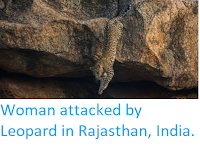
A Leopard in Rajasthan. Godwad Safari Camp.

Leopards are considered to be Vulnerable under the terms of the International Union for the Conservation of Nature's Red List of Threatened Species, with the Indian subspecies, Panthera pardus fusca, considered to be particularly vulnerable due to India's rapidly rising Human population, which has resulted in agriculture and other Human activities expanding into many former wilderness areas. For this reason the Indian Forest Service usually try to relocate Leopards that come into conflict with Humans to more remote areas, preferably within national parks, though the extent to which local people co-operate is variable.

See also...

https://sciencythoughts.blogspot.com/2019/03/kashmir-farmer-injured-by-leopard.htmlhttps://sciencythoughts.blogspot.com/2018/12/woman-mauled-to-death-by-tiger-in.html
https://sciencythoughts.blogspot.com/2018/12/leopard-captured-after-attacks-on.htmlhttps://sciencythoughts.blogspot.com/2018/04/woman-attacked-by-leopard-in-rajasthan.html
https://sciencythoughts.blogspot.com/2018/04/german-tourist-attacked-by-leopard-in.htmlhttps://sciencythoughts.blogspot.com/2018/02/leopard-killed-by-police-officer-in.html
Follow Sciency Thoughts on Facebook.

Friday, 28 December 2018

Woman mauled to death by Tiger in Rajasthan.

A Rajasthan woman has died after apparently being mauled by a Tiger, Panthera tigris, on Thursday 27 December 2018. Naroti Devi Koli, 62, from the village of Koli Mahalla in Sawai Madhopur District  went missing while washing cloths in a pool near a forest. When her absence was reported to local police, who followed a trail of bloodstained clothing into the forest till they found the woman's badly mutilated body. The matter has been raised with the Indian Forest Service, though as the incident took place within the boundaries of the Ranthambore National Park it is unclear what, if any, action will be taken.

Naroti Devi Kiol, 62, mauled to death by a Tiger inside the Ranthambore National Park on 27 December 2018. Times of India.

The Ranthambore National Park is home to a large population of Tigers, making it a major draw for tourists from both India and overseas. However, like other wild areas in India it is under pressure from the country's rising population, with more people living closer to the park each year, creating the possibility for conflict between people and animals.

Tigers are considered to be Endangered under the terms of the International Union for the Conservation of Nature's Red List of Threatened Species, with the Indian subspecies, Panthera tigris tigris, threatened by poaching, loss and fragmentation of habitat, with the result that the total adult Tiger population in India is currently thought to be about 3890 (up from about 1400 in 2006). As such Tigers are heavily protected in India, and the Indian Forest Service usually try to relocate Tigers that come into conflict with Humans to more remote areas, preferably within national parks, though the extent to which local people co-operate is variable, and where conflict occurs within national parks there is limited action that can be taken.

See also...

https://sciencythoughts.blogspot.com/2018/12/leopard-captured-after-attacks-on.htmlhttps://sciencythoughts.blogspot.com/2018/12/crocodile-attacks-man-in-karnataka.html
https://sciencythoughts.blogspot.com/2018/12/atractosteus-spatula-alligator-gar.htmlhttps://sciencythoughts.blogspot.com/2018/10/woman-attacked-by-crocodile-in-odisha.html
https://sciencythoughts.blogspot.com/2018/04/crocodile-kills-fourteen-year-old-boy.htmlhttps://sciencythoughts.blogspot.com/2018/04/woman-attacked-by-leopard-in-rajasthan.html
Follow Sciency Thoughts on Facebook.