Showing posts with label Gujarat. Show all posts

Tuesday, 3 September 2024

Outbreak of Chandipura Virus causes at least 82 deaths in India.

Between 1 June and 15 August 2024, the Indian Ministry of Health and Family Welfare recorded 245 cases of suspected Chandipura Virus infection in Gujarat and Rajasthan states, with 45 districts affected and 82 known deaths, a case fatality rate of 33%, according to a press release issued by the World Health Organization on 23 August 2024. Sixty four of the cases have been confirmed as Chandipura Virus by either immunoglobulin M enzyme-linked immunosorbent assay or reverse transcription polymerase chain reaction, sixty one of these in Gujarat and three in Rajasthan. The number of new cases being reported has been declining since 19 July 2024.

Chandipura Virus, or Chandipura vesiculovirus, is endemic to western, central, and southern India, with sporadic outbreaks occurring across this region,  typically during the monsoon season. In 2023 an outbreak of the Virus in Andhra Pradesh led to 183 deaths among 329 reported cases, a case fatality rate of 55.6%. Other recent outbreaks have led to case fatality rates of between 56 and 75%. In Gujarat there appears to be a spike in cases every four-to-five years. 

Chandipura vesiculovirus is a negative-sense single-stranded RNA Virus in the family Rhabdoviridae. Like many Viruses in this family, it is a zoonotic disease which can be spread by a number of Arthropod vectors, including Sandflies, Mosquitoes, and Ticks, although its main vector appears to be the Sandfly, Phlebotomus papatasi. Notably, although Human infections with Chandipura vesiculovirus have been reported only from India, the Sandfly, Phlebotomus papatasi, has a much wider distribution, and the Virus has been extracted from Sandflies in Senegal, as well as a range of Mammals in Senegal, Nigeria, Bhutan, and Nepal, suggesting a much wider, undetected, range.

Transmission electron micrographs of primary Chandipura Virus isolates from culture. Rao et al. (2004).

Chandipura Virus infection can lead to the development of a febrile disease, predominantly in children under 15, which can lead rapidly to convulsions, coma, and in the worst cases, death. In children, where fatality occurs, it typically happens within 48-72 hours of the first symptoms being detected.

The Indian Ministry of Health and Social Welfare has deployed specialist teams to Gujarat State to help implement control measures, including fumigating dwellings with insecticide to control the vectors of the disease and an education campaign aimed at raising awareness of the Virus, symptoms, and preventive measures.

See also...

Thursday, 29 December 2022

Yprezethinus grimaldii: A Pselaphine Rove Beetle from Early Eocene Cambay Amber.

The Indian Plate separated from Madagascar about 88 million years ago, and collided with Eurasia between 60 and 45 million years ago. Since this time, there has been significant floral and faunal exchange between India and Eurasia, but during the period of isolation, the wildlife of India should, at least in theory, have been closer to that of Madagascar and Africa. However, fossils of African affinities from India during this interval are actually quite rare, while many appear to be more closely related to groups from Europe.

Cambay Amber, from Gujarat State, India, has been dated to about 54.5 million years ago, making it Ypressian (Early Eocene) in age, i.e. dating from the period during which India was colliding with Eurasia. This deposit has yielded a rich assemblage of Insects and other small Arthropods, although the majority of these show Laurasian affinities, and the overall Insect assemblage resembling that of the slightly younger Baltic Amber of northern Europe. Groups with affinities to Eurasian faunas include Electrapine and Melikertine Bees, Lygistorrhinid Flies, and a variety of Termites, while Africa-linked groups include Scelembid Webspinners, and a Paleoamblypygid Whipspider.

In a paper published in the journal Palaeoentomology on 22 September 2022, Joseph Parker of the Division of Biology and Biological Engineering at the California Institute of Technology, and the Division of Invertebrate Zoology at the American Museum of Natural History, describes a new species of Pselaphine Rove Beetle from Cambay Amber, with clear affinities to species from tropical Africa.

The Beetle is assigned to a new species and genus, and given the name Yprezethinus grimaldii, where 'Yprezethinus' derives from 'Ypressian' plus 'Zethinus', a modern genus of Pselaphine Rove Beetle which it resembles, and 'grimaldii' honours the American palaeoentomologist David Grimaldi on the advent of his 65th birthday.

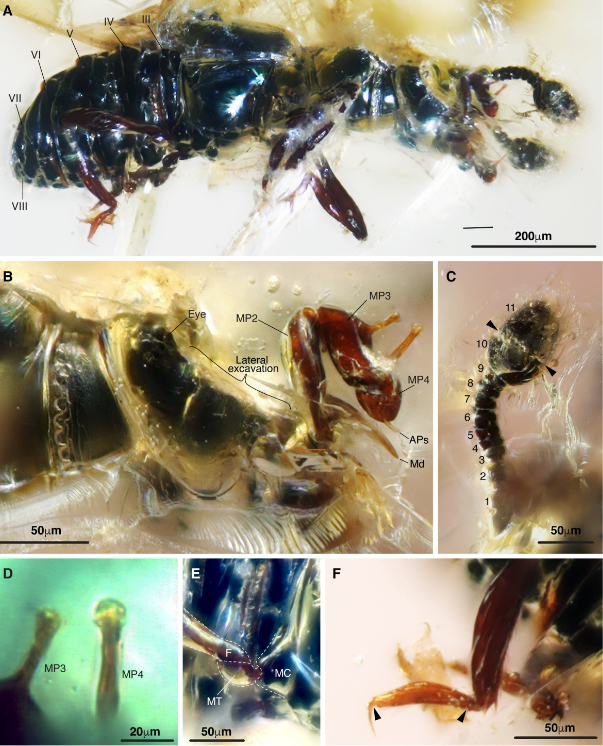
Yprezethinus grimaldii Holotype AMNH Tad-130. (A) Habitus with visible abdominal sternites labelled. (B) Head and pronotum with segments of maxillary palpomeres numbered MP2–MP4. Bythinoplectina-type lateral excavation, eye, apical  pseudosegment of maxillary palp, APs, and mandible, Md, indicated. (C) Right antenna with antennomeres numbered. Note the  club formed from tightly appressed, hemisphere-shaped antennomeres 10 and 11. D, Close-up view of apically globose tubercles  of maxillary palpomeres 3 and 4. (E) Proximal leg articulation, showing conically projecting metacoxa, MC, short metatrochanter, MT, and femur, F. (F) Right metatarsus, F with bythinoplectine-type enlarged third tarsomere spanning distance between arrowheads, and minute first visible tarsomere. Parker (2022).

Yprezethinus grimaldii is about 0.8 mm in length with a flattened body and a glossy black carapace. It is assigned by Parker to the subtribe Bythinoplectina, which is found today in leaf-litter in tropical forests, and considered to be closely related to the modern Zethinus, which is found in the tropical forests of West-Central Africa, from Côte d’Ivoire south to Angola. 

Interestingly, many modern Pselaphine Rove Beetles are considered to be Ant-associated, and while examples of them actually living in Ant's nests are rare, they certainly appear to do better in environments where the leaf-litter community is dominated by Ants. The oldest abundant Ant fossils come from Middle Cretaceous Amber from Kachin State, Myanmar ('Burmese Amber'), but these Ants are quite unlike modern Ants, and no members of any (modern) Ant-associated group are known from Kachin Amber. Cambay Amber represents one of the earliest known ecosystems dominated by this modern Ants, making the discovery of a potentially Ant-related Beetle here significant.

Many of the flying Insects from Cambay Amber appear to be more closely related to Eurasian than African groups. Pselaphine Rove Beetles are, in contrast, poor fliers, as are Webspinners (a group in which, in modern species at least, only the males can fly); Whipspiders are wingless Arachnids and do not fly at all. Thus the flying Insect assemblage at Cambay appears to have been replaced by species from Eurasia, while more terrestrial groups still show African affinities. 

See also...

Online courses in Palaeontology. 

Follow Sciency Thoughts on Facebook.

Follow Sciency Thoughts on Twitter.


Sunday, 24 July 2022

Mesolithic microliths from Gujarat State, India.

The term 'microlith' was first coined by the English archaeologist Archibald Campbell Carlyle, to describe small retouched stone blades generally thought to have been part of a larger tool, while he was working in the Vindhya Hills of central India in the 1860s. Here these items were produced from about 45 000 years ago onwards, with Pleistocene examples being referred to as 'Late Palaeolithic' and Holocene examples as 'Mesolithic'. The term was later applied to a wide range of similar small tools at sites around the world, and became the defining tool for separating Mesolithic from earlier technologies. 

The term is now used to cover a wide range of small stone tools with a wide variety of uses, with a confusing variety of descriptions. These tools appear at different times in different places, but are found on every inhabited continent by the end of the Pleistocene. The use of these tools persisted through the Neolithic and Bronze ages, and in some parts of the world into the modern era, making their use as a dating tool limited without a good understanding of local history.

In India, these tools were used by a wide range of semi-nomadic peoples engaging in hunting, gathering, fishing, and foraging, over a long time period that saw the arrival of the first Human inhabitation of the Ganga plains, the West Bengal delta, the Indian west coast and Kerala. Microlithic tools appear to have been used for a huge range of activities during this time, but there was no single microlith-producing culture or technology, but rather a vast range of peoples making and using microlithic tools over a long period of time.

The Thar Desert, which covers large areas of Rajastan and Gujarat states in India and Sindh Province in Pakistan, contains thousands of relic dunes (dunes which have no present day source of sand) with scatters of microlithic tools on their tops. These dunes typically overlook bodies of water, such as lakes or rivers, and which may be permanent or seasonal. Studies of the local geography suggest that these waterways date to the latest Pleistocene, at which time the dunes were still active. This was associated with the development of a wetter climate, with higher rainfall and increased vegetation, which in turn stabilised the dunes. This wetter climate appears to have attracted the first hunter gatherers into the area, resulting in the microliths on the dune tops.

This was not a simple change from a dry to a wetter climate, but a gradual process with bodies of water appearing and then disappearing over a period of several thousand years, which presumably resulted in different groups of people moving into and out of the area over that time. The available evidence appears to support this, with some dunes having successions of different tool-bearing and non-tool-bearing layers up to 150 cm thick. However, few of these sites have had chronologies developed, and there has been almost no work done which correlates any of this material to material elsewhere in India.

In a paper pulished in the journal Plos One on 22 June 2022, Charusmita Gadekar of the Department of Archaeology and Anthropology of the Milà iFontanals Institution for Research in Humanities, Juan José García-Granero, also of the Department of Archaeology and Anthropology of the Milà i Fontanals Institution for Research in Humanities, and of the School of Archaeology at the University of Oxford, Marco Madella of the Department of Humanities at the Universitat Pompeu Fabra, the Institució Catalana de Recerca iEstudis Avançats, and the School of Geography, Archaeology and EnvironmentalStudies, at the University of the Witwatersrand, and Pottentavida Ajithprasad of the Department of Archaeology and Ancient History at the Maharaja Sayajirao University of Baroda, examine the a lithic assemblage from Vaharvo Timbo, a dune-top archaeological site in the Patan District of Gujarat State, India.

The Vaharvo Timbo site was discovered in the 1980s, and was the subject of an excavation by the North Gujarat Archaeological Project (a collaboration between the Maharaja Sayajirao University of Baroda and the Milà i Fontanals Institution for Research in Humanities) in 2011. The site covers 52 000 m² at the top of a set of stabilised dunes in the estuary of the River Rupal. 

Two trenches were dug during the excavation, both measuring 4 x 4 m. The first of these was on the dune summit, and found a layer 135 cm deep, containing lithic tools and debitage, pieces of ochre, iron or manganese oxide nodules, Dentalium sp. (Tusk Shell) shell beads, bone points, and grinding stones, which was isotope dated to between 5600  and 5000 BC. The second trench was excavated lower on the dune slope, and uncovered a Human burial, containing a young individual and two pottery vessels in the style of the Early Harrapan Period (3300-2600 BC).

Vaharvo Timbo is located about 6 km to the south of the Loteshwar site, which was excavated by the North Gujarat Archaeological Project in 2009. The Loteshwar site produced material dated to 7168–4703 BC, which makes it one of the earliest known Holocene settlements in northwest India, including a wide range of Mesolithic stone tools, as well as traces of the consumption of Animals (principally Antelope) and Plants (principally wild grains and pulses) and charcoal.

Map of western India showing the location of notable archaeological sites in the Thar Desert. Francesc Conesa in Gadekar et al. (2022).

The relatively recent exploration of Loteshwar and Vaharvo Timbo mean that both were excavated in a controlled manner, with the precise location of each lithic item carefully recorded, and directly related to sediment structures, and biological items from which dates can be obtained, allowing direct comparison of the sites.

Gadekar et al.'s study concentrated on the early hunter-gatherer inhabitants of the Thar desert, and therefore concentrated on the material from the trench on the top of the dune, rather than the later burial. The lithic material included 5034 pieces of debitage (waste from the manufacturing of tools), 192 blades (including simple blades with parallel sides, backed blades, obliquely blunted blades, and retouched blades), 90 geometric tools (including isosceles triangles, with two equal sides, scalene triangles, without equal sides, lunates, shaped like a crescent, and trapezes, with two parallel horizontal sides and two non-parallel shorter sides), and 20 non-geometric tools (including points and double-sided scrapers). The material from which these tools were made includes chert, chalcedony, banded agate, moss agate, carnelian, bloodstone and quartz. The presence of large amounts of debitage implies that stone tools were being made at the site.

Examples of the lithic assemblage recovered from Vaharvo Timbo: (a)-(j) trapezes, (k)-(l) lunates, (m)-(p) points, (q) triangle isosceles and (r)-(z) various types of blades. Pottentavida Ajithprasad in Gadekar et al. (2022).

The microliths at Loteshwar and Vaharvo Timbo appear to have been made using similar techniques, and both at both sites the assemblage is dominated by blades. However, the Vaharvo Timbo assemblage contains a far higher proportion of retouched blades and geometric tools than that at Loteshwar. Conversely, the Loteshwar assemblage is dominated by blade flakes (flakes without uniform parallel sides like a blade), which are very rare at Vaharvo Timbo.

The Vaharvo Timbo site shows extensive evidence of tool manufacturing, as well as the exploitation of Plant and Animal resources. Ceramics are absent from the site, and, curiously, none of the tools show signs of wear, possibly implying they were being manufactured here for use elsewhere. The tools at Vaharvo Timbo appear to have been made using similar techniques to those at Loteshwar, but the range of tools is more limited. Possibly this reflects Loteshwar, which is located about 500 m from the Khari River, being a more permanent settlement, while Vaharvo Timbo was used as a base for hunting and fishing expeditions.

See also...

Follow Sciency Thoughts on Facebook.

Follow Sciency Thoughts on Twitter.


Sunday, 16 May 2021

Two dead in Kerala as Cyclone Tauktae moves up the west coast of India.

Two people have died in Kerala State, India, as Cyclone Tauktae moved up the western Indian coast over the past two days, bringing with it high winds, heavy rainfall, and storm surges. The storm has caused widespread disruption, flooding low lying areas, uprooting trees and downing power lines, but has so far caused relatively few casualties to the evacuation of thousands of people from areas expected to be the worst hit (before the introduction of this practice, tropical storms making landfall in India regularly killed thousands of people). So far the storm has passed along the shores of Tamil Nadu and Kerala states, and is expected to pass Goa and move on to Maharashtra today, eventually making landfall in Gujarat on Tuesday 18 May 2021.

 
A storm surge near Mangaluru, in Karnataka State, India, on Saturday 15 May 2021. Press Trust of India.

Tropical storms, called Cyclones in the Indian Ocean and South Pacific, are caused by solar energy heating the air above the oceans, which causes the air to rise leading to an inrush of air. If this happens over a large enough area the inrushing air will start to circulate, as the rotation of the Earth causes the winds closer to the equator to move eastwards compared to those further away (the Coriolis Effect). This leads to tropical storms rotating clockwise in the southern hemisphere and anticlockwise in the northern hemisphere. These storms tend to grow in strength as they move across the ocean and lose it as they pass over land (this is not completely true: many tropical storms peter out without reaching land due to wider atmospheric patterns), since the land tends to absorb solar energy while the sea reflects it.

 
A rescue team carries a woman from a flooded building in Kochi, Kerala, on Saturday 15 May 2021. NDTV.

Despite the obvious danger of winds of this speed, which can physically blow people, and other large objects, away as well as damaging buildings and uprooting trees, the real danger from these storms comes from the flooding they bring. Each drop millibar drop in air-pressure leads to an approximate 1 cm rise in sea level, with big tropical storms capable of causing a storm surge of several meters. This is always accompanied by heavy rainfall, since warm air over the ocean leads to evaporation of sea water, which is then carried with the storm. These combined often lead to catastrophic flooding in areas hit by tropical storms.

 
The path and strength of Cyclone Tauktae. Thick line indicates the past path of the storm (till 6.00 am GMT on Sunday 16 May 2021), while the thin line indicates the predicted future path of the storm, and the dotted circles the margin of error 12, 24, 36, 48 and 72 hours ahead. Colour indicated the severity of the storm. Tropical Storm Risk.

 
The formation and impact of a storm surge. eSchoolToday.

See also...


Follow Sciency Thoughts on Facebook.

Follow Sciency Thoughts on Twitter.