Showing posts with label Butterfly Conservation. Show all posts

Friday, 28 December 2018

Woman mauled to death by Tiger in Rajasthan.

A Rajasthan woman has died after apparently being mauled by a Tiger, Panthera tigris, on Thursday 27 December 2018. Naroti Devi Koli, 62, from the village of Koli Mahalla in Sawai Madhopur District  went missing while washing cloths in a pool near a forest. When her absence was reported to local police, who followed a trail of bloodstained clothing into the forest till they found the woman's badly mutilated body. The matter has been raised with the Indian Forest Service, though as the incident took place within the boundaries of the Ranthambore National Park it is unclear what, if any, action will be taken.

Naroti Devi Kiol, 62, mauled to death by a Tiger inside the Ranthambore National Park on 27 December 2018. Times of India.

The Ranthambore National Park is home to a large population of Tigers, making it a major draw for tourists from both India and overseas. However, like other wild areas in India it is under pressure from the country's rising population, with more people living closer to the park each year, creating the possibility for conflict between people and animals.

Tigers are considered to be Endangered under the terms of the International Union for the Conservation of Nature's Red List of Threatened Species, with the Indian subspecies, Panthera tigris tigris, threatened by poaching, loss and fragmentation of habitat, with the result that the total adult Tiger population in India is currently thought to be about 3890 (up from about 1400 in 2006). As such Tigers are heavily protected in India, and the Indian Forest Service usually try to relocate Tigers that come into conflict with Humans to more remote areas, preferably within national parks, though the extent to which local people co-operate is variable, and where conflict occurs within national parks there is limited action that can be taken.

See also...

https://sciencythoughts.blogspot.com/2018/12/leopard-captured-after-attacks-on.htmlhttps://sciencythoughts.blogspot.com/2018/12/crocodile-attacks-man-in-karnataka.html
https://sciencythoughts.blogspot.com/2018/12/atractosteus-spatula-alligator-gar.htmlhttps://sciencythoughts.blogspot.com/2018/10/woman-attacked-by-crocodile-in-odisha.html
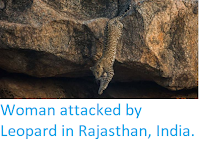
https://sciencythoughts.blogspot.com/2018/04/crocodile-kills-fourteen-year-old-boy.htmlhttps://sciencythoughts.blogspot.com/2018/04/woman-attacked-by-leopard-in-rajasthan.html
Follow Sciency Thoughts on Facebook.

Saturday, 23 March 2013

The taxonomic implications of host preference in Large Blue Butterflies.

Butterflies of the genus Maculinea (Large Blues) are social parasites targeting Ants of the genus Myrmica. The Butterflies lay their eggs on Gentian Flowers (Gentiana spp.) where the caterpillars emerge and pass through a number of instars (growth phases separated by molting events), before reaching a final larval stage, which secretes chemicals attractive to the host Ants, which then cary them back to their nests and feed them as they would their own larvae. 

The life cycle of Large Blue Butterflies. (a) The adult female, living about 5 days, lays 50-100 white eggs on the leaves and flower buds of Gentiana spp. (b) The young caterpillar bores into the plant, where it feeds on the developing seeds for 10-15 days, reaching 2% of its adult biomass. (c) The caterpillar emerges and falls to the ground, where it secretes chemicals attractive to ants of the genus Myrmica, who carry the caterpillar back to their nest. (d) The caterpillar competes with the ant larvae in the nest. Each species is capable of secreting chemicals specific to one species of ant; if carried to the wrong sort of nest it stops secreting chemicals, relying on the general smell of the nest to provoke the ants to feed it, however this is much less reliable and frequently results in the death of the caterpillar. (e) The growing ant makes vocalizations similar to the ants' queen, causing it to be fed in preference to the ants' own larvae. It feeds this way for 10-22 months before emerging as an adult and repeating the life-cycle. Thomas et al. (2013).


The taxonomy of Large Blue Butterflies is notoriously hard to unravel. The genus is currently split into six morphospecies (species differentiated by their appearance) but it is thought likely that each of these is made up of a number of different cryptic species. In order to test this a team of scientists led by Jeremy Thomas of the Department of Zoology at the University of Oxford and the Centre for Ecology and Hydrology carried out an experiment in which Butterflies of the species Maculinea rebeli from Poland and Spain were raised under laboratory conditions, along with their respective hosts. The results of the study were published in a paper in the Proceedings of the Royal Society Series B on 22 January 2013.

Thomas et al. found that the Butterflies from Poland used Ants of the species Myrmica sabuleti, while those from Spain used Myrmica schencki. Neither group of Butterflies were capable of surviving with the host of the other, suggesting that they are reproductively isolated, and should be regarded as separate species. 

This has important conservation implications. All Large Blue Butterflies are considered to be threatened by habitat loss. If the known morphospecies are all made up of a number of different cryptic species, as seems likely, then the reproductive populations of each of these populations will be much lower than is currently thought, and the species will be at greater risk of extinction.


Follow Sciency Thoughts on Facebook.

Wednesday, 25 April 2012

New species of moth from Yunnan Province.

In May 1992 entomologist Xue Dayong collected a single moth of an unknown species outside Heinitang village in western Yunnan Province, China, near the border with Myanmar. In the intervening 20 years no further specimens of this moth have been found, while the area has suffered steady deforestation due to slash-and-burn agriculture, leading to a distinct possibility that there are no more of these moths to be found.

The effects of slash-and-burn agriculture near Heinitang village. Li et al. (2012).

In the absence of any further material the species has been described from the single specimen in a paper published in the journal Zootaxa on 25 April 2012 by Jing Li, Nan Jiang and Hongxiang Han of the Key Laboratory of Zoological Systematics and Evolution at the Institute of Zoology at the Chinese Academy of Sciences.

The new moth is (tentatively) placed in the genus Heterophleps, though Li et al. are cautious of making a full taxonomic analysis based upon a single specimen. It is given the specific name inusitata, meaning rare. Heterophleps inusitata is a brown larentiine moth with a yellow underside, with a 17 mm forewing (the only measurement given).

Heterophleps inusitata. Li et al. (2012).


Follow Sciency Thoughts on Facebook.