Showing posts with label Reindeer. Show all posts

Monday, 27 August 2018

Assessing the impact of large animal carcasses on plant biodiversity, using data from a Norwegian Reindeer herd killed by lightning.

A total of 323 Reindeer, Rangifer tarandus, were killed by a lightning strike during a thunder storm on the Hardanangervidda National Park on Friday 26 August 2016. The Reindeer migrate across the park, which is a mountainous plateau, at this time of year, and are believed to have huddled together during the storm, an action which helps to protect the younger members of the herd (which included 70 calves) from the worst of the elements, but which makes them particularly vulnerable to (rare) lightning strikes. While tragic for the Reindeer, this event provided a unique opportunity to study the impact of large cadavers on a (nutrient poor) tundra environment.
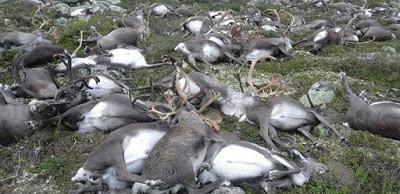
Reindeer killed by lightning on the Hardangervidda Plateau on 26 August 2016. Håvard Kjøntvedt/Norwegian Environment Agency.

In a paper published in the journal Biology Letters on 15 August 2018, Sam Steyaert of the Department of Natural Sciences and Environmental Health at the University of South-Eastern Norway, and the Faculty of Environmental Sciences and Natural Resource Management at the Norwegian University of Life Sciences, Shane Frank, also of the Department of Natural Sciences and Environmental Health at the University of South-Eastern Norway, Stefano Puliti, also of the Faculty of Environmental Sciences and Natural Resource Management at the Norwegian University of Life Sciences, and of the Norwegian Institute of Bioeconomy Research, Rudy Badia, again of the Faculty of Environmental Sciences and Natural Resource Management at the Norwegian University of Life Sciences, Mie Arnberg, again of the Department of Natural Sciences and Environmental Health at the University of South-Eastern Norway, Jack Beardsley of the Surveying and Spatial Sciences Group at the University of Tasmania, Asle Økelsrud, once again of the Department of Natural Sciences and Environmental Health at the University of South-Eastern Norway, and Rakel Blaalid of the Norwegian Institute for Nature Research, describe the results of a study which monitored the site of the 2016 mass Reindeer site for seeds introduced by scavengers, as a way of demonstrating that endozoochory (seed dispersal via ingestion by vertebrate animals) provides a viable means for plants to reach a new nutrient source within an otherwise nutrient poor environment.

The vegetation at the sire of the study was dominated by Dwarf Birch, Betula nana, as well as Heathers, Grasses, and an understory of Mosses and Lichens. A range of Mammals and Birds were seen scavenging at the site, including Corvids (Raven, Corvus corax, and Hooded Crow, Corvus cornix), Golden Eagle (Aquila chrysaetos), Foxes (Red Fox, Vulpes vulpes, and Arctic Fox, Vulpes lagopus), Wolverine (Gulo gulo) and several Rodents (Arvicolidae). In addition a number of small Birds were observed feeding on Blowflies (Calliphoridae) attracted to the carrion.

Steyaert et al. searched the site for feces of mesopredators, Birds and Rodents, finding a particular corelation between Bird feces and carcass density (i.e. there was more Bird erces in areas where the carcasses were most dense). They then examined the Bird feces for seeds of the Crowberry, Empetrum nigrum, keystone species of the alpine tundra with predominantly vegetative reproduction, finding 87.5% of the feces sampled contained viable seeds.

The Crowberry, Empetrum nigrum, an Arctic keystone species shown to be distributed to sites with carrion by scavenging Birds. Wikimedia Commons.

See also...

https://sciencythoughts.blogspot.com/2018/02/vultures-and-lions-poisoned-outside.htmlhttps://sciencythoughts.blogspot.com/2017/12/understanding-dispersal-of-rockwood-and.html
https://sciencythoughts.blogspot.com/2017/02/isaberrysaura-mollensis-neornithischian.htmlhttps://sciencythoughts.blogspot.com/2016/08/lightning-kills-323-reindeer-in.html
https://sciencythoughts.blogspot.com/2016/08/ceratocaryum-argenteum-plant-producing.htmlhttps://sciencythoughts.blogspot.com/2016/04/understanding-role-of-bears-in-enabling.html
Follow Sciency Thoughts on Facebook.

Tuesday, 30 August 2016

Lightning kills 323 Reindeer in Norwegian national park.

A total of 323 Reindeer have been killed by a lightning strike during a thunder storm on the Hardanangervidda National Park on Friday 26 August 2016, according to the Norwegian Environment Agency. The Reindeer migrate across the park, which is a mountainous plateau, at this time of year, and are believed to have huddled together during the storm, an action which helps to protect the younger members of the herd (which included 70 calves) from the worst of the elements, but which makes them particularly vulnerable to (rare) lightning strikes.

Reindeer killed by lightning on the Hardangervidda Plateau on 26 August 2016. Håvard Kjøntvedt/Norwegian Environment Agency.

Thunderstorms occur when warm, moist bodies of air encounter cooler, drier air packages. The warm air rises over the cooler air until it rises above its dew point (the point where it cools to far to retain its water content as vapor), and the water precipitates out, falling as rain, sleet or hail.

Warm moist air passing over the surface of the Earth acts as an electrical generator, creating a negative charge in the cloud tops and a positive charge at the ground (or occasionally in a second cloud layer). The atmosphere acts as an electrical insulator, allowing this potential to build up, until water begins to precipitate out. This allows a channel of ionized air to form, carrying a current between the clouds and the ground, which we perceive as lightning.

See also...

Thirteen dead after helicopter crashes during flight from Norwegian oilfield.                 Thirteen people have died after a helicopter crashed to the west of Bergen, Norway, on Friday 29 April 2016, during a return flight from the Gullfaks Oil Field in...


Magnitude 3.8 Earthquake off the west coast of Norway.                                          The British Geological Survey recorded a Magnitude 3.8 Earthquake at a depth of 10 kmabout 30 km offshore of the town of Florø in Sogn og Fjordane County...


Fireball over northern Europe.       Eyewitnesses across much of northern Europe reported seeing a bright fireball in the sky moving southwest to northeast at about 6.05 pm GMT on Saturday 31 October 2015. The event was seen from the Netherlands, Germany, Denmark...


Follow Sciency Thoughts on Facebook.

Tuesday, 10 January 2012

Industrialization of the East Canadian Tundra blamed for 90% drop in Caribou numbers.

Caribou (Rangifer tarandus), or reindeer as they are known in the Old World, are ubiquitous Arctic herbivores, found from Northern Scandinavia across the Russian Arctic, Alaska, the tundras of Northern Canada and in Western Greenland. A former population in Eastern Greenland, that some scientists believe to have been a separate subspecies, was driven extinct in the nineteenth century (Caribou taxonomy is not clear; there are clearly several subspecies, but different authorities do not agree on how they should be defined). They are widely domesticated, both for their meat, and as a beast of burden, and wild herds are hunted by indigenous peoples across much of the Arctic. Because of the widespread domestication of Caribou the species is not in danger of extinction, but wild herds have suffered sharp declines in numbers in recent decades, something that has been widely blamed on increased human activity in the Arctic.

A Caribou on the Tundra of Quebec.

A study for the human rights group Survival International released last month, found that the world's largest wild Caribou herd, the George River Herd, which roams across the tundras of northern Quebec and Labrador, has fallen from around 800 000 in 1993 to about 74 000, a loss of slightly over 90% of the population. The Canadian Government has also been monitoring the herd, and has recently introduced tougher restrictions on reindeer hunting in the area.

The study by Survival International, which concentrates on witness statements from Innu Tribal Elders, does not see hunting as the main reason for the George River Herd's decline, but rather suggests the herd may have been effected adversely by increasing industrialization in the area, particularly extraction of iron ore from the Labrador Trough, a geological feature that runs across Labrador and Quebec, by mining company Cap-Ex Ventures and the rising number of road-building and hydro-electric projects in the area.

While this initially sounds persuasive, Caribou populations are naturally prone to severe population fluctuations. As recently as 1950 the total Caribou population for Labrador and Quebec was estimated to be as low as 5000, divided into two herds, the George River and the Leaf. These fluctuations are thought to be caused by the grazing habits of the Caribou. In good times the population of Caribou grows steadily, till there are more Caribou than the environment can sustain, then overgraze their food supply, leading to widespread starvation and a general population crash. This then allows the environment to recover, whereupon the Caribou numbers start to rise again. This is bad for individual Caribou, but not necessarily a bad thing for the species, as the periodic crashes weed out less fit individuals and serve to keep down predator numbers, be they wolves or hunting permits.

Obviously reducing the total grazing are available will reduce the maximum population size the herd can reach, and therefore bring about the population crash sooner, but it does not necessarily follow that a dramatic crash in Caribou populations can be completely attributed to human activity.