Showing posts with label São Paulo State. Show all posts

Friday, 15 December 2023

Boipeba tayasuensis: An exceptionally large Blindsnake from the Late Cretaceous of Brazil.

Snakes are one of the most successful groups of terrestrial Vertebrates, with over 3800 described extant species. Of these, about 620 are Blindsnakes, Scolecophidia, small, worm-like Snakes with reduced eyes covered by scales, subterminal mouths, and blunt snouts and tails which can make it hard to determine which end is the front. These Snakes are interesting taxonomically, as they retain more Lizard-like features than other Snakes, as well as having a set of derived adaptations for a burrowing environment all their own, which has led to the conclusion that they are the earliest-branching group of extant Snakes, something which has been supported by genetic analysis. However, if this is the case, then Blindsnakes should have appeared in the Late Jurassic or Early Cretaceous, whereas the oldest known fossils assigned to the group come from the Late Palaeocene of Morocco and Early Eocene of Europe.

In a paper published in the journal iScience on 19 November 2023, Thiago Schineider Fachini of the Laboratório de Paleontologia at the Universidade de São Paulo, Silvio Onary, also of the Laboratório de Paleontologia at the Universidade de São Paulo, and of the College of Science and Engineering at Flinders University, and the South Australian MuseumAlessandro Palci and Michael Lee, also of the College of Science and Engineering at Flinders University, and the South Australian Museum, Mario Bronzati of the Laboratório de Evolução e Biologia Integrativa at the Universidade de São Paulo, and  Annie Schmaltz Hsiou, again of the Laboratório de Paleontologia at the Universidade de São Paulo, describe a new species of Blindsnake from the Late Cretaceous  Adamantina Formation of São Paulo State, Brazil.

The new species is named Boipeba tayasuensis, where 'Boipeba' means 'flat Snake' in the Tupi-Guarani language of Brazil, and 'tayasuensis' means 'from Taiaçu' in reference to the location where the specimen was found. The new species is described on the basis of an isolated vertebra articulated with the anterior region of a fragmentary following vertebra, from a fossiliferous outcrop of the Adamantina Formation beside a rural road between the municipalities of Monte Alto and Taiaçu, in the Northwest of the state of São Paulo, Brazil. The Adamantia Formation here has not been precisely dated, but a maximum age of 87.8 million years has been established based upon of uranium-lead dating (uranium-lead dating can give absolute dates for igneous rocks, but only maximum age dates for sedimentary deposits containing derived materials), and the overlying Marília Formation contains Dinosaur bones, indicating that it was laid down before the End Cretaceous Extinction Event.

Holotype of Boipeba tayasuensis. (A) MPMA 16-0008-08, Isolated precloacal vertebra in (upper row) anterior, posterior, and lateral views, respectively, and (lower row) dorsal, and ventral views, respectively. (B) Geographical and geological map showing the type locality where the fossil material was recovered. Abbreviations: cn., condyle; ct., cotyle; ns., neural spine; ptz., postzygapophysis; ppz., prezygapophyseal accessory processes; pz., prezygapophysis.; sf., subcentral foramina; sy., synapophysis; zs., zygosphene. Fachini et al. (2023).

The specimen shows a number of features that are known only in members of the crown group Scolecophidia (the crown group comprises everything descended from the last common ancestor of all living members of a group). These include  (1) dorsoventrally flattened vertebra, (2) absence of median notch in the posterior border of the neural arch, (3) narrow and cylindrical centrum, (4) absence of hemal keel and/or median ventral prominence between the cotyle and condyle, (5) presence of asymmetrical subcentral foramina, (6) weakly developed precondylar constriction, (7) cotyle and condyle oval in anteroposterior view, (8) the presence of well-developed prezygapophyseal processes, and (9) undivided synapophyses with no distinction between the para- and diapophyseal articular facets. Furthermore, the specimen has synapophyses located dorsal to the ventral margin of the cotyle, a feature seen only in members of the Family Typhlopidae.
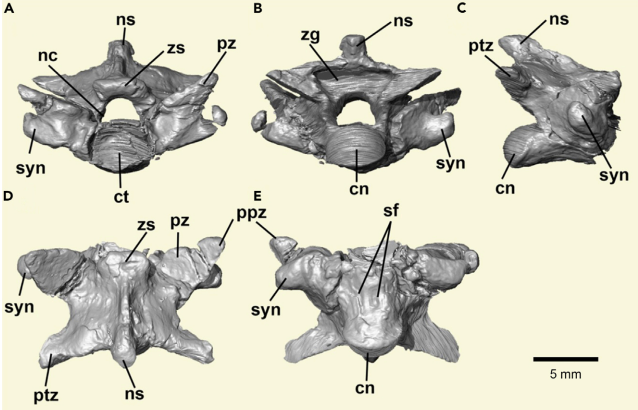
Three-Dimensional Reconstruction of Boipeba tayasuensis. (A)–(E) MPMA 16-0008-08, isolated precloacal vertebra in (A) anterior, (B) posterior, (C) lateral, (D) dorsal, and (E) ventral views. Abbreviations: Cn, condyle; ct., cotyle; nc, neural canal; ns., neural spine; ptz., postzygapophysis; ppz., prezygapophyseal accessory processes; pz., prezygapophysis.; sf., subcentral foramina; syn., synapophysis; zg, zygantrum; zs., zygosphene. Fachini et al. (2023).

Although the material assigned to Boipeba tayasuensis is extremely limited, it is entirely consistent with derivation from a Snake, and in particular a Blindsnake, showing no real similarity to any member of any other group. A phylogenetic analysis recovered the specimen as being firmly placed within the Scolecophidia, forming a sister group to the living Typhlopidae.

Boipeba and the Evolution of Snakes. (A) Phylogenetic relationships of the giant fossil Blindsnake Boipeba and other major snake lineages, based on Bayesian and parsimony analyses of morphology and DNA;  numbers at Blindsnake clade are Bayesian posterior and parsimony bootstrap support. Divergence dates for living Snakes are based on molecular dates; ; bold lines indicate stratigraphic range or uncertainty for fossil taxa. Quotes denote non-monophyletic taxon names. (B) Size distribution of all species for each major living Snakes lineage and important fossil taxa, on a log scale; note Boipeba is larger than living Blindsnakes. (C) Boipeba greatly increases the size estimate for the most recent common ancestor of living Blindsnakes. Fachini et al. (2023).

The vertebra of Boipeba tayasuensis has a centrum length of 6.8 mm, exceptionally large compared to that of most modern Blindsnakes, leading to an estimated total length of 110 cm. This is three and a half times the size of most living Typhlopoids, which are themselves among the largest Blindsnakes, although it would be a fairly average size for most modern Snake groups, as well as most known Mesozoic Snakes, suggesting that small size is a derived feature in modern Scolecophidians.

Life reconstruction of Boipeba tayasuensis. This large Cretaceous Blindsnake inhabited the arid palaeoenviroment of the Bauru Basin, Brazil, alongside Titanosaur Sauropods, Theropods, and terrestrial Crocodiles such as Montealtosuchus (Mesoeucrocodylia, Peirosauridae). The latter was found in the same outcrop as Boipeba. Jorge Blanco in Fachini et al. (2023).

Until the oldest known Blindsnakes come from the Palaeocene of Morocco and the Eocene of Europe, making Biopeba the oldest known, and the fisrt Mesozoic member of the group, as well as between 10 and 28 million years older than the next oldest known member of the group. A phylogenetic study recovered Biopeba as the sister taxon to the Family Typhlopoidea, which is consistent with molecular clock predictions that that group originated in the Cretaceous.

This in turn has biogeographical implications for the origin of the Typhlopoidea, suggesting that the group may have emerged in Western Gondwana (i.e. modern South America), instead of Eastern Gondwana (India or Madagascar) as previously theorised. The find also supports the younger of two possible origin dates for the Typhlopoidea, at about 122 million years ago in the Early Cretaceous, rather than about 150 million years ago, in the Late Jurassic.

Because Biopeba is recovered as more closely related to the Family Typhlopoidea than the Family Leptotyphlopidae, it also provides a minimum age for the divergence of these two groups.

Biopeba is a giant among Blindsnakes, but of fairly average size for most Snake groups, with the exception of the living Boas and Pythons, and some extinct stem group Snakes (i.e. Animals more closely related to living Snakes than to any other living group, but not decended from the last common ancestor of all living Snakes). This suggests that the small size of modern Blindsnakes is a derived character, and that the ancestors of the group were much larger Animals than had previously been theorized. In addition, small size appears likely to have apeared separately in the three major Blindsnake lineages. 

Large size is extremely rare in modern Blindsnakes, but may have been normal in Cretaceous members of the group. The small size of modern Blindsnakes may be a result of the End Cretaceous extinction, which smaller cryptic Animals had a better chance of surviving. It has been suggested that the earliest Snakes were small burrowing Animals, at least in part because the burrowing Blindsnakes are thought to be the earliest branching Snake group. However, the large size of Biopeba suggests that this extrapolation is false, and that the earliest Blindsnakes were more similar in size to other Snake groups, rather than the other way round.

See also...

Online courses in Palaeontology

Follow Sciency Thoughts on Facebook.

Follow Sciency Thoughts on Twitter.


Monday, 26 June 2023

Fireball meteor over southern Brazil.

Witnesses in Bahia, Distrito Federal, Espírito Santo, Goiás, Mato Grosso do Sul, Minas Gerais, Paraná, Rio de Janeiro and São Paulo states have reported observing a bright fireball meteor slightly before 6.40 pm local time (slightly before 9.40 pm GMT) on Monday 19 June 2023 (slightly before 6.00 am on Sunday 7 June, GMT). The fireball is described as having moved from northeast to southwest, entering the atmosphere over Minas Gerais State and disappearing over São Paulo. A fireball is defined as a meteor (shooting star) brighter than the planet Venus. These are typically caused by pieces of rock burning up in the atmosphere, but can be the result of man-made space-junk burning up on re-entry.  

The 19 June 2023 Brazilian fireball seen from Passos in Minas Gerais State. Denilson Silva/American Meteor Society.

Objects of this size probably enter the Earth's atmosphere several times a year, though unless they do so over populated areas they are unlikely to be noticed. They are officially described as fireballs if they produce a light brighter than the planet Venus. The brightness of a meteor is caused by friction with the Earth's atmosphere, which is typically far greater than that caused by simple falling, due to the initial trajectory of the object. Such objects typically eventually explode in an airburst called by the friction, causing them to vanish as an luminous object. However, this is not the end of the story as such explosions result in the production of a number of smaller objects, which fall to the ground under the influence of gravity (which does not cause the luminescence associated with friction-induced heating).

Heat map showing areas where sightings of the meteor were reported (warmer colours indicate more sightings)and the apparent path of the object (blue arrow). American Meteor Society.

These 'dark objects' do not continue along the path of the original bolide, but neither do they fall directly to the ground, but rather follow a course determined by the atmospheric currents (winds) through which the objects pass. Scientists are able to calculate potential trajectories for hypothetical dark objects derived from meteors using data from weather monitoring services.

See also...

Follow Sciency Thoughts on Facebook.

Follow Sciency Thoughts on Twitter.


Monday, 31 January 2022

Flooding and landslides kill at least 21 people in São Paulo State, Brazil.

Twenty one people are now known to have died and several more are missing amid heavy rains that have battered the Brazilian state of São Paulo since Friday 28 January 2022. Over 500 000 people have been displaced from their homes by flooding events, and at least 11 to have been killed in a series of landslides triggered by the rains. Landslides are a common problem after severe weather events, as excess pore water pressure can overcome cohesion in soil and sediments, allowing them to flow like liquids. Approximately 90% of all landslides are caused by heavy rainfall.

 
Flooding in the municipality of Franco da Rocha in São Paulo State, Brazil, on Sunday 30 January 2022. CNN.

Southern Brazil has a rainy season that lasts from Ocotober to March, with peak rains from mid-November to mid-January, however, this year's rains have been exceptionally strong. Brazil has suffered a string of flood-related disasters in recent years, most notably in 2011, when over 800 people died. The country has a rapidly growing population, with little effective urban planning, which has led to sprawling urban developments springing up with little thought to natural hazards, and in particular poorer neighbourhoods often expanding up unstable hillsides, with the result that when floods occur (which is not unusual) communities are often quickly overwhelmed. This years exceptional rains have led to more widespread flooding, which may also persist for longer, and there is a distinct danger that without determined action the death toll may exceed that of 2011. Such events are becoming increasingly common in Brazil, something which many climatologists are citing as direct evidence of global warming.

See also...


Follow Sciency Thoughts on Facebook.

Follow Sciency Thoughts on Twitter


Thursday, 30 December 2021

Pneumatisation in a nanoid Saltasaurid Titanosaur from the Upper Cretaceous of western São Paulo State, Brazil.

The Dinosaurs were (and are) and exceptionally diverse group of Animals, and developed a wide range of novel innovations over their long evolutionary history. One of these inovations was the pneumatisation of the post-cranial skeleton, a trait found in both Sauropods and Theropods (including the living Birds). In these Dinosaurs the axial skeleton is infiltrated by a system of diverticula (pouches) which derive from the lungs. Although the pneumatisation of  the post-cranial skeleton has been known about in non-Avian Dinosaurs for a long time, the phenomenon has not been widely studied, as traditionally the only way to do this was through the observation of macroscopic structures, which could not usually be observed without cutting into the bone, and which were not always preserved anyway. More recently, the advent of computed tomography has enabled the non-destructive study of a wider range of bones, and led to a better understanding of the distinctive bone histologies associated with pneumatisation.

In a paper published in the journal Scientific Reports on 17 December 2021, Tito Aureliano of the Laboratory of Paleontology and Paleohidrogeology at the University of Campinas, the Diversity, Ichnology and Osteohistology Laboratory at the University of Rio Grande do Norte, and the Laboratório de Paleoecologia e Paleoicnologia at the Federal University of São Carlos, Aline Ghilardi, also of the Diversity, Ichnology and Osteohistology Laboratory at the University of Rio Grande do Norte, Bruno Navarro, also of the Laboratório de Paleoecologia e Paleoicnologia at the Federal University of São Carlos, and of the Laboratório de Paleontologia and Museu de Zoologia at the University of Sao Paulo, Marcelo Fernandes, again of the Laboratório de Paleoecologia e Paleoicnologia at the Federal University of São Carlos, Fresia Ricardi‑Branco, also of the Laboratory of Paleontology and Paleohidrogeology at the University of Campinas, and Mathew Wedel of the College of Osteopathic Medicine of the Pacific and College of Podiatric Medicine at the Western University of Health Sciences, present the results of a study of a posterior dorsal vertebra from an adult Saltasaurid Titanosaur from the Upper Cretaceous São José do Rio Preto Formation of western São Paulo State, Brazil.

The specimen studied by Aureliano et al. (LPP-PV-0200) was collected by Marcelo and Luciana Fernandes at the 'Vaca morta' locality in Ibirá in western São Paulo State, and subsequently prepared by Aline Ghilardi. It is part of a skeleton which is currently in the process of being described as a new species of  'nanoid' Saltasaurid Titanosaur, with a total length of only 5.7 m, despite clearly being mature, and indeed apparently of advanced years. This specimen is one of the three members of the new species discovered, with one of the other specimens apparently suffering from pathologies associated with acute osteomyelitis and preserved phosphatized blood parasites inside the vascular canals.

 
Posterior dorsal vertebra of the Upper Cretaceous nanoid Saltasaurid LPP-PV-0200. Three-dimensional reconstruction from computed tomography scan in left lateral view (A). Circle and rectangle show sampling planes and the respective thin sections are in (B) and (C). Abbreviations: ce, centrum; ns, neural spine; pn, pneumatopore; poz, postzygaphophysis; prz, prezygapophysis. Scale bar in (A) 10 cm; in (B) and (C) 1 cm. Aureliano et al. (2021).

A three-dimensional vertebra was made using computed tomography. The internal structure of the bone proved to be well preserved, allowing assessment of most of the pneumatic structures. The centrum (disk) of the vertebra has an array of elongated parallel cavities extending dorsoventrally in anterior view and anteroposteriorly in lateral view. This creates a honeycomb of cavities within the bone, which is also present within the neural arch. The cavities within the centrum average 3.9 mm in width, those within the neural arch 4.8 mm.

 
Dorsal vertebra internal structures of LPP-PV-0200. Reconstructed tomography model in distal (A) and right lateral (B) views illustrating subvertical tangential computed tomography scan slices in false colour (1)–(9). Images show that only a few structures had survived diagenesis which restricted the assessment of the internal architecture to limited spaces. Lighter blue and green indicate lower densities (e.g., pneumatic cavities). Purple and darker blue demonstrate denser structures (e.g., camellate bone). Dashed lines indicate internal plates of bone that sustain radial camellae. Abbreviations: ce, centrum; cc, circumferential chambers; cml, camellae; hc-cml, ‘honeycomb’ camellae; ns, neural spine; pf, pneumatic foramen; pn, pneumatopore; pacdf, parapophyseal-centrodiapophyseal fossa; pocdf, postzygapophyseal-centrodiapophyseal fossa; rad, radial camellae. Aureliano et al. (2021).

The vertebra shows a complex arrangement of foramina, fossae, laminae, and camellate internal architecture, which in life would have housed a system of pulmonary diverticula, similar to the air sac system in extant Birds. These camellae are elongate within the central part of the centrum, but radially arranged close to the surface. As a similar arrangement has been seen in cervical vertebrae of the Titanosaurs Austroposeidon and Uberabatitan, Aureliano et al. assume that this pattern relates to the to the structural needs of the vertebral articulation surfaces, rather than the position of the vertebae within the spine or body. Plates of bony tisue separate the camellae from the concave surfaces of the centrum; this has also been seen in vertabrae of the Opisthocoelicaudiine Titanosaur Alamosaurus and the Saltasaurid Titanosaur Saltasaurus. Curiously, both LPP-PV-0200 and Alamosaurus have multiple bony plates, whereas Saltasaurus had one single plates, despite Saltasaurus and LPP-PV-0200 being more closely related to one-another than to Alamosaurus

Circumferential camellae are found around the margins of the centrum, and in particular close to the concave faces. This arrangement has previously been recorded in the Diplodocoid Sauropod Apatosaurus, but not in a specimen with as extensive a (preserved) camellae system as LPP-PV-0200. The basal Titanosaur Giraffatitan has a different structure, with the surface camellae becoming chaotically arranged closer to the concave surfaces, possibly suggesting that the situation seen in LPP-PV-0200 and Apatosaurus evolved convergently in Diplodocoids and Titanosaurs.

 
Dorsal vertebra centrum near the cotyle. Detail of internal structures of the Saltasaurid Titanosaur LPP-PV-0200 in (A)-(C) and comparison with Apatosaurus (OMNH 01094) in (E). Reconstructed tomography model in lateral view (D) illustrating computed tomography scan slices in false colour (A)–(C). Small circumferentially arranged chambers are present in LPP-PV-0200 near the cotyle. A similar condition has previously been documented in the camerate vertebra of Apatosaurus (E). Abbreviations: cc, circumferential chambers; cmr, radially arranged camerae. Scale bar 10 cm. Aureliano et al. (2021).

The high level of pneumatisation seen in LPP-PV-0200 has been reported in other Titanosaurs, and the suggestion has been made that this is related to the extreme size of some of these Animals. However, the presence of a similar level of pneumatisation in the dwarf LPP-PV-0200 suggests that whatever prompted the evolution of these chambers, they were not exclusively linked to large size.

See also...


Online courses in Palaeontology. 

Follow Sciency Thoughts on Facebook.

Follow Sciency Thoughts on Twitter.


Saturday, 20 June 2020

Psolidium lonchostinum & Psolidium nanoplax: Two new species of Sea Cucumbers from the Brazilian Coast.

Sea Cucumbers (Holothuroidea) are a class of Echinoderms that have become elongated and worm-like, effectively becoming secondarily bilaterally symmetrical. Like all Echinoderms they have a calcareous exoskeleton, but this is greatly reduced, typically only occurring as ossicles within the epidermis. The muscle structure of Sea Cucumbers is instead supported by a layer of modified collegen that can be stiffened or relaxed at will, allowing for a more flexible body than that of other Echinoderms. The Holothuroidea fauna from the Brazilian coast is still poorly know, but efforts over the last 18 years have improved our knowledge of the Hlothuroid biodiversity.

In a paper published in the journal Zoological Studies on 4 February 2020, Luciana Martins and Marcos Tavares of the Museu de Zoologia at the Universidade de São Paulo, describe two new species of the Holothuroid genus Psolidium from São Paulo and Rio Grande do Sul. This is the first record of the genus from the Brazilian coast.

The first new species is named Psolidium lonchostinum, where 'lonchostinum' is formed by the combination of two Greek words, lonche (spear) and ostinos (bony, Latinized to ostinum), and refers to the thorn-shaped ossicles (branched rods) found in the sole. The species is described from sixteen specimens collected with the aid of a Van Veen grab and a rectangular dredge from infaunal assemblages off the coast of São Paulo.

(A)–(F) Psolidium lonchostinum. (A)–(D) Holotype (MZUSP 744). (A) upper view; (B) detail of dorsal tube feet (black arrow); (C) detail of lateral scales (white arrow); (D) ventral view; detail of ambulacral feet (note the inner and outer rows of tube feet: black and white circles, respectively); (E) paratype (MZUSP 591) detail of ventral tube feet (black arrow); (F) outline of the calcareous ring. Abbreviations: R, radial plate; IR, interradial plate. Note in (F) interradial plate entire and radial plate notched. Scale bars: (A) 4 mm; (D) 2 mm; (E) 3 mm; (F) 500 μm. Martins & Tavares (2020).

The body of Psolidium lonchostinum is flat, oval in outline, 6–8.3 mm long and 4–5.9 mm wide. The mouth and anus covered by a variable number of small and irregular scales (0.8–1 mm wide), up to two tube feet penetrate each scale dorsally and laterally. The species lacks oral and anal valves.

The marginal dorsolateral scales are 0.1–0.3 mm, smaller than the dorsal scales.The species has a thin sole, lacking scales, tube feet arranged in a double series: inner series of large tube feet and outer peripheral series of smaller tube feet close to the ventral margin, which lacks mid-ventral (sole) radial series of tube feet, except for a cluster (up to 5) posteriorly and anteriorly. The calcareous ring is simple, lacking posterior processes; radial and interradial plates united only at the base, notched only at the radial plate.

Dorsal/lateral ossicles are smooth and perforated plates, irregular in outline, with undulating margins (100–120 μm long) and round holes (5–20 μm in diameter) and branched rods (thorn ossicles) (40–60 μm long). Dorsal tube feet with perforated rods (70–130 μm long), with undulating in margins.

(A)–(F) Psolidium lonchostinum, holotype (MZUSP 744). Scanning electron microscope photomicrographs of the ossicles. (A) scale from dorsal body wall, showing canals for tube feet (white arrow); (B) smooth plate from dorsal body; (C) branched rods (thorn ossicle) (black arrow); (D) rod from dorsal tube feet; (E)–(F) knobbed plates from sole. Scale bars: (A)–(B) 50 μm; (C) 40 μm; (D)–(F) 50 μm. Martins & Tavares (2020).

The sole of Psolidium lonchostinum is covered with single-layered and elongated plates (130–150 μm long), perforated at their entire length and knobbed at center and margins, and smooth plates slightly knobbed in the margin (70–100 μm long). Ventral tube feet with perforated rods with irregular, curved and undulating margins (80–160 μm long) and an end-plate.

(A)–(F) Psolidium lonchostinum, holotype (MZUSP 744). Scanning electron microscope photomicrographs of the ossicles. (A) four-holed smooth plate from sole, ventral view; (B) four-holed smooth plate from sole, dorsal view; (C)–(D) multiperforated smooth plate from sole, dorsal view; (E) four-holed smooth plate from sole, lateral view; (F) rod from ventral tube feet, dorsal view. Scale bars: (A)–(B) 30 μm; (C) 40 μm; (D)–(E) 50 μm; (F) 80 μm. Martins & Tavares (2020).

The second species is named Psolidium nanoplax, where 'nanoplax' is formed by the Greek words, nano (little) and plax (plate), in reference to the reduced length of the sole plates. The species is described from two specimens collected from the offshore part of the Campos Basin of southeastern Brazil, with the aid of an ELOS dredge.

(A)–(F) Psolidium nanoplax (MZUSP 589, 592). (A) Lateral view of holotype preserved in ethanol (note anal cone in white arrow); (B) upper view of paratype-MZUSP 592 preserved in ethanol (note mouth and anus in black and red arrows, respectively); (C) detail of anal cone holotype-MZUSP 592 (note anal cone and papillae, in white and red arrows, respectively); (D) detail of dorsal tube feet holotype-MZUSP 592 (red arrow); (E) detail of lateral scales paratype-MZUSP 592; (F) ventral view detail of ambulacral feet paratype-MZUSP 592, (note the inner and outer rows of tube feet: black and white arrows, respectively); (G) calcareous ring (H) detail of retractor muscle (white arrow) and (I) outline of the calcareous ring paratype-MZUSP 592. Abbreviations: R, radial plate; IR, interradial plate. Note, only radial plate notched. Scale bars: (A) 5 mm; (B) 4 mm; (C) 500 μm, (D) 500 μm, (E) 0.5 mm; (F) 2 mm; (G)–(I) 500 μm. Martins & Tavares (2020).

The body of the first of the specimens was elongate, reaching 11 mm, the smaller was ventrally and dorsally flattened and measured 8 mm. Ths mouth and anus lack valves, the anal cone is slightly raised. The dorsal and lateral body are covered with conspicuous imbricating scales (0.8–1 mm) and without granules or tubercles at the surface. One inconspicuous tube foot is present at each scale. The marginal dorsolateral scales smaller than dorsal scales (0.1–0.3 mm). Ventral sole lacking scales, tube feet arranged in a double series: inner series of large tube feet and outer peripheral series of smaller tube feet close to ventral margin, mid-ventral tube feet absent. Calcareous ring simple, lacking posterior processes, radial and interradial plates united only at the base; radial plate notched.

The dorso-lateral ossicles are knobbed and multiperforated single plates, flat, oval in outline, heavily knobbed on one side, smooth on the other surface, knobbed edges (150–170 μm long) and rounded holes 10–20 μm in diameter.

(A)–(I) Psolidium nanoplax (MZUSP 589). Scanning electron microscope photomicrographs of the ossicles. (A) knobbed plate from dorsal body (B) supporting rod from dorsal tube feet; (C) 'cup-like' plates from sole in dorsal view; (D) 'cup-like' multiperforated plates from sole in ventral view; (E) 'cup-like' four-holed plates from sole in dorsal view; (F) 'cup-like' plates from sole in lateral view (G) knobbed plates from sole and (H)–(I) knobbed plates from ventral tube feet. Scale bars: (A)–(B) 50 μm; (C) 20 μm; (D)–(I) 30 μm. Martins & Travares (2020).

The sole is covered with with knobbed and multiperforated single plates, strongly concave, oval in outline, heavily knobbed on one side, smooth on the other surface, knobbed edges (70–100 μm long), and round holes 15–20 μm in diameter and 'cup-like' multiperforated plates, concave, oval in outline (50–70 μm long) 10–15 μm in diameter. 

Dorsal tube feet with supporting rods, curved with one central perforation and one central apophysis (80–150 μm). Ventral tube feet with knobbed and multiperforated plates.

See also...

https://sciencythoughts.blogspot.com/2019/07/sollasina-cthulhu-new-species-of.htmlhttps://sciencythoughts.blogspot.com/2019/01/epitomapta-simentalae-new-species-of.html
https://sciencythoughts.blogspot.com/2019/01/diadema-setosum-invasive-alien-sea.htmlhttps://sciencythoughts.blogspot.com/2019/01/understanding-how-carbon-from-kelp.html
https://sciencythoughts.blogspot.com/2018/12/linguaserra-triassica-new-species-of.htmlhttps://sciencythoughts.blogspot.com/2012/12/a-new-species-of-sea-cucumber-from.html
Follow Sciency Thoughts on Facebook.

Wednesday, 4 March 2020

Landslides kill at least 24 in Brazil.

At least twenty four people have died in a series of landslips in the Brazilian states of São Paulo and Rio de Janeiro on Tuesday 3 March 2020. The incidents were triggered by a large storm hitting the coastal areas of the two states, brining with it 280 mm of rain in just 12 hours. Landslides are a common problem after severe weather events, as excess pore water pressure can overcome cohesion in soil and sediments, allowing them to flow like liquids. Approximately 90% of all landslides are caused by heavy rainfall. As well as the known fatalities at least 30 people are missing and several hundred have been displaced from their homes, making it likely that the number of fatalities will rise. The majority of the deaths occurred in São Paulo State, where nineteen people have died, including a mother and her child who became trapped beneath the rubble of their home following a landslide, and two firefighters who were killed when a second landslip hit the same area as they were trying to rescue them. A further five fatalities have been recorded in Rio de Janeiro State.

House displaced from its foundations by a landslide in the municipality of Guarujá in São Paulo State, Brazil, on 3 March 2020. AFP/Getty Images.

Southern Brazil has a rainy season that lasts from Ocotober to March, with peak rains from mid-November to mid-January, however, this year's rains have been exceptionally strong. Brazil has suffered a string of flood-related disasters in recent years, most notably in 2011, when over 800 people died. The country has a rapidly growing population, with little effective urban planning, which has led to sprawling urban developments springing up with little thought to natural hazards, and in particular poorer neighborhoods often expanding up unstable hillsides, with the result that when floods occur (which is not unusual) communities are often quickly overwhelmed. This years exceptional rains have led to more widespread flooding, which may also persist for longer, and there is a distinct danger that without determined action the death toll may exceed that of 2011.

 The aftermath of a landslide in the  Baixada Santista Metropolitan Area of  São Paulo State, Brazil, on 3 March 2020. São Paulo Civil Defense.

This extreme weather may be linked to an El Niño wearther system over the Pacific Ocean. The El Niño is the warm phase of a long-term climatic oscillation affecting the southern Pacific, which can influence the climate around the world. The onset of El Niño conditions is marked by a sharp rise in temperature and pressure over the southern Indian Ocean, which then moves eastward over the southern Pacific. This pulls rainfall with it, leading to higher rainfall over the Pacific and lower rainfall over South Asia. This reduced rainfall during the already hot and dry summer leads to soaring temperatures in southern Asia, followed by a rise in rainfall that often causes flooding in the Americas and sometimes Africa. Worryingly climatic predictions for the next century suggest that global warming could lead to more frequent and severe El Niño conditions, extreme weather conditions a common occurrence.
 
 
Movements of air masses and changes in precipitation in an El Niño weather system. Fiona Martin/NOAA.
 
See also...

https://sciencythoughts.blogspot.com/2020/03/understanding-nature-of-exceptional.htmlhttps://sciencythoughts.blogspot.com/2020/01/landslides-and-flash-floods-kill-at.html
https://sciencythoughts.blogspot.com/2019/08/international-community-begins-to-send.htmlhttps://sciencythoughts.blogspot.com/2019/01/hundreds-feared-dead-after-collapse-of.html
https://sciencythoughts.blogspot.com/2018/11/landslide-kills-at-least-ten-in-rio-de.htmlhttps://sciencythoughts.blogspot.com/2018/03/yellow-fever-outbreak-kills-237-in.html
Follow Sciency Thoughts on Facebook.