Showing posts with label Snakes. Show all posts

Monday, 29 June 2026

Trachischium lalremsangai: A new species of Worm-eating Snake from Mizoram State, India, and Chin State, Myanmar.

Members of the Natricid Snake genus Trachischium are commonly known as Slender Snakes or Worm-eating Snakes. They are fossorial in nature (live underground in burrows) and are distributed in the montane forests of India, Nepal, Bhutan, China, Myanmar, and Bangladesh, typically at altitudes of between 800 and 2500 m above sealevel. Their lifestyle and habitat makes studying (or indeed finding) them difficult, and they are subsequently one of the least well known groups of Snakes. The genus Trachischium currently contains ten species, including two which were previously assigned to the genus Blythia; the two genera having been merged in 2024 on the basis that their defining criteria overlapped.

In a paper published in the journal Herpetozoa on 19 May 2026, Virender Bhardwaj, Amit Bal, and Chhangte Tluanga of the Developmental Biology and Herpetology Laboratory at Mizoram University, and Zeeshan Mirza of the Max Planck Institute for Biology, describe a new species of Trachischium from Mizoram State, India, and Chin State, Myanmar.

The new species is described on the basis of a specimen collected by Bhardwaj et al. in the Murlen National Park in 2025. A second specimen, which was collected in Chin State, Myanmar, in 2003, and now sits in the collection of the California Academy of Sciences, where it has been classified as Blythia reticulata (a species currently reassigned to Trachischium as Trachischium reticulata) on the basis of a scale pattern and colouration which matches the new species, but is atypical for Trachischium reticulata

Bhardwaj et al. name the new species Trachischium lalremsanga, in honour of Hmar Tlawmte Lalremsanga of Mizoram University for his contributions to herpetology in Northeast India, his guidance to numerous students, and his facilitation of research throughout the region and the Indo-Burma Biodiversity Hotspot. The species is described from two specimens, both male, one 409 mm in length and the other 506 mm, which makes it one of the larger species of Worm-eating Snakes. The dorsal surface of these Snakes is dark brown with a lustrous blue iridescence throughout, the front quarter of the ventral surface is a creamy white, the remainder brown with white speckles.

Trachischium lalremsangai, holotype male, MZMU 3757, in life. Bhardwaj et al. (2026).

The specimen Bhardwaj et al. collected was found moving along a road, close to the village of Murlen on the fringe of the Murlen National Park, 1560 m above sealevel, at about 9.30 in the evening, and shortly before a period of rain. This area forms part of the India-Burma Biodiversity Hotspot, and contains a mixture of tropical, semi-evergreen, and montane forests, with a dense canopy cover. Annual rainfall varies between about 2500 mm and about 3000 m, and the temperature varies between about 5°C in the winter and about 35°C in the winter. The area where the Snake was found has a diverse vegetation, including Oaks, Quercus spp., Needlewood, Schima wallichii, Birches, Betula spp., Champak, Michelia champaca, Khasi Pines, Pinus khasiana, Cherries, Prunus spp., Bayberry, Myrica spp., Rhododendrons, Rhododendron spp., dense stands of Thorny Bamboo, Arundinaria callosa, Cane Grasses, and a rich array of Orchids. The specimen collected in Myanmar was found at a site about 90 km away in a straight line, with a similar environment. Based upon this, Bhardwaj et al. estimate that the species may be present across northeast Mizoram and adjoining Manipur in India, as well as within the similar elevation realms of the Chin Hills.

The phylogeny of the genus Trachischium is still somewhat uncertain, and in need of thorough revision. Many species are described from single specimens, with only vague locations recorded. The genus is found from Jammu and Kashmir in the west to Arunachal Pradesh in the east, south as far as northern Myanmar and north as far as Tibet. At least one widely distributed species, Trachischium fuscum, is likely to be a species complex (group of closely related, yet reproductively isolated, and similar-appearing species). The genus Blythia was incorporated into the genus Trachischium as a junior synonym in 2024, yet this group of Snakes remain distinctive in appearance and this may be revised again; it is to this Blythia-group that the new species, Trachischium lalremsanga, belongs. Genetic data is available for only a single specimen of many species.

With this in mind, Bhardwaj et al. carried out a phylogenetic analysis for Trachischium lalremsanga using the mitochondrial 16S rRNA and cytochrome b genes and the nuclear oocyte maturation factor mos and recombination activating gene 1 genes, and comparing these to publicly available sequences from the GenBank database. 

This analysis found that the genus Trachischium can be split into three distinct subgroupings, which Bhardwaj et al. refer to as Clade 1, Clade 2 (which corresponds to the Blythia-group), and Clade 3. Clade 2 and Clade 3 are more closely related to one-another than either is to Clade 1, which forms an outgroup, so while Clade 2 could potentially be taken out of the genus Trachischium and returned to its original name, this would also require the renaming of Clade 3, with the designation Trachischium limited to Clade 1, which contains the type species for the genus, Trachischium fuscum (a type species is the species which defines a genus; other species are determined to belong or not belong to the genus on the basis of how closely they are related to that genus).

Maximum likelihood phylogeny based on concatenated two nuclear (c-mos and RAG-1) and two mitochondrial (16S and cyt b) genes of selected Natricine Snakes showing relationships within the genera Trachischium and Blythia. Numbers at nodes show maximum likelihood clade support. The new species from Murlen National Park is highlighted in red text. Bhardwaj et al. (2026).

See also...


Monday, 1 January 2024

Assessing the impact of predation on birth size in marine Snakes.

Moving from one environment to another exposes organisms to new selective pressures on life histories, and where multiple organisms from related lineages make the same transition, it presents an opportunity for biologists to analyse these pressures. For example, Squamates (Snakes and Lizards) which migrate from warm environments to cooler ones frequently switch from egg-laying to bearing live young, while Birds making the same transition tend to produce smaller clutches of eggs.

Birth size is considered to be a fundamental life-history trait, subject to a number of evolutionary pressures. Where intraspecific competition is low, smaller birth sizes are often a result, as offspring survival is not dependent on size at birth. Conversely, larger birth size can be driven by a number of factors, for example a lack of small prey can drive up birth size in species where the young must hunt for themselves, as only larger neonates are able to capture enough prey to survive. 

The shift from a terrestrial habitat to a marine one presents organisms with a variety of different challenges, including thermal regimes, oxygen availability, light levels, ocean currents, types of predators, prey, competitors and pathogens. Nevertheless, the marine environment clearly presents opportunities for terrestrial Tetrapods, with numerous lineages of Mammals, Reptiles, and even Birds having made the transition. Elapid (Front-fanged) Snakes have made this transition at least three times, with the Sea Kraits, Laticaudinae, having split from terrestrial relatives in Asia about 16 million years ago, while at least two lineages within the Australian subfamily Hydrophiinae (together referred to as Sea Snakes) switched to a marine habit more recently. The three lineages show convergent evolution for a number of traits, including the development of laterally compressed bodies with paddle-like tails, the appearance of salt-excreting glands, and common life-history traits. A fourth group of (non-Elapid) Snakes, the Acrochordidae, are semi-aquatic, and often semi-marine in habit, and show some of these traits.

Marine Snakes typically produce fewer young than terrestrial Snakes, which has been linked to a need for gravid females to retain a hydrodynamic shape. Nevertheless, the offspring are typically larger at birth than those of their terrestrial relatives, which would seem to work against this.

In a paper published in the journal Royal Society Open Science on 13 December 2023, Richard Shine of the School of Natural Sciences at Macquarie UniversityShai Meiri of the School of Zoology and Steinhardt Museum of Natural History at Tel-Aviv University, Terri Shine and Gregory Brown, also of the School of Natural Sciences at Macquarie University, and Claire Goiran of LabEx Corail and  Institut de sciences exactes et appliquées at the Université de la Nouvelle-Calédonie, examine the possibility that size-selective predation on young Snakes could be the driver of increased neonatal size in Marine Snakes.

Smaller terrestrial Snakes are known to be vulnerable to a wider range of predators than larger Snakes, with many predators targeting smaller Snakes while actively avoiding larger ones. However, predation rates on smaller Snakes can be lower than on larger individuals, due to the ability of small Snakes to remain inactive in well-hidden retreats.

Marine Snakes are less able to do this, as they must ascend to the surface to breath. This means that Snakes must leave their protective shelters and cross open water, where they are vulnerable to predation, several times per day. Predation of Snakes by large Fish during these crossings is well-documented, supporting the hypothesis that this is a risky endeavour for marine Snakes.

In order to test the hypothesis, Shine et al. first examined records of birth sizes in both marine and terrestrial Snakes, to confirm that the perceived trend was in fact real, then carried out experimental trials with model Snakes of different sizes to see if smaller Snakes were in fact more vulnerable to predation.

Shine et al. obtained data on hatchling and neonate sizes (Snakes can lay eggs or bear live young, but this does not appear to affect infant size much) and snout-vent lengths of adult females of 166 species of terrestrial, semi-aquatic, and marine Snakes, from published literature and the collection of the Steinhardt Museum. Semi-aquatic Snakes were found to produce slightly smaller offspring than terrestrial Snakes on average. However, the sample size for these Snakes was very small, and the subject was not investigated further. The adult snout-vent length for female Snakes in the study averaged at 800 mm, with the offspring of terrestrial Snakes having an average length of 200 mm, and the average length of new-born marine Snakes being 300 mm. 

Based upon this, Shine et al. hypothesised that a 200 mm Snake would be at significantly higher risk of predation in a typical marine Snake environment than a 300 mm Snake. To test this, an experiment was devised in which commercially available fibreglass fishing lures designed to resemble Snakes had their hooks removed and additional weights added to ensure they retained negative buoyancy, and were painted black to resemble the most common colour morph of the locally abundant Turtlehead Sea Snake, Emydocephalus  annulatus. These were then dragged by a snorkeler, Claire Goiran, over Coral reefs off the island of Ile aux Canards in New Caledonia, while a second snorkeler, Richard Shine, followed and recorded the reaction of large predatory Fish to the lures. 

A Camouflage Grouper, Epinephelus polyphekadion, following a black Snake-shaped lure, immediately prior to launching an attack. Teri Shine in Shine et al. (2023).

During 47 trials, Shine et al. recorded 114 responses. These included 38 attacks, and 76 encounters in which Fish followed the lure but did not attack. The size of the lure did not appear to influence whether or not Fish followed it, but they were significantly more likely to attack the smaller lures. Similarly, larger Fish were more likely to attack the lures, while smaller Fish tended to break off following without attacking. Thus, the majority of attacks were by large Fish on small lures.

Multiple lineages of Snakes which have invaded marine habitats have had an increase in neonatal size, combined with a reduced brood size (which are probably connected). Shine et al.'s study suggests that increased predation on smaller Snakes is a plausible explanation for this (although they stress that the results of their study cannot be taken as an absolute proof).

Shine et al. also note that larger Snakes are more likely to survive attacks by Fish, noting that two incidents of Snakes being seized by Fish and then released because the Fish was unable to overpower the Snake have been recorded on reefs close to their study area. In one of these incidents a Chocolate Grouper, Cephalopholis  boenak, unsuccessfully attacked a Turtlehead Sea Snake, Emydocephalus  annulatus, and in the other a Reef Stonefish, Synanceia verrucosa, was forced to break off an attack on a Blue Lipped Sea Krait, Laticauda  laticaudata, suggesting that larger size may present an advantage to young Snakes in surviving attacks, even if Fish do not discriminate against larger Snakes when choosing whether to attack.

Reef Stonefish, Synanceia verrucosa, making an unsuccessful attack on a Blue Lipped Sea Krait, Laticauda  laticaudata, off the coast of Ile aux Canards in October 2022. Richard Fish/iNaturalist.

Predation is often cited as a likely cause of evolutionary pressure, influencing traits such as size and colouration. However, direct evidence of such impacts is difficult to gather accurate information on this unless predation rates are extremely high. Furthermore, it is difficult to design experiments looking at predatory behaviour for larger Animals without running into ethical and logistical constraints.

Predation is not the only driver of larger size in young marine Snakes which has been made, but it does seem to be the best supported by the available evidence. 

It has been suggested that larger size may provide an advantage when swimming, with smaller Snakes potentially being less efficient swimmers, using more energy to go slower. However, research into Sea Kraits has shown that smaller individuals have a higher swimming speed relative to crawling speed than larger individuals, suggesting that in these marine Snakes smaller size produces an advantage when swimming. 

Another possibility is that larger size in neonatal marine Snakes might be driven by prey size, with a shortage of suitable prey capturable by smaller Snakes creating a need for infant Snakes to be as large as possible. However, many Sea Snakes feed on smaller prey, notably members of the genus Emydocephalus are specialist feeders on Fish eggs, and several members of the genus Hydrophis have miniaturized heads and slender forebodies that enable them to penetrate the burrows of the small Fish upon which they prey.

Another possibility is that intraspecific competition drives larger size in young marine Snakes, with larger individuals excluding smaller individuals from better territories or access to prey. However, aggressive behaviour between members of the same species has never been observed in marine Snakes, making this unlikely.

Finally, larger size can act as a buffer against temperature changes, with larger bodies taking longer to either warm up or cool down that smaller bodies, thereby giving the Snakes more time to react to changes in conditions. However, marine environments offer much more protection against such temperature fluctuations than terrestrial ones, due to the high conductivity of water, making this highly unlikely as a driver of size in marine Snakes.

See also...

Follow Sciency Thoughts on Facebook.

Follow Sciency Thoughts on Twitter.


Saturday, 30 December 2023

Trimeresurus ayeyarwadyensis: A new species of Mangrove Pit Viper from the Ayeyarwady and Yangon regions in Myanmar.

The taxonomy of the Asian Pit Viper genus Trimeresurus have proved difficult to unravel, as species tend to be both similar to one-another and morphologically variable. The Mangrove Pit Vipers, Trimeresurus purpureomaculatus and Trimeresurus erythrurus are considered to form a species complex, with Trimeresurus purpureomaculatus being an obligate Mangrove-inhabitant with variable colouration and dark blotches on its back, found in southern Thailand, Peninsula Malaysia, and on the island of Sumatra, while Trimeresurus erythrurus is a green Snake lacking markings, found in but not restricted to Mangroves, found in northern Myanmar, and eastern Bangladesh and India. Between these, in southern Myanmar, is a population of Snakes which show a mixture of traits seen in the other two groups, which have been assumed to represent a zone of hybridization. However, a recent study of genetic structures within the group has suggested that this southern Myanmar population is actually a separate species, which forms a sister taxon to Trimeresurus purpureomaculatus, although this species does show signs of hybridizing with Trimeresurus erythrurus.

In a paper published in the journal ZooKeys on 13 December 2023, Kin Onn Chan of the Lee Kong Chian Natural History Museum at the National University of Singapore, and the School of Biological Sciences at the Universiti Sains MalaysiaShahrul Anuar, also of the School of Biological Sciences at the Universiti Sains Malaysia, Ananthanarayanan Sankar of the Herpetological Society of Singapore, and the Department of Biological Sciences at the National University of Singapore, Ingg Thong Law and Ing Sind Law, also of the Herpetological Society of Singapore, Rasu Shivaram, also of the Lee Kong Chian Natural History Museum at the National University of Singapore, and of the Herpetological Society of Singapore, Ching Christian, again of the Herpetological Society of Singapore, and of the Department of Life Sciences at the Natural History MuseumDaniel Mulcahy of the Museum für Naturkunde at the Leibniz Institute for Evolution and Biodiversity Science, and Anita Malhotra of the School of Natural Sciences at Bangor University, formally describe the southern Myanmar Trimeresurus population as a new species. 

The new species is named Trimeresurus ayeyarwadyensis, meaning 'from Ayeyarwady'; the species is known from the Ayeyarwady and Yangon regions on the Ayeyarwady delta in southern Myanmar. The species has partially fused first infralabial and nasal scales, a condition not seen in any other member of the genus Trimeresurus, but otherwise shows a mosaic of traits seen in other species.

An unvouchered, live specimen of Trimeresurus ayeyarwadyensis from the Yangon Region, Myanmar. Wolfgang Wüster in Chan et al. (2023).

Unhybridized populations of Trimeresurus ayeyarwadyensis were found in Mangrove forests in the Pyapon and Myaungmya districts of the Ayeyarwady Region, as well as in a forest surrounding a lake unconnected to any Mangrove system in the Hlawga Park in the Yangon Region. In the Pathein District of the Ayeyarwady Region a population of Trimeresurus ayeyarwadyensis hybridized with Trimeresurus erythrurus was found living alongside an unhybridized population of Trimeresurus erythrurusTrimeresurus purpureomaculatus is known from the Dawei District in the Tanintharyi Region of Myanmar, and could potentially have a contact zone with Trimeresurus ayeyarwadyensis in Mon State, where no members of the genus Trimeresurus have been recorded, but this is thought likely to be due to a lack of searching rather than an absence of Snakes.

See also...

Follow Sciency Thoughts on Facebook.

Follow Sciency Thoughts on Twitter.


Friday, 15 December 2023

Boipeba tayasuensis: An exceptionally large Blindsnake from the Late Cretaceous of Brazil.

Snakes are one of the most successful groups of terrestrial Vertebrates, with over 3800 described extant species. Of these, about 620 are Blindsnakes, Scolecophidia, small, worm-like Snakes with reduced eyes covered by scales, subterminal mouths, and blunt snouts and tails which can make it hard to determine which end is the front. These Snakes are interesting taxonomically, as they retain more Lizard-like features than other Snakes, as well as having a set of derived adaptations for a burrowing environment all their own, which has led to the conclusion that they are the earliest-branching group of extant Snakes, something which has been supported by genetic analysis. However, if this is the case, then Blindsnakes should have appeared in the Late Jurassic or Early Cretaceous, whereas the oldest known fossils assigned to the group come from the Late Palaeocene of Morocco and Early Eocene of Europe.

In a paper published in the journal iScience on 19 November 2023, Thiago Schineider Fachini of the Laboratório de Paleontologia at the Universidade de São Paulo, Silvio Onary, also of the Laboratório de Paleontologia at the Universidade de São Paulo, and of the College of Science and Engineering at Flinders University, and the South Australian MuseumAlessandro Palci and Michael Lee, also of the College of Science and Engineering at Flinders University, and the South Australian Museum, Mario Bronzati of the Laboratório de Evolução e Biologia Integrativa at the Universidade de São Paulo, and  Annie Schmaltz Hsiou, again of the Laboratório de Paleontologia at the Universidade de São Paulo, describe a new species of Blindsnake from the Late Cretaceous  Adamantina Formation of São Paulo State, Brazil.

The new species is named Boipeba tayasuensis, where 'Boipeba' means 'flat Snake' in the Tupi-Guarani language of Brazil, and 'tayasuensis' means 'from Taiaçu' in reference to the location where the specimen was found. The new species is described on the basis of an isolated vertebra articulated with the anterior region of a fragmentary following vertebra, from a fossiliferous outcrop of the Adamantina Formation beside a rural road between the municipalities of Monte Alto and Taiaçu, in the Northwest of the state of São Paulo, Brazil. The Adamantia Formation here has not been precisely dated, but a maximum age of 87.8 million years has been established based upon of uranium-lead dating (uranium-lead dating can give absolute dates for igneous rocks, but only maximum age dates for sedimentary deposits containing derived materials), and the overlying Marília Formation contains Dinosaur bones, indicating that it was laid down before the End Cretaceous Extinction Event.

Holotype of Boipeba tayasuensis. (A) MPMA 16-0008-08, Isolated precloacal vertebra in (upper row) anterior, posterior, and lateral views, respectively, and (lower row) dorsal, and ventral views, respectively. (B) Geographical and geological map showing the type locality where the fossil material was recovered. Abbreviations: cn., condyle; ct., cotyle; ns., neural spine; ptz., postzygapophysis; ppz., prezygapophyseal accessory processes; pz., prezygapophysis.; sf., subcentral foramina; sy., synapophysis; zs., zygosphene. Fachini et al. (2023).

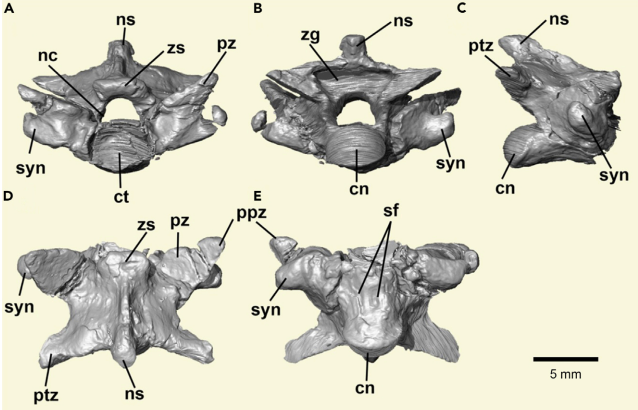
The specimen shows a number of features that are known only in members of the crown group Scolecophidia (the crown group comprises everything descended from the last common ancestor of all living members of a group). These include  (1) dorsoventrally flattened vertebra, (2) absence of median notch in the posterior border of the neural arch, (3) narrow and cylindrical centrum, (4) absence of hemal keel and/or median ventral prominence between the cotyle and condyle, (5) presence of asymmetrical subcentral foramina, (6) weakly developed precondylar constriction, (7) cotyle and condyle oval in anteroposterior view, (8) the presence of well-developed prezygapophyseal processes, and (9) undivided synapophyses with no distinction between the para- and diapophyseal articular facets. Furthermore, the specimen has synapophyses located dorsal to the ventral margin of the cotyle, a feature seen only in members of the Family Typhlopidae.

Three-Dimensional Reconstruction of Boipeba tayasuensis. (A)–(E) MPMA 16-0008-08, isolated precloacal vertebra in (A) anterior, (B) posterior, (C) lateral, (D) dorsal, and (E) ventral views. Abbreviations: Cn, condyle; ct., cotyle; nc, neural canal; ns., neural spine; ptz., postzygapophysis; ppz., prezygapophyseal accessory processes; pz., prezygapophysis.; sf., subcentral foramina; syn., synapophysis; zg, zygantrum; zs., zygosphene. Fachini et al. (2023).

Although the material assigned to Boipeba tayasuensis is extremely limited, it is entirely consistent with derivation from a Snake, and in particular a Blindsnake, showing no real similarity to any member of any other group. A phylogenetic analysis recovered the specimen as being firmly placed within the Scolecophidia, forming a sister group to the living Typhlopidae.

Boipeba and the Evolution of Snakes. (A) Phylogenetic relationships of the giant fossil Blindsnake Boipeba and other major snake lineages, based on Bayesian and parsimony analyses of morphology and DNA;  numbers at Blindsnake clade are Bayesian posterior and parsimony bootstrap support. Divergence dates for living Snakes are based on molecular dates; ; bold lines indicate stratigraphic range or uncertainty for fossil taxa. Quotes denote non-monophyletic taxon names. (B) Size distribution of all species for each major living Snakes lineage and important fossil taxa, on a log scale; note Boipeba is larger than living Blindsnakes. (C) Boipeba greatly increases the size estimate for the most recent common ancestor of living Blindsnakes. Fachini et al. (2023).

The vertebra of Boipeba tayasuensis has a centrum length of 6.8 mm, exceptionally large compared to that of most modern Blindsnakes, leading to an estimated total length of 110 cm. This is three and a half times the size of most living Typhlopoids, which are themselves among the largest Blindsnakes, although it would be a fairly average size for most modern Snake groups, as well as most known Mesozoic Snakes, suggesting that small size is a derived feature in modern Scolecophidians.

Life reconstruction of Boipeba tayasuensis. This large Cretaceous Blindsnake inhabited the arid palaeoenviroment of the Bauru Basin, Brazil, alongside Titanosaur Sauropods, Theropods, and terrestrial Crocodiles such as Montealtosuchus (Mesoeucrocodylia, Peirosauridae). The latter was found in the same outcrop as Boipeba. Jorge Blanco in Fachini et al. (2023).

Until the oldest known Blindsnakes come from the Palaeocene of Morocco and the Eocene of Europe, making Biopeba the oldest known, and the fisrt Mesozoic member of the group, as well as between 10 and 28 million years older than the next oldest known member of the group. A phylogenetic study recovered Biopeba as the sister taxon to the Family Typhlopoidea, which is consistent with molecular clock predictions that that group originated in the Cretaceous.

This in turn has biogeographical implications for the origin of the Typhlopoidea, suggesting that the group may have emerged in Western Gondwana (i.e. modern South America), instead of Eastern Gondwana (India or Madagascar) as previously theorised. The find also supports the younger of two possible origin dates for the Typhlopoidea, at about 122 million years ago in the Early Cretaceous, rather than about 150 million years ago, in the Late Jurassic.

Because Biopeba is recovered as more closely related to the Family Typhlopoidea than the Family Leptotyphlopidae, it also provides a minimum age for the divergence of these two groups.

Biopeba is a giant among Blindsnakes, but of fairly average size for most Snake groups, with the exception of the living Boas and Pythons, and some extinct stem group Snakes (i.e. Animals more closely related to living Snakes than to any other living group, but not decended from the last common ancestor of all living Snakes). This suggests that the small size of modern Blindsnakes is a derived character, and that the ancestors of the group were much larger Animals than had previously been theorized. In addition, small size appears likely to have apeared separately in the three major Blindsnake lineages. 

Large size is extremely rare in modern Blindsnakes, but may have been normal in Cretaceous members of the group. The small size of modern Blindsnakes may be a result of the End Cretaceous extinction, which smaller cryptic Animals had a better chance of surviving. It has been suggested that the earliest Snakes were small burrowing Animals, at least in part because the burrowing Blindsnakes are thought to be the earliest branching Snake group. However, the large size of Biopeba suggests that this extrapolation is false, and that the earliest Blindsnakes were more similar in size to other Snake groups, rather than the other way round.

See also...

Online courses in Palaeontology

Follow Sciency Thoughts on Facebook.

Follow Sciency Thoughts on Twitter.


Sunday, 18 December 2022

Naja fuxi: A new species of Cobra from China.

Cobras, Naja spp., are a highly distinctive and widespread group of Venomous Snakes, responsible for many cases of Snake-bites in Humans across a wide geographical area every year, with the number of bites being particularly high in South and Southeast Asia and southern China. The toxins found within the venom of Cobras varies from species to species, with the effect that an antivenom developed to treat the bite of one species will not counteract the venom from the bite of another. Unfortunately, the taxonomy of Asian Cobras is still not fully understood, with many populations potentially assigned to the wrong species, or even to cryptic species (species which resemble other species upon physical examination, but which are genetically distinct).

All Asian Cobras were originally placed in the species Naja naja by Linnaeus in 1758, with multiple subspecies and colour variants recognised in the following years. Eventually, this proved to be unreliable, with the species being split into several new species from 1768 onwards. There are now twelve recognised species of Cobra in Asia, including two found in China.

The Monocled Cobra, Naja kaouthia, was first described by René-Primevère Lesson from Bengal (modern Bangladesh) in 1831. Populations of Cobras assigned to this species are currently found in northeastern India, Bangladesh, Bhutan, Nepal, Myanmar, Cambodia, Laos, northern Malaysia, southern Vietnam, Thailand and southern China. However, these species vary greatly in their colouration, spitting behaviour, and even the composition of their venom, making it likely that not all these Cobras do in fact belong to the same species. In China this species is known from the south and southwestern parts of Yunnan, the southwestern part of Sichuan, Xizang (Tibet Autonomous Region), and Guangxi. 

The Chinese Cobra, Naja atra, is known from southern China, south of the Yangtze River, including Zhejiang, Fujian, Taiwan, Guangdong, Hainan, Guangxi, Macao, Hong Kong, Jiangxi, Anhui, Hubei, Hunan and Guizhou. It is also found in northern Vietnam. The Yunnan population of this species is known to be genetically distinct from other populations, including that from Zhoushan Island in Zhejiang Province, which is the population from which the species was first described. 

Thus, both populations of Cobras in Yunnan Province, appear to present taxonomic problems, and may not belong to the species to which they are currently assigned.

In a paper published in the journal Animals on 9 December 2022, Sheng‑Chao Shi of Guangxi Normal University, and the Chengdu Institute of Biology, Gernot Vogel of the Society for Southeast Asian Herpetology, Li Ding, also of the Chengdu Institute of Biology, Ding‑Qi Rao and Shuo Liu of the Kunming Institute of Zoology, Liang Zhang of the Institute of Zoology of the Guangdong Academy of Sciences, Zheng‑Jun Wu, also of Guangxi Normal University, and Ze‑Ning Chen, again of Guangxi Normal University, and the Chengdu Institute of Biology, re-examine the distributions of Naja kaouthia and Naja atra in China and South and Southeast Asia, and describe a new species of Cobra from China.

The new species is named Naja fuxi, in reference to Fuxi (伏羲), an ancestral spirit in Chinese mythology, often depicted as a half-Man, half-Snake figure in a rearing Cobra posture. It is described from 34 specimens from Sichuan and Yunnan provinces, from populations previously assigned to Naja kaouthia.

Naja fuxi in life and habitats. (A), (B) Dorsolateral view and hood pattern of adult female paratype CIB DL2018081005 from Panzhihua, Sichuan, China; (C), (D) Dorsolateral and front view of an unvouchered adult from Jiangcheng, Pu’er, Yunnan, China; (E), (F), two adults from Wenshan, Yunnan, China; (G) Subtropical Forest at type locality Panzhihua, Sichuan, China; (H) Tropical monsoon forest and farmland at Jiangcheng, Pu’er, Yunnan, China. Sheng-Chao Shi, Li Ding & Liang Zhang in Shi et al. (2022).

The examined adult specimens of Naja fuxi ranged from 680 to 1165 mm in length, and can be distinguished from other Cobras by the presence of a series of well-spaced narrow crossbands along the length of the body and tail. These Snakes are mostly buff-coloured, and have 19-29 scale rows on the front part of their bodies, 19-27 on their mid-section, and 12-19 on the posterior part. The fangs are short, and not adapted to spitting.

Naja fuxi was found in tropical and subtropical areas at altitudes of between 1000 and 1400 m above sealevel. It favours gentle slopes, with open bush or forest edge environments. It is known to consume a wide range of prey, including Frogs, Snakes, Birds, and small Mammals. It sometimes enters settlements to take chicks, creating a potential for conflict with Humans, and records suggest it is the Snake responsible for most bites suffered by Humans in Xishuangbanna Prefecture.

See also...

Follow Sciency Thoughts on Facebook.

Follow Sciency Thoughts on Twitter.


Sunday, 13 June 2021

Aplonis opaca: The Såli (or Micronesian Starling) holds on despite the presence of the invasive Brown Treesnake on Guam.

Invasive species present one of the biggest challenges for conservation biologists, with many endemic species threatened by the arrival of invasive predators or competitors. Such organisms typically arrive in an area where local species are naïve to their behaviour, and undergo an explosive ecological release, being freed from their own predators and pathogens whilst at the same time able to exploit local prey which have no defences against them. Species on oceanic islands are often particularly vulnerable to the arrival of invasive predators, and are also often home to highly endemic species, not found anywhere else, which means that the arrival of a novel predator on such an island can quite often lead to a cascade of extinctions. Among Vertebrates, island-dwelling Bird species appear to be particularly vulnerable to such effects, with widespread loss of native Bird species across island systems such as Hawai’i, New Zealand, and the Mascarenes.

However, where species are not completely wiped out, they can respond positively to predator control programs, with the recovery of Bird species recorded on many small islands where invasive Mammal species have been removed. Such programs are difficult to run on larger islands however, and in such cases species recovery is often limited to fenced-off areas where the predators have been removed, although the presence of wild populations in such areas greatly increases the availability of recruits to repopulate the rest of the island, should this later become possible.

The predatory Brown Treesnake, Boiga irregularis, was introduced to Guam, an island in the Mariana Archipelago, shortly after the end of World War II, since which time nine of the island's eleven indigenous Bird species have been wiped out. By the early 1990s, there were an estimated 5000-10 000 Brown Treesnakes per square kilometre on Guam, with 1-2 million thought to be living on island in total. Despite this, some Birds have managed to survive on the island, notably the endangered Yåyaguak (or Mariana Swiftlet), Aerodramus bartschi, which is a cave-roosting Bird, difficult for the Snakes to attack, and the locally endangered Såli (or Micronesian Starling), Aplonis opaca, a cavity-nesting Bird found across the Marianas. The omnivorous Såli is an important seed-disperser, and therefore critical to the ecology of the island, where it was formerly found in all habitats, but underwent a catastrophic decline after the introduction of the Brown Treesnake, with the last recorded survey of the species, carried out in the early 1990s, finding only 60-120 Birds remaining on Guam, almost all of which resided on Andersen Air Force Base on the northeast of the island.

Despite a lack of formal assessment since this time, the Såli is known to still be present on Guam, with the population around Andersen Air Force Base thought to have expanded due to Snake control measures. The species is known to be suffering high fledgeling mortality, again due to the Snakes, but has recently been seen in urban areas in northern and central Guam, where it has not been seen since the 1980s, leading to hopes that these Birds may be expanding back into parts of their former range, despite a lack of Snake control.

In a paper published in the journal Bird Conservation International on 1 March 2021, Henry Pollock of the School of Global Environmental Sustainability at Colorado State University, Martin Kastner of the Department of Ecology, Evolution, and Organismal Biology at Iowa State University, Gary Wiles of Olympia in Washington State, Hugo Thierry, also of the Department of Ecology, Evolution, and Organismal Biology at Iowa State University, Laura Barhart Dueñas of the Division of Aquatic and Wildlife Resources at the Guam Department of Agriculture, Eben Paxton of the Pacific Island Ecosystems Research Center of the U.S. Geological Survey. Nicole Suckow, also of the School of Global Environmental Sustainability at Colorado State University, Jeff Quitugua also of the Division of Aquatic and Wildlife Resources at the Guam Department of Agriculture, and Haldre Rogers, again of the Department of Ecology, Evolution, and Organismal Biology at Iowa State University, present the results of a study of an island-wide survey of the distribution and abundance of the Såli on Guam, 

At 541 km², Guam is the largest island in Micronesia, as well as the most populated, with a population of about 160 000 people in 2010, and the most developed, with about 20% of the . The northern part of the island is covered by a limestone plateau, with karst forest, and the majority of the island's Human population and urbanised areas, while the southern part is dominated by volcanic geological features, with areas of savanna and ravine forest, and a more sparse Human population.

Previous studies have established that Såli roosting on Andersen Air Force Base range widely throughout the forested areas along the eastern and southern perimeter of the base during the day, but return to the developed area around 3.00 pm, where they are relatively sedentary and easier to count. In 2017-8 over 350 Birds from the Air Force Base population were colour-banded, providing a basis for future population estimates based upon resighting of these Birds; a number of Birds were also radio-tagged, all of which used forest extensively and travelled off-base but returned to the core roosting area at night.

 
The study area on Andersen Air Force Base and the search areas used for the standardised area searches. The developed areas of Andersen Air Force Base were divided into 28 search areas, comprising three types of habitats (forest search areas FO₀₁, FO₀₂, and FO₀₃ were included in the closest adjacent search area): urban (UR), residential housing (HW, HE, HN), and golf course (GC). Inset depicts the island of Guam, with the study area indicated by the white rectangle. Pollock et al. (2021).

Pollock et al. divided the main developed area of Andersen Air Force Base into 28 search areas of roughly similar size, comprising three habitat types: urban, residential housing, and golf course. Every day two areas were chosen at random, and each of these was observed by two fieldworkers, who traversed the search area together, to increase overall detection probability and the accuracy of colour-band identifications. Adjacent search areas were never searched on the same day, to minimise the risk of double-counting Birds. Observers also remained in constant contact during surveys, and communicated movements of any Birds throughout a given search area. All Birds detected in the search areas were logged, along with data on their ages and any banding information; the open nature of the landscape made it relatively easy to approach and visually observe Birds detected by sound.

In order to study the distribution of the Såli away from Andersen Air Force Base, Pollock et al. combined data from transect surveys with recorded opportunistic sightings of the Birds. They excluded the small, but stable, population of Såli known to be present on the nearby island of Cocos. Three data sources were consulted for data on opportunistic sightings, the eBird website, which enables members of the public to record Bird sightings anywhere in the world, a database if sightings maintained by the Guam Division of Aquatic and Wildlife Resources, and a personal database maintained by Martin Kastner. All of the sightings in the Division of Aquatic and Wildlife Resources database were confirmed by biologists from the department, and all of the sightings recorded in Martin Kastner's database were made by scientists familiar with the species.

 
A Såli (or Micronesian Starling), Aplonis opaca, on Cocos Island, Guam. Joseph Mancuso/eBird.

A total of 46 transect surveys were carried out in April–May 2018. Each transect route was visited once, with 19 of the routes having been previously used in a Division of Aquatic and Wildlife Resources survey in 1985, ten surveys were carried out in rural areas with little development (two northern, three central, and five southern), and nine in suburban areas within a kilometre of forest (five northern and four central). The transects were an average of 5189 m in length, with ten-minute surveys being carried out at ten points spaced roughly evenly along these lines. A further 27 transects were carried out in areas where sightings of Såli had recently been recorded by the Division of Aquatic and Wildlife Resources; these surveys were only 500 m in length, and did not overlap with the longer surveys. All but one of these short surveys were carried out within 500 m of an area of forest, with surveys carried out at six points roughly 100 m apart on the transect.

Pollock et al. found 16 previous studies that mentioned either the abundance or distribution of Såli on Guam published between 1901 and 1995. Twelve of these were published prior to 1970, and invariably described the Såli as very common. By 1978–1979 the species was rare on the southern part of the island, and uncommon on the northern and central parts. The first attempt at assessing the population of the Birds on Guam was carried out in 1981, and counted 1667 Såli in a series of surveys, which was extrapolated to a total of 15 132–18 602 Birds on the island. By this time Såli were completely absent from the southern part of the island, and in the central part, only a single small population was found, around the village of Hagåtña. This survey only found an estimated 231 individuals living at and around Andersen Air Force Base.

Subsequent surveys found almost no Såli on the island, and by the early 1990s it was estimated that only 60–120 Birds remained, including 50–100 living on Andersen Air Force Base, and the nearby areas of Mt. Santa Rosa and Gayinero, Yigo. Smaller groups of Birds, totalling no more than five individuals, were present at the Conventional Weapons Storage Area (now called ‘Munitions Storage Area’), and Naval Computer and Telecommunications Area Master Station (now called ‘Naval Base Guam Telecommunications Site’), as well as a scattering of solitary Birds along the southern coast.

 
Såli distribution on the island of Guam during the last three population surveys. Panel (a) indicates results from the 15 search areas surveyed in 1981. Panel (b) indicates results from the island-wide population assessment conducted between 1992-1994. Panel (c) indicates the current distribution on the island as derived from opportunistic sightings and the Andersen Air Force Base area search in 2018. Pollock et al. (2021).

During their three week-long surveys of Såli around Andersen Air Force Base, Pollock et al. counted 683, 609, and 844 Birds, respectively. However, in forests along the southern and eastern peripheries of the base they only counted 3–6 Birds each week. The Såli appeared to be concentrated towards the centre of the base’s main developed area, with less Birds in peripheral search areas adjacent to forest edge. Less than 5% of the Birds counted were banded, including 42 unique individuals, with 13 re-sightings of Birds seen in week one in week 2, and four re-sightings of Birds seen in weeks one or two in week 3. Extrapolating from this, Pollock et al. conclude about 50 ringed Birds remain on Andersen Air Force Base, out of a total population of about 1391, 91.1% of which are adults and subadults.

Pollock et al. compiled records of sightings of Såli at 64 unique locations across Guam from 2005 to 2019, these were largely concentrated in villages of northern and central Guam, with a few sightings around the southernmost tip of the island. A total of 64 sightings were recorded in 12 of the island's 19 villages, representing 156 Birds. The Birds were more common in urbanised areas, including the island’s main business districts (particularly at large malls and shopping centres), as well as urban parks and residential areas. No Birds were sighted more than 2 km from a built-up area or major road. The Birds were most frequently seen perched on power lines, power poles, buildings, and trees. Ten nests were observed outside the Air Base, all on lamp posts or power poles.

Duromg the transect surveys, Pollock et al. made 91 observations of Såli on 20 of the 29 surveys. All sightings were on the northern and central parts of the island, with the majority around the Air Force Base and the island of Yigo. No Såli were detected in the southern villages of Merizo or Umatac, despite these being the closest points to the island of Cocos, with its own population of the Birds. 

 
Satellite imagery of the island of Guam showing the locations of, panel (a), both long (white) and short (orange) transect surveys and, panel (b), the island’s 19 villages. Panel (b) lists the villages where Såli were detected (pink polygons) or not (red polygons) during transect surveys. Pollock et al. (2021).

Based upon the results of the sightings records and survey results, Pollock conclude there are currently around 1450–1490 Såli living on the island of Guam. This includes 30–40 individuals living around the villages of Yigo and Dededo on northern Guam, 20–30 Birds in Hagåtña, and 10–20 in Tamuning-Tumon-Harmon, in the central part of the island, as well as up to ten further Birds living outside of these areas; the remainder of the population being resident at Andersen Air Force Base.

Pollock et al. have produced the first update on the distribution and abundance of Såli on Guam since the 1990s. They record a 15-fold increase in population size since the last population survey took place, with the population up from about 100 to about 1500, although 93-96% of the population is concentrated at a single location, Andersen Air Force Base. Despite this uneven distribution, the Såli do appear to be in the process of recolonising urbanised areas elsewhere in northern and central Guam, with a few isolated Birds being seen on southern parts of the island. 

Away from Andersen Air Force Base almost all sightings of Såli occur in urbanised areas, with the overwhelming majority of such sightings. It is, however, unclear how well established the Birds are in areas away from the Base, as while the majority of these sightings were of pairs or small groups of Birds, indicating a potential for breeding, very few nests or juveniles were seen. This is further complicated by the fact that, apart from at Hagåtña, almost all of these sightings occurred at shopping malls, which might indicate that the (highly mobile) Birds are exploiting a new food source rather than settling in these areas.

For any Bird to survive on Guam today, they need to be able to avoid Brown Treesnakes. This means there are two major factors likely to influence the long-term survival of the Såli on Guam; Snake control measures, and the Birds increasing adaptation to urban areas. Snake control measures have been in place at Andersen Air Force Base since 1993, with thousands of Snakes being removed from the site each year, which has clearly benefitted the Såli. Similar Snake eradication programs are in place at other military installations on the island, but these sites are all much smaller, and do not seem to have created suitable safe environments.

Brown Treesnakes avoid brightly lit area, brightly lit areas, and open spaces such as lawns and car parks, and urbanised areas seem to have become refugia for the Såli on Guam. Recorded nesting by the Birds occurs in solitary trees, building cavities, lamp posts and artificial nest boxes. 

Snake eradication programs on Guam are largely restricted to military instillations, and Guam International Airport, and although other urban areas clearly present some refuge from the Snakes, most also include patches of vegetation, where the Snakes are found. Most urban areas are known to have fairly high Snake populations, with the largest Snakes often found in such areas, where there is an abundance of prey. However, even the limited protection presented by these areas appears to be beneficial, with the Birds apparently becoming re-established here.

Whatever the current successes of the Såli, the Snake control measures currently present on Guam are unlikely to protect the species in the long run, as these are intended to protect the island's electrical infrastructure and prevent the spread of the Snakes to new islands, rather than to eradicate them. The number of Snakes captured at Andersen Air Force Base has remained steady since the 1990s, indicating the overall population of Snakes has been uneffected, and a constant supply of new recruits exists to replace any Snakes removed. In addition, studies have shown that, even on Andersen Air Force Base, very few fledgling Såli survive to adulthood, due to predation by both Brown Treesnakes and Domestic Cats, leaving the Bird population unusually skewed towards older Birds. The Såli have failed to recolonise the extensive suburban areas on the east-central Guam, despite the high Human population here. The Birds are also largely absent from the sparsely-populated central and southern parts of the island. This strongly suggests that the Birds will be unable to repopulate the island properly without a more extensive Snake control program being implemented. 

One action that has clearly proven beneficial to the Såli has been the provision of nest boxes. These provide additional nesting opportunities for cavity-nesting Birds such as the Såli, and can offer protection from both the elements and predators. Such boxes have been placed on Andersen Air Force Base since the 1990s, with at least 50 predator-resistant boxes in place at any one time since 2015, which is thought to have allowed the fledging of about 900 Birds. However, fledgelings still suffer very high predation rates from both Brown Treesnakes and Domestic Cats, and there are still more nests in natural cavities than in nest boxes, so it is unclear how much of an impact this program has on the overall population.

The survival of the Såli is considered essential for ecosystem functioning on Guam. These omnivorous Birds are the only surviving native frugivores on the island, and as such are vital for the distribution of the seeds of many Plants, and subsequently the ability of the indigenous forests to regenerate. The ability of these Birds to survive in urban areas is beneficial for the species itself, but clearly of limited value to the island's forests. Thus, plans for rewilding efforts on Guam will require extensive application of Snake-control measures if they are to resume their natural ecological function.

See also...


Follow Sciency Thoughts on Facebook.

Follow Sciency Thoughts on Twitter