Only once in Earth’s history did vertebrates make the transition from an aquatic to terrestrial environment; trackway evidence indicates this occurred approximately 393 million years ago, although the earliest definite Tetrapod body fossils are approximately 20 million years younger. By contrast, there have been multiple adaptive radiations of Vertebrates from land back to the ocean, e.g. separate groups of semi-aquatic Mammals becoming the earliest Cetaceans and Sirenians at around 50 million years ago. The origin of Tetrapods was itself part of the rapid early diversification of Bony Fish (Osteichthyes); shortly after their origin, the Osteichthyes split into Ray-finned Fish (Actinopterygii, the predominant Fish group today) and Lobe-finned Fish (Sarcopterygii), the latter giving rise to Tetrapods. The earliest known crown-group Usteichthyans come from the Late Silurian (425 million years ago) of South China, suggesting that the whole process took little more than 30 million years. Most of the terrestrial adaptations, including the modification of the pectoral and pelvic fins into weightbearing limbs, were acquired during the origin of Tetrapods. However, one key component, the lungs, is older and can be traced back to the origin of the Osteichthyes, where they evidently evolved for use as supplementary respiratory organs in an aquatic environment before being co-opted to support terrestrial life. The crown-group Osteichthyes most probably originated in South China, as the earliest known members are found there, and the Late Silurian to Early Devonian (starting 425 million years ago) faunas of the region contain a diversity of Osteichthyans that cannot be matched elsewhere. The origin of tetrapods is more difficult to pinpoint, but the two earliest known trackway localities are situated in present day Europe, which at the time was part of the ancient supercontinent Laurussia; the earliest body fossils are also Laurussian. Although the drivers behind the evolution of Osteichthyans and Tetrapods are as yet poorly understood and many hypotheses have been suggested to be behind these evolutionary events, it is known that the palaeoenvironment was rapidly transforming due to the emergence of macroscopic Plant communities on land and a period of overall marine regression occurring from the Late Silurian to Middle Devonian.
In a paper published in the Proceedings of the Royal Society Series A: Mathematical, Physical, and Engineering Sciences on 21 October 2020, Hannah Byrne of the School of Ocean Sciences at Bangor University, and the Department of Organismal Biology at Uppsala University, Mattias Green, also of the School of Ocean Sciences at Bangor University, Steven Balbus of the Department of Physics at the University of Oxford, and Per Ahlberg, also of the Department of Organismal Biology at Uppsala University, explore the hypothesis that tides were an important environmental adaptive pressure.
The influence of tides on the Fish-Tetrapod transition has been the subject of several studies by palaeontologists and developmental biologists, with Steven Balbus producing the most comprehensive intertidal hypothesis. The hypothesis, an elaboration on Alfred Romer’s classical ‘drying pools’ hypothesis, is that as the tide retreated, Fish became stranded in shallow water tidal-pool environments, where they would be subjected to raised temperatures and hypoxic conditions. If there was a large spring–neap variation in tides, which today occurs on a 14-day cycle, individuals trapped in upper-shore pools during spring tides could be stranded for several days or considerably longer, depending on the beat frequency of the solar and lunar tides. This would select for efficient air-breathing organs, as well as for appendages adapted for land navigation, so that the Fish could make their way to more frequently replenished pools closer to the sea. Experimental rearing of Polypterus (a basal member of Actinopterygians, the sister group to Sarcopterygians) in terrestrial conditions results in single-generation morphological adaptation to terrestrial locomotion by means of developmental plasticity, suggesting that environmental factors are powerful drivers of such evolutionary changes. While the expanse of estuaries and deltas is largely controlled by long-term sea-level fluctuations, a large tidal range would also help to maintain such regions, which provide an ideal transitory environment for the terrestrialization of Tetrapods. Many of the earliest Tetrapods, as well as the transitional ‘Elpistostegalians’ Panderichthys and Elpistostege (though not Tiktaalik), are found in sediments identified as deltaic or estuarine, and isotopic evidence supports a lifestyle adapted to a wide range of salinities. Furthermore, a recent study on ancestral Vertebrate habitats has suggested that many early Vertebrate clades originated in shallow intertidal–subtidal environments.
Byrne et al. investigated whether there is a detailed hydrodynamic basis for inferring that large tides did indeed exist during the Late Silurian to the early Late Devonian in locations where evidence for early Osteichthyans and early Tetrapods have been found. Byrne et al. have used recent global palaeogeographic reconstructions for the Late Silurian (420 million years ago), early Middle Devonian (400 million years ago) and early Late Devonian (380 million years ago) in an established state-of-the-art numerical tidal model. Byrne et al. evaluate the two dominant components of the contemporaneous tide: the principal lunar constituent and the principal solar constituent to allow us to compute spring–neap range variability. Neap tides occur when principal lunar constituent and the principal solar constituent are out of phase, and spring tides when they are in phase, so the spring–neap range difference is equal to the range of the principal solar constituent. Byrne et al. also discuss the simulated tidal ranges for both tidal constituents. They focus on two geographical areas in the reconstructions: the South China region for the 420 million years ago time slice, and Laurussia for the 400 million years ago time slice, because of their respective associations with the earliest Osteichthyans and the earliest trace fossil evidence of Tetrapods in the form of trackways. The 380 million years ago time slice is included to encompass the period in which body fossils of Elpistostegalians occur, during the late Givetian to mid-Frasnian. Like the earliest Tetrapod trackways, two of the three main Elpistostegalid genera (Panderichthys and Elpistostege) occur along the Southern coastline of Laurussia. The South China region for Byrne et al.'s study includes Indochina, as there is evidence that the South China and Indochina blocks were linked due to the presence of similar fauna in the fossil record. To test the robustness of our simulation outputs, Byrne et al. have identified three tidal proxies for each time slice which they have used for comparison.

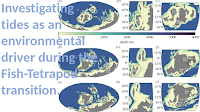
Themodel bathymetry for 420 million years ago (a), 400 million years ago (d) and 380 million years ago (g), with depth saturating at 6000 m (Abyssal ocean is at 4200 m, with trenches at 6000 m). The major continents are as follows: Laurussia is highlighted as panels (c), (f) and (i), Gondwana is the major continent in the south of panels, and Siberia is located northeast of Laurussia denoted as S in panels (a), (d) and (g). The South China region is highlighted in panels (b), (e) and (h), with South China denoted as SC and Indochina as IC. The tidal proxies have been indicated in each time slices; Kez Fm, Keziertage Formation; Kar Fm, Karheen Formation; Man Fm, Manlius Formation; Pad Fm, Padeha Formation; Batt P Fm, Battery Point Formation; Pär and Rez Fms, Pärnu and Rēzekne Formations; Gau Fm, Gauja Formation; Ham gp, Hamilton Group and Esc Fm, Escuminac Formation. The stars in (f) indicate the locations of the two earliest fossil Tetrapod trackways. Zachelmie is denoted by Z and Valentia Island as V. Byrne et al. (2020).
The tides for the periods of interest were simulated using the Oregon State University Tidal Inversion Software, which has been used extensively to simulate deep-time, present day and future tides. The Oregon State University Tidal Inversion Software provides a numerical solution to the linearised shallow water equations, with the nonlinear advection and horizontal diffusion excluded without a loss in accuracy.
Byrne et al. generated close to 100 simulations using five different reconstructions of the bathymetry for present day, and for the 420 million year ago, 400 million year ago and 380 million year ago time slices. To replicate the relevant tidal forcing for the past time slices, the equilibrium tidal elevation and frequency of the tidal constituents were altered. These constituents allow the calculation for the tidal range and spring–neap range. For the Late Silurian (420 million year ago), the principal lunar constituent period used was 10.91 hours and the principal solar constituent period was 10.5 hours. For the early Middle Devonian (400 million year ago), slightly longer periods of 10.98 hours for principal lunar constituent and 10.7 hours for principal solar constituent were used, whereas the early Late Devonian (380 million year ago) had an principal lunar constituent period of 11.05 hours and an principal solar constituent period of 11.0 hours. These numbers are based on small changes to a contemporaneous lunar semi-major axis (average distance between the Earth and the Moon) of 365 000 km, and are consistent with studies on Silurian–Devonian Corals and Brachiopods growth increments (simulations run with present day values for these parameters show qualitatively similar overall results). Because the orbital periods are directly related to lunar distance, Byrne et al. increased the corresponding lunar force by 15%, but did not allow for this to vary between the time slices.
The bathymetric dataset for the present day simulations were a conglomerate of version 14 of the Smith and Sandwell topographic database, along with updated bathymetries for regions north of 79°N from the International Bathymetric Chart of the Arctic Ocean and south of 79°S from a recent research paper by Laurie Padman, Helen Fricker, Richard Coleman, Susan Howard, and Lana Erofeeva. The combined dataset was averaged to 1/4° in both latitude and longitude, to match that of the palaeobathymetry data. Simulations with this bathymetry are referred to as ‘present day control’.
There are several reconstructions of the palaeogeography available for the time periods in question. Byrne et al. have used the latest products from Deeptime Maps, representing 420 million years for the Late Silurian (Pridoli–Lochkovian), 400 million years for the late Early Devonian (Emsian) and 380 million years for the early Late Devonian (Middle Frasnian). There is a difficulty to directly turn the maps into numerical model grids due to a lack of bathymetry depth information for the deep time slices, beyond what is included in the published reconstructions. Byrne et al. have quantified the oceanic bathymetry using step-changes in depths of 150 m, 300 m, 800 m for the continental shelf, and a 4200 m deep abyssal plain. Byrne et al. refer to this simulation as ‘control’ in the following. The assumption for this choice of depths is that the period of study is at a similar point in the supercontinent cycle as present day, so the age of the oceanic plates would be comparable between the Devonian and present day.
This means that the mean depths of the abyssal plain and continental shelfs should be similar for both; this underpins Byrne et al.'s control bathymetry set The bathymetry outlines (e.g. what are shelf seas, continental slope) is determined by the palaeogeographic reconstructions. Because of the poorly constrained depths in the past reconstructions, Byrne et al. did a suite of sensitivity simulations where the depths were modified to check the robustness of our results. These are referred to as ‘shallow’ and ‘deep’ and have the depths shallower than 800 m from the mid-bathymetries halved or doubled, respectively. Byrne et al. also did a set of simulations were water shallower than 150 m in the mid-bathymetries were set to land (testing sensitivity to coastline locations), another two sets of simulations where water shallower than 800 m in the mid-bathymetries were set to wither 800 m or 150 m, respectively. Byrne et al. refer to these three sets as ‘no shelf’, ‘deep shelf’ and ‘shallow shelf’.
Stratification is also poorly constrained because there are as yet no ocean model simulations of the period published (although some are in progress). It has been shown that the tides are relatively insensitive to the buoyancy frequency, within an order of magnitude or so from present day values. Consequently, Byrne et al. used the standard globally averaged buoyancy profile used before in their simulations as well, and then did a series of sensitivity tests to explore robustness. In the sensitivity simulations, which were done for all six bathymetries (shallow, mid and deep, and no shelf, shallow shelf and deep shelf) for all three time slices, with the buoyancy frequency halved or doubled. As ongoing ocean model experiments are able to produce progressively more reliable estimates of Devonian stratification, Byrne et al. will revisit the details of their computations. For now, the sensitivity simulations show a degree of robustness that warrants the support of theirr emphasis on the role of tides in the evolution of Osteichthyans and early Tetrapods. The shelf simulations, and the stratification sensitivity simulations are mainly used for statistics of the robustness of the tidal dynamics.
Byrne et al. also introduced degraded present day bathymetries based on the method for the Devonian simulations. In these, the same depth ranges were used as in the Devonian bathymetries, i.e. any water shallower then 150 m was set to 150 m, anything in the range 150–300 m or 300–800 m was set to 300 m and 800 m, respectively, and anything deeper than 800 m was set to 4200 m (Byrne et al.'s abyssal depth). Byrne et al. refer to this as present day mid, and again computed deep and shallow bathymetries.
Themodel output consists of the amplitudes and phases of the surface elevations and velocities for each simulated tidal constituent. Both the present day control simulation and degraded present day simulation, were then compared to the TPXO9 satellite altimetry constrained product, giving a globally averaged root-mean-square error of 12 cm and 20 cm, respectively, for the principal lunar constituent amplitudes. The results suggested that Byrne et al. should expect an over-estimate in tidal ranges located in shelf seas for their palaeotidal simulations. Byrne et al. discuss a classification of tidal ranges, and say that micro-tidal refers to a range of 0–2 m, a meso-tidal range is 2–4 m, a macro-tidal range sits between 4–8m and a mega-tidal range is larger than 8 m.

(a), (b) Show the modelled principal lunar constituent tidal ranges (in metres) for the present day control (a) and present day reconstructed simulations (b). The root-mean-square error values between the modelled and the TPXO M2 amplitudes are approximately 12 cm for present day and approximately 20 cm for present day reconstructed. (c), (d) as in (a) and (b) but for the principal solar constituent. Byrne et al. (2020).
The extraction of palaeotidal data from the geological record can be difficult and uncertain, but there are tidal deposits described in the literature for the periods of study. Byrne et al. have identified three deposits per time slice that can be used to test the robustness of our simulations. They have used the tidal depositional systems and relative tidal ranges classification from a recent paper by Sergio Longhitano, Donatella Mellere, Ronald Steel, and Bruce Aimsworth, to quantify tidal regimes represented in the tidal deposits.
For the 420 million year time slice, two of the tidal proxies are situated in Laurussia and one near Gondwana. The Keziertage Formation is part of the Tarim Basin, which belongs to the Late Pridoli (420 million years) as determined by zircon dating, and represents a tidal flat environment, likely representing a meso–macro (i.e. larger than 2 m) tidal regime. The Manlius Formation is a lagoonal deposit fromthe Silurian–Devonian boundary at around 419 million years, currently situated in New York, USA, and represents a micro-tidal regime. The Karheen Formation dates to the Early Lochkovian (around 419–415 million years), is located in present day Prince of Wales Island, Alaska, and is an intertidal flat deposition likely representing a meso–macro-tidal regime.
For the 400 million year time slice, two of the proxies are again from Laurussia and one from Gondwana. The Battery Point Formation of Eastern Canada, dating to the Late Emsian (approximately 400–393 million years old), is a deposit made of sedimentary structures representing a meso-tidal environment. The Padeha Formation, dating to the Emsian–Eifelian boundary (approximately 393 million years old), belongs to the Central block of Iran and is a tidal flat deposit, likely showing a meso-macro-tidal regime. The Rēzekne and Pärnu Formations, dating to the Late Emsian to Early Eifelian (approximately 395–390 million years old), belong to the Baltic Basin, a vast delta which measured about 250 × 500 km. These formations indicate that the delta was tidally dominated at this stage, suggesting a meso–macro-tidal regime.
For the 380 million year time slice, all three proxies are located in Laurussia. The Gauja Formation is also part of the succession of deposits from the Baltic Delta, dating to the Late Givetian (approximately 385–383 million years old). It indicates that the Baltic Delta has gone from being tidally dominated, as shown in the earlier Rēzekne and Pärnu Formations, to being tidally influenced, and hence experiencing a shift to a micro–meso-tidal regime (0–4 m). The Appalachian Foreland basin, now in the Eastern USA, was a large epeiric sea, and is well-known for containing vast Coral Reef systems and several shale deposits in the Hamilton Group from the Givetian (388–383 million years old), indicative of a micro-tidal regime. Lastly, the Escuminac Formation from Eastern Canada, is well-known as the location for the Elpistostegalian, Elpistostege watsoni, and Tetrapodomorph Fish, Eusthenopteron foordi. The deposit dates to the Middle Frasnian (approximately 378 million years old) and represents a wave-dominated estuary associated with a micro-tidal regime.
The positioning of the proxy locations on the relevant palaeogeographic reconstructions were done using the present day locations of each proxy in conjunction with palaeogeographic reconstructions which had present day country outlines superimposed, which were provided from Deeptime Maps. Precise placement of the tidal proxy locations on the palaeogeographic reconstructions was unattainable due to the coarse resolution of the reconstructions, and so the location markers are approximate. In the future, Byrne et al. plan to have higher-resolution simulations concentrated in these regions with higher-resolution and smaller-scale palaeogeographic reconstructions.
In the 420 million year control simulation, the principle lunar constituent tidal response shows several localised macro-tidal areas near West and East Laurussia, and around East Siberia. Several distinct macro-tidal areas are also found around East Gondwana, with the majority occurring in Byrne et al.'s region of interest. The maximum principle lunar constituent range for the South China region is mega-tidal and is located around the Indochina block. The principle lunar constituent tide is generally weak away from coastlines and in the strait between the middle and west islands of Laurussia, although Byrne et al. find the maximum global principle lunar constituent range at West Laurussia (13 m). Meso-tidal spring–neap ranges are seen in multiple areas throughout Laurussia and Gondwana, occurring in areas where principle lunar constituent macro-tidal ranges are found. Laurussia is home to several meso-tidal areas, reaching almost macro-tidal ranges along West Laurussia. The South China region has three distinct meso-tidal spring–neap range areas, with a maximum of over 3 m reached around Indochina. The meso-tidal ranges, or larger, in both principle lunar constituent and principle solar constituent tides around the South China region show a large tidal variability occurring in the region and at the time of the origin and diversification of Osteichthyans.

The 420 million year simulation with tidal range (colour, range in metres) for the principle lunar constituent (a)–(c) and principle solar constituent (d)–(f ). Enlarged areas of evolutionary interest are shown in (b) and (e) for the South China region and (c) and (f ) for Laurussia. Note that the principle lunar constituent range is equal to the spring–neap range difference, so panels (d)–(f) show the spring–neap range difference as well. Byrne et al. (2020).
The depth sensitivity simulations show a similar picture in terms of the spatial patterns, but there are expected variations in range. For the 420 million year shallow bathymetry simulation, the principle lunar constituent tide is much less energetic compared to the control, particularly around East Gondwana. There are again meso-tidal spring–neap ranges found in the principle lunar constituent macro-tidal areas, having the same global average and a reduced maximum range compared with the control. By contrast, the deep bathymetry simulation is muchmore tidally energetic (i.e. experiences larger tidal ranges) for the principle lunar constituent, with more and larger macro-tidal areas seen around the coastlines of all three continents. This trend is also observed for the spring–neap range.
The 420 million year simulation, using the shallow bathymetry. Byrne et al. (2020).
The globally averaged principle lunar constituent ranges for the control and shallow bathymetries are similar (0.4 m and 0.5 m, respectively), whereas the deep bathymetry comes in at 0.7 m. The maximum principle lunar constituent range found in the 420 million year simulations vary from 7.9 to 13 m, and it is evident that the deep. However, despite this global amplification, the maximum values for both the principle lunar constituent and spring–neap ranges are lower than the control simulation bathymetry creates a general amplification of the principle lunar constituent and principle solar constituent tide. However, despite this global amplification, the maximum values for both the principle lunar constituent and spring–neap ranges are lower than the control simulation.
The 420 million year simulation, using the deep bathymetry. Byrne et al. (2020).
For the 400 million yeara control simulation, there are several principle lunar constituent macro-tidal areas located along North Laurussia and Siberia and around East Gondwana. There is one distinct macrotidal region around South China, with several more localized upper meso-tidal ranges around Indochina, with the region being less energetic compared with the 420 million year control simulation. Around Laurussia, there are several macro-tidal areas across the north, with a weaker principle lunar constituent tide in the south. This simulation shows a weakened principle lunar constituent tide along the south and west coast of Laurussia between 420 and 400 million years ago. The spring–neap range at 400 million years shows a similar distribution as in the 420 million years control simulation, located in principle lunar constituent macro-tidal areas. The South China region again experiences a smaller spring–neap range compared to that in the 420 million years control simulation; it also has a smaller average and maximum range. As in South China, the spring–neap raAs in figure 3 but for the 400 Ma simulation.nge is smaller around much of Laurussia compared to in the 420 million years control simulation.

The 400 million year simulation. Byrne et al. (2020).
The 400 million years shallow bathymetry simulation is much less energetic, for both the principal lunar constituent and principal solar constituent tide, than the control and deep bathymetry simulations of the same time slice. There are fewer principal lunar constituent macro-tidal areas and they are more localized, with the global average principal lunar constituent range being some 75% of that found in the control and deep bathymetry simulations. A similar trend occurs for the spring–neap range. The Deep 400 million year bathymetry simulation is similar to that of the control bathymetry for both principal lunar constituent and principal solar constituent. For Laurussia, the principal lunar constituent tide appears to be less energetic around the north coast and more energetic towards the west and south coast, with a macro-tidal range occurring at the Baltic Basin. The South China region is more tidally energetic in the deep bathymetry simulation, with the global maximum principal lunar constituent range occurring here. Globally, the spring–neap range is largest in the deep bathymetry simulation, with the maximum found in East Gondwana.

The 400 million year simulation, using the shallow bathymetry. Byrne et al. (2020).
The simulation for 380 million year shows a slightly reduced global tidal range for both principal lunar constituent and principal solar constituent compared with simulations from the other two time slices, whereas the tides in South China and Laurussia are on par with those in the 400 million year simulation of the same region. There are, however, a few local hotspots in the 380 million year simulations, where the islands in the north-west experience principal lunar constituent macro-tidal ranges over 8 m. Around Laurussia, the tides are still macro-tidal, albeit weaker than in the earlier time slices.
The 400 million year simulation, using the deep bathymetry. Byrne et al. (2020).
The 380 million year shallow simulation has a similar global tidal range output as the control simulation, though produces lower maximum ranges for both principal lunar constituent and principal solar constituent, with a similar trend observed in the regions of interest. The deep simulation is more energetic than both the control and shallow bathymetry simulations, producing tidal ranges comparable with the deep bathymetry simulations from the previous two time slices.
The 380 million year simulation. Byrne et al. (2020).
The 420 million year control simulation fits best with the tidal proxy ranges for the time, with macrotidal ranges occurring in the Karheen Formation region, micro-tidal ranges at the Manlius Formation region and macro-tidal ranges at the Keziertage Formation region. In the shallow bathymetry simulation, tidal ranges for both the Karheen and Keziertage Formation locations are smaller than the proxy ranges and for the deep bathymetry simulation, the Keziertage Formation region has smaller ranges than the proxy. For the 400 million year simulations, the control matches reasonably well with all three proxies: it shows a meso-tidal regime at the Battery Point Formation locality and a meso-tidal regime in the region of the Padeha Formation. However, the control simulation does not agree with the tidal proxy of the Rēzekne and Pärnu Formations. The proxy represents a meso–macro-tidal regime, with the simulation showing micro-tidal conditions. The shallow bathymetry simulation produces tidal ranges smaller than all three proxy tidal regimes and the although the deep bathymetry fits well with both the Pärnu and Rēzekne and the Padeha Formation proxies, it does not fit with the Battery Point Formation proxy, with the simulation underestimating the tidal regime at that location. In the 380 million years time slice, the control simulation fits well with all three proxies, with micro-tidal regimes for the Escuminac Formation and Hamilton Group regions and a micro–meso-tidal regime occurring in the Baltic Basin area, where the Gauja Formation is located. The shallow bathymetry simulation is less tidally energetic than the control simulation, and also fits well with the three proxies, though has a slightly smaller tidal range output in the Baltic Baltic region. The deep bathymetry produced tidal regimes much greater than the tidal proxies, particularly in the region of the Escuminac Formation.
The earlier time slices for our period of study (420–400 million years) and presnt day are believed to be at roughly similar central points in their respective super-continental cycles, whereas the 380 millio year slice is closer to the formation of a supercontinent (Pangea in this case) than the modern continents currently are. This central position in the cycle is associated with multiple ocean basins, and thus an increased chance of ocean resonances in one or multiple basins which would lead to the tides becoming more energetic. At present we are experiencing a tidal maximum due to the near resonance of the North Atlantic, whereas the period of study occurs after a tidal maximum, shown in other simulations to have occurred at around 440 million years ago. This is important as tides can be sensitive to small-scale changes in bathymetry when the ocean is near resonance, but as this is not the case for our period of study, our results are not prone to this sensitivity. The similar positioning within a super-continent cycle of our period of study with present day would also suggest that the contemporaneous oceanic crust would have been of similar age to the present day crust; consequently, we based the control bathymetry on present day bathymetry values. The sensitivity simulations show that the results are generally robust when the depths are changed.
The control simulation produces the best fit for the three tidal proxies for 420 million years ago, and although only the deep bathymetry simulation produced a meso-tidal regime matching the Baltic Basin tidal proxy for 400 million years ago, it is not a representative bathymetry for this time slice. This is due to the early Middle Devonian being in a period of lowered sea-level caused by marine regression occurring from the Late Silurian. Byrne et al. therefore argue that the control simulation is still a valid baseline for the 400 million year time slice. Higher-resolution simulations are required to resolve the tides of the Baltic Basin for the control bathymetry, as it is common for the local full tidal range not to be captured in global tidal simulations, like the Bay of Fundy of the present day, which is dominated by a small-scale resonance. For the 380 million years time slice, the control simulation also fits well with the three tidal proxies for that period, as does the shallow bathymetry simulation.
For the 420 million year time slice, the South China region is consistently associated with multiple principal lunar constituent macro-tidal areas across the sensitivity simulations. Furthermore, multiple spring–neap meso-tidal areas also persist, implying a large tidal variability during the time of the origin of Osteichthyans. It should also be noted that a macro-tidal regime also occurs along the coastline of Indochina in conjunction with South China. Combined with evidence of shared fauna between the two blocks, this warrants further palaeontological exploration of present day countries belonging to the Indochina block: Vietnam, Laos, Cambodia and Thailand. The Van Canh and Dong Tho sandstone Formations, which represent the Silurian–Devonian of Eastern Indochina, show indications of extensive tidal zones and are associated with early Dipnomorph Fish (members of the Lungfish lineage, the extant sister group to Tetrapods).
In the 400 million year time slice, the tidal regimes vary throughout the simulations in areas where the earliest Tetrapod trackways are located in Southern Laurussia, and these results are supported by the later 380 million year simulation. The Zachelmie trackway locality lies on the western margin of the entrance to the Baltic Basin; in the control simulation, the Baltic Basin is located in a micro-tidal area but changes to a macro-tidal area in the Deep bathymetry simulation. The Baltic Basin was a shallow epicontinental sea which existed from the Silurian into the Early Carboniferous. Tidal regimes within ancient epicontinental seas have been greatly debated, with arguments for the weakening of the propagating tide due to shallow depths and the vast expansion of the seaways, leading to micro-tidal conditions. Offsetting this, other studies have found evidence for tide-domination in both extant and extinct epicontinental seas. Numerical models of ancient seaways have produced varied results; the Late Devonian Catskill seaway of Southern Laurussia is expected to have experienced meso-tidal ranges, whereas largely micro-tidal conditions are expected in the Late Carboniferous seaway of northwest Europe and the Early Jurassic Laurasian Seaway. Tidalites from the Pärnu and Rēzekne Formations suggest a meso-macro-tidal regime, which will be investigated further in future studies using higher-resolution simulations for the Baltic Basin.
Byrne et al.'s principal conclusion is that simulations representing ocean tides for the time periods of the evolution of Osteichthyans and the emergence of tetrapods are broadly consistent with the hypothesis that tides were an important environmental and evolutionary driver for these events. Of particular significance is the fact that those areas with some of the largest tidal ranges and tidal variability in the palaeotidal simulations coincide with fossil proxy sites, i.e. South China from 420 million years ago. From the fossil record, it is apparent that tidal environments are closely associated with the fossils of Elpistostegalians and stem-Tetrapods. This stimulates the need for high-resolution tidal simulations to access tidal regimes in these regions in more detail, e.g. the Balsic Basin and Escuminac Formation sites. Extended tidal simulation studies using a variety of palaeogeographic reconstructions at more finely sliced time intervals, as well as at higher spatial resolution around areas of palaeontological interest, will more fully elucidate whether differing tidal regimes are correlated with the origin and diversification of other early Vertebrate clades. More generally, establishing the role of palaeotides in influencing major evolutionary events is a field holding great promise, a novel blend of fluid dynamics and palaeobiology that is still very much in its infancy.
See also...


Online courses in Palaeontology.
Follow Sciency Thoughts on Facebook.
Follow Sciency Thoughts on Twitter.


.jpg)
.jpg)
.jpg)