Showing posts with label Sea Slugs. Show all posts

Monday, 29 June 2020

Phestilla fuscostriata: A new species of Nudibranch Sea Slug from the South China Sea.

The Nudibranch superfamily Fionoidea is a highly diverse group of marine Sea Slugs, containing 20 families, 52 genera and 324 species. ike many other nudibranchs, however, there has been some controversy with the systematics and phylogeny of Fionidea. In the family Trinchesiidae, the majority of species are free-living, though some form obligate association with their prey species on which they settle, feed and lay eggs. Among the most well-known examples of such obligate relationship are those between the genus Phestilla, and certain Acroporid, Agariciid, Poritid and Dendrophylliid Coral species: the Nudibranchs live on these Corals, feed on them, and their larvae show host specificity in settlement. Different from other genera of Trinchesiidae, Phestilla does not possess a cnidosac (an anatomical feature in which the Sea Slug stores cnidocytes, Cnidarian stinging cells harvested from its prey and used for its own defence) at the tip of its cerata, but has a glandular region in this location. The genus Phestilla currently has nine recognized species, among which, eight are obligate corallivores. Field observation and laboratory studies have revealed the specificity between Corals and their Nudibranch predators, with a particular species of Phestilla feeding on only one species or genus of Coral, which implies host shifts are associated with speciation.

In a paper published in the journal Zoological Studies on  June 2020, Juntong Hu of the Department of Biology at Hong Kong Baptist University, Yanjie Zhang, also of the Department of Biology at Hong Kong Baptist University, and of the Southern Marine Science and Engineering Guangdong Laboratory, James Yang Xie, again of the Department of Biology at Hong Kong Baptist University, and Jian-Wen Qiu, once again of the Department of Biology at Hong Kong Baptist University, and of the Southern Marine Science and Engineering Guangdong Laboratory, describe a new species of Phestilla from the Coral Pavona decussata, a structure forming Agariciid species in the South China Sea.

Colonies of the Scleractinian Coral Pavona decussata were collected from Sharp Island, Hong Kong, at depths of about 2 m, in August 2018 by SCUBA diving and then cultured in the laboratory in an aquarium system. Nudibranchs and their egg masses, found on the surface of the Pavona decussata in October 2018, were collected from the Coral surface. The specimens were preserved either in 95% ethanol for molecular study or in 4% formaldehyde in seawater for morphological analysis. All specimens examined werer deposited in the collection of the Swire Institute of Marine Science, at the University of Hong Kong.

The new species is named Phestilla fuscostriata, from the Latin 'fuscus' meaning 'brown' and 'striatus' meaning 'streaky', refers to the brown stripes on the body, which is a morphological character of the new species.

A colony of the Coral Pavona decussata showing three adults of the Nudibranch Phestilla fuscostriata  (indicated by red arrows) and many crescent-shaped egg masses of the Nudibranch on the Coral surface. Scale bar is 1.0 cm. Hu et al. (2020).

Living specimens of Phestilla fuscostriata are 2 mm to 8 mm in length. The body excluding the cerata is elongate and dorsal-ventrally flattened. The general body colour is white with dense brown pigmentation on dorsal side of head, tentacles, body and cerata. Ethanol preserved specimens are white due to loss of brown pigmentation.

The oral tentacles and rhinophores are digitiform; in adults the former are approximately twice as long and twice the diameter of the latter. A very small eye is present behind the rhinophore. The cerata are digitiform, swollen distally, and arranged in seven transverse rows in the holotype, each row consisting of 1 to 6 cerata attached laterally on a distinctly raised ridge on each side of the body, with the number of cerata decreasing from anterior to posterior. Fewer rows of cerata and fewer cerata per row are present in juveniles. Within a row, one single pair of dorsal cerata and zero to several pairs of ventral cerata are present. In the holotype, there are seven pairs of dorsal cerata, and six rows of ventral cerata with 5, 5, 4, 3, 2 and 1 pair from first row to the sixth row, respectively. The longest cerata on the second row is approximately 1.5 times as long as the body width. A translucent glandular region present at the tip of each ceras. Comparing adult and juvenile specimens indicates that the dorsal cerata develop earlier than the ventral cerata.

The anus is acleioproctic, located dorsally on right side of body between the third and fourth rows of cerata. The reproductive opening is located anterior to the first row of cerata, on right side of body.

Living specimens of Phestilla fuscostriata. (A) Holotype, SWIMS-Mol-19-001, dorsal view. (B) Holotype, SWIMS-Mol-19-001, ventral view; (C) Paratype, SWIMS-Mol-19-002, dorsal view. (D) Paratype SWIMS-Mol-19-002, ventral view. (E) Paratype, SWIMS-Mol-19-005, dorsal view. (F) Paratype, SWIMS-Mol-19-005, ventral view. Scale bars are 1.0 mm. Hu et al. (2020).

Eggs of Phestilla fuscostriata are white, 0.2 mm in diameter, and clearly observable through translucent body wall on the ventral side. Egg masses are crescent-shaped, about 0.25 cm in diameter, and have a translucent membrane enclosing around 20–50 eggs. At about 24°C, eggs develop into veliger larvae and break through membrane in 2–3 weeks. Veligers have a pair of black eyes and a well-developed swimming velum. Newly settled juveniles are more elongate, the velum is lost, but the oral tentacles or cerata have not yet developed. After roughly one week, juveniles resemble adults, with black eyes, but with tentacle and cerata, although at this stage cerata few and small.

Early developmental stages of Phestilla fuscostriata. (A) Embryos inside egg membrane. (B) Rudimentary veligers without well-formed shells inside egg membrane. (C) Veligers with well-formed shells. (D) Hatched veliger with well-developed velum for swimming. (E) Postlarva, dorsal view. (F) Early juvenile, with the head turned to the left when the photograph was taken. Scale bars: (A)–(C), (F) 500 μm; (D)–(E) = 40 μm. Hu et al. (2020).

Phestilla fuscostriata resembles its host coral P. decussata in the coloration pattern, therefore exhibiting excellent camouflage. Hu et al. were unaware of its presence in our aquarium system until this nudibranch built up a dense population on Pavona decussata, which eventually killed some of the colonies. The only known food source for Phestilla fuscostriata is Pavona decussata. When other species of Scleractinian Coral such as Platygyra carnosa and Acropora digitifera were also present in the same aquarium, the Nudibranch was found only on Pavona decussata, which indicates its host specificity. During reproduction, this Nudibranch deposits egg masses and glues them tightly on the surface of the Coral colonies.

See also...

https://sciencythoughts.blogspot.com/2020/06/pereionotus-tinggiensis-new-species-of.htmlhttps://sciencythoughts.blogspot.com/2020/05/zhangiella-condensum-hydractinia.html
https://sciencythoughts.blogspot.com/2020/05/oulastrea-crispata-understanding.htmlhttps://sciencythoughts.blogspot.com/2020/05/deciphering-changes-in-symbiotic.html
https://sciencythoughts.blogspot.com/2020/03/crambione-cf-mastigophora-bloom-of.htmlhttps://sciencythoughts.blogspot.com/2020/03/haliaeetus-leucogaster-observation-of.html
Follow Sciency Thoughts on Facebook.

Wednesday, 26 December 2018

Platydoris guarani: A new species of Nudibranch Sea Slug from Brazil.

Nudibranch Sea Slugs are marine Gastropod Molluscs that lose their shells during their larval stage. Like other Sea Slugs (not all of which are closely related) they are often colourful and have feathery external gills, and while often hard to tell apart from these other Sea Slug groups, can be distinguished by morphological examination. All Sea Slugs are externally biliterally symetrical, however Nudibraches are Opisthobranches (members of the same Gastropod group as the terrestrial Pulmonate Snails), and lack internal symmetry. This is manifested externally in the positioning of the sexual openings, with both male and female openings on the right side of the body. Almost all Nudibranches are benthic (live on the sea floor or other surfaces) and are found from the intertidal zone to the abyssal ocean floors, though most species are found on shallow tropical reefs.

The Nudibranch Platydoris angustipes is considered to be widespread in the western Atlantic, being found from the Caribbean in the north, south to the coast of Brazil and east as far as Ascension Island. However, the species was described from specimens collected in the Caribbean (the US Virgin Islands) and shows considerable morphological variation across its range, so it is not completely certain that it whether all populations assigned to Platydoris angustipes are in fact the same species.

In a paper published in the journal Zoological Systematics on 2 January 2018, Patricia Lima and Luiz Ricardo Simone of the Museu de Zoologia da Universidade de São Paulo describe a new, cryptic, species of Platydoris from the coast of Rio de Janeiro State in Brazil.

Cryptic species are species that closely resemble other species, and cannot be separated by simple, non-invasive examination. While taxonomists have known about cryptic species for a long time, it was not realised how numerous such species were until taxonomists began to use genetics to determine relationships between species, about twenty years ago. The presence of cryptic species can have a profound influence on conservation efforts, as ‘species’ thought to be wide ranging with large populations and broad environmental tolerances can turn out to be complexes of closely related but reproductively isolated species, each with a smaller population and distribution, and narrower range of environmental tolerances.

The Brazilian and Caribbean populations of Platydoris angustipes have previously been suggested to be different in several ways, including the colour and shape of the body, the length of the foot, the covering of the dorsal surface, the nature of the oral tentacles, and the number of gills branches. However, Lima and Simone found that all these features are variable in both populations, and that while the two populations show different frequencies of all these traits, none of them could be reliably used to assess which population an individual specimen came from.

Nevertheless, it did prove possible to different the two populations, based upon on several important morphological differences. Firstly, the shape of the radula (tongue) is different in the two populations, with the Caribbean populations having a straight-sided radula and the Brazilian populations having a radula distinctively wider at the base (radula shape is considered an important diagnostic feature in all Gastropod groups). Secondly, the renal vesicles (kidneys) of the Brazilian population are much larger. Thirdly the digestive tract of the two populations is arranged differently, with the Brazilian population having shorter odontophore muscles and a shorter cecum. Finally, the reproductive systems of the two populations are quite different, with the Brazilian population lacking spines on either the penis or vagina, unlike the Caribbean population, and indeed any previously described species of Platydoris. The structure of the reproductive tract is particularly important for establishing species boundaries in all animal groups that mate internally (as opposed to releasing eggs and sperm into the environment), as populations with different reproductive apparatus typically cannot mate.

The radula of (left) a specimen of Platydoris angustipes from the US Virgin Islands, and (right) Platydoris sp. from Rio de Janeiro State, Brazil. Scale bars are 100 μm. Lima & Simone (2018).

The new species is named Platydoris guarani, in honour of the Guarani indigenous people of Rio de Janeiro State. These Sea Slugs are typically about 60 mm in length and 40 mm in width, with a rounded body, and are usually orange in colour with a white ribbon around their edges, and a row of brown spots just above this. The dorsal surface is covered in small tubercles, and the gills typically have six white branchial leaves.

Platydoris guarani, living animals. (A) Dorsal view, specimen from Papagaio, Cabo Frio, Rio de Janeiro. (B) Same specimen in ventral view. (C) Living animal with spawning, specimen from Enseada da Meia Lua, Cabo Frio, Rio de Janeiro. Vinícius Padula in Lima & Simone (2018).

Lima and Simone suggest that all Brazilian populations of ‘Platydoris angustipes’ should in fact be assigned to ‘Platydoris guarani’, but are uncertain as to the status of the Ascension Island populations, and suggest that this should be investigated in the future.

See also...

https://sciencythoughts.blogspot.com/2018/09/alionchis-jailoloensis-new-species-of.htmlhttps://sciencythoughts.blogspot.com/2018/08/rioting-in-hout-bay-cape-town-after.html
https://sciencythoughts.blogspot.com/2017/08/a-hydrocarbon-seep-from-late-triassic.htmlhttps://sciencythoughts.blogspot.com/2016/12/dendronotus-arcticus-dendronotus.html
https://sciencythoughts.blogspot.com/2016/03/echinolittorina-nielseni-new-species-of.htmlhttps://sciencythoughts.blogspot.com/2014/11/a-new-species-of-dog-whelk-from-south.html


Follow Sciency Thoughts on Facebook.

Tuesday, 27 December 2016

Dendronotus arcticus & Dendronotus robilliardi: Two new species of Nudibranch Sea Slugs from the North Pacfic and Arctic Oceans.

Nudibranch Sea Slugs are marine Gastropod Molluscs that lose their shells during their larval stage. Like other Sea Slugs (not all of which are closely related) they are often colourful and have feathery external gills, and while often hard to tell apart from these other Sea Slug groups, can be distinguished by morphological examination. All Sea Slugs are externally biliterally symetrical, however Nudibraches are Opisthobranches (members of the same Gastropod group as the terrestrial Pulmonate Snails), and lack internal symmetry. This is manifested externally in the positioning of the sexual openings, with both male and female openings on the right side of the body. Almost all Nudibranches are benthic (live on the sea floor or other surfaces) and are found from the intertidal zone to the abyssal ocean floors, though most species are found on shallow tropical reefs.

In a paper published in the journal ZooKeys on 9 November 2016, Tatiana Korshunova of the Koltzov Institute of Developmental Biology of the Russian Academy of Sciences, and the Zoological Museum of the Moscow State University, Nadezhda Sanamyan of the Pacific Geographical Institute of the Far Eastern Branch of the Russian Academy of Sciences, Olga Zimina of the Murmansk Marine Biological Institute, Karin Fletcher of Port Orchard in Washington, USA, and Alexander Martynov, also of the Zoological Museum of the Moscow State University, describe two new species of Nudibranch Sea Slugs from the North Pacific and Arctic Oceans, both of which are placed in the widespread shallow water genus Dendronotus.

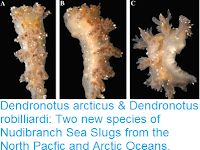
The first species is named Dendronotus arcticus, in reference to the area where it was found, the Laptev Sea to the north of Siberia, part of the Arctic Ocean. This species is brownish with scattered white dots and reaches 19 mm in length. It is found in soft substrates such as sand and mud with gravel and small stones.

Dendronotus arcticus, living specimens. Olga Zimina in Korshunova et al. (2016).

The second species is named Dendronotus robilliardi, in honour of the American marine biologist Gordon Robilliard for his work on the taxonomy of the genus Dendronotus. This species is a cryptic species, described from a population formerly assigned to the widespread species Dendronotus albus, but now identified as a separate species using molecular data. This species is translucent with opaque white stripes, and was found on stones and rocky seafloor feeding on the Hydroid Abietinaria annulata. The species was found in the waters around the Kanchatka Peninsula, but as Dendronotus albus was originally described from Baja California, Korshunova et al. suggest that populations assigned to this species from Korea to Washington State may in fact be Dendronotus robilliardi.

 Dendronotus robilliardi. Nadezhda Sanamyan in Korshunova et al. (2016).

See also...

http://sciencythoughts.blogspot.co.uk/2016/09/sphendone-insolita-new-species-of.htmlhttp://sciencythoughts.blogspot.co.uk/2016/05/bothriembryon-sophiarum-new-species-of.html
http://sciencythoughts.blogspot.co.uk/2016/04/lacustrine-gastropods-from-late-miocene.htmlhttp://sciencythoughts.blogspot.co.uk/2016/03/echinolittorina-nielseni-new-species-of.html
http://sciencythoughts.blogspot.co.uk/2016/03/stemmatopsis-nangphaiensis-stemmatopsis.htmlhttp://sciencythoughts.blogspot.co.uk/2015/11/a-new-species-of-diapherid-snail-from.html
Follow Sciency Thoughts on Facebook.