Showing posts with label Suidae. Show all posts

Tuesday, 17 September 2019

African Swine Fever reported in South Korea.

South Korea has reported its first case of African Swine Fever, after the disease was detected at a Pig farm near the city of Paju in Gyeonggi Province, close to the border with North Korea, where the disease was detected four months ago. Authorities in South Korea have imposed a temporary moratorium on all movements of Pigs, as well as ordring the culling of 4000 Pigs at the farm where the outbreak was detected and two neighbouring farms.

Pigs being rounded up for culling at a farm near Paju in South Korea, following the detection of the African Swine Fever Virus. Yelim Lee/AFP/Getty Images.

The African Swine Fever Virus is a Double Stranded DNA Virus and the sole member of the Asfivirus Family. It is indigenous to tropical Africa, where it infects Warthogs and Bushpigs as well as domestic Pigs, and is transmitted by Ticks of the genus Ornithodoros. The disease presents no threat to Humans, but produces a lethal haemorrhagic fever in Pigs. Infected animals will develop a high fever within a few days of contracting the Virus, this is acompanied by a loss of appatite and reddening of the skin of light-skinned breeds, caused by the rupturing of blood vessels. Pigs will then develop difficulties in standing, and huddle together in groups, shivering and coughing, and within a few days will become comatose and eventually die.

A transmission electron microscope image of a single African Swine Fever Viron. Institute for Animal Health/Wikipedia.

Occasional outbreaks of African Swine Fever have been recored outside of Africa for decades, but the current epidemic has spread from China, where the disease was detected in August 2018, since when it has spread rapidly within the country's large number of intensive Pig farms. Since then around 100 million Pigs have died in China, and it is feared that as many as 350 million may die before the outbreak is contained (25% of the global population). The outbreak has spread to the Philippines, Vietnam, North Korea, and now South Korea, and there are concerns that it could spread to other parts of East Asia and the world. The outbreak has also provoked China to wave all tariffs on imported pork, a major foodstuff in the country, provoking an increase in intensive Pig farming in other parts of the world - something which may also make the countries where this expansion has occured more vulnerable to the disease.

Pigs that have died after becoming infected with African Swine Fever in South Korea. Pig World.

See also...

https://sciencythoughts.blogspot.com/2019/09/seven-cofirmed-deaths-from-yellow-fever.htmlhttps://sciencythoughts.blogspot.com/2019/09/understanding-wild-ecology-of-ebola.html
https://sciencythoughts.blogspot.com/2019/09/number-of-measles-cases-reported-in-new.htmlhttps://sciencythoughts.blogspot.com/2018/11/british-citizen-dies-after-contracting.html
https://sciencythoughts.blogspot.com/2018/11/ebola-outbreak-kills-198-in-democratic.htmlhttps://sciencythoughts.blogspot.com/2018/06/suspected-foot-and-mouth-outbreak-in.html
Follow Sciency Thoughts on Facebook.

Thursday, 4 December 2014

A new species of Pig from the Late Miocene of Chad.


Pigs have been important parts of African faunas from the Miocene onwards, and have been extensively used to interpret environments and date strata. Unfortunately a large number of taxa have been erected from limited and fragmentary material, which has led to doubts about several interpretations of Miocene and Pliocene deposits that were initially based upon data from Pigs. The genus Nyanzachoerus was initially described in 1958 by Louis Leaky, and currently contains at least eleven species, though it is likely that this is an overestimation of true diversity, as many species were erected on very limited material.

In a paper published in the journal PLoS One on 27 August 2014,  Jean-Renaud Boisserie of the Institut de paléoprimatologie, Paléontologie Humaine: Évolution et Paléoenvironnements at the Université de Poitiers, Antoine Souron, also of the Institut de paléoprimatologie, Paléontologie Humaine: Évolution et Paléoenvironnements at the Université de Poitiers and of the Human Evolution Research Center at the University of California, Berkeley, Hassane Taïsso Mackaye and Andossa Likius of the Département de Paléontologie at the Université de N’Djamena, Patrick Vignaud, again of the Institut de paléoprimatologie, Paléontologie Humaine: Évolution et Paléoenvironnements at the Université de Poitiers and Michel Brunet, also of the Institut de paléoprimatologie, Paléontologie Humaine: Évolution et Paléoenvironnements at the Université de Poitiers and of the Collège deFrance, describe a new species of Nyanzachoerus from Toros-Ménalla, a fossil producing area in the northern Lake Chad basin, about 500 km northeast of N’Djamena.

The new species is named Nyanzachoerus khinzir, meaning ‘Pig’ in Chadian dialect Arabic. Boisserie et al. were cautious about erecting about erecting a new species of Nyanzachoerus, due to previous over-description of species within the genus, and because the site has previously been interpreted as being chronologically and environmentally similar to sites producing the widespread species Nyanzachoerus syrticus. However the site has now yielded a total of 280 specimens, including six well preserved crania (skulls), and this interpretation is no longer possible, due to its distinctive dentition.

Partial cranium of Nyanzachoerus khinzir.(A) Lateral view; (B) ventral view; (C) nuchal view; (D) occlusal view of left P3-M3. Scale bars equal 10 cm (A–C) and 5 cm (D). Boisserie et al. (2014).

The Toros-Ménalla locality has produced remains of Hippopotamuses, Elephants, Bovids, Anthracotheriids (explain), Birds, Carnivores and Fish as well as the Hominid Sahelanthropus tchadensis, currently the earliest known member of the group. Correlation of the fauna with that at other sites suggests that the Toros-Ménalladeposits are between 7.4 and 6.6 million years old, while attempts at radiocarbon-dating the Hominid producing localities here have yielded results of between 7.2 and 6.8 million years old and between 7.5 and 7.1 million years old.

Crania of Nyanzachoerus khinzir.(A–C)Male partial cranium in dorsal (A), lateral (B), and rostral (C) views; (D–E) ventral view of female partial cranium in ventral (D) and lateral (E) view; (F–G) male partial cranium in dorsal (F) and lateral (G) views; (H) rostral portion of palate ventral view. Scale bars equal 10 cm (A–G) and 5 cm (H). Boisserie et al. (2014).

An isotopic analysis of specimens of Nyanzachoerus khinzir suggests that had a mixed diet, but likely to include a considerable amount of grass, probably feeding largely in a wetland environment. Combined with previous data on fauna from the area, Boisserie et al. suggest that in the Late Miocene the Toros-Ménalla area may have been similar to the modern Okavango Delta in Botswana.

Mandibles of Nyanzachoerus khinzir.(A–C) male in dorsal (A), lateral (B), and occlusal view of right p2-m3 (C); (D–F) female mandible in dorsal (D), lateral (E), and occlusal view of right p2-m3 (F).Scale bars equal 10 cm (A–B, D–E) and 2 cm (C, F). Boisserie et al. (2014).

See also…

The Chacoan Peccary (Catagonus wagneri) was first recorded from pre-Columbian archaeological sites in northern Argentina in 1930, and subsequently found to be still living in the dry Chacos thorny forests of northern Argentina, western Paraguay and southeastern Bolivia in the 1970s. The Chacos Forests are hot and dry, with average annual temperatures over 24˚C and average annual rainfall between 80 and 800 mm. The two...


Pigs (Suidae) are found throughout the Old World. They are members of the Artiodactyla, the group that also includes Cattle, Deer and Antelopes (and, curiously, Whales), though they are considered less highly derived than other members of the group, lacking a rumen (additional stomach compartment) and retaining four toes on each foot (though two of these are...


Follow Sciency Thoughts on Facebook.

Sunday, 29 June 2014

A Chacoan Peccary from the Late Pleistocene of northern Uruguay.

The Chacoan Peccary (Catagonus wagneri) was first recorded from pre-Columbian archaeological sites in northern Argentina in 1930, and subsequently found to be still living in the dry Chacos thorny forests of northern Argentina, western Paraguay and southeastern Bolivia in the 1970s. The Chacos Forests are hot and dry, with average annual temperatures over 24˚C and average annual rainfall between 80 and 800 mm. The two archaeological sites in northern Argentina where Catagonus wagneri has been recorded are outside the Chacos Forests, but are relatively close and still within areas with a hot dry climate; both are about a thousand years old.

In a paper published in the journal Historical Biology on 18 December 2012, Germán Mariano Gasparini of the División Paleontología Vertebrados at the Museo de La Plata, Martín Ubilla of the Facultad de Ciencias at the Universidad de la República and Eduardo Pedro Tonni, also of the División Paleontología Vertebrados at the Museo de La Plata, describe the skull of a Choacan Peccary from the Late Pleistocene Sopas Formation in Artigas Department in northern Uruguay. 

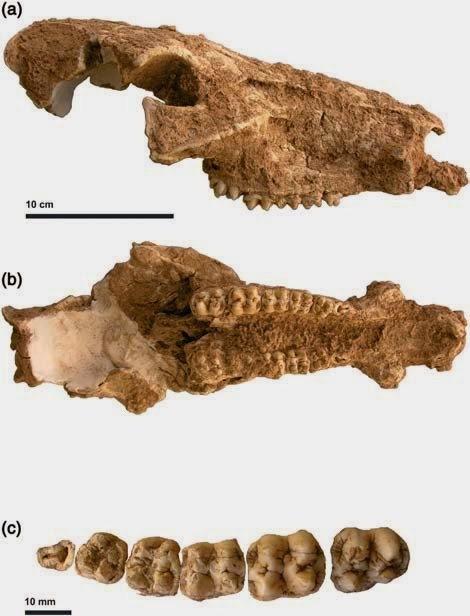
The specimen comprises a partial skull covered in carbonaceous material (limestone) with most of its teeth intact. The skulls of Catagonus wagneri are quite distict, and there is no doubt about the assignation of this specimen to the species.

Specimen assigned to Catagonus wagneri: (a) Lateral view. (b) Palatal view. (c) Occlusal view of right P2-M3 series. Gasparini et al. (2012).

The Sopas Formation outcrops along streams and rivers in northern Uruguay. It is about 15 m thick and comprises brownish mudstones, siltstones, sandstones and occasionally conglomerates. It has not been dated precisely, but based upon biostratigraphical evidence it is Late Pleistocene, and probably predates the last Glacial Maximum. It has previously yielded other fossils associated with dry climates, such as Camelids and Guinea Pigs, but also species associated with much wetter environments, such as Otters, Tapirs and Capybaras, suggesting that the climate varied considerably during the time period when it was laid down.

Archaeological and paleontological sites where fossil remains of Catagonus wagneri were found and current range. (1) Llajta Maüca archaeological site, 15 km north-west of Melero, Santiago del Estero Province. (2) Tulip-Loman archaeological site, near Icano, Santiago del Estero Province, 45 km south of Llajta Maüca. (3) Paleontological site in the Cuareim river, Artigas Department, Uruguay. (a) Mariscal Estigarribia, Boquerón Department, Paraguay. (b) Las Lomitas, Formosa Province, Argentina. Grey area: current range of Catagonus wagneriGasparini et al. (2012).

See also


A diverse fauna of Musk Oxen (Ovibovines) is known from the Late Miocene of China, each showing distinct and specialized horn cores (the bone core upon which the keratin horn is supported; the diversity of horn core shapes can be used to infer a diversity of horn shapes, even in the absence of horns), but otherwise quite similar. One of...


Pigs (Suidae) are found throughout the Old World. They are members of the Artiodactyla, the group that also includes Cattle, Deer and Antelopes (and, curiously, Whales), though they are considered less highly derived than other members of the group, lacking a rumen (additional stomach compartment) and retaining four toes on each foot (though two of these are...


The Przewalski’s Gazelle (Procapra przewalskii) is a species of high altitude adapted Antelope, which formerly ranged across much of...


Follow Sciency Thoughts on Facebook.

Monday, 25 November 2013

A new species of fossil Pig from the early Pleistocene of Ethiopia.

Pigs (Suidae) are found throughout the Old World. They are members of the Artiodactyla, the group that also includes Cattle, Deer and Antelopes (and, curiously, Whales), though they are considered less highly derived than other members of the group, lacking a rumen (additional stomach compartment) and retaining four toes on each foot (though two of these are held permanently above the ground). The earliest fossil Pigs appear in the Oligocene of Asia.

In a forthcoming paper in the journal Acta Palaeontologica Polonica, available online from 26 July 2013, Antoine Souron of the Institut de Paléoprimatologie, Paléontologie Humaine: Évolution et Paléoenvironnements at the Université de Poitiers and the Human Evolution Research Center at the The University of California, BerkeleyJean-Renaud Boisserie also of the Institut de Paléoprimatologie, Paléontologie Humaine: Évolution et Paléoenvironnements at the Université de Poitiers as well as the Ministère des Affaires Étrangères, Ambassade de France en Éthiopie, and Tim White of the Human Evolution Research Center and Department of Integrative Biology at The University of California, Berkeley, describe a new species of fossil Pig from the early Pleistocene of the Middle Awash region  of the Afar Depression in northern Ethiopia.

The new species is placed in the genus Kolpochoerus, which has eight previously described species from the Pliocene and Pleistocene of Africa, and which is thought to be ancestral to the modern Giant Forest Hog (Hylochoerus meinertzhageni), and is given the specific name phillipi, in honour of the South African paleoanthropologist Phillip Tobias of the University of the Witwatersrand, who passed away in 2012.

Kolpochoerus phillipi is described from a partial cranium and associated mandible and a second partial mandible, as well as a series of detached teeth. It is similar in size to the skull of a modern Giant Forest Hog, and is thought to be about 2.5 million years old.

Cranium of Kolpochoerus phillipi in (A) dorsal, (B) ventral, (C) anterior, and (D) lateral views. Souron et al. (2013).

Mandible of Kolpochoerus phillipi in (A) dorsal, (B) anterior, and (C) lateral views. Souron et al. (2013).


Follow Sciency Thoughts on Facebook.