Showing posts with label Tiger Sharks. Show all posts

Friday, 9 February 2024

Ten fatal Shark attacks recorded globally in 2023.

The International Shark Attack File, which is maintained by the Florida Museum of Natural History, recorded ten fatalities caused by unprovoked Shark attacks around the globe in 2023, double the number recorded in 2022. A total of 69 unprovoked attacks were recorded, which is in line with the five year average of 63. Four of the ten fatalities occurred in Australia, with two in the United States, and one each in the Bahamas, Egypt, Mexico and New Caledonia. Non-fatal attacks were recorded in the United States, Australia, New Caledonia, Brazil, Egypt, South Africa, Costa Rica, Colombia, New Zealand, the Seychelles, the Galapagos, and the Turks and Caicos islands.

There were a total of 69 confirmed unprovoked shark bites (green dots) and ten fatalities (blue dots) in 2023. Florida Museum.

The International Shark Attack File also recorded 22 provoked Shark attacks, defined as attacks caused by a Human provoking a Shark in some way, although these statistics are considered less useful for scientific purposes, as they do not relate to the Sharks' natural behaviour. While these were the result of multiple forms of Human behaviour, the most common targets of provoked attacks were spear fishers.

Three of the four fatalities in Australia happened off the Eyre Peninsula, a remote location in South Australia, noted for its wild beaches and spectacular surf. This area is also home to several Seal colonies, and a large number of Great White Sharks. Seals are extremely fast and agile swimmers, and Sharks have little hope of chasing them down in active pursuit, but they can sometimes be caught splashing around on the surface, by a Shark attacking directly from below. Unfortunately, a surfer paddling a board on the surface can look very like a Seal to a Great White Shark, leading to occasional attacks on surfers. The Sharks typically break of after a single exploratory bite, enough to determine that the surfer is not a Seal, but they are large Animals and can cause considerable damage with a single bite. 

The Eyre Peninsula is home to several beaches with substantial surf breaks, such as this one at Sleaford Bay. Mackfish/Wirestock/Adobe Stock/Florida Museum

Surfers are the most commonly attacked group globally, accounting for 42% of all bites. Many beaches in Australia have excellent beach safety programs, including rapid responders for Shark attacks. The Eyrie Peninsula, however, lacks any such support, and its remote location mean that help, if summoned, is unlikely to arrive quickly, and it is hard to evacuate Shark attack victims to medical facilities quickly.

Seven unprovoked bites, of which three were fatal, came from Great White Sharks, Carcharodon carcharias, in 2023. John Sears/Florida Museum.

The fourth Australian fatality was caused by a Bull Shark attack in a brackish river close to the coast ow Western Australia, the second of three species of Sharks known to have caused fatalities in 2023. An attack on the Red Sea coast of Egypt was carried out by a Tiger Shark, which was observed to return and attack its victim several times. This is typical of Tiger Sharks, which are an open water species, spending most of their lives in waters where prey is rare, and which are therefore more willing to take unfamiliar prey. The geography of the Red Sea, with a deep ocean trench close to shore, brings large pelagic Sharks (and other Fish) close to beaches with tourists, sometimes with fatal consequences.

While Shark attacks are alarming, they are extremely rare, with less than a hundred happening each year globally. Where rises in the number of attacks are observed, this is invariably as a consequence of more people entering the water, rather than Sharks becoming more dangerous. Some combinations of events can place Humans at greater risk of being attacked by Sharks, such as hot weather on holiday weekends. 

See also...

Wednesday, 23 March 2022

Italian tourist dies after being bitten by a Shark in the Caribbean.

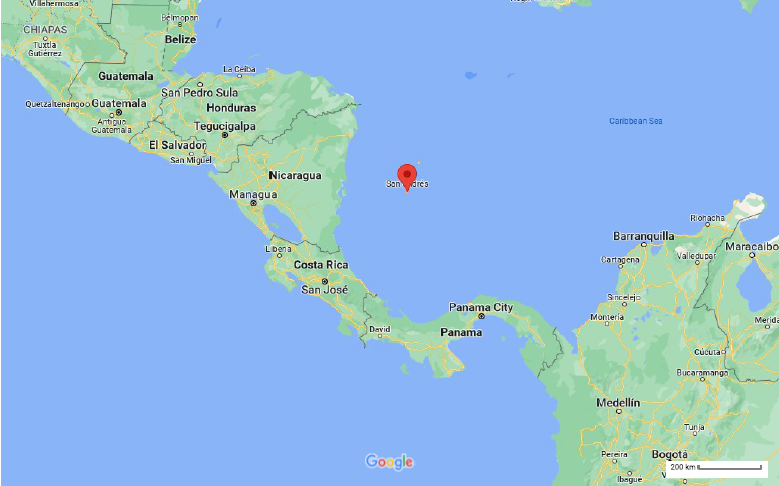
An Italian tourist has died after being bitten by a Shark while snorkelling of a beach on San Andres Island on the Caribbean coast of Colombia on Friday 18 March 2022. Antonio Straccialini, 56, from the Abruzzo Region of Italy was received a single bite to the thigh, and while he was able to pull himself out of the water, he died of blood-loss shortly after. The identity of the Shark is not completely certain, but there are reports of a pair of Tiger Sharks, Galeocerdo cuvier, being seen in the area before the attack, and this species is known to occasionally attack Humans.

A Tiger Shark in the Bahamas in 2012. Albert Kok/Wikimedia Commons.

Despite their fearsome reputation, attacks by Sharks are relatively rare and most attacks on Humans by Sharks are thought to be mistakes. Tiger Sharks have a diverse diet, including invertebrates, Fish, Birds, Marine Reptiles and Marine Mammals, which we superficially resemble when we enter the water. Marine Mammals are attacked principally for their thick adipose (fat) layers, which are a nutritious high-energy food, but which we lack. Due to this, when Sharks do attack Humans, these attacks are often broken off without the victim being consumed. Such attacks frequently result in severe injuries, but are seldom immediately fatal, and victims are likely to survive if they receive immediate medical attention.

 
The location of San Andreas Island. Google Maps.

Following the incident there are reports of local people organising a Shark hunt to find and kill the offending Animal, despite the fact that this is illegal in Colombia, where Sharks are protected, as well as pictures having been posted on social media of hunters with a dead Nurse Shark, Ginglymostoma cirratum, a species considered to present no threat to Humans. This has been condemned by environmental groups in Colombia, and in particular Colombian actor and dive master Victor Mallarino, who has observed that this response is completely inappropriate, and a consequence of poor public education about Sharks in the country. In Italy, meanwhile, many people are questioning why no alarm was raised after a Shark of a species considered to be dangerous was seen in the viacinity of Human bathers.

See also...


Follow Sciency Thoughts on Facebook.

Follow Sciency Thoughts on Twitter. 


Saturday, 28 December 2019

Human remains found inside Shark caught off Réunion Island identified.

A set of partial Human remains found inside a 3.4 m Tiger Shark, Galeocerdo cuvier, caught off the coast of La Réunion, an island in the western Indian Ocean which is a department of France, on Thursday 26 December 2019, have been identified. The remains comprised a pair of arms plus an item of jewelry, which has been identified as having belonged to an elderly kayaker who went missing off the island on 12 December. The shark was caught as part of a research program studying the feeding behaviour of the Sharks, following a number of attacks on Humans around La Réunion. This is the third Shark-related fatality recorded around the island this year.

A Tiger Shark, Galeocerdo cuvier, in the Western Indian Ocean. Thomas Peschak/Save Our Seas Foundation.

Despite their fearsome reputation, attacks by Sharks are relatively rare and most attacks on Humans by Sharks are thought to be mistakes. Tiger Sharks have a diverse diet, including invertebrates, Fish, Birds, Marine Reptiles and Marine Mammals, which we superficially resemble when we enter the water. Marine Mammals are attacked principally for their thick adipose (fat) layers, which are a nutritious high-energy food, but which we lack. Due to this, when Sharks do attack Humans these attacks are often broken off without the victim being consumed. Such attacks frequently result in severe injuries, but are seldom immediately fatal, and victims are likely to survive if they receive immediate medical attention.

See also...

https://sciencythoughts.blogspot.com/2019/11/two-english-tourists-injured-in-shark.htmlhttps://sciencythoughts.blogspot.com/2019/10/tourist-badly-imjured-in-shark-attack.html
https://sciencythoughts.blogspot.com/2019/08/sharks-and-rays-from-eocene-of.htmlhttps://sciencythoughts.blogspot.com/2019/06/mollisquama-mississippiensis-new.html
https://sciencythoughts.blogspot.com/2019/06/american-tourist-killed-in-shark-attack.htmlhttps://sciencythoughts.blogspot.com/2019/06/icelandic-fishermen-fired-for-cruelty.html
Follow Sciency Thoughts on Facebook.

Friday, 28 June 2019

American tourist killed in Shark attack in the Bahamas.

An American student has died after being attacked by three Tiger Sharks, Galeocerdo cuvier, while holidaying in the Bahamas. Californian Jordan Lindsay, 21, was snorkeling of Rose Island, when she was attacked by three Sharks, which bit her on the legs and buttocks as well as removing her right arm. Such attacks are extremely rare (the Bahamas only recorded four Shark attacks in the period 2007-2016, including a single fatality), and experts in the region are trying to work out what triggered the incident.

Jordan Lindsay, 21, of Torrence, California, killed in a Shark attack in the Bahamas. Evening Standard.

Despite their fearsome reputation, attacks by Sharks are relatively rare and most attacks on Humans by Sharks are thought to be mistakes. Tiger Sharks have a diverse diet, including invertebrates, Fish, Birds, Marine Reptiles and Marine Mammals, which we superficially resemble when we enter the water. Marine Mammals are attacked principally for their thick adipose (fat) layers, which are a nutritious high-energy food, but which we lack. Due to this, when Sharks do attack Humans these attacks are often broken off without the victim being consumed. Such attacks frequently result in severe injuries, but are seldom immediately fatal, and victims are likely to survive if they receive immediate medical attention.

A Tiger Shark in the Bahamas. Albert Kok/Wikimedia Commons.

See also...

https://sciencythoughts.blogspot.com/2019/06/icelandic-fishermen-fired-for-cruelty.htmlhttps://sciencythoughts.blogspot.com/2019/06/teenager-injured-by-shark-in-north.html
https://sciencythoughts.blogspot.com/2019/06/sphyrna-mokarran-pregnant-great.htmlhttps://sciencythoughts.blogspot.com/2019/05/californian-man-killed-by-shark-off.html
https://sciencythoughts.blogspot.com/2019/05/diprosopovenator-hilperti-new-species.htmlhttps://sciencythoughts.blogspot.com/2019/05/identifying-sharks-and-rays-from-waters.html
Follow Sciency Thoughts on Facebook.

Thursday, 7 December 2017

American tourist killed by Shark in Costa Rica.

An American tourist has died after being attacked by a Tiger Shark, Galeocerdo cuvier, off the coast of Cocos Island, a Costa Rican territory in the Pacific Ocean, on Thursday 30 November 2017. Rohina Bhandari, 49, of New York was part of a diving expedition that was attacked by the animal, and was one of two people who received bites, along with a dive organiser, before the Shark broke off the attack and departed. Ms Bhandari was alive when pulled from the water, but had received a number of severe bites to her limbs and died despite receiving prompt medical treatment.

Rohina Bhandari, killed by a Tiger Shark off the coast of Cocos Island on 30 November 2017. Billy Farrell/Patrick McMullan/Getty Images.

Despite their fearsome reputation, attacks by Sharks are relatively rare and most attacks on Humans by Sharks are thought to be mistakes. Tiger Sharks have a diverse diet, including invertebrates, Fish, Birds, Marine Reptiles and Marine Mammals, which we superficially resemble when we enter the water. Marine Mammals are attacked principally for their thick adipose (fat) layers, which are a nutritious high-energy food, but which we lack. Due to this, when Sharks do attack Humans these attacks are often broken off without the victim being consumed. Such attacks frequently result in severe injuries, but are seldom immediately fatal, and victims are likely to survive if they receive immediate medical attention.

A Tiger Shark, Galeocerdo cuvier. Albert Kok/Wikimedia Commons.

See also...

http://sciencythoughts.blogspot.co.uk/2017/12/californian-student-recovering-after.htmlhttp://sciencythoughts.blogspot.co.uk/2016/09/megachasma-alisonae-megamouth-shark.html
http://sciencythoughts.blogspot.co.uk/2016/01/mollisquama-sp-pocket-shark-from-gulf.htmlhttp://sciencythoughts.blogspot.co.uk/2015/11/evidence-of-shark-predation-on-whale.html
http://sciencythoughts.blogspot.co.uk/2015/07/carcharocles-megalodon-did-megashark.htmlhttp://sciencythoughts.blogspot.co.uk/2015/06/gogoselachus-lynnbeazleyae-first.html
Follow Sciency Thoughts on Facebook.