Sunday, 30 August 2015

Preservation of haemoglobin-derived chemicals in a fossil Mosquito from the Eocene of Montana.


The 1993 film Jurassic Park speculated that Dinosaur DNA might be extracted from blood preserved inside Mosquitoes, Culcidae, trapped in amber during the Mesozoic. Needless to say this is highly improbable for a number of reasons, most notably that fossils preserved in amber, while retaining physical shape, are known to be chemically altered during the preservation process. A less obvious flaw in this story is that Mosquitoes do not typically favour woodland environments, and are therefore rather rare as fossils preserved in amber, though a number of Biting Midges, Ceratopogonidae, are known from amber, and some of these have been found in association with preserved Trypanosome parasites, which are spread by blood-sucking Insects, implying that these fossil Midges were blood-feeders.

In a paper published in the Proceedings of the National Accademy of Sciences of the United States of America on 12 November 2013, Dale Greenwalt of the Department of Paleobiology at the National Museum of Natural History, Yulia Goreva of the Department of Mineral Sciences at the National Museum of Natural History, Sandra Siljeström, also of the Department of Mineral Sciences at the National Museum of Natural History, as well as the Geophysical Laboratory at the Carnegie Institution and the Department of Chemistry, Materials, and Surfaces at the SP Technical Research Institute of Sweden, Tim Rose, again of the Department of Mineral Sciences at the National Museum of Natural History and Ralph Harbach of the Department of Life Sciences at the Natural History Museum in London describe the presence of haemoglobin-derived chemicals in a fossil Mosquito from the Middle Eocene Kishenehn Formation of Montana.

The Kishenehn Formation comprises finely bedded shales laid down in anoxic conditions at the bottom of a lake about 46 million years ago. These shales have produced a number of very well preserved Mosquitoes, which have been assigned to two species, Culiseta kishenehn and Culiseta lemniscata, both interpreted to be small Bird-feeding species. One of these appears to be a blood-engorged female (only female Mosquitoes suck blood, and then only before producing eggs), which Greenwalt et al. chose for testing for haemoglobin derived products. This specimen was well enough preserved to assign it to the genus Culiseta but not to a specific species, though the abdomen region was well preservesd.

Culiseta species (Diptera: Culicidae), a blood-engorged female from the Middle Eocene Kishenehn Formation of northwestern Montana. Note the distended and opaque dark-coloured abdomen. Scale Bar is 2 mm. Greenwalt et al. (2015).

The most obvious indicator of haemoglobin is iron; however iron is a very common element in fossil preservation, particularly is fossils such as those from the Kishenehn Formation which were preserved in anoxic waters, where sulphur-iron Bacteria typically play a role in preservation. In order to establish whether the engorged female Mosquito contained more iron than would be expected, Greenwalt et al. also tested a male Mosquito from the same formation (male Mosquitoes do not suck blood). Samples of material from the abdomens of both specimens were tested for iron with mass spectrometry, revealing that the female did indeed contain raised levels of iron, suggesting the presence of haemoglobin derived chemicals.

Culiseta species (Diptera: Culicidae), a male from the Middle Eocene Kishenehn Formation of northwestern Montana. The white dots indicate the areas of that were analysed. Scale Bar is 2 mm. Greenwalt et al. (2015).

Next Greenwalt et al. tested the specimens for porphyrins, a group of proteins from which haemoglobin molecules are constructed, and which it breaks back down to as it decays. These could be used to definitively indicate the presence of vertebrate blood in the Mosquito at the time of death. Porphyrins are not exclusively produced by vertebrates; chlorophyll is composed of porphyrins as are the haemocyanin molecules used to transport oxygen in some invertebrates (but not Mosquitoes), and many microorganisms also use porphyrins. However no known organism produces porphyrins in any appreciable quantities in an anoxic environment, so any porphyrins found in the specimens are likely to have got there before the Mosquitoes died.

Using time-of-flight secondary ion mass spectrometry Greenwalt et al. were able to detect haemoglobin-derived porphyrin molecules in the female Mosquito, but not the male, suggesting that this specimen was indeed gorged with vertebrate blood at the time of death. This is the first detection of blood derived chemicals in a blood-feeding Insect known in the fossil record.

See also…

Winter Crane Flies (Trichoceridae) are large True Flies (Diptera) with a (slightly erroneous) reputation for being tolerant of cold conditions. In fact a few species are capable of remaining active in winter, with some even mating and laying eggs beneath snow cover, but other members of the group are no more tolerant of...

Non-biting Midges (Chironomidae) are small Flies closely related to the Biting Midges, Solitary Midges and Blackflies. They closely resemble Mosquitoes, but despite their appearance and relationships, they are quite harmless, lacking biting mouthparts. It was...

Mosquitoes are small Flies notorious for their habit of sucking blood. Only the females do this, the males...


Follow Sciency Thoughts on Facebook.


Saturday, 29 August 2015

Nisada stipitata: A new species of Cyanobacteria from the coast of Oaxaca State, Mexico.


Cyanobacteria are filament-forming photosynthetic Bacteria which often form dense mats by extruding polysaccharide films, which bind the individual filamentous colonies together as well as attaching them to surfaces. These mats are among the first biological traces found in the geological record, with stromatolites (deposits in which thin layers of microbial mat alternate with other sedimentary deposits such as limestone or sands) being found in some of oldest sedimentary formations on Earth. Modern Cyanobacteria are found in all modern ecosystems where there is light, including desert sands and the surfaces of glaciers, but their full diversity is poorly understood, though the group is no longer thought to be monophyletic (it is no longer thought that all members of the group are descended from a single common ancestor) and there are likely to be many undiscovered species living in poorly explored environments.

In a paper published in the journal Phytotaxa on 24 July 2015, Michelle Gold-Morgan, Laura González-Resendiz, Hilda León-Tejera and Gustavo Montejano of the Departamento de Biología Comparada at the Universidad Nacional Autónoma de México describe a new species of Cyanobacteria from rocky shores on the coast of Oaxaca State, Mexico.

The new species is named Nisada stipitata, where ‘Nisada’ means ‘marine’ in the indigenous Zapotec language spoken in parts of Oaxaca State and ‘stipitata’ meand ‘stipulate’ (having dots) in Latin. The species is described from colonies found living on granitic rocks on the coast of Oaxaca near San Agustín in Huatulco, where the Sierra Madre del Sur mountains meat the sea in a series of rocky bays and cliffs. Nisada stipitata forms colonies up to 5 mm thick, with each colony consisting of a biofilm to which numerous coccoid (spherical) cells are attached by short stipes (stems).

Morphology of Nisada stipitata. (A) Macroscopic view of partially covered rock (black portion). (B) Macroscopic view of strip of biofilm on rock. (C) Pseudofilament apices in fluorescent microscopy. (D) Edge of biofilm with pseudofilaments in a row. (E) Apices of morph 2 before cell division (single arrow) and after division but before separation (double arrow). Gold-Morgan et al. (2015).

The coccoid cells show distinct polarity, which is to say that they have distinct ends, despite being spherical. The stipes of the cells form distinct rows in on the biofilm, with each stipe supporting one-to-three cells; this is connected to the way in which the cells divide, either in or at 90˚ to the plane of the stipe-row, with each parent cell apparently splitting into two daughter cells, one of which then itself splits in two, resulting in three cells on the stipe. Further divisions after this are not seen, and numerous stipes were found without cells, suggesting a distributive phase (cells leaving the stipe and either settling in the biofilm or forming new colonies).

Line drawings of Nisada stipitata. (A) Edge of biofilm with pseudofilaments in a row. (B) Complete pseudofilament of morph 1. (C) Complete pseudofilament of morph 2. Ps, pseudofilament sheath; dc, daughter cell; c, cup; mc, mother cell; st, stipe; p, pad; cs, colonial sheath. Scale bars: (A) 8 μm, (B, C) 6 μm. Gold-Morgan et al. (2015).

Insufficient material of Nisada stipitata was recovered to allow a DNA comparison to other Cyanobacteria (which is generally considered the best way to compare and classify any Bacterium), and it did not prove possible to cultivate the species in the lab. However reproductive strategies and in particular splitting plains are considered significant in the classification of these organisms, and the pattern of splitting seen in Nisada stipitata is sufficiently unique that Gold-Morgan et al. are confident in their diagnosis of the colonies as a new species.

(Top) Line drawing of life cycle of morph 1. (Bottom) Line drawing of life cycle of morph 2. . Gold-Morgan et al. (2015).

See also…

Water quality is a major issue in South Africa, where efforts to expand clean water supplies to the whole population in the post-Apartheid era have faced severe challenges due to a limited supply of potable...


In the nineteenth century the origin of life seemed an intractable problem for palaeontologists, with large complex animal fossils appearing in the Cambrian explosion, but scientists having access to neither examples of earlier fossils nor the means with which to examine them. However from the early twentieth...


Cyanobacteria are filament-forming photosynthetic Bacteria found across the globe and with a fossil record dating back over 3.5 billion years. They are thought to have been the first organisms on Earth to obtain carbon through photosynthesis, and it is also thought that the...


Follow Sciency Thoughts on Facebook.

Magnitude 1.8 Earthquake in Derbyshire, England.

The British Geological Survey recorded a Magnitude 1.8 Earthquake at a depth of 1 km about 1 km to the east of the town of Chapel-en-le-Frith in the Peak District in Derbyshire, England slightly before 1.30 pm British Summertime (slightly before 12.30 pm GMT) on Wednesday 26 August 2015. There are no reports of any injuries associated with this event, though it may have been felt locally.

The approximate location of the 26 August 2015 Peak District Earthquake. Google Maps.

Earthquakes become more common as you travel north and west in Great Britain, with the west coast of Scotland being the most quake-prone part of the island and the northwest of Wales being more prone  to quakes than the rest of Wales or most of England. However, while quakes in southern England are less frequent, they are often larger than events in the north, as tectonic presures tend to build up for longer periods of time between events, so that when they occur more pressure is released.

The precise cause of Earthquakes in the UK can be hard to determine; the country is not close to any obvious single cause of such activity such as a plate margin, but is subject to tectonic pressures from several different sources, with most quakes probably being the result of the interplay between these forces.

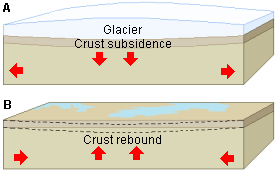
Britain is being pushed to the east by the expansion of the Atlantic Ocean and to the north by the impact of Africa into Europe from the south. It is also affected by lesser areas of tectonic spreading beneath the North Sea, Rhine Valley and Bay of Biscay. Finally the country is subject to glacial rebound; until about 10 000 years ago much of the north of the country was covered by a thick layer of glacial ice (this is believed to have been thickest on the west coast of Scotland), pushing the rocks of the British lithosphere down into the underlying mantle. This ice is now gone, and the rocks are springing (slowly) back into their original position, causing the occasional Earthquake in the process.

(Top) Simplified diagram showing principle of glacial rebound. Wikipedia. (Bottom) Map showing the rate of glacial rebound in various parts of the UK. Note that some parts of England and Wales show negative values, these areas are being pushed down slightly by uplift in Scotland, as the entire landmass is quite rigid and acts a bit like a see-saw. Climate North East.

Witness accounts of Earthquakes can help geologists to understand these events, and the structures that cause them. If you felt this quake, or were in the area but did not (which is also useful information) then you can report it to the British Geological Survey here.

See also...

The British Geological Survey recorded a Magnitude 1.1 Earthquake at a depth of 7 km between the villages of Sutton on the Hill and Marston on Dove in south...


A seven-year-old girl has escaped with cuts and bruises after falling into an 8 m sinkhole near her home in Shuttlewood, Derbyshire. Daisy-Mae Jones was playing with friends in a field near her home when she fell into the whole, which was about a meter across...

A sinkhole 50 m across and 40 m deep opened up near the village of Foolow in the Peak District, Derbyshire, England, early in the morning of Monday 30 December 2013. No buildings were damaged nor any...

Follow Sciency Thoughts on Facebook.

Tropical Storm Erika kills at least 25 in the Caribbean.

At least 36 people are known to have died and over 50 more are missing after Tropical Storm Erika swept across the islands of Dominica, Puerto Rico and Hispaniola this week. On Thursday 27 August the storm swept across the island of Dominica, bringing 38 cm of rain within 24 hours and causing widespread flooding and a number of landslides. Landslides are a common problem after severe weather events, as excess pore water pressure can overcome cohesion in soil and sediments, allowing them to flow like liquids. Approximately 90% of all landslides are caused by heavy rainfall. Twenty people have been confirmed dead on the island, and at least 31 more are known to be missing, with the death toll likely to rise as contact is made with remote parts of the mountainous country, where much of the transport infrastructure has been knocked out.

Flood damage in Roseau, Dominica on 28 August 2015. Robert Tonge/EPA.

After leaving Dominica the storm next passed over Puerto RIco, where power to around 200 000 households was cut, and crops with an estimated value of US$16 million, then the southern tip of Hispaniola, where it caused further flooding and at least five deaths. One person died in a landslide to the north of Port-au-Prince in Haiti, and four more were killed and another eleven injured after a truck carrying clairin (a form of raw liquor distilled from cane sugar) crashed into a bus shelter in heavy rain at Leogane and reportedly exploded.

The path to date of Tropical Storm Erika. Tropical Storm Risk.

Following its passage across southern Hispaniola the storm passed over the eastern part of Cuba, where it brought around two hours of heavy rain around the city of Santiago, prompting authorities to evacuate around 2000 people from low-lying areas.

Storm surge at Santo Domingo in the Dominican Republic on 28 August 2015. Erika Santelices/AFP.

Tropical storms are caused by the warming effect of the Sun over tropical seas. As the air warms it expands, causing a drop in air pressure, and rises, causing air from outside the area to rush in to replace it. If this happens over a sufficiently wide area then the inrushing winds will be affected by centrifugal forces caused by the Earth's rotation (the Coriolis effect). This means that winds will be deflected clockwise in the northern hemisphere and anti-clockwise in the southern hemisphere, eventually creating a large, rotating Tropical Storm. They have different names in different parts of the world, with those in the northwest Atlantic being referred to as hurricanes.

Damage to a home in Port-au-Prince, Haiti, on 29 August 2015. Dieu Nalio Chery/AP.

Despite the obvious danger of winds of this speed, which can physically blow people, and other large objects, away as well as damaging buildings and uprooting trees, the real danger from these storms comes from the flooding they bring. Each drop millibar drop in air-pressure leads to an approximate 1 cm rise in sea level, with big tropical storms capable of causing a storm serge of several meters. This is always accompanied by heavy rainfall, since warm air over the ocean leads to evaporation of sea water, which is then carried with the storm. These combined often lead to catastrophic flooding in areas hit by tropical storms.

See also...

Hurricane Arthur swept across the Outer Banks Islands of North Carolina on Friday 4 July 2014, causing flooding and disruption but with no reports of loss of life or serious damage. Maps of the...


Five members of of one family received minor injuries as part of a facade on the Brooklyn Bridge, New York, collapsed during...

Twelve people have died when a mudslide buried a bus in Altotonga in Veracruz State, Mexico, on Monday 16 September 2013. The...


Follow Sciency Thoughts on Facebook.

Cryptosporidium discovery at water treatment plant leaves around 300 000 without drinkable water in Lancashire, England.

Around 300 000 homes were left without drinkable water after the parasitic microorganism Cryptosporidium was discovered at the United Utilities operated Franklaw Water Treatment Plant near Preston in Lancashire, northwest England, on Thursday 6 August 2015. The parasite, which causes stomach cramps and diarrhea and which can cause severe and persistent infections in small children and people with immunological disorders, is notoriously hard to remove by the use of disinfectants and is best eradicated from water supplies with exposure to ultraviolet radiation. For this reason around 300 000 customers in the Blackpool, Chorley, Fylde, Preston, South Ribble and Wyre areas were advised to boil all water prior to use for consumption or cleaning from 7 August onwards. On Thursday 27 August United Utilities lifted the boil water on about 80 000 homes in the Preston, Blackpool and Chorley areas, and the company hopes to restore normal water supplies to all of its customers within a week.

Cryptosporidium: Mature schizont releasing merozoites. The spherical organisms releasing the crescent-shaped merozoites are seen attached to the microvillus brush border. RE Pugh/Deb Stenzel/Laurine Moreau.

Cryptosporidium is an Apicomplexan Protist (single celled Eukaryote, an organism having a cell nucleus) related to the pathogenic Toxoplasma and Malaria causing Plasmodium, though unlike these organisms it causes infections in Mammals and Birds without an intermediate invertebrate host. The organisms live and reproduce inside the small intestines of their hosts, producing large numbers of hardy cysts which are expelled in feces, and which can survive outside a host for long periods of time. It is these cysts which are resistant to disinfectants, making them problematic if they reach water treatment plants, swimming pools or similar man-made environments. Eventually the cysts reach a new host, typically via consumption of water, and mature to become reproductive schizonts, causing a new infection and repeating the infection cycle.

See also...

Water quality is a major issue in South Africa, where efforts to expand clean water supplies to the whole population in the post-Apartheid era have faced severe challenges due to a limited supply of potable...


Free-living Amoebae are unicellular protozoan’s common in aquatic ecosystems, which are also known to colonize Human created water systems such as water supply systems and swimming pools. Whilst in some ways these organisms can be helpful, consuming a range of Bacterial, Viral and Fungal pathogens...


Toxoplasma gondii is a protozoan parasite that affects humans, and many other animals, across the globe. While it causes disease in many organisms, it reproduces only in Felids, particularly in Domestic Cats, with oocysts (egg-like cysts) being shed in Cat faeces spreading the disease to many other organisms...


Follow Sciency Thoughts on Facebook.

Lonchophylla inexpectata: A new species of Nectar-feeding Bat from the Caatinga of Brazil.


Nectar-feeding Bats of the genus Lonchophylla are found tropical South and Central America, where they are important pollinators of some plant groups. There are currently twelve recognized species, with a cluster of smaller species having recently been transferred to another genus, Hsunycteris.

In a paper published in the journal ZooKeys on 22 July 2015, Ricardo Moratelli of the Fiocruz Mata Atlântica of the Fundação Oswaldo Cruz and the Division of Mammals at the National Museum of Natural History and Daniela Dias of the Laboratório de Biologia e Parasitologia de Mamíferos Silvestres Reservatórios at the Instituto Oswaldo Cruz, describe a new species of Nectar-feeding Bats of the genus Lonchophylla, from museum specimens collected in the arid Caatinga habitat (dry shrubland and thorn forest) of northeastern Brazil between 1908 and 1976.

The new species is named Lonchophylla inexpectata, where ‘inexpectata’ means ‘unexpected’. It is based entirely on museum specimens previously ascribed to the species Lonchophylla mordax, a species first described in 1903 from Brazil, and which formerly included populations from as far west as Colombia and Ecuador and as far north as Costa Rica, but which is now regarded as exclusively east-Brazilian in distribution. However, while previous taxonomists have removed distant populations from the species, it is currently considered to inhabit both the wet Atlantic Rainforests and arid Caatinga environment within this region, an improbable juxtaposition of habitats.

Moratelli and Dias examined museum specimens of ‘Lonchophylla mordax’ from both Atlantic Rainforest and Caatinga environments, and found that the Caatinga specimens were persistently paler than the Atlantic Forest specimens, many being described in museum records as ‘faded’. Further investigation revealed that these specimens also had smaller skulls, with narrower, more slender snouts, and slightly different dentition, with a well-developed lingual cusp (cusp on the inner, tongue, side of the tooth) on the fourth premolar, which was absent from the Atlantic Forest specimens.

Dorsal (A) and ventral (B) pelage of Lonchophylla inexpectata. Scale bar is 10 mm. Moratelli & Dias (2015).

Lonchophylla inexpectata has not yet been studied as a separate species in the wild, and its exact distribution is unclear, though museum specimens have been identified that were collected in both Pernambuco and Bahia States. However Moratelli and Dias note that expansion of agriculture in eastern Brazil has led to clearing of many areas of Atlantic Rainforest and its replacement with an artificial environment closer to the arid Caatinga, which may have led to Lonchophylla inexpectata expanding its range.

See also…

The diets of most Bats in the UK (and most other temperate countries) have been well studied in summer, but less so in winter. It was assumed for a long time that since such bats hibernate in winter, then they did not eat in winter months. However it is now known that most bat species cannot survive a whole winter...


Bats (Chiroptera) have long been considered to comprise about 25% of all Mammal species, but in recent years they have been shown to be considerably more diverse than previously thought, with a number of small, widespread Bat species being shown by genetic analysis to be made up of complexes of related but distinct cryptic species. Bats are morphologically...


Disk-winged Bats (Thyroptera) are small insectivorous foliage nesting Bats found in lowland moist forests from Mexico to southeastern Brazil. They are distinguished by small adhesive disks on their feet, an...


Follow Sciency Thoughts on Facebook.

Saturday, 22 August 2015

Magnitude 4.3 Earthquake beneath Escuintla Department, Guatemala.

The United States Geological Survey Recorded a Magnitude 4.3 Earthquake at a depth of 78 km in the west of Esculinta Department in southern Guatemala, slightly before 4.50 am local time (slightly 10.50 am GMT) on Friday 21 August 2015. This event was felt across in the municipality of Jocotenango, though there are no reports of any damage or casualties; which is roughly what would be expected from an Earthquake of this size at this depth; the quake is big enough to be felt over a wide area, but most of its energy has dissipated before the shock-waves reach the surface.

The approximate location of the 21 August 2015 Esculinta Earthquake. Google Maps.

Guatemala is located on the southern part of the Caribbean Plate, close to its boundary with the Cocos Plate, which underlies part of the east Pacific. The Cocos Plate is being pushed northwards by expansion of the crust along the East Pacific Rise, and is subducted beneath the Caribbean Plate along the Middle American Trench, which runs parallel to the south coast of Guatemala and neighboring countries, passing under Central America as it sinks into the Earth's interior. This is not a smooth process, the plates tend to stick together, breaking apart again once the pressure from the northward movement of the Cocos Plate builds up to much, triggering Earthquakes. 

Witness accounts of Earthquakes can help geologists to understand these events, and the structures that cause them. The international non-profit organization Earthquake Report is interested in hearing from people who may have felt this event; if you felt this quake then you can report it to Earthquake Report here.

See also...

The Instituto Nacional de Sismologia, Vulcanologia, Meteorologia, e Hidrologia in Guatemala has ordered an evacuation of communities close to Mount Fuego, an active volcano in the south of the country...


At least three people have died and several dozen more have been injured, following an Earthquake in the southeast of the Mexican state of Chiapas slightly after 6.20 am local time (slightly after 11.20 am GMT)...


The United States Geological Survey Recorded a Magnitude 5.0 Earthquake at a depth of 74.2 km in the east of Esculinta Department in southern Guatemala...


Follow Sciency Thoughts on Facebook.