Saturday, 4 March 2017

Glasgow pub evacauted after chemical spill at nearby nail bar.

A pub in the Finnieston area of Glasgow was briefly evacuated after a chemical spill at a nearby nail bar on Friday 3 March 2017. The Scottish Fire and Rescue Service was called to Lebowskis Bar and Restaurant in Argyle Street slightly after 11.30 am, after a strong chemical smell was noticed. This was later identified as being acetone spilled in a nearby nail bar, and the business was able to reopen once the spill had been contained.

Fire crews attend Lebowskis in Argyle Street, Glasgow, following a chemical spill on 3 March 2017. STV.

Acetone (or propanone, (CH3)2CO) is a widely used organic solvent, that is found in, amongst other things, nail polish remover. It is naturally present in the Human body, and not considered harmful at low levels, though at higher levels it can be more problematic; it is a component of Bee stings, can cause irritation by dissolving subcutaneous fat, and small children and pregnant women are recommended to avoid it. It is however considered a fire hazard, being a flammable liquid that produces abundant fumes (also flammable), and it produces a strong smell that can be alarming to people unfamiliar with it.

See also...

http://sciencythoughts.blogspot.co.uk/2017/02/mercury-spill-leads-to-raod-closure-in.htmlhttp://sciencythoughts.blogspot.co.uk/2017/01/evacuatios-after-ammonia-leak-at-plant.html
http://sciencythoughts.blogspot.co.uk/2016/12/seven-hospitalized-after-acid-spill-at.htmlhttp://sciencythoughts.blogspot.co.uk/2016/12/museum-evacuated-after-chemical-spill.html
http://sciencythoughts.blogspot.co.uk/2016/12/cleanup-underway-after-chemical-spill.htmlhttp://sciencythoughts.blogspot.co.uk/2016/11/evacuations-after-ammonia-spill-in.html
Follow Sciency Thoughts on Facebook.

Asteroid 2017 DT34 passes the Earth.

Asteroid 2017 DT34 passed by the Earth at a distance of 938 600 km (2.44 times the average distance between the Earth and the Moon, 0.63% of the average distance between the Earth and the Sun), slightly after 3.30 pm GMT on Friday 24 February 2017. There was no danger of the asteroid hitting us, though had it done so it would have presented no threat. 2017 DT34 has an estimated equivalent diameter of 5-16 m (i.e. it is estimated that a spherical object with the same volume would be 5-16 m in diameter), and an object of this size would be expected to explode in an airburst (an explosion caused by superheating from friction with the Earth's atmosphere, which is greater than that caused by simply falling, due to the orbital momentum of the asteroid) in the atmosphere between 40 and 25 km above the ground, with only fragmentary material reaching the Earth's surface.

The calculated orbit of 2017 DT34. Minor Planet Center.

2017 DT34 was discovered on 22 February 2017 (two days before its closest approach to the Earth) by the University of Arizona's Mt. Lemmon Survey at the Steward Observatory on Mount Lemmon in the Catalina Mountains north of Tucson. The designation 2017 DT34 implies that the asteroid was the 869th object (object T34) discovered in the second half of February 2017 (period 2017 D).

2017 D34 has a 720 day orbital period and an eccentric orbit tilted at an angle of 3.56° to the plane of the Solar System, which takes it from 0.87 AU from the Sun (i.e. 87% of he average distance at which the Earth orbits the Sun) to 2.26 AU from the Sun (i.e. 2.26% of the average distance at which the Earth orbits the Sun, considerably outside the orbit of the planet Mars). It is therefore classed as an Apollo Group Asteroid (an asteroid that is on average further from the Sun than the Earth, but which does get closer). This means that close encounters between the asteroid and Earth are common, with the last having occurred in April 2014 and the next predicted in February 2019.  

See also...

http://sciencythoughts.blogspot.co.uk/2017/03/fireball-over-northern-texas.htmlhttp://sciencythoughts.blogspot.co.uk/2017/02/asteroid-2017-db-passes-earth.html
http://sciencythoughts.blogspot.co.uk/2017/02/asteroid-2017-df-passes-earth.htmlhttp://sciencythoughts.blogspot.co.uk/2017/02/asteroid-2017-cp32-passes-earth.html
http://sciencythoughts.blogspot.co.uk/2017/02/looking-for-pieces-of-piecki-meteor.htmlhttp://sciencythoughts.blogspot.co.uk/2017/02/asteroid-2017-bq6-approaches-earth.html
Follow Sciency Thoughts on Facebook.

Friday, 3 March 2017

Salmonella enterica: Enteric Fever Bacterium recovered from a sixteenth century Mexican grave.

From the end of the fifteenth century onwards the conquest of the Americas by European powers was accompanied by a series of major epidemics which caused declines in indigenous populations of up to 95% and which often reached areas ahead of the Europeans themselves. Old World diseases such as Smallpox, Measles, Mumps, and Influenza have been recorded as causing such outbreaks among Native Americans in the eighteenth and nineteenth centuries, but the causes of earlier epidemics are less clear; modern ideas on disease were yet to develop, making diagnosis of disease in the way we think of it impossible, and the recording of symptoms highly subjective (even assuming that disease-causing micro-organisms have not evolved in ways that have caused their symptoms to change). Some success has been made in diagnosing diseases from archaeological sites where pathogens induce symptoms that cause pathological modification of the skeleton (such as Syphilis or Leprosy), but most infections cause no such damage, with many fatal diseases attacking soft tissues to rapidly for the skeleton to be affected before death. 

In a paper published on the bioRxiv prepring database on 8 February 2017, Åshild Vågene of the Max Planck Institute for the Science of Human History, Michael Campana of the Department of Human Evolutionary Biology at Harvard University and the Institute of Evolutionary Medicine at the University of Zurich, Nelly Robles García of the Teposcolula-Yucundaa Archaeological Project of the National Institute of Anthropology and History in Mexico, Christina Warinner, Maria Spyrou, and Aida Andrades Valtueña, also of the Max Planck Institute for the Science of Human History, Daniel Huson of the Center for Bioinformatics at the University of Tübingen, Noreen Tuross, also of the Department of Human Evolutionary Biology at Harvard University, and Alexander Herbig, Kirsten Bos and Johannes Krause, also of the Max Planck Institute for the Science of Human History, describe the results of a palaeopathological study of remains from the middle sixteenth century Grand Plaza and Churchyard cemeterie at Teposcolula-Yucundaa in Oaxaca State Mexico.

Vågene et al. used a genetic pathogen-screening program that was able to test samples for genetic traces of a wide range of disease-causing organisms. Many previous studies have found genetic material from pathogens in archaeological remains, but earlier techniques were only able to screen for a small number of organisms, with the effect that such studies could only be carried out where skeletal modification or historical records gave scientists a rough idea what they were looking for. 

The Teposcolula-Yucundaa cemeteries was used between 1545 and 1550, by a highland Mixtec population that were being struck down by a disease recorded by the Spanish as ‘Pujamiento de Sangre’, or ‘full bloodiness’ and the Aztecs as ‘Cocoliztli’ or ‘pestilence’. The bodies were buried in multiple occupancy graves which were subsequently covered over by stone slabs; the site was abandoned shortly after the epidemic, reducing the chance of subsequent contamination of the remains.
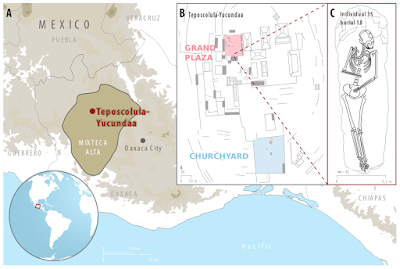
Overview of Teposcolula-Yucundaa. (A) Illustrates the location of the Teposcolula-Yucundaa site in the Mixteca Alta region of Oaxaca, Mexico; (B) central administrative area of Teposcolula-Yucundaa showing the relative positioning of the Grand Plaza and churchyard cemetery sites. Burials within each cemetery are indicated with dark grey outlines and the excavation area is shaded in grey; (C) drawing of individual grave. Vågene et al. (2017). 

Vågene et al. extracted material from the tooth pulp-cavities of 24 skeletons from Grand Plaza and five from the Churchyard Cemetery. This was then screened for DNA from a variety of Human oral and soil microbiota. Three of these tested positive for the Bacterium Salmonella enterica, a major cause of Enteric Fever.

A variety of causes have previously been suggested for the Cocoliztli epidemic of 1545-50, including Typhus or Typhoid Fever, Measles, and Bubonic Plague. Enteric Fever, a condition associated today with food poisoning, is a less obvious candidate, but the infection pattern associated with the Bacterium does make it a plausible cause of the epidemic. Infection results in severe diarrhea, with infection spreading through food or water that encounters the faeces of sufferers. Victims remain infectious after symptoms have cleared, and a small proportion become carriers, remaining infectious for long periods without showing any symptoms. Such carriers could potentially cross the Atlantic on ships without the disease being detected, thereby reaching Native American communities that had not previously encountered the disease.

Communities in Mexico (and other areas under Spanish rule) would have been particularly vulnerable to this, due to the policy of congregación, under which Native populations were forcibly resettled in new communities, making them easier to control. This policy was often associated with rapid declines in population (as much as 90% in some areas), as people were moved into much closer proximity to one another at the same time as they were introduced to new diseases. Enteric Fever would be particularly dangerous under such circumstances, as forced relocation would lead to the breakdown of traditional hygiene arrangements, without necessarily implementing any suitable replacement. 

See also...
 
http://sciencythoughts.blogspot.co.uk/2016/12/smallpox-virus-recovered-from.htmlhttp://sciencythoughts.blogspot.co.uk/2016/05/decapod-crustaceans-from-tarioba-shell.html

http://sciencythoughts.blogspot.co.uk/2015/11/genotyping-500-year-old-inca-child-mummy.htmlhttp://sciencythoughts.blogspot.co.uk/2015/05/evidence-of-leprosy-in-from-early-anglo.html
http://sciencythoughts.blogspot.co.uk/2015/04/late-pleistocene-lithic-artefacts-from.htmlhttp://sciencythoughts.blogspot.co.uk/2014/10/parasite-infections-in-german-soldiers.html
Follow Sciency Thoughts on Facebook.

Thursday, 2 March 2017

Fireball over northern Texas.

The American Meteor Society has received reports of a bright fireball meteor being seen over parts of the the southwest United States slightly before 8.00 pm on Sunday 26 February local time (slightly before 3.00 am on Monday 27 February GMT). The majority of the reports came from the northern Texas, but sightings were also reported from Colorado, New Mexico, Kansas and Oklahoma. A fireball is defined as a meteor (shooting star) brighter than the planet Venus. These are typically caused by pieces of rock burning up in the atmosphere, but can be the result of man-made space-junk burning up on re-entry.

The 26 February 2017 Texas Fireball seen from Hawley in Texas. Kevin Palivec/American Meteor Society.

Objects of this size probably enter the Earth's atmosphere several times a year, though unless they do so over populated areas they are unlikely to be noticed. They are officially described as fireballs if they produce a light brighter than the planet Venus. It is possible that this object will have produced meteorites that reached the surface (an object visible in the sky is a meteor, a rock that falls from the sky and can be physically held and examined is a meteorite).

Witness reports can help astronomers to understand these events. If you witnessed this fireball you can report it to the American Meteor Society here. 

See also...

http://sciencythoughts.blogspot.co.uk/2017/02/looking-for-pieces-of-piecki-meteor.htmlhttp://sciencythoughts.blogspot.co.uk/2017/02/fireball-over-american-mdwest.html
http://sciencythoughts.blogspot.co.uk/2017/02/the-alpha-centaurid-meteors.htmlhttp://sciencythoughts.blogspot.co.uk/2017/01/fireball-over-arkhangelsk-region-of.html
http://sciencythoughts.blogspot.co.uk/2017/01/osterplana-065-unique-meteorite-from.htmlhttp://sciencythoughts.blogspot.co.uk/2016/12/the-quadrantid-meteors.html
Follow Sciency Thoughts on Facebook.

Worker killed at illegal stone quarry in Sylhet Division, Bangladesh.

At least one man died and two more were injured in a rockfall at an illegal quarry in the Companiganj District of Sylhet, Bangladesh, on Thursday 2 March 2017. The man has been identified as Yeakub Ali, 22, of Purba Narayanpara village. The accident happened on a quarry on the Shah Arefin Tila hill, on which at least two other fatal accidents have happened already this year.

An illegal quarry on Shah Arefin Tila hill in Compahiganj District. Daily Star.

Illegal quarrying for stone used in the building industry is a major problem in Sylhet, with hills and river beds the usual targets. The situation has caused major environmental issues in the region, with a number of hills having disappeared completely. The illegal nature of the quarries adds to the dangerous nature of the work; the quarries not only lack any form of health and safety management, they are often also active in the hours of darkness without lighting in order to avoid detection.

See also...

http://sciencythoughts.blogspot.co.uk/2017/02/nine-killed-in-landslide-at-myanmar.htmlhttp://sciencythoughts.blogspot.co.uk/2017/01/collapse-at-illegal-coal-mine-kills-at.html
http://sciencythoughts.blogspot.co.uk/2016/12/rescue-operation-underway-after.htmlhttp://sciencythoughts.blogspot.co.uk/2016/12/lanslide-at-myanmar-jade-mine-may-have.html
http://sciencythoughts.blogspot.co.uk/2016/05/landslide-at-myanmar-jade-mine-kills-at.htmlhttp://sciencythoughts.blogspot.co.uk/2015/12/landslide-kills-at-least-five-at-mine.html
Follow Sciency Thoughts on Facebook.

Magnitude 5.5 Earthquake beneath Cook Inlet, Alaska.

The United States Geological Survey recorded a Magnitude 5.5 Earthquake at a depth of 76.9 km, beneath Cook Inlet, about 42 km to the southwest of Anchorage, Alaska, slightly after 5.10 pm local time on Wednesday 1 March 2017 (slightly after 2.10 am on Thursday 2 March GMT) . There are no reports of any damage or casualties associated with this event, but people have reported feeling it over a wide area of southern Alaska.

The approximate location of the 1 March 2017 Cook Inlet Earthquake. USGS.

Alaska lies on the North American Plate, with the Pacific Plate underlying the ocean to the south. The Aleutian Trench runs along much of the south coast of Alaska, with the Pacific Plate being subducted beneath this and passing under Alaska as it sinks into the Earth. The 4 January quake occurred in the far southeast of the state; east of the extent of the Aleutian Trench. Off the coast of southeast Alaska the Pacific and North American Plates pass one-another horizontally, with the Pacific Plate moving northward and the North American to the south (a transform plate margin). This is not a smooth process, and the plates frequently stick together, then break apart as the pressure builds up, causing Earthquakes.
 
 Model of the subduction of the Pacific Plat beneath the North American Plate along the southern coast of Alaska and the Aleutians. USGS.
 
Witness accounts of quakes can help geologists to understand these events and the rock structures that cause them. If you felt this quake (or if you were in the area but did not, which is also useful information) you can report it to the USGS here.

See also...

http://sciencythoughts.blogspot.co.uk/2016/12/eruptions-on-bogoslof-island.htmlhttp://sciencythoughts.blogspot.co.uk/2016/11/magnitude-52-earthquake-beneath-alaskan.html
http://sciencythoughts.blogspot.co.uk/2016/08/magnitude-38-earthquake-rattles.htmlhttp://sciencythoughts.blogspot.co.uk/2016/07/landslide-deisplaces-about-150-000.html
http://sciencythoughts.blogspot.co.uk/2016/03/eruption-on-mount-pavlof-causes-severe.htmlhttp://sciencythoughts.blogspot.co.uk/2014/06/eruptions-on-mount-pavlof-on-alaskan.html
Follow Sciency Thoughts on Facebook.

Wednesday, 1 March 2017

Eruptions on Mount Etna.

Mount Etna, Italy, began erupting for the first time this year on Monday 27 February, producing fountains of lava and ash and lava flows on its flanks. The activity continued through Tuesday 28 February, and is expected to continue for several more days, but is not thought likely to present an threat to Human settlements.

Lava fountain on Mount Etna on 28 February 2017. Salvatore Allegra/AP.

Etna first erupted about half a million years ago, beneath the sea off the east coast of Sicily, and has been going strong ever since. It now stands 3330 m above sea level, and covers 1200 km³. It is responsible for fertile soils across eastern Sicily. Records of eruptions on Etna go back to 1500 BC. It is Europe's second largest volcano, after Teide in the Canary Islands, and is one of the most active volcanoes in the world.

 The location of Mount Etna. Google Maps.

Despite all this Etna has only ever caused 77 recorded deaths (the most recent being two tourists caught in a summit explosion in 1987) and relatively little destruction. In 1928 it destroyed the village of Mascali on its northeastern flank, though there were no reported casualties, the village being slowly overrun by a lava flow. In 1669 a much larger lava flow destroyed at least 10 villages, reaching the walls of the city of Catania, 40 km to the south, but again without loss of life. In 122 BC a heavy ash fall covered much of the region, causing several buildings to collapse in Catania. The destruction was deemed so severe by the Roman authorities that they granted the city a 10 year tax holiday. In about 6000 BC a landslide on the eastern flank of the volcano is thought to have caused a tsunami that caused destruction around much of the eastern Mediterranean.  

Etna is located on the border of the African and European Plates, specifically where Africa is being subducted beneath the European Plate. As it is drawn into the Earth's interior material from the African Plate melts, and the lighter portions rise up through the overlying European Plate, causing a number of volcanoes including Etna and Vesuvius. 

See also...

http://sciencythoughts.blogspot.co.uk/2017/01/magnitude-57-earthquake-triggers-deadly.htmlhttp://sciencythoughts.blogspot.co.uk/2016/10/basilica-of-st-benedict-destroyed-by.html
http://sciencythoughts.blogspot.co.uk/2016/10/central-italy-shaken-by-pair-of.htmlhttp://sciencythoughts.blogspot.co.uk/2016/05/dozens-of-cars-swallowed-by-sinkhole-in.html
http://sciencythoughts.blogspot.co.uk/2015/12/spectacular-eruption-on-mount-etna.htmlhttp://sciencythoughts.blogspot.co.uk/2015/05/volcanic-activity-on-mount-etna.html
Follow Sciency Thoughts on Facebook.