Monday, 5 February 2024

Patagomaia chainko: A large Therian Mammal from the Late Cretaceous of southern Patagonia.

Our typical perception of Mesozoic Mammals is of small, Shrew-like creatures, which were probably nocturnal in habit. However, recent discoveries have revealed a more diverse range of ecological strategies, including swimming, gliding, and burrowing Mammals, as well as species growing as large as a small Dog. The majority of known fossil Therian Mammals from the Late Cretaceous come from the Laurasian continents of the Northern Hemisphere, which has led to the assumption that this is where these Mammals originated, and that they subsequently radiated into the Southern Hemisphere following the End Cretaceous extinction. This has been contradicted by both genetic and palaeontological evidence that some Therian lineages diversified in the Southern Hemisphere prior to the End of the Cretaceous.

In a paper published in the journal Scientific Reports on 3 February 2024, Nicolás Chimento of the Laboratorio de Anatomía Comparada y Evolución de los Vertebrados at the Museo Argentino de Ciencias Naturales 'Bernardino Rivadavia', and the Consejo Nacional de Investigaciones Científicas y Técnicas, Federico Agnolín, also of the Laboratorio de Anatomía Comparada y Evolución de los Vertebrados at the Museo Argentino de Ciencias Naturales 'Bernardino Rivadavia', and of the Fundación de Historia Natural 'Félix de Azara' at the Universidad Maimónides, and the Consejo Nacional de Investigaciones Científicas y Técnicas, Jordi García‑Marsà, again of the Laboratorio de Anatomía Comparada y Evolución de los Vertebrados at the Museo Argentino de Ciencias Naturales 'Bernardino Rivadavia', and the Consejo Nacional de Investigaciones Científicas y Técnicas, Makoto Manabe of the Japanese National Museum of Nature and Science, Takanobu Tsuihiji  of the Department of Earth and Planetary Science at the University of Tokyo, and Fernando Novas, once again of the Laboratorio de Anatomía Comparada y Evolución de los Vertebrados at the Museo Argentino de Ciencias Naturales 'Bernardino Rivadavia', and the Consejo Nacional de Investigaciones Científicas y Técnicas, describe a new species of Therian Mammal from the lower Maastrichtian Chorrillo Formation of Santa Cruz Province, Argentina.

The new species is named Patagomaia chainko, where 'Patagomaia' is a combination of 'Patagonia' the region of Argentina where the fossil was found, and 'maia', the Greek word for 'mother', and 'chainko', means 'large bone' in the Aonikenk language, which is indigenous to eastern Patagonia. The species is described from two specimens, the first comprising the distal end of the left ulna, two fragments of the preacetabular wing of the left ilium, the acetabular region of the left hemipelvis, a fragment of the ischial blade, the proximal end of the right femur; the distal end of the left femur, the proximal end of the left tibia, and other indeterminate bone fragments, while the second comprises a partial left acetabulum and ischium and an incomplete right femoral shaft.

Images of Patagomaia chainko holotype remains, MPM-PV-23365: (a) fragments of the left pelvis; (b) silhouette and skeletal scheme with details of the preserved bones; (c) distal end of the left ulna; (d) proximal end of the right femur and distal end of the left femur; e, proximal half of the left tibia. Scale bar is 20 mm. Chimento et al. (2024).

A number of features of the femur and associated bones are indicative of Patagomaia chainko having been a Therian Mammal (the group which includes both the Eutherians, or Placental Mammals, and the Metatherians, or Marsupial Mammals), and not in other Mammalian groups present in the Late Cretaceous, such as the Monotremes, Multituberculates, Morganucodontans, and Docodontans. However, it was not possible to place the species precisely within a phylogenetic analysis, as most fossils from the period are known only from teeth and cranial remains.

Simplified time-calibrated cladogram showing the phylogenetic affinities of Patagomaia chainko, geographic location and palaeohistological images. The simplified cladogram shows our interpretation unifying three analyses conducted. Map showing the fossil locality. The specimen was recovered at the new site located at S 50° 30′ 39.888″ and W 72° 33′ 18.035″, close to the Isasicursor 2 site (marked with a red star) in the Maastrichtian Chorillo Formation. Transverse section of the femur (left) showing the External Fundamental System (white arrowheads); and tibia (right) in polarized light with lambda compensator. Abbreviations: ER, Erosion room; PFB, parallel-fibered bone tissue; TB, trabecular bone; VC, vascular canal. Scale bar is 0.75 mm. Chimento et al. (2024).

Patagomaia chainko is estimated to have had a mass of between 2.6 kg and 26 kg in life, with an  average estimate of 14 kg. Whilst this is far from huge,  even the smallest estimate would have made it one of the largest known Mesozoic Mammals, most of which were smaller than 1 kg, and the average size estimate would have made it larger than the estimated sizes of the two largest previously described Mesozoic Mammals, the Early Cretaceous Chinese Eutriconodont, Repenomamus, which has an estimated mass of 10 kg, and the Late Cretaceous Gondwanatherian, Vintana, which has an estimated mass of 8.9 kg.

Most Late Cretaceous Mammals from the Northern Hemisphere have a mass of less than 100 g, with less than 1% of described species estimated to have been larger than 1 kg. In Patagonia 17 Mammalian taxa have previously been described, belonging to a variety of taxa, including the Monotremata, Gondwanatheria and Meridiolestida, with eight species calculated to have exceeded 1 kg in mass. This implies ecological pressures were present in Patagonia which favoured the evolution of larger species at least 5 million years before the End Cretaceous Extinction. 

See also...

Jade mask among items found in Mayan tomb in Guatemala.

A mosaic jade mask is among the items discovered in a 1700-year-old Mayan tomb in Guatemala, according to a press release issued by Tulane University on 29 January 2024. The site, at Chochkitam, close to the borders with Mexico and Belize, was investigated by a team led by archaeologist Fran Blom of the Middle American Research Institute at Tulane University in 1924, but nothing was discovered at that time. In 2022 a series of tunnels was detected in a lidar (Light Detection and Ranging, a system of scanning land surface and near-surface structures from an aircraft using lasers) survey of the area, leading to an investigation on the ground led by Francisco Estrada-Belli of Tulane University. 

A mosaic jade mask discovered inside an ancient Maya tomb dating back 1700 years in Chochkitam, Guatemala, near the borders of what are now Mexico and Belize, on 1 July 2022. Francisco Estrada-Belli/Tulane University.

The tunnels discovered by the lidar survey turned out not to be connected to the tomb, or any other structure, and are thought to have been dug by would-be-looters with some idea that there was a tomb in the area, who eventually gave up before finding it. The actual tomb was located about 2 m from the end of the looters tunnel. This was found to be remarkably intact, although part of the stone ceiling had collapsed, and some natural decay had set in.

The excavation site of an ancient Maya tomb discovered in Chochkitam, Guatemala, near the  borders of what are now Mexico and Belize, on 1 July 2022. The tomb and relics inside date back 1700 years. Francisco Estrada-Belli/Tulane University.

The tomb contains a series of Human femur bones inscribed in a Mayan hieroglyphic script, which identify the occupant of the tomb as a previously unknown Mayan king, listing his father and grandfather, which makes it possible to link him to the Maya states of Tikal in Guatemala and Teotihuacan, to the northeast of Mexico City . The tomb is thought to have been sealed in about 350 AD, and also contains a series of shells of the Mollusc Spondylus, a type of Spiny Oyster, which were used as currency by the Mayans.

Incised femur bone with drawing of the inscription upon it.  Alexandre Tokovinine/Holmul Archaeological Project/Tulane University.

See also...


Sunday, 4 February 2024

Sanfordiacaulis densifolia: A tree with a preserved crown from the Early Carboniferous of New Brunswick, Canada.

The first trees appear in the fossil record during the Middle Devonian, about 393 million years ago, with the first woody trees appearing by about 385 million years ago. The evidence for these early trees is somewhat limited, comprising a variety of impressions in mud- and sandstones, as well as a few mineralized stumps and root-systems. Preserved fossils with root and crown structure attached to trunks are extremely rare. More common are preserved trunks, lacking their roots or crown structures, often in assemblages in which a few dozen trunks would accumulate over tens of millions of years, which give us a reasonable understanding of the early evolution of xylem systems and wood.

Intact trees become more common in the Early Carboniferous, from about 350 million years ago, when peat-forming forests first appeared, often leading to trees 5-7 m in height being preserved with attached rooting structures and sometimes also canopy branches. These trees often retain sufficient architecture to assign them to groups such as the Lycophytes, Pteridophytes, Equisetaleans, and seed-bearing Gymnosperms, even when the reproductive structures which define the groups are absent. This has enabled palaeobotanists to develop an idea of the diversity present in Late Palaeozoic forests, although our understanding of the ecological structure of these forests is much more restricted. 

In a paper published in the journal Current Biology on 2 February 2024, Robert Gastaldo of the Department of Geology at Colby College, and the Department of Paleobiology at the Smithsonian National Museum of Natural History, Patricia Gensel of the Department of Biology at the University of North Carolina, Ian Glasspool, again of the Department of Geology at Colby College, and of the Field Museum of Natural History, Steven Hinds of the Geological Surveys Branch at the New Brunswick Department of Natural Resources and Energy Development, Olivia King of the New Brunswick Museum and the Department of Geology at Saint Mary’s University, Duncan McLean of MB Stratigraphy Ltd, Adrian Park, also of the Geological Surveys Branch at the New Brunswick Department of Natural Resources and Energy Development, Matthew Stimson, also of the New Brunswick Museum and the Deptartment of Geology at Saint Mary’s University, and Timothy Stonesifer, again of the Department of Geology at Colby College, describe a new species of tree from the Early Carboniferous of New Brunswick, Canada, with several specimens preserving a three-dimensional crown structure.

The new species is named Sanfordiacaulis densifolia, where 'Sanfordiacaulis' is a combination of 'Sanford' which is the name of both the quarry where the specimens from which the new species is described where found, and the name of the owners of that quarry, and 'caulis' means stalk, while 'densifolia' refers to the dense foliage of the specimens. The species is described from five trees preserved in close proximity, within a block roughly 2.3 m long and 2 m wide; one of these trunks still remains in situ at the quarry, although there are plans to excavate it and place it in the New Brunswick Museum, where the other four specimens already reside.

Sanford Quarry locality, New Brunswick, Canada (A) Geologic map of Upper Devonian-Lower Carboniferous strata exposed around Norton (red dot) and the Sanford Quarry (yellow star; N 45.627786, W 65.691610). Scale in km. Inset: Canadian Maritime Provinces. (B) August 2023 quarry exposure where white arrow shows the location of primary tree crown. Matthew Stimson (yellow ellipse) for scale. Gastaldo et al. (2024).

The largest trunk is 2.25 m in length and 12-16 cm wide, lacking either a base or an apex, but a second specimen, with a trunk 7-8 cm in diameter, retains a crown. This is comprised of leaves which depart from the trunk at an acute angle, curve outward for about 5–6 cm, and then project up to 1.75 m in length distal to the trunk, being cut off by the edge of the block; the tips are not present. Leaves and leaf scars are arranged in a tight spiral about the stem.

Trunk and petiole features. NBM 22403/1 (A) An approximately 40 cm interval showing helically arranged, mudcast petiole bases in an estimated 1/13 phyllotaxy with coalified and mudcast petioles departing side of the trunk. Scale in cm and mm. (B) Finely striated and adaxially grooved petioles diverge at about 90° to the trunk (white arrows) beneath the apex; petioles are without secondaries. Scale in cm/mm. (C) Petioles diverge from trunk at about a 90° angle. Scale in cm and mm. (D) Divergence of petioles in dimensions reflecting their spiral arrangement. Strong longitudinal ridges mirror the petiole cross-sectional geometry, and striated petioles may exhibit transverse markings, similar to coal cleat, from tectonism. Scale in cm and mm. Gastaldo et al. (2024).

It was not possible to assign Sanfordiacaulis densifolia to any particular group of Plants; the general morphology with tightly packed leaves/leaf stems around a single trunk is a common one, found in numerous fossil extant and extinct Plant groups. However, it is possible to make some assumptions about the ecological role of the living tree. It is calculated to have stood about 2.65 m in height, in a forest that contained Pteridophyte and Pteridosperm trees which reached in excess of 20 m in height. This implies that it was an understory tree, growing beneath much taller trees. Modern trees with this habit often have dense crowns similar to that seen in Sanfordiacaulis densifolia, which enables them to capture as much light as possible in the darker, understory environment.

Actual and reconstructed tree heights and biostratigraphic ranges of Middle Devonian to Pennsylvanian trees Plants depicted based on fossils preserved with either trunks, trunks with attached crowns, or forest elements buried in growth position. Plant reconstructions are Cladoxylales: Calamophyton, Pseudosporochnus, and Eospermatopteris/Wattieza; Progymnosperms: Callixylon, Pitus, and Protopitys; Ferns: Megaphyton and Psaronius; Gymnosperms: Elkinsia, Medullosa, and Alethopteris zeilleri; Lycophytes: Lepidodendron sp., Lepidodendron lycopodioides, and Lepidophloios hallii; and Equisetales: Arthropitys bistrata. Horizontal scale in meters; log₁₀ vertical scale. Plants arranged in chronostratigraphic order according to geologic intervals in which they are reported. Trees that colonised landscapes at two successive geologic intervals are shown as overlapping the time scale. Hence, Callixylon and Pitus are known from both the Late Devonian and Early Mississippian; Medullosa, Alethopteris, and Psaronius are reported first in the middle Mississippian (Visean) and continue into the Pennsylvanian. Horizontal scale in 0.5 m; vertical log scale. Gastaldo et al. (2024).

The development of a stratified forest structure with a layer of understory trees would have had a profound impact on the Early Carboniferous environment. Stratified forests utilise light much more efficiently than non-stratified forests, absorbing more carbon dioxide, and creating a greater range of microhabitats and microclimates. This in turn allows for the existence of a much wider range of smaller organisms to inhabit these new environments. The development of an understory may also have helped the propagation of forest fires, as the understory can act as a ladder, helping fire to ascend from the ground into the canopy, further changing the emerging forest environment.

See also...


Saturday, 3 February 2024

Record number of breeding Eurasian Cranes in the UK in 2023.

In 2023 a record number of Eurasian Cranes, Grus grus, were observed breeding in the UK, with eighty observed pairs, the highest number seen since the species was re-introduced in the 1970s. Eurasian Cranes were once abundant in the UK, but a combination of heavy hunting and the drainage of wetlands to create new agricultural land led to the species becoming locally extinct in the sixteenth century.

A pair of Eurasian Crans, Grus grus, during a courtship dance. RSPB.

While Cranes dissapeared as a resident species, occasional individuals were observed in the East of England in spring and autumn, during their annual migration between their summer breeding grounds in Europe (almost certainly Scandinavia for these Birds) and their wintering grounds in Africa. Then, in 1979, a single pair was observed to remain in the UK, breeding on Hickling Broad in Norfolk. From this point on a growing number of breeding pairs of Cranes were observed on the Norfolk Broads, with the Birds slowly expanding their range to reach Suffolk, Cambridgeshire, and South Yorkshire in England, as well as parts of Aberdeenshire in Scotland.

In addition to this, a reintroduction program was set up on the Somerset Levels in the West of England in the 2010s, with eggs collected from Brandenberg in Austria being incubated and  raised in captivity between 2010 and 2014, before being released onto the Levels. Cranes were first observed breeding in Somerset in 2015, although breeding remained slow their for some years, possibly because the Birds were hand-reared, which can hamper the ability of Birds to acquire courting and chick-rearing skills, but from 2021 onwards the Somerset population began to breed at similar rates to Cranes elsewhere in the UK. In 2022, twenty six pairs of cranes were observed breeding on the Somerset levels, out of a total UK population of 69 breeding pairs of the Birds.

A young Eurasian Crane, Grus grus, in flight on Sutton Fen in Somerset, England. RSPB.

See also...

Friday, 2 February 2024

Images from Japan's Smart Lander for Investigating Moon (SLIM).

The Japanese Aerospace Exploration Agency's Smart Lander for Investigating Moon (SLIM) probe has sent back it's first images, following a not-quite-to-plan landing on 19 January 2024. These images show an area of lunar landscape, and are built up by the synthesis of 257 individual low-resolution images from the probe's Multi-Band Camera (MBC). A number of potentially interesting rocks have been identified for future investigations.

A lunar surface scan mosaic image captured by the SLIM-mounted MBC (left) and its enlarged view (right). The grey area on the right of the mosaic lacks data due to the discontinuation of scanning operation. Japan Aerospace Exploration Agency.

The SLIM probe landed on the edge of Shioli Crater, a small lunar impact crater that is located within the much larger Cyrillus Crater in the Moon's Southern Hemisphere, on 19 January 2024. However, due to a problem with its engines it landed nose-down, then toppled so that its solar panels face to the west, a sub-optimal position which leave it receiving more sunlight than would be ideal. It was able to deploy one of the two small landers it carried, the Lunar Excursion Vehicle (LEV-1), which carried out a series of operations, including becoming the smallest ever independent probe to communicate directly with the Earth from the Moon (LEV-1 weighs only 2.1 kg, of which 90 g is its communication system), before powering down.

The SLIM landing site is now entering the lunar night, which will last for 14 days, and the probe which, which is reliant on solar power, will power down for this period. However, due to the unplanned nature of its landing orientation, it is not completely clear if it will be able to re-awaken at the end of this period.

See also...


Thursday, 1 February 2024

Medieval Ulfberht sword recovered from Polish river.

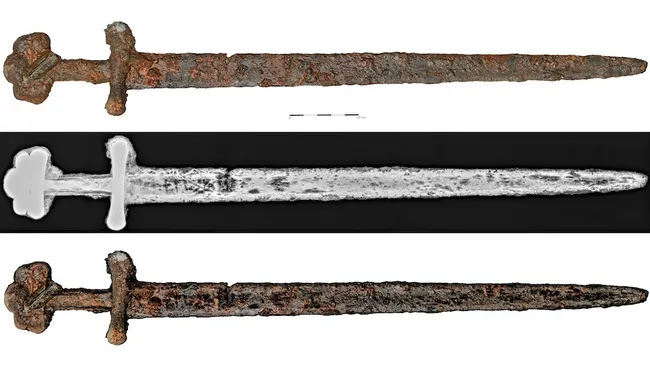
Workers carrying out a dredging operation in the River Wisła in Włocławek in central Poland in the second week of January 2024 recovered an example of a type of sword thought to be over a thousand years old along with a load of river silt. The sword is double-edged with a three-lobed pommel, which are distinctive features of these swords, and when viewed in x-ray could be seen to bear the inscription +VLFBERTH+, which have been found on about 170 similar swords from across Northern Europe and Scandinavia.

This is the eighth Ulfberht sword found in Poland; the country which has produced the largest number of these swords is Norway, with about 40 known to date. This has led to these swords sometimes being referred to as 'Viking' swords, although historians are fairly confident that they are of Frankish origin, and probably from the southern part of the Frankish realm, in southern Germany or possibly even France. These swords date from the ninth and tenth centuries, and are considered to be an intermediate stage between the earlier swords used across northern Europe and the knightly swords of Late Medieval Europe. They are typically made of superior steel to that used in earlier swords, which would have made them stronger and sharper.

The sword shortly after its discovery. Provincial Office for the Protection of Monuments in Toruń.

A ninth or tenth century date for the sword would suggest it was in use around the time of the founding of the modern state of Poland, by the Piast Dynasty, who, according to legend, unified the Slavic tribes of the region, fought for independence from the area's German rulers, defended against raiders from Scandinavia, and introduced Christianity to Poland.

See also...