Wednesday, 30 January 2013

Dutch court fines Shell over pollution in ther Niger Delta.

A court in the Hague ruled that the Shell Petroleum Development Company of Nigeria Ltd., a subsidiary of oil company Shell must pay compensation to a Nigerian farmer for an oil leak that damaged fish ponds in his village. The damage was caused by a leak from a disused wellhead, dubbed the 'Christmas Tree' by locals because of its shape, which sprayed oil into fishponds in Icot Ada Udo village in the Niger Delta, belonging to farmer Friday Alfred Akpan, killing his fish and rendering the ponds unusable.
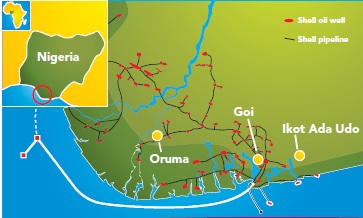
 The location of Ikot Ada Udo, and other villages involved in the case. Milieudefensie/Friends of the Earth Netherlands.

The wellhead was installed in the 1960s as part of an exploratory drilling program, then capped off and effectivelly abandonded when it was decided it would not be profitable to extract oil from the site. It began to leak in the 1990s; workers from Shell coming out when called upon by villigers to cary out ad-hoc repairs. This persisted until August 2007 when the Christmas Tree began to spray oil across the village. This (unsurprisingly) lead to disagreement between the villagers and Shell Nigeria, resulting in no work being carried out until government mediators became involved, with the leak finally sealed in November 2007.

The 'Christmas Tree' in Ikot Ada Udo village. Kadir van Lohuizen/NOOR/Milieudefensie/Friends of the Earth Netherlands.

Shell did not attempt a clean-up in the village until September 2008, by which time the rainy season had come, spreading the oil into fields and fishponds and contaminating the local water suply. Shell Nigeria provided the village with a water tank and pipes, but did not compensate them for the damage to crops and fish ponds.

This prompted Milieudefensie (Friends of the Earth Netherlands), working with NGO partners in Nigeria, to file a case on behalf of Mr Akpan in the Hague against both Shell Nigeria and its Anglo-Dutch parent company, along with four other cases on behalf of villagers in the Delta which the court rejected. Shell had argued that the spill was the result of sabotage, but the court rejected this on the grounds that Shell had an obligation to make the wellhead safe agianst such actions. Milieudefensie now plan to bring actions on behalf of other villagers in Ikot Ada Udo village, and ar considering appealing the other cases. Shell is also currently facing a law suit in London on behalf of 11 000 members of the Bodo community, who were affected by a major spill in 2008.

See also Pipeline explosion in Ogun State, southwest Nigeria, Oil barge explosion in Port of Lagos, Amnesty International reports on the 2012 Bodo Oil Spill, Explosion aboard oil vessel in Port Harcourt, Nigeria, and Oil spill in Bayelsa State, Nigeria.
Follow Sciency Thoughts on Facebook.
 

Monday, 28 January 2013

Magnitude 6.0 Earthquake in eastern Kazakhstan.

On Monday 28 January 2013, slightly before 10.40 pm local time (slightly before 4.40 pm, GMT), the United States Geological Survey recorded a Magnitude 6.0 Earthquake at a depth of 15 km in the southeast of Khazakhstan, close to the border with Kyrgyzstan and the Chines province of Xingjiang. This is a fairly large quake, capable of causing damage (the USGS estimate that a quake of this size in this area would have a 35% chance of causing fatalities), though on this occasion no damage has been reported. The quake was felt in Almaty, the countries largest city and former capitol, where it reportedly caused considerable alarm.

The location of the 28 January Earthquake. Google Maps.

The quake occurred on the northern fringes of the Dzungarian Alatau Mountains, which form the border between Kyrgyzstan, Khazakhstan and China, and form part of the greater  Tian Shan range. The Tian Shan are part of the Himalayan Orogenic Belt, mountains in Central Asia pushed upwards by the collision of India and Asia. The Indian Plate is currently pushing into the Eurasian Plate from the south at a rate of 3 cm per year. Since both are continental plates, which do not subduct, the Eurasian Plate is folding and buckling, causing uplift in the Himalayas and other mountains of Central Asia.

The movement of India relative to Asia, and the blocks within the eastern part if the Eurasian Plate. University of Wollongong.


Follow Sciency Thoughts on Facebook.

Saturday, 26 January 2013

Two new species of Cichlid Fish from Lake Victoria.

Cichlid Fish are widespread freshwater Perch (Perciformes), found in Africa, South America, southern North America, parts of the Caribbean, Madagascar, the Middle East and South Asia. There are one of the most diverse Fish, and therefore Vertebrate, families, with over 1600 described species. They are popular in the aquarium trade, which has led to them becoming naturalized in many parts of the world where they are not native.

In a paper published in the journal ZooKeys on 2 January 2013, a team of scientists led by Marnix de Zeeuw of the Naturalis Biodiversity Center in Leden describe two new species of Cichlid Fish from the waters of southern Lake Victoria. Neither of these is, strictly speaking, new to science, but neither has been formally described before.

The first species described is named Haplochromis argens, it has appeared previously in numerous scientific publications under the name Haplochromis 'argens' (argens meaning silver) from the 1970s onwards, but has never actually been properly described. Haplochromis argens is a 53-78 mm, slender Cichlid Fish. Males have a blue-to-purple sheen on their upper sides and a yellow-to-green sheen on their flanks, as well as reddish fins with spots on the anal fin. They consume zooplankton in the photic zone (top part of the water that light can penetrate), being restricted to the top two meters at night, but foraging deeper at night. The species was abundant in the Mwanza, Speke and Emin Pasha Gulfs and around Kome Island until the 1980s, but suffered a collapse in population due to the introduction of Nile Perch (Lates niloticus) to the lake, and have not recovered despite the success of measures to reduce the Nile Perch population. The species is also well known in the aquarium trade.

Haplochromis argens; (top) male specimen from Emin Pasha Gulf, (middle) male specimen from Mwanza Gulf, (bottom) line drawing. Scale bar is 10 mm. de Zeeuw et al. (2013).

The second Cichlid Fish is named Haplochromis goldschmidti; it has previously been known as Haplochromis 'dusky argens', and is now named after Tijs Goldschmidt, the scientist who first referred to the Fish, and an expert on the Cichlids of Lake Victoria who has studied both their ecology and evolution, and the extinction event they suffered as a result of the introduction of the Nile Perch. It is similar to H. argens, but darker and with a curved profile. It is known only from Emin Pasha Gulf; it is unclear if the species survives.

Haplochromis goldschmidti; (top and middle) male specimens, (bottom) line drawing of male specimen. Scale bar is 10 mm. de Zeeuw et al. (2013).

Southern Lake Victoria. (A) The known distribution of Haplochromis argens (crosshatched area). (B) Area where Haplochromis argens specimens were collected in Mwanza Gulf. Letters indicate the locations of research stations. (C) Locations where specimens were collected in Emin Pasha Gulf. Circles are for H. argens, triangles for H. goldschmidti. de Zeeuw et al. (2013).


Follow Sciency Thoughts on Facebook.

Sunday, 20 January 2013

A new species of Chalcid Wasp from the Western Ghats of Kerala State, India.

Chalcid Wasps are among the most widespread and numerous of all Insects, with over 22 000 described species to date, and estimates of up to half a million species in total. Chalcids are found in almost every habitat on every continent except Antarctica, though they are often overlooked due to their small size. Most Chalcids are parasitoids, laying their eggs in other invertebrates, with the larvae devouring their hosts from the inside as they grow, though a few species mature their young in galls on plants or inside seeds. The larvae of Chalcid Wasps are known to parasitize Butterflies, Moths, Beetles, True Flies, True Bugs, Spiders and even Nematodes.

In a paper published in the Journal of Threatened Taxa on 26 May 2012, P.M. Sureshan of the Western Ghat Regional Centre of the Zoological Survey of India describes a new species of  Chalcid Wasp from the southern Western Ghats of Kerala State, India.

The new species is placed in the genus Cyrtoptyx, and given the specific name wayanadensis, after the Wayanad District where it was found. Cyrtoptyx wayanadensis is described from four female and one male specimens, found at an altitude of 834 m in the foot hills of Banasura peak. It is a 3-4 mm metalic blue Wasp with yellowish limbs and long, slender antennae. The host species for its larvae is unknown, but other members of the genus Cyrtoptyx are known to target Flies, Beetles, Butterflies and other Wasps.

Cyrtoptyx wayanadensis male (top) and female (bottom). Sureshan (2012).


Follow Sciency Thoughts on Facebook.

Saturday, 19 January 2013

Two new species of Mole Cricket from Columbia.

Mole Crickets, Gryllotalpidae, are burrowing insects related to Grasshoppers and True Crickets. They dig extensive tunnel systems, which in places can cause erosion and habitat destruction. Mole Crickets are fairly common on all continents except Antarctica, though they are seldom seen or recognized due to their subterranean lifestyle. Temperate species are usually capable of hibernating in winter.

In a paper published in the journal Zootaxa on 27 April 2012, Fernando Rodríguez of the Grupo de Investigación en Artrópodos at the Universidad Distrital Francisco José de Caldas, and Sam Heads of the Illinois Natural History Survey at the Prairie Research Institute at the University of Illinois at Urbana-Champaign, describe two new species of Mole Cricket from Columbia.

Both new species are place in the previously described genus Scapteriscus, a genus native to South America, but which has at least three species that have been introduced to the United States, where they are considered to be destructive pests. 

The first species described is given the specific name cerberus, after the mythical dog that supposedly guarded the gates to the Underworld. Scapteriscus cerberus is a 28-35 mm robust, brown Mole Cricket with particularly large digging claws and reduced hind wings.

Scapteriscus cerberus, in ventral (top) and dorsal (bottom) views. Scale bars represent 1 mm. Rodríguez and Heads (2012).

The second species described is given the specific name zeuneri, in honour of Frederick Eberhard Zeuner, a noted entomologist who carried out a lot of work on Mole Crickets in the mid twentieth century. Scapteriscus zeuneri is a 41 mm Mole Cricket with a prominent dark patch on its head and well developed wings.

Scapteriscus zeuneri, in ventral (top) and dorsal (bottom) views. Scale bars represent 1 mm. Rodríguez and Heads (2012).


Follow Sciency Thoughts on Facebook.

New species of Leafhopper from Laos, southeast Asia.

Leafhoppers (Cicadellidae) are small members of the True Bug Order Hemeptera, with specialized mouthparts for sucking sap. They are extremely abundant across the globe, with over 20 000 described species. Many species are considered to be agricultural pests, both for the damage they do to crops, and for the plant diseases that they can spread.

In a paper published in the journal ZooKeys on 8 November 2012, Wu Dai of the Key Laboratory of Plant Protection Resources and Pest Management at the Entomological Museum at Northwest A&F University and Chris Dietrich of the Illinois Natural History Survey at the Prairie Research Institute at the University of Illinois at Urbana-Champaign describe a new species of Leafhopper from Laos in Southeast Asia.

The new species is placed a new genus, Tardrabassus, which is a combination of the names of three previously described genera, Tartessus, Drabescus, and Iassus; it has a mixture of features seen in each of these three genera, which make its exact taxonomic position hard to assess. It is given the specific name pakneunensis, after the village where it was discovered, Pak Neun in Luang Prabang province. Tardrabassus pakneunensis is a 10-10.8 mm dark brown Leafhopper with yellow markings on its body and orange markings on its head. Only the male is known.

Tardrabassus pakneunensis in dorsal (top) and lateral (bottom) views. Scale bar is 1 mm. Dai & Deitrich, (2012).


Follow Sciency Thoughts on Facebook.

New species of Devonian Tetrapod from the northeast of Greenland.

Tetrapod is a term used to describe the four-legged Vertebrates, i.e. Amphibians, Reptiles, Birds and Mammals (it includes Vertebrates thought to have descended from four-legged ancestors, but which now lack all the limbs). It also includes the group of Palaeozoic Fish from which modern Tetrapods descend, animals in which the Tetrapod body configuration, comprising four limbs supported a pelvic and pectoral girdles and a skull separated from the pectoral girdle by a distinct neck, had emerged, but yet which were clearly still fully aquatic Fish.

In a paper published in the January 2012 edition of the journal Palaeontology, Jennifer Clack of the University Museum of Zoology at the University of Cambridge, Per Ahlberg and Henning Blom of the Department of Organismal Biology at Uppsala University and Sarah Finney of the Sedgwick Museum at the University of Cambridge, describe a new species of Tetrapod Fish from the Late Devonian of northeastern Devonian. The species is described on the basis of specimens collected in the 1930s and 1940s, which  have remained undescribed in the collection of the Geological Museum in Copenhagen until now.

The new species is named Ymeria denticulata, where Ymeria refers to Ymer Island, off the northeast coast of Greenland, where the specimens were found, and denticulata refers to the fact that it has teeth on its prearticular, a bone in the back of its jaw. The species is described on the basis of two partial specimens, both of the lower jaw. The post-cranial skeleton is unknown, the species being assigned to the Tetrapoda due to its close resemblance to the better known Ichthyostega.

(Top) Photograph of the first specimen of Ymeria denticulata, in ventral view. Scale bar is 10 mm.  (Bottom) interpretive drawing of (Top) Clack et al. (2012)


(Top) Photograph of the first specimen of Ymeria denticulata, in dorsal view. Scale bar is 10 mm.  (Bottom) interpretive drawing of (Top) Clack et al. (2012)

(Top) Photograph of the second specimen of Ymeria denticulata, in lateral view. Scale bar is 10 mm.  (Bottom) interpretive drawing of (Top) Clack et al. (2012)