Wednesday, 24 September 2014

A possible Cnidarian from the Late Ediacaran of Newfoundland.

The fossils of the Ediacaran Period record the first widespread macrofossils in the rock-record. Many of these fossils do not appear to belong to any modern group, but instead are thought to belong to an extinct taxa (sometimes known as ‘Vendobionts’), which may-or-may-not be related to modern Animals, though some fossils have been linked to Sponges (a group which also has pre-Ediacaran potential members), Anthozoan, Hydrozoan and Scyphozoan Cnidarians, Ctenophores, Placozoans, early Molluscs and even Ascidian Chordates. Most of these potential members of modern groups are from the latest part of the period, between 555 and 541 million years ago, when these groups are predicted to have existed, but remain rather controversial.

In a paper published in the Proceedings of the Royal Society SeriesB; Biological Sciences on 27 August 2014, Alexander Liu of the Department of Earth Sciences at the University of Cambridge, Jack Matthews and Latha Menon of the Department of Earth Sciences at the University of Oxford, Duncan McIlroy of the Department of Earth Sciences at the Memorial University of Newfoundland and Martin Brasier of the Department of Earth Sciences at the University of Oxford and the Department of Earth Sciences at the Memorial University of Newfoundland, describe a new Ediacaran fossil from the 560 million year old Fermeuse Formation on the Bonavista Peninsula, Newfoundland, which they interpret as an impression of a fibrous, muscular, quadrilaterally symmetrical organism.

The new fossil is named Haootia quadriformis, where ‘Haootia’ means ‘Demon’ in the indigenous Beothuk language of Newfoundland, and ‘quadriformis’ means ‘fourfold-form’ in Latin. Haootia quadriformis has a 56 x 37 mm discoid structure interpreted as a basal disk, and a 49 x 72 mm roughly rectangular body, covered with linear ridges interpreted as muscle fibres. At each of the corners bundles of fibres bifurcate (split in two) several times.

Digitized images of Haootia quadriformis, emphasizing the convergence of fibrous linear features at the corners of the body, and the symmetry ofthe fossil. (a) Photograph of the specimen as it appears in situ. (b) Interpretive sketch of the non-retrodeformed specimen. Labels indicate: (a) muscle bundles, (b) expanded bundles, (c) ‘contracted’ bundles, (d) twisting fibres, (e) superimposed fibres and (f ) disc. Liu et al. (2014).

This is very different from the typical anatomy of a frondose Ediacaran, which usually have a circular basal disk with a single leaf-like frond, and which have never been found to have anything resembling muscle fibres. Quadrilateral symmetry is not found in other Ediacarans, but it is the most common body-plan within both modern and ancient Cnidarians, and thought to be the ancestral state within the group.

Artistic reconstruction of Haootia quadriformis. Liu et al. (2014).

Not only does Haootia quadriformis have a bodyplan that strongly suggests Cnidarian affinities, it actually resembles the structure of a group of modern Cnidarians, the Staurozoans, which have a cup-like body attached to a circular basal disk, with branching arms at each corner. While the specimen does not preserve enough features for Liu et al. to place it within this group, would be an exceptionally large member of the group, and has multiply branching limbs at each corner while modern members have limbs that branch only once, the presence of a member of this group within strata of this age (about 560 million years old) would not fall outside our understanding of the history of the group. Staurozoans are placed within the Medusozoa (the group of Cnidarians which includes Jellyfish), which are predicted by molecular data to have split from their closest relatives, the Octocorallia, about 571 million years ago. Within the Medusozoa, the Staurozoans are thought to be the group which split from all other (known) members the earliest, making the presence of such an organism in 560 million year old sediments quite possible.

The extant staurozoan Lucernaria quadricornis, exhibiting abody plan similar to that hypothesized for Haootia quadriformis. Liu et al. (2014).

See also…


In 1997 Stefan Bengtson of the Department of Palaeozoology at the Swedish Museum of Natural History and Yue Zhao of the  Institute of Geology of the Chinese Academy of Geological Sciences announced...


http://sciencythoughts.blogspot.co.uk/2013/08/punctatus-emeiensis-not-cnidarian-after.html Punctatus emeiensis, not a Cnidarian after all?                                                         Punctatus emeiensis is an enigmatic fossil from the earliest Cambrian of northern China. Many thousands of specimens have been found from a number of...
http://sciencythoughts.blogspot.co.uk/2011/12/ediacaran-fauna-not-animals-after-all.html The Ediacaran Fauna; not animals after all?   Most modern animal groups appear abruptly at, or very shortly after, the beginning of the Cambrian period...

Follow Sciency Thoughts on Facebook.

Tuesday, 23 September 2014

A new species of Armoured Catfish from the Rio Doce Basin in Minas Gerais State, Brazil.

Armoured Catfish (Loricariidae) are distinctive Catfish (Siluriformes) with bodies covered in bony armoured plates found only in South America. They are a diverse group, with a high number of species, many of which have very limited distributions, and several new species are described every year. They are popular in the aquarium trade, where they are known as ‘Plecs’.

In a paper published in the journal ZooKeys on 15 September 2014, Fábio Roxo and Gabriel Silva of the Laboratório de Biologia e Genéticav de Peixes at the Departamento de Morfologia at the Universidade Estadual Paulista, Cláudio Zawadzki of the Núcleo de Pesquisasem Limnologia, Ictiologia e Aquicultura at the Departamento de Biologia at the Universidade Estadual deMaringá and Claudio Oliveira, also of the Laboratório de Biologia e Genéticav de Peixes, describe a new species of Armoured Catfish from the Rio Doce Basin in Minas Gerais State, Brazil.

The new species is placed in the genus Neoplecostomus, and given the specific name doceensis, meaning ‘from Doce’.Neoplecostomusdoceensis reaches slightly over 100 mm in length. It is brownish when preserved in alcohol, but as the species is described entirely from museum specimens, the original colour is unknown. It is distinguished from other members of the same genus by two fleshy flaps between the lower jaws. This is present in older males of some other species, but is found in all specimens of Neoplecostomusdoceensis.

Neoplecostomusdoceensis, male specimen, 101.1 mm long, from the affluent of Rio Gualaxo do Norte, Rio Doce Basin, municipality of Ouro Preto, Minas Gerais State, Brazil. Roxo et al. (2014).

Neoplecostomusdoceensis, same specimen as above, arrow showing the developed papillae between dentaries. Roxoet al. (2014).

Neoplecostomusdoceensis is described from specimens collected from the Rio Gualaxo do Norte, Rio Gualaxo do Sul, Rio José Pedro, Rio Piranga, Rio Manhuaçu, Rio Suaçuí Pequeno and Rio Xopotó, all within the Rio Doce Basin in Minas Gerais State, Brazil. All were in areas of clear water with rocky or sandy bottoms, and often rocky outcrops forming small waterfalls. The Rio Doce Basin is a drainage system covering 83 400 km² in Minas Gerais and Espirito Santo states in southeastern Brazil.

Map showing the type localitieswhereNeoplecostomusdoceensiswas collected in the Rio Doce Basin (green highlighted drainages).

Neoplecostomusdoceensis is most closely related to other members if the same genus from streams in the Rio Grande Basin, which drains into the Atlantic Ocean. Roxoet al. suggest that the species was probably separated from its closest relatives by uplift in the Serra do Espinhaço about 3.5 million years ago, due to the reactivation of ancient faults in the area.

See also…

http://sciencythoughts.blogspot.co.uk/2014/05/a-new-species-of-armored-catfish-from.html A new species of Armored Catfish from Pará State, Brazil.                                            Armored Catfish, Loricariidae, are large river-dwelling Fish native to Central and South America. They are...
http://sciencythoughts.blogspot.co.uk/2013/12/a-new-species-of-catfish-from-minas.html  A new species of Catfish from Minas Gerais State in southeast Brazil.                         Armored Catfish, Loricariidae, are large river-dwelling...
http://sciencythoughts.blogspot.co.uk/2013/11/two-new-species-of-armored-catfish-from.html Two new species of Armored Catfish from Columbia.                                                Armored Catfish, Loricariidae, are large river-dwelling Fish native to Central and South America. They are...
Follow Sciency Thoughts on Facebook.

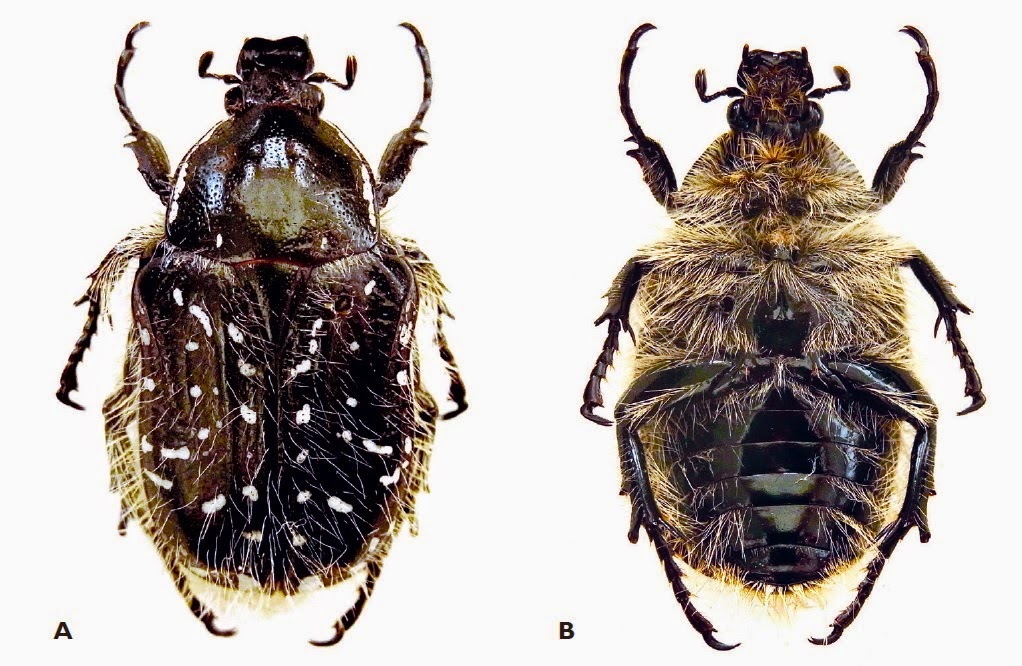
A new species of Scarab Beetle from Hardap Province, Namibia.

There are currently eight species of Scarab Beetles in the genus Scapanoclypeus, which is known from Namibia and western South Africa. They are placed within a group of Tanyproctine Scarabs which are found only in Africa.

In a paper published in the journal Zootaxa on 11 September 2014 Richard Sehnal of the Department of Zoology and Fisheries at the CzechUniversity of Life Sciences describes a new species of Scapanoclypeus from Hardap Province in Namibia.

The new species is named Scapanoclypeus hardap, after the province where it was found. The species is described from nine specimens, all male, collected near the village of Gochas, at an altitude of 1090 m. These range from 8.2–9.7 mm in length and are brownish yellow with blackish brown markings.

Scapanoclypeushardap in dorsal view. Scale bar is 1.0 mm. Sehnal (2014).

See also…

http://sciencythoughts.blogspot.co.uk/2014/08/a-new-species-of-scarab-beetle-from.html A new species of Scarab Beetle from the Elandsberg Mountains of the Western Cape, South Africa.                                                    Scarab Beetles of the genus Trichostetha occur across southern Africa, reaching their greatest diversity in...
http://sciencythoughts.blogspot.co.uk/2013/10/a-new-species-of-scavenger-scarab.html A new species of Scavenger Scarab Beetle from the Early Cretaceous of Liaoning Province, China.                                               Scavenger Scarab Beetles (Hybosoridae) are small (5-7 mm), oval Scarab Beetles, with enlarged mandibles and mouthparts. They are typically carrion feeders, with some species favouring vertebrate dung. They are not a large group of Beetles, with only about 600 species...
http://sciencythoughts.blogspot.co.uk/2013/05/a-new-species-of-bumble-bee-scarab.html  A new species of Bumble Bee Scarab Beetle from the Early Cretaceous of Inner Mongolia.  Bumble Bee Scarab Beetles (Glaphyridae) are small, brightly coloured Scarab Beetles; they are active animals, and frequently resemble Bumble Bees when in flight. There are eight extant genera in the family, two of which have fossil records. Another two genera are known from the fossil record only. The fossil record of the family dates back to the Early Cretaceous...

Follow Sciency Thoughts on Facebook.

Monday, 22 September 2014

The September Equinox.

The September Equinox will fall on 23 September 2014, when the day and night will be of equal length in both of the Earth's hemispheres. The Earth spins on its axis at an angle to the plain of the Solar System. This means that the poles of the Earth do not remain at 90° to the Sun, but rather the northern pole is tilted towards the Sun for six months of the year (the northern summer), and the southern pole for the other six months (the southern summer). This means that twice a year neither pole is inclined towards the Sun, on days known as the equinoxes.

How the combination of the Earth's equatorial plane (horizontal circle labled as Celestial equator) and the plane of the Earth's orbit (diagonal circle labled as Path of the Sun) creates the Solstices and Equinoxes that we observe. Christopher Crockett.

The equinoxes fall each year in March and September, with the March Equinox being the Spring (or Vernal) Equinox in the Northern Hemisphere and the Autumn Equinox in the Southern Hemisphere, while the September Equinox is the Autumn Equinox in the Northern Hemisphere and the Spring Equinox in the Southern Hemisphere. On these two days the day and night are both exactly twelve hours long at every point on the planet, the only days on which this happens.


See also...  


The planet Venus will reach perihelion (the closest point on its orbit to the Sun) at 3.3p pm GMT on Friday 5 September 2014, when it will be 0.718 440 AU (107 477 000 km) from the Sun. This is not...

The planet Neptune reached opposition (i.e. was directly opposite the Sun seen from Earth) at  2.18 pm GMT on Friday 29 August 2014. This means that it will both be at its closest to the Earth this year, about 28.96 AU (28.96 times the average distance between the Earth and the Sun, or about 4 332 000 000 km), and completely...

At 5.44 pm GMT on Sunday 10 August 2014 the Moon will be at its closest point to the Earth in 2014, at a...

Follow Sciency Thoughts on Facebook.


Tuesday, 16 September 2014

The Newton Abbott Lynx.

Stories of Big Cats sighted, or sometimes killed or captured in the British countryside have been popular in the national press for a long time, and modern folklore often postulates the existence of a permanent population of such animals within the UK. Since the implementation of the 1976 Dangerous Wild Animals Act a number of large Felids have been captured, killed or found dead in the UK, though the majority of these were probably escaped animals that had spent little time in the wild (a large Cat accustomed to being fed by humans is likely to return to humans when it wants food, resulting in its death or capture after a very short period in the wild), and some have been shown to be deliberate hoaxes (for example a Leopard skull discovered in Devon in 1995 was found to have eggs from tropical Insects inside it, showing that it had arrived in the UK after its death).

In a paper published in the journal Historical Biology on 23 April 2013, Max Blake of the Institute of Biological, Environmental and Rural Sciences at Aberystwyth University, Darren Naish of the National Oceanography Centre at the University of Southampton, Greger Larson of Durham Evolution and Ancient DNA at the Department of Archaeology at Durham University, Charlotte King of the Department of Anthropology at Durham University, Geoff Nowell of the Department of Earth Sciences at Durham University, Manabu Sakamoto of the School of Earth Sciences at the University of Bristol and Ross Barnett, also of Durham Evolution and Ancient DNA, discuss a preserved Lynx in the collection of Bristol Museum and Art Gallery, which was apparently shot by a farmer in Newton Abbot, south Devon, in 1903, after it killed two Dogs. Both the skeleton and the mounted skin of this animal are present in the collection.

The Newton Abbot Lynx as mounted in the Bristol Museum and Art Gallery. Blake et al. (2013).

The identification of historic biological specimens in non-specialist museums is sometimes problematic, with both the origin and nature of such specimens sometimes recorded inaccurately. The Bristol Museum is generally considered to have good record-keeping, and is unlikely to have mixed up a UK specimen with one from overseas, though Blake et al. note that they were unable to find any record of a Lynx being shot in 1903 in the press of the day.

The specimen is clearly a Lynx, though no attempt to identify it to species level has apparently been previously made. There are four species of extant Lynx currently recognized, the Eurasian Lynx, Lynx lynx, the Iberian Lynx, Lynx pardinus, the Canadian Lynx, Lynx canadensis, and the Bobcat, Lynx rufus; of these only the Eurasian Lynx has ever been native to the British Isles. The Eurasian Lynx was formerly believed to have become extinct in the UK at the end of the Pleistocene, though it is now recognized that it probably survived as late as the third century AD in parts of England and the fifth century in Scotland, though a population of native Eurasian Lynxes surviving as late as the early twentieth century in southwest England is, at best, highly unlikely.

The mounted skin was apparently not preserved with aiding later taxonomists in mind (it is unlikely that a taxidermist in southwest England in the early twentieth century had seen a Lynx previously, making accurate preservation of identifying features difficult), though it appears unlikely to be either a Eurasian or Iberian Lynx. An attempt to use DNA analysis to identify the specimen proved unsuccessful, the (unknown) preservation method used having apparently destroyed all DNA in the skin. However a morphometric analysis of the skull (comparison of different measurements of the skull, a powerful tool for species identification) strongly supports the identification of the specimen as a Canadian Lynx rather than a Bobcat.

The skull of the Newton Abbot Lynx in (A) right lateral and (B) anterior view. Blake et al. (2013).

Next Blake et al. attempted to carry out a strontium isotope ratio analysis of the bones of the Lynx to determine where it had lived when alive. Strontium is found at low levels in almost all geological formations, from where it leaches into water, and is incorporated into bones and teeth by animals. Since different geological formations have different ratios of the two main isotopes of strontium (⁸⁶Sr and ⁸⁷Sr), it is often possible to determine where an animal lived when it was alive by analysing the ratios of these two isotopes. In this instance it was possible to rule out eastern Canada as the home of the living Lynx, as the rocks of the ancient Precambrian Shield have a much higher ⁸⁷Sr content than seen in the bones of the Lynx, but it was not possible to rule out either western Canada or south Devon as its home when alive. 

Finally Blake et al. examined the teeth of the specimen. The animal had lost its incisors, and the incisive alveoli were overgrown by fresh bone. The remaining teeth of the animal show extensive calculus (dental plaque) build-up, to the extent that several of the molars are completely overgrown suggesting that the animal had been afflicted by periodontal disease. This is unusual in wild Felids, but common in Domestic Cats and also well documented in other Carnivores kept in captivity and fed on a soft or wet diet (i.e. a diet lacking in abrasive surfaces, such as bone, which scrape clean the surface of the teeth – domestic Dogs often protect themselves from this by chewing other hard objects, such as sticks, to clean their teeth, but Cats have no such instinct). From this Blake et al. conclude that the Lynx was about 10-11 years old at the time of its death, and that it had been kept in captivity and fed a non-abrasive diet for much of its life. 

Lateral view of P3–P4 in the Newton Abbot Lynx showing build-up of dental calculus. Scale bar is 10 mm. Blake et al. (2013).

This suggests that the Newton Abbot Lynx has escaped from captivity, rather than being a truly wild animal able to survive in the Devon countryside. The incidents with the Dogs and then the fatal encounter with a farmer suggest that it was trying to obtain food from Humans, probably the only food source with which it was familiar.

See also…


Lions (Panthera leo) are large, charismatic predators currently found in Africa and India, with a fossil record that includes areas of northern Eurasia and North America. Lions outside their current...


Dogs are our oldest domestic animal, and the only one which predates the adoption of agriculture. This has led to a great deal of study of the origin of domestic dogs over the years. Despite this we are still not entirely sure where dogs were first domesticated. We are...


Spotted Hyaenas (Crocuta crocuta) are now restricted to sub-Saharan Africa, but in the Pleistocene were far more widespread, roaming across much of Eurasia. The oldest known fossil Spotted Hyaenas...


Follow Sciency Thoughts on Facebook.

Monday, 15 September 2014

Magnitude 4.7 Earthquake in Dalarna County, Sweden.

The United States Geological Survey recorded a Magnitude 4.7 Earthquake at a depth of 14.3 km in Dalarna County, Middle Sweden, slightly before 3.10 pm local time (slightly before 1.10 pm GMT) on Monday 15 September 2014. This is a large event for Scandinavia, but not particularly dangerous, and there are no reports of any damage or injuries, but people have reported feeling the quake across much of Sweden and in parts of Norway and Finland.

The approximate location of the 15 September 2014 Dalarna County Earthquake. Google Maps.

Earthquakes are rare in Sweden, and the waters between them, and those that do occur tend to be small, which makes the causes hard to determine. The entire of Europe is being pushed eastward by the expansion of the Atlantic Ocean and northward by the impact of Africa from the south, though these are remote from the Kattegat. There are lesser areas of expansion beneath the North Sea and Rhine Valley, both of which will presumably have some effect on southern Scandinavia. 

Finally their is glacial rebound; until about 10 000 years ago much of northern Europe was covered by a thick layer of ice. This pushed the rocks of the lithosphere down into the underlying mantle, and now that the ice is gone these rocks are springing back up, albeit very slowly, a process which is not smooth as rocks  tend to stick to one-another, and which therefore causes the occasional small Earth tremor.

(Top) Simplified diagram showing principle of glacial rebound. (Bottom) The extent of glaciation in Europe at the last glacial maximum. Wikipedia.

See also...


Lake Vättern is the second largest lake in Sweden. It lies in the south of the country, and is 135 km long and 31 km in width at its widest...


The Kattegat Sea separates Denmark from Sweden, north of the Islands of the Straits of Denmark. On Monday 6 August 2012, slightly before 5 am local time (slightly before 3 am GMT), an Earthquake took place 5.8 km beneath this sea, according to the...


On Thursday 24 May 2012, slightly after 10.45 pm, GMT, the United States Geological Survey recorded an Earthquake on the Mid-Atlantic Ridge, roughly 600 km north of Tromsø, at a depth of 8.8 km, and measuring 6.2 on the Richter Scale. Since this time...


Follow Sciency Thoughts on Facebook.

Asteroid 2014 RC passes the Earth.

Asteroid 2014 RC passed by the Earth at a distance of 39 910 km (0.1 times the average distance between the Earth and the Moon, or 0.03% of the average distance between the Earth and the Sun - closer than some satellites), slightly after 6.00 pm GMT on Sunday 7 September 2014, passing directly over New Zealand and parts of the South Pacific. There was no danger of the asteroid hitting us, though had it done so it would have presented only a minor threat. 2014 RC has an estimated equivalent diameter of 8-26 m (i.e. it is estimated that a spherical object with the same volume would be 8-26 m in diameter), and an object of this size would be expected to break up in the atmosphere between 36 and 18 km above the ground, with only fragmentary material reaching the Earth's surface.

Image of 2014 RC with a minute long exposure, showing the asteroid's movement as a long streak, about 30 minutes before its closest approach to the Earth on 7 September 2014. Ernesto Guido/Nick Howes/Martino Nicolini/Universe Today.

2014 RC was discovered on 1 September 2014 (six days before its closest approach to the Earth) by the University of Arizona's Catalina Sky Survey, which is located in the Catalina Mountains north of Tucson. The designation 2014 RC implies that it was the third asteroid (asteroid C) discovered in the first half of September 2014 (period 2014 R).

The path of 2014 RC at its closest to Earth. NASA/JPL/Caltech. 

2014 RC has a 549 day year orbital period and an eccentric orbit tilted at an angle of 4.6° to the plane of the Solar System, which takes it from 0.82 AU from the Sun (i.e. 82% of the average distance at which the Earth orbits the Sun) to 1.80 AU from the Sun (i.e. 180% of the average distance at which the Earth orbits the Sun, considerably more than the distance at which the planet Mars orbits the Sun). It is therefore classed as an Apollo Group Asteroid (an asteroid that is on average further from the Sun than the Earth, but which does get closer). This means that close encounters between 2014 RC and the Earth are fairly common, with the last thought to have occurred in December 2009 next one predicted for September 2017. 

The calculated orbit of 2014 RC. JPL Small Body Database Browser.

See also...


Asteroid 2014 RT17 passed by the Earth at a distance of 1 427 000 km (3.69 times the average distance between the Earth and the Moon, or 0.95% of the average...


Asteroid 2014 RS17 passed by the Earth at a distance of about 4 103 000 km (10.69 times the average distance between the Earth and the Moon, or 2.7% of the average...


Asteroid 2014 QP33 passed by the Earth at a distance of 14 330 000 km (37.47 times the average distance between the Earth and the Moon, or 10% of the average...


Follow Sciency Thoughts on Facebook.