Showing posts with label Bison. Show all posts

Monday, 15 June 2026

Bison which killed woman in South Dakota to be relocated.

A Bison which killed a 70-year-old Canadian woman in Custer State Park, South Dakota, is to be relocated to another area. The incident happened on 18 May, when the woman and her husband encountered a group of five Bison bulls on the Grace Coolidge Trail, which runs through the park. At this time the bulls were about 500 m ahead of the couple, who allowed them to move off before following. A little while later the couple encountered the Bison again, though this time they were only about 15 m away. The couple waited for them to move before starting to follow, but this time moved while the Animals were still in site, causing one of the bulls to turn and charge.

Bison in Custer State Park, South Dakota. Wikimedia Commons.

The initial charge resulted in the woman being thrown about two metres in the air, sustaining serious injuries to the leg and abdomen. The Bison then stood over the injured woman for about 15 minutes while her husband hid behind a tree and called the local sheriff's office. During this time the woman remained conscious, and was able to talk to her husband. The bull eventually wandered off, after which the husband approached the woman, but this caused the Animal to turn and charge again, this time throwing her about three meters into the air and causing fatal injuries. After this the Bison walked off, and the husband attempted to perform CPR, being joined shortly after by first aid-trained park staff, but it was impossible to save her. The death was the first Bison-related fatality in the park for 21 years.

Following the incident, rumours began to circulate that the park authorities planned to euthanize the Bison, leading to a public outcry, and many people contacting the South Dakota Governor’s Office, the South Dakota Game, Fish, and Parks and Custer State Park, asking for the Animal to be spared. On Wednesday 10 June the Rosebud Sioux Tribe Game, Fish and Parks announced that they were willing to rehome the bull and take care of its welfare. 

Bison are large animals, the American Bison can reach 1.8 m in length and weigh around 900 kg, and have notoriously unpredictable tempers, often appearing placid and indifferent to their surroundings, and then charging without warning. They can reach speeds of 35 km per hour, and both sexes have horns, which can make unexpected charging highly dangerous.

North America is thought to have been home to about 50 million Bison at the beginning of the nineteenth century, a number that fell to less than a thousand individuals by the middle of the twentieth century due to over-hunting, not just for the purpose of food, but as part of a conscious effort to change the landscape from one amenable to traditional, Native American, lifestyles to a landscape suitable to European-style farming. However since the mid-twentieth century conservation efforts and breeding programs have reversed this decline, with the population now about 530 000 across the continent, including around 40 000 in South Dakota.

See also...

Wednesday, 16 December 2020

International Union for the Conservation of Nature declares 31 species extinct in 2020.

The European Bison, Bison bonasus, Europe’s largest land Mammal, has moved from Vulnerable to Near Threatened thanks to continued conservation efforts, according to a press release issued by the International Union for the Conservation of Nature on 10 December 2020. With this update, 31 species also move into the Extinct category, and all of the world’s Freshwater Dolphin species are now threatened with extinction.

 
European Bison, Bison bonasus. Rafał Kowalczyk/International Union for the Conservation of Nature.

There are now 128 918 species on the International Union for the Conservation of Nature's Red List of Threatened Species, of which 35,765 are threatened with extinction.

'The European Bison and twenty-five other species recoveries documented in today’s IUCN Red List update demonstrate the power of conservation,' said Bruno Oberle, International Union for the Conservation of Nature's Director General. 'Yet the growing list of Extinct species is a stark reminder that conservation efforts must urgently expand. To tackle global threats such as unsustainable fisheries, land clearing for agriculture, and invasive species, conservation needs to happen around the world and be incorporated into all sectors of the economy.'

'The conservation successes in today’s Red List update provide living proof that the world can set, and meet, ambitious biodiversity targets. They further highlight the need for real, measurable commitments as we formulate and implement the post-2020 global biodiversity framework,' said Jane Smart, Global Director of International Union for the Conservation of Nature's Biodiversity Conservation Group. 

As a result of long-term conservation management, the wild population of European Bison, Bison bonasus, has grown from around 1800 in 2003 to over 6200 in 2019, justifying the move from Vulnerable to Near Threatened. The species survived only in captivity in the early 20th century, and was reintroduced to the wild in the 1950s. The largest subpopulations are now found in Poland, Belarus and Russia. There are currently 47 free-ranging European Bison herds. However, herds are largely isolated from one another and confined to non-optimal forest habitats, and only eight of them are large enough to be genetically viable in the long term. The species remains dependent on ongoing conservation measures such as translocations of Bison to more optimal open habitats and reduction of Human-Bison conflicts.

'Historically, European Bison were reintroduced mostly to forest habitats, where they don’t find enough food in winter. However, when they move out of the forest into agricultural areas, they often find themselves in conflict with people. To reduce the conflict risk and the bison’s dependence on supplementary feeding, it will be important to create protected areas that include open meadows for them to graze”, said Rafał Kowalczyk, co-author of the new assessment and member of the International Union for the Conservation of Nature's Bison Specialist Group. 

 
A European Bison, Bison bonasus. Rafał Kowalczyk/International Union for the Conservation of Nature.

With the Tucuxi, Sotalia fluviatilis, moving from Data Deficient to Endangered, all of the world’s Freshwater Dolphin species are now listed as threatened on the International Union for the Conservation of Nature's Red List. This small grey Dolphin species found in the Amazon river system has been severely depleted by incidental mortality in fishing gear, damming of rivers and pollution. Eliminating the use of gillnets, curtains of fishing net that hang in the water, and reducing the number of dams in Tucuxi habitat are priorities to enable numbers to recover. Enforcing the ban on the deliberate killing of Tucuxis is also essential.

 
Tucuxi, Sotalia fluviatilis. Fernando Trujillo/International Union for the Conservation of Nature.

The Lost Shark, Carcharhinus obsoletus, which was only formally described last year, enters the Red List as Critically Endangered (Possibly Extinct). The species was last recorded in 1934. Its habitat in the South China Sea has been extensively fished for more than a century and remains one of the most overexploited marine regions in the world. As it is unlikely that the species could have persisted under this heavy pressure, the Lost Shark may already be extinct.

All of the 17 Freshwater Fish species endemic to Lake Lanao and its outlet in the Philippines are now Extinct (15 species) or Critically Endangered (Possibly Extinct) (two species). The extinctions were caused by predatory introduced species, compounded by overharvesting and destructive fishing methods.


Extinct Cyprinid Fish from Lake Lanao, the Philippines. Armi Torres/International Union for the Conservation of Nature.

Three Central American Frog species have been newly declared Extinct. Additionally, twenty-two Frog species across Central and South America were listed as Critically Endangered (Possibly Extinct). The main driver of these drastic declines is Chytridiomycosis disease. Conservation efforts to protect critical habitat are helping populations of several other Amphibian species to recover. Among them is the Oaxaca Treefrog, Sarcohyla celata, which moved from Critically Endangered to Near Threatened thanks to actions by local communities in Mexico.

The Protea family has been comprehensively assessed with this update, revealing that 45% (637 of 1464 species) of these striking Flowering Plants that grow mainly across the Southern Hemisphere are Vulnerable, Endangered or Critically Endangered. Many of the species have highly restricted ranges, making them more vulnerable to the spread of invasive alien species, changes to natural fire cycles caused by Humans and linked with climate change, and loss of habitat to agriculture. The Protea family includes three Macadamia species, the same species that produce the farmed Macadamia nut crop, which have entered the International Union for the Conservation of Nature's Red List as threatened with extinction in the wild. The Macadamia Nut (Macadamia integrifolia) is listed as Vulnerable, while Macadamia ternifolia and Macadamia tetraphylla are listed as Endangered.

 
The Protea, Grevillea caleyi, from New South Wales, now classified as Critically Endangered. Tony Auld/International Union for the Conservation of Nature.

Oak trees have been comprehensively assessed, revealing that almost one third (31%, 113 of 430 species) are threatened with extinction. Nine Asian oaks enter the International Union for the Conservation of Nature's Red List already Critically Endangered (Possibly Extinct or Possibly Extinct in the Wild). The highest numbers of threatened species are in China and Mexico, followed by Viet Nam, the United States and Malaysia. Land clearance for agriculture and logging are the most common threats in China, Mexico and Southeast Asia. Invasive alien species and diseases and climate change are the key threats to Oaks in the United States.

 
Quercus liaoi, a species of Oak known only from Taiwan. Béatrice Chassé/International Union for the Conservation of Nature.

See also...


Follow Sciency Thoughts on Facebook.

Follow Sciency Thoughts on Twitter.


Sunday, 28 July 2019

Charging Bison injures nine-year-old girl in Yellowstone National Park.

A nine-year-old required medical treatment after being charged by a Bison in the Yellowstone National Park this week. The unnamed girl, reported to be from Odessa, Florida, was part of a group of about 50 tourists that surrounded the adult male Bison on Monday 22 July 2019. The Bison apparently put up with the tourists for about 20 minutes before losing its temper and charging, with the girl being caught after adults managed to get out of the way.

Two images taken from a video clip of a Bison charging a nine-year-old girl the Yellowstone National Park this week. Yellowstone National Park.

Bison are large animals, the American Biron can reach 1.8 m in length and weigh around 900 kg, and have notoriously unpredictable tempers, often appearing placid and indifferent to their surroundings, and then charging without warning. They can reach speeds of 35 km per hour, and both sexes have horns, which can make unexpected charging highly dangerous.

North America is thought to have been home to about 50 million Bison at the beginning of the nineteenth century, a number that fell to less than a thousand individuals by the middle of the twentieth century due to overhunting, not just for the purpose of food, but as part of a conscious effort to change the landscape from one amenable to traditional, Native American, lifestyles to a landscape suitable to European-style farming. However since the mid-twentieth century conservation efforts and breeding programs have reversed this decline, with the population now measured in the hundreds of thousands, including around 5000 in the Yellowstone National Park.

See also...

https://sciencythoughts.blogspot.com/2019/06/muntiacus-gigas-new-specimen-of-giant.htmlhttps://sciencythoughts.blogspot.com/2018/03/giraffe-tracks-from-late-pleistocene-of.html
https://sciencythoughts.blogspot.com/2018/01/calculating-role-of-pleistocene-refugia.htmlhttp://sciencythoughts.blogspot.com/2016/10/understanding-ancestry-of-european-bison.html
https://sciencythoughts.blogspot.com/2016/08/lightning-kills-323-reindeer-in.htmlhttps://sciencythoughts.blogspot.com/2016/01/ammotragus-lervia-diet-of-barbary-sheep.html


Follow Sciency Thoughts on Facebook.

Monday, 24 October 2016

Understanding the ancestry of the European Bison.

The European Bison, or Wisent (Bison bonasus), is one of a very small number of megafaunal (large) animal species to have survived from the Pleistocene in northern temperate latitudes. However the origin of the European Bison is less clear than it would immediately seem, as the earliest known fossil specimens date only from the Early Holocene (i.e. less than 11 700 years ago), prior to which Europe was inhabited by a different Bison species, the Steppe Bison (Bison priscus), which ranged from Britain in the east across Europe, Asia and Beringia (the landmass between Alaska and the Russian Far East which was exposed during the Pleistocene glaciations when the sea level was lower) and into western Canada. The Steppe Bison is considered to be the ancestor of the American Bison (Bison bison), but its relationship to the modern European Bison is less clear, as the European Bison, while clearly related to the American Bison, is genetically more closely related to Cattle (Bos spp.). This could potentially be due to recent hybridization between the species, the European Bison having gone through a number of population bottlenecks as it came into conflict with Humans and domestic animals, with the population having fallen to just twelve individuals in the 1920s, but hybrids between Bison and Cattle are usually infertile, making this a somewhat doubtful hypothesis.

In a paper published in the journal Nature Communications on 18 October 2016, a team of scientists led by Julien Soubrier of the Australian Centre for Ancient DNA at the University of Adelaide describe the results of a new study of the ancestry of the European Bison, which takes into account both archaeological and genetic evidence.

Soubrier et al. sequenced DNA from 64 Bison specimens from Late Pleistocene sites (from before 50 000 years ago to about 14 000 years ago) across Europe. 38 of these specimens, from the Caucasus, Urals, North Sea, France and Italy, were found to belong to a previously unknown Bison lineage, identified as Clade X (in biology a clade is a group of organisms with a common ancestor; a clade includes all the organisms descended from that ancestor and no organisms not descended from that ancestor). Based upon the relationship between Clade X and the European Bison, the two species shared a last common ancestor about 120 000 years ago (during the Eemian Interglacial), however like the European Bison, including Ancient European Bison used in this study (and unlike the American Bison) members of Clade X appear to derive about 10% of their DNA from a Cattle (Bos sp.) ancestor.

This discovery is interesting as it rules out the possibility of recent hybridization between Modern Cattle and European Bison, instead suggesting that the species came about as the result of a hybridization between ancient Steppe Bison and the Aurochs (Bos primigenius), a large Pleistocene animal thought to have been ancestral to modern Domestic Cattle. Further examination of the Bison samples in the study revealed that they all derived their mitochodrial DNA (mtDNA) from a Bos ancestor, but none of them any Y-chromosome DNA, This implies that both the European Bison and Clade X came about as a result of a hybridization between male Steppe Bison and female Aurochs, not implausible given that in all known Bovid species males tend to capture harems of females which they defend aggressively against other males, and that while the Aurochs were big animals, Steppe Bison were even larger. However whether or not the European Bison and Clade X arose from a single hybridization event, a cluster of such events or completely unrelated events could not be determined.

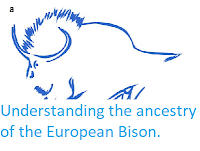
Soubrier et al. further observe that two distinct morphologies of Bison are recorded in European Pleistocene cave art. A total of 820 depictions of Bison are known from European cave art (21 % of all known animal depictions from the Pleistocene of Europe), and all of these fall into two morphotypes (shapes). The first is a long-horned animal with robust forequaters and a distinct hump, that appears in art dating from before the Last Glacial Maximum, roughly between 22 000 and 18 000 years ago. The second form is a more slender animal with small, recurved, horns and a small hump, which appears in Magdalenian art, roughly between 17 000 and 12 000 years ago. These differences have previously been regarded the expression of different artistic styles, however Soubrier et al. reject this hypothesis. Two different Bison morphologies (a robust form and a slender form) have also been noted from bones dredged from beneath the North Sea).

Cave painting example of steppe Bison-like and Wisent-like morphs. (a) Reproduction from Lascaux cave (France), from the Solutrean or early Magdalenian period (about 20 000 years ago). (b) Reproduction from the Pergouset cave (France), from the Magdalenian period (less than 17 000 years ago). Soubrier et al. (2016).

The oldest specimens with a European Bison genotype dated from before 55 000 years ago, while the oldest Clade X specimen dated from 23 000 years ago, and the youngest Steppe Bison from 19 000 years ago. However all known specimens from between 50 000 and 34 000 years ago are Steppe Bison. Environmental reconstructions and stable isotope studies of remains (which can reconstruct the environments in which ancient organisms live by studying the ratios of different carbon and nitrogen isotopes in their bones) suggest that the European Bison and Steppe Bison inhabited different environments, with the Steppe Bison dwelling in cold, tundra grasslands and the European Bison favouring a warmer, more mixed environment.

Based upon this Soubrier et al. suggest that there were two distinct Bison species present in Europe for much of the Late Pleistocene. The Steppe Bison favoured cold grassland environments and expanded its range during colder periods, disappearing at the end of the Pleistocene, probably due to a mixture of a loss of much of this environment and a rising Human population armed with better hunting tools. The European Bison arose from one or more hybridization events between the Steppe Bison and the Aurochs, but was able to persist as a ecologically separate entity due to a preference for a different environment, favouring warmer landscapes with mixed vegetation. This species has also been severely pressured by expanding Human populations, but was better able to cope with the changing climate and has persisted till modern times.

See also...

http://sciencythoughts.blogspot.co.uk/2016/01/ammotragus-lervia-diet-of-barbary-sheep.htmlAmmotragus lervia: The diet of the Barbary Sheep in the Bou Hedma Mountains of Tunisia.                                                         The Barbary Sheep (or Aoudad), Ammotragus lervia, is a wild Caprid found in North Africa, from the Mediterranean as far south as the Niger and Lake...
http://sciencythoughts.blogspot.co.uk/2014/07/a-highly-specialized-musk-ox-from-late.htmlA highly specialized Musk Ox from the Late Miocene of Gansu Province, China.              In 1932 Birger Bohlin, chief palaeontologist with the explorer Sven Hedin’s Sino-Swedish Scientific Expedition to Northwest China, discovered an...
http://sciencythoughts.blogspot.co.uk/2013/08/how-fencing-tibetan-prairies-is.htmlHow fencing the Tibetan prairies is effecting the endangered Przewalski’s Gazelle. The Przewalski’s Gazelle (Procapra przewalskii) is a species of high altitude adapted Antelope, which formerly ranged across much of northwestern China and Inner Mongolia. It is now restricted to a small area around Qinghai Lake on the Tibetan Plateau, with...
Follow Sciency Thoughts on Facebook.