Showing posts with label Salmonid Fish. Show all posts

Tuesday, 16 December 2025

United Nations recognises three conservation projects as new World Restoration Flagships.

The United Nations has recognised three conservation projects as World Restoration Flagships, according to a press release issued by the United Nations Environment Program on 4 December 2025. World Restoration Flagships are projects intended to have large-scale and long-term impacts, held up as examples which embody the 10 Restoration Principles of the UN Decade on Ecosystem Restoration (2021–2030). World Restoration Flagships already cover an area of over 10 million km², an area larger than China.

The first new project recognised is the Shellfish Reef Building Program in Australia. This project, a partnership between the Nature Conservancy and the Australian Government, aims to restore reefs of Oysters and Mussels which were once found around much of the southern coast of Australia but which have been greatly depleted by over-harvesting, sedimentation and pollution.

Globefish amongst Mussels and restored shellfish reef in Dromana, Port Phillip Bay. Jarrod Boord/Streamline Media in Reef Builder (2024).

Since its inception in 2020, the Reef Builder Program has worked with local communities to restore reefs at thirteen locations along the southern coastline of Australia; it aims to restore 30% of Australia's original shellfish reefs by 2030. The project has generated over 425 jobs, and about US$10 million in income for over 50 small and medium sized businesses, as well as helping local communities to reconnect to nature and promote stewardship over the natural environment.

The second project recognised is the Respectful Returns Initiative in Canada, a partnership between Parks Canada and local and Indigenous communities, which aims to restore damaged rivers and streams in seven national parks along Canada’s Pacific and Atlantic coasts. 

Salmon being released into the Bay of Fundy as part of the Respectful Returns Initiative. Parks Canada.

Since its initiation in 2010, the Respectful Returns Initiative has restored over 650 km² of land and 228 km of waterways, created over 100 jobs, supported research projects by three universities, and formed partnerships with 32 local organisations and community groups. The Salmon population has increased at six of the seven locations where the Initiative works. The Initiative aims to both protect Salmon and to strengthen the connection between the population and their environment. 

The third project recognised is the Thicket Restoration Movement in South Africa, a collaboration uniting over 60 initiatives in Eastern and Western Cape provinces, which aims to restore over 8000 km² of indigenous subtropical thicket by 2030.

Replanting a Kuzuko Thicket in South Africa. AfriCarbon. 

These thickets serve as a grazing resource for both wild Mammals and livestock, particularly under drought conditions, which is an important consideration following the drought of 2023/4, which is the worst the region has suffered in over 100 years. It is a particularly important resource for threatened species such as Black Rhinoceros and African Bush Elephant, and is also a significant carbon reserve, with soils covered by thicket retaining notably more carbon than exposed soils. It is estimated that restoring these thickets sequesters around eight million tonnes of carbon dioxide per year. The project is also predicted to directly create over 1000 jobs in rural communities, as well as improving the lives of around two million people.

See also...


Sunday, 10 April 2022

Canadian Salmon farm invaded by Sea Lions.

A Salmon farm on the coast of British Columbia has been invaded by a group of Sea Lions, raising alarm among conservation groups, who fear they may become habituated to the environment. The Rant Point Salmon Farm near Tofino was the subject of an 'invasion event' in mid-March, according to Cermaq, the Norwegian multinational that runs the site, along with several others on the coast of British Columbia, and at other sites in Norway and Chile. However, conservation groups were not informed of the event until Sunday 3 April, when a Whale-watching trip observed the Sea Lions moving in and out of pens.

 
A Sea Lion consuming a Salmon at the Rant Point Salmon Farm in British Columbia. Jérémy Mathieu/Clayoquot Action.

Several previous Sea Lion invasions have been recorded at Salmon Farms in British Columbia, resulting in heavy losses of Fish stocks (Sea Lions can consume up to three times their own bodymass in Fish each day, piling on fat which enables them to survive seasonal food shortages), and numerous Sea Lion deaths through entanglement. During a previous invasion at Rant Point in 2016, the Canadian Department of Fisheries allowed the company to shoot the offending Sea Lions, but this stance has not been repeated in 2022, with the same body insisting that only methods which remove the Animals without hurting them can be used. This is part of a wider change in policy on Salmon farming in Canada, which now wants to see the practice phased out by 2025, following years of campaigning by conservation and indigenous rights groups.

 
Sea Lions inside and outside Salmon Pens at the Rant Point Salmon Farm in British Columbia. Jérémy Mathieu/Clayoquot Action.

Salmon farming on the coast of British Columbia brings employment to the area, and enables farmers to access lucrative US markets easily, but, as in other areas where it is practiced, is strongly opposed by environmental groups. Farmed Salmon, which live at far higher densities than would naturally be the case, are seen as a reserve for Salmon diseases, which can go on to infect wild Salmon, with potentially devastating effects on wild populations. This has potential knock-on effects for many other species, including marine predators such as Sea Lions which rely upon them for food, but also Bears and even forest trees far from the shore. This is due to the complex life cycle of the Salmon, which spend much of their lives at sea, acquiring nutrients from marine sources, before swimming back up the rivers where they were born to mate, spawn, and die. Since most natural processes tend to wash nutrients downstream from the land to the sea, this makes Salmon important ecosystem engineers in British Colombia and other areas of natural temperate rainforests. 

Salmon farms are also seen as highly poluting. This is because Salmon are predatory Fish, requiring farmed Salmon to be fed with Fish meal (generally made from wild-caught Fish species not favoured as food by Humans, raising further concerns about links between Salmon farming and overfishing), with the effect that both waste food and Salmon droppings are potential environment-changing pollutants. Furthermore, the problem of infections spreading easily within Salmon farms often results in farmers dosing the water with antibiotics and other medications, causing further environmental problems, and potentially leading to the spread of anti-biotic resistance in marine pathogens.

See also...


Follow Sciency Thoughts on Facebook.

Follow Sciency Thoughts on Twitter. 


Wednesday, 12 August 2020

Manayunkia occidentalis: A new species of Sabellid Polychaete from the Pacific Northwest of the United States, and an alternate host of two Myxosporean parasites of Salmonid Fish.

Annelids are a diverse and speciose invertebrate group, particularly in marine systems. Apart from Clitellate Annelids ('Oligochaetes' and 'Leaches'), there are relatively few known freshwater species, and several of these belong to the Sabellid genus Manayunkia. Manayunkia currently contains 11 accepted nominal species, though this may need further assessment. The most recent taxa described are the marine Manayunkia mizu, described in 1996 from Papua New Guinea, and the freshwater Manayunkia zenkewitschii, described in 1997 from Lake Baikal. Currently, there are freshwater Manayunkia described from Europe and North America, and brackish/marine species known from Australia, Europe, Papua New Guinea and Brazil. Two species of Manayunkia are recorded from North America: Manayunkia aestuarina, from brackish coastal environments (though the type locality is in the UK), and Manayunkia speciosa, which was first briefly described by Joseph Leidy in 1859, from the Schuylkill River in Pennsylvania, and in much greater detail from specimens from New Jersey in 1883. The species was later reported from the Great Lakes in 1829, the Klamath and Sacramento river basins of Oregon and California in 1966, lakes in Alsaka in 1967, and lakes in North Carolina in 1971. Manayunkia speciosa has been identified as the invertebrate alternate host of two Myxosporean parasites of Salmonid Fish: Ceratonova shasta (formerly Ceratomyxa shasta) and Parvicapsula minibicornis. Myxosporeans are common Myxozoan Cnidarian parasites with complex life cycles that require two hosts: a vertebrate (usually a Fish) in which parasite Myxospores develop, and an invertebrate (usually an Annelid) in which actinospores develop. Both Ceratonova shasta and Parvicapsula minibicornis are widespread in the Pacific Northwest but have not been recorded from the Great Lakes, or east coast of North America, despite presence of both Manayunkia speciosa and susceptible Salmon hosts in these regions.

In a paper published in the journal Zootaxa on 17 March 2020, Stephen Atkinson and Jerri Bartholomew of the Department of Microbiology at Oregon State University, and Greg Rouse of the Scripps Institution of Oceanography at the University of California, San Diego, present the results of a survey based upon the hypothesis that that these two Myxozoans actually require a heretofore unrecognized Annelid host, which is present only in western North American river basins, and which has been consistently mis-identified as Manayunkia speciosa.

Atkinson et al. sampled both infected and uninfected Annelids from the two localities where the parasites were recorded originally from their annelid hosts: the Klamath River, California, and the Willamette River, near Corvallis, Oregon. Using morphology and mitochondrial Cytochrome oxidase subunit I DNA sequencing, they compared these specimens with Manayunkia speciosa samples from New Jersey and the Great Lakes. Atkinson et al. discovered that all Klamath and Willamette Manayunkia, both infected and uninfected, were a novel species, they further sequenced Annelid samples from collections made between 2006 and 2018 and identified only the new species. They did not detect any Manayunkia speciosa from either river basin.

Annelids were collected by hand at depths of 10–50 cm from rocks and periphyton from the Klamath River, California, from below Iron Gate Dam. Additional specimens were collected from the Willamette River, Oregon. Under a dissection microscope, living Annelids were separated from substrate, then examined by light microscopy either alive or fixed in 10% neutral buffered formalin, frozen for DNA analysis, or fixed in 2% glutaraldehyde in cacodylate buffer for electron microscopy. Type and voucher specimens were deposited in the Benthic Invertebrate Collection at Scripps institution of Oceanography, La Jolla, California. To confirm identity and infection status, Atkinson et al. examined additional archived Annelid samples collected opportunistically 2006–2018 by Oregon State University as part of their long term, on-going ecological and disease studies of parasites Ceratonova shasta and Parvicapsula minibicornis. These samples were collected from localities in the Klamath and Willamette Rivers. Atkinson et al. also obtained Manayunkia speciosa from Lake Superior (St. Marys River, Ontario, Canada) and South River, New Jersey, in 2009. A marine Fabriciid, Echinofabricia goodhartzorum, was used as the outgroup, since Echinofabricia has been shown to be the sister group to Manayunkia.

Live Annelids were found in clusters of tubes, most often attached to rocks or intertwined with periphyton. Females were observed frequently with broods of larvae in their tubes. Males and females with overt parasite infections often lacked gametes. Five individuals were sequenced from the type collection locality/date, with an additional 79 from archival material from the Klamath River; 10 were sequenced from the Willamette River. The five paratype specimens were up to 1.6% divergent with each other (0–6 nucleotides differed over the total alignment of 439 nucleotides), compared with a divergence of up to 2.8% among all 84 Klamath River Annelids sequenced. The 10 Willamette River specimens were up to 0.4% divergent with each other, and pairwise distances between Willamette and Klamath River specimens were 3.1–4.1%. These west coast samples were 10.5%–12.2% divergent from the Great Lakes and East Coast Manayunkia speciosa reference sequences. The parasite Ceratonova shasta was detected in 16 Annelids from the Klamath River, whereas Parvicapsula minibicornis was detected in four annelids from the Klamath River and one from the Willamette River; these parasite abundances were typical.

The new species is named Manayunkia occidentalis, which is derived from the Latin word for 'west', to contrast with Manayunkia speciosa, which occurs in eastern and central North American drainages. The holotype (SIO-BIC A12115) is a male with eight thoracic segments and three abdominal segments. Total length (unfixed) 3.0 mm, crown 0.3 mm. Body cylindrical with tapering, dorso-ventrally flattened abdomen. Body wall translucent grey with minor brown pigmentation on peristomium and pygidium, and green pigmentation on chaetiger 6. Branchial crown about 10% of total body length. Two pairs of radioles, each with six pinnules. One ventral pinnule on radiole with 4–5 yellow-white spots in life. One pair of vascularised, unbranched ventral filamentous appendages present, extending for about two-thirds length of radiolar crown, approximately same width as pinnules. Anterior peristomial ring with membranous collar, followed by posterior peristomial ring. Collar margin smooth, higher ventrally, separated by a narrow dorsal gap that corresponds with ciliated faecal groove. Peristomial eyes, black rounded spots. Pygidial eyes absent. Superior thoracic notochaetae elongate, narrowly hooded; 5–7 per fascicle (chaetigers 1–5), 4–5 per fascicle (chaetigers 6–8). Inferior thoracic notochaetae on chaetigers 1–8 short; 3–4 per fascicle except chaetiger 2, which has 6 per fascicle. Thoracic neuropodia each with 4–7 uncini in chaetigers 2–8. Thoracic uncini with rows of evenly small teeth gradually decreasing in size away from main fang. Position of chaetae and uncini reversed in abdominal segments; number of abdominal uncini per fascicle decreasing posteriorly from 22 to 9. Abdominal uncini each with multiple rows of teeth that are uniform in size; manubrium at least five times longer than dentate region, with base about two thirds the width of the dentate region. Abdominal neuropodia are elongate, narrowly hooded, decreasing posteriorly from 4–6 to 2 per fascicle.


Gross morphological features of Manayunkia occidentalis resolved by light microscopy: (A) multiple individuals emerged and feeding from their tubes; (B) Individual annelid with prominent vascularized appendages (va) and showing refractile spots on one feeding palp on each side (arrowheads); (C) female in reflected light, showing white oocytes (o) in segments 4–6; (D) male in reflected light showing bright spermatogonic tissue (sp) in multiple posterior segments; (E) Male in transmitted light showing parallel vascularized appendages (va) and fanned-out feeding palps nteriorly with two dark eyespots in peristomium, and granular coelom posteriorly due to presence of developing sperm. Atkinson et al. (2020).


Paratypes are similar to the holotype. However, females have oocytes in thoracic chaetigers 4–5 and a pair of pigmented spermathecae in the base of the radiolar crown. Females differ from males in having thoracic neuropodia with uncini in chaetigers 2–5 followed by 3–6 elongate hooded chaetae in neuropodia of chaetigers 6–8. 


Images showing chaetal characters of Manayunkia occidentalis: (A) inferior and superior notochaete typical of thoracic segments 2–8; (B) thoracic uncini; (C) abdominal uncini; (D) dorsal view of posterior thoracic segments and abdomen of male showing typical uncini in chaetigers t7 and t8 (arrowheads) and in scanning electron micrograph shown in (F); (E) dorsal view of posterior thoracic segments and abdomen of female showing neuropodia of thoracic chaetigers 6–8 with elongate neuropodia instead of uncini, seen also in scanning electron micrograph in (G) (arrowhead). (H) anterior thoracic segment of female showing notochaetae and uncini (arrowhead), characteristic of thoracic segments 2–5 in both sexes. Atkinson et al. (2020).


Manayunkia speciosa was described originally from Philadelphia, USA with subsequent reports from the Great Lakes and several west coast river basins. This Annelid is reported to be the obligate alternate host of two Myxozoan parasites Ceratonova shasta and Parvicapsula minibicornis. Unambiguous identification of the invertebrate hosts of Myxozoans, which produce the infectious stage to Fish, is essential for risk assessment and stock management as these parasites cause disease and death within populations of salmon and trout. Atkinson et al.'s findings support the hypothesis that the Annelid host of the parasites has likely been mis-identified as Manayunkia speciosa, and is actually a novel taxon Manayunkia occidentalis.


Morphological features of Manayunkia occidentalis resolved by scanning electron microscopy: (A) lateral view; (B) dorsal view; (C) ventral view; (D) anterior showing membranous collar (c) of the peristomal ring (pr), margin with fecal groove (fg); mucus covers the pinnules and adheres Diatoms; (E) detail of typical thoracic uncini; (F) abdominal segments and anus, showing ciliated fecal groove extending anteriorly and wrapping around to the ventral surface at boundary between abdominal and thoracic segments; (G) lateral view of thoracic segments showing contracted uncini and prominent neuropodia; (H) higher magnification view of retracted abdominal uncini. Atkinson et al. (2020).


The 94 west coast Manayunkia occidentalis specimens that Atkinson et al. characterised had cytochrome oxidase subunit I sequences at least 11% different from the reference Manayunkia speciosa sequences from Lake Superior and New Jersey. This east-west genetic divergence underpinned the rationale for describing the west coast Annelids as a distinct, novel taxon. Among the Manayunkia occidentalis specimens, the greatest genetic difference (4.1%) was between isolates from the two rivers, which are more than 500 km apart. These genetic differences are not surprising given the relative immobility of the Annelids, particularly from above- and below-dam localities, and between river basins separated by saltwater. Atkinson et al. hypothesise that similar degrees of genetic differences, with corresponding novel haplotypes, will be observed among populations in other unconnected river basins on the West Coast (Fraser, Rogue, Sacramento), and probably within large basins like the Columbia.

Atkinson et al. did not detect any Manayunkia speciosa among the 94 Annelids sampled from multiple localities in two river basins. This was surprising given historical records of that taxon in West Coast basins, particularly associated with Myxozoan parasites. The collection localities in the Klamath River included one where 'Manayunkia speciosa' was collected and sequenced previously. This published sequence is only minimally divergent (0–1%) from Manayunkia speciosa reference sequences collected from Lake Superior and the East Coast. Atkinson et al. cannot explain how these trans-continental Manayunkia speciosa sequences could be so similar, given that they observed genetic distances up to 2.8% among Manayunkia occidentalis samples from the Klamath Basin, and up to 4.1% between specimens from different West Coast river basins. Based on their survey data, Atkinson et al. postulate that Manayunkia speciosa may not be present in the Klamath or Willamette rivers, and they suspect that the earlier assignations of Klamath River Annelids as Manayunkia speciosa are incorrect. Almost all previous identifications relied on morphology, and Atkinson et al. have now shown that there are few morphological characters to distinguish the two taxa, though the markedly smaller number of pinnules in Manayunkia occidentalis is an obvious difference from Manayunkia speciosa. This and the cytochrome oxidase subunit I sequence divergence of at least 10.5% makes future discrimination between Manayunkia speciosa and Manayunkia occidentalis relatively straightforward.

Twenty-one of the 94 examined annelids were infected with either or both Ceratonova shasta and Parvicapsula minibicornis, and all were identified by sequence as Manayunkia occidentalis, and thus Atkinson et al. could not confirm that Manayunkia speciosa is a host for these Myxozoans. If Manayunkia speciosa is not a permissive host, then this would explain why Ceratonova shasta and Parvicapsula minibicornis have not become established in the Great Lakes or in East Coast river systems where Manayunkia speciosa, only, is present. It is likely, however, that Manayunkia speciosa hosts other Myxozoan species, as evidenced by detection of Ceratonova-like DNA in Annelids from the Great Lakes. Atkinson et al. predict that they will find Manayunkia occidentalis in all river basins where the parasite is found on the west coast, and none in the Great Lakes. Accordingly, they are sampling and sequencing additional Annelid populations from river basins where Ceratonova shasta and Parvicapsula minibicornis occur, to determine the phylogeography of the host, any correlation between infection and host haplotype, and if any Manayunkia speciosa sensu stricto exists on the west coast of North America.


See also...


Follow Sciency Thoughts on Facebook.


Sunday, 24 July 2016

Jellyfish damage to farmed Salmon on the West Coast of Ireland.

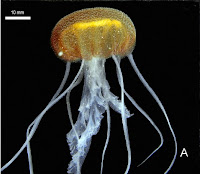
Farmed Salmon are raised within caged enclosures in marine embayments, spending their entire lives within a limited area, unlike wild Salmon which roam over vast areas during their life-cycles, spending parts of their lives in marine environments and parts in freshwater. This makes farmed Salmon vulnerable to a variety of environmental threats that wild Salmon are able to avoid. One such threat is damage by Jellyfish swarms, which drift in vast numbers on the ocean currents, and which can cause significant damage when they encounter farmed Salmon, with smaller Jellyfish able to pass through cage meshes directly and adult specimens being broken up by the meshes, killing the Jellyfish but creating body fragments with still active stinging cells which could enter the cages. In one notorious case in 2007 a swarn of Mauve Stinger Jellyfish, Pelagia noctiluca, wiped out the entire stock of a Salmon farm in Northern Ireland, about 250 000 Fish.

In a paper published in the Journal of Fish Disease in January 2016, Mar Marcos-L opez, Susie Mitchell and Hamish Roger of Vet-Aqua International in Oranmore, County Galway, Ireland, descibe the results of a study of Jellyfish damage to farmed Salmon on the West Coast of Ireland in 2013.

The most abundant swarming Jellyfish seen on thw West Coast during the study peroid was the Mauve Stinger, however unidentified species of Phialella and Muggiaea were also recorded. Mauve Stingers are an entirely free-living species, unlike many Jellyfish which have a bottom-dwelling atteched polyp stage, enabling swarms drifting on ocean currents to continuously add to their own numbers (species with an attached polyp stage typically swarm for a season, then produce an overwintering polyp stage). They are found in vast numbers in all warm and temperate seas and oceans, though in seasonal climates they do die off in winter, so the biggest swarms are found in autumn and late summer, when seasonal storms often push them onto shores.

In 2013 Mauve Stingers swarms were reported at Salmon farms from August to November on the West Coast of both Northern Ireland and the Republic of Ireland, resulting in mortality rates among caged Salmon of up to 70%. Examination of both dead and live Salmon revealed numerous skin lessons, with Fish sufferning from respiratory distress (a syptom of Jellyfish venom), loss of apatite, apathy and increased jumping.

Numerous Pelagia noctiluca jellyfish inside marine Atlantic Salmon pen. Pete McDonagh in Marcos-L opez et al. (2016).

Many of the lessons caused by Jellyfish stings were found to be infected with a filamentous Bacterium, Tenacibaculum sp., which appeared to colonize necrotic Jellyfish filaments; these Bacteria are known to be carried by living Jellyfish, suggesting the infection was brought with the swarm, and was not just an opportunistic action by an organism living free in the water. The Salmon farmers responded to these infections by raising the levels of anti-biotics administered to the Fish.

See also...

http://sciencythoughts.blogspot.co.uk/2014/06/a-new-species-of-jellyfish-from-north.htmlA new species of Jellyfish from the North Adriatic Sea. While instantly familiar and biologically simple, Jellyfish (Scyphozoa) are still in many ways poorly understood, with frequently poorly understood life-cycles and population structures, leading to unexpected shifts in population and sudden blooms of large numbers of Jellyfish, which can impact on commercial...
http://sciencythoughts.blogspot.co.uk/2013/10/jellyfish-force-closure-of-swedish.htmlJellyfish force closure of Swedish nuclear power plant.                                   The Oskarshamn Nuclear Power Plant in Kalmar County on Sweden's southeast coast was forced to...
http://sciencythoughts.blogspot.co.uk/2013/06/the-mysterious-ebb-and-flow-of.htmlThe mysterious ebb and flow of Jellyfish populations.                                               Many scientists and conservationists are worried about the state of the world's oceans. Many important marine ecosystems are known to be under stress: once prolific fisheries have collapsed; dead


Follow Sciency Thoughts on Facebook.

Saturday, 27 February 2016

Cleanup underway after sewage spill in Bellingham, Washington.

A cleanup operation is underway after about 1 140 000 liters of sewage was spilt into Padden Creek in the south of Bellingham in Whatcom County, Washington, on Tuesday 23-Thursday 25 February 2016. The spill occured during work to replace sewer pipes in the area, and was shut off as soon as it was discovered. Acces to an are of the creek between Seventeenth Street and Padden Lagoon has been shut off.

A sign warning of the dangers of spilt sewage on Padden Creek on Friday 26 February 2016. Philip Dwyer/The Bellingham Herald.

As well as the obvious dangers to health presented by sewage, which is likely to contain a variety of Bacteria and other micro-organisms harmful to Human health, sewage provides a source of nutrients which can lead to eutrophication and the rapid growth of blooms of Algae, Bacteria or other micro-organisms, which absorb oxygen from the water leading Fish and other aquatic organisms to asphyxiate.

Paddne Creek was culvertized (covered and channeled through a concrete culvert) in the late nineteenth century) but has recently undergone restoration work intended to return it to a natural state, both to improve the local habitat and to provide a run for Salmon and Trout, which historically used the creek to access Padden Lake and the waterways which supply it. Officials involved in the project have describes the spill as 'disheartening'.

See also...

http://sciencythoughts.blogspot.co.uk/2015/12/widespread-lead-poisonng-prompts-city.htmlWidespread lead poisonng prompts city of Flint, Michigan, to declare a state of emergnecy.                                                   The City of Flint, in Genesee County, Michigan, has declared a stare of emergency, following an outbreak of lead poisoning in the city. Mayor Karen Weaver...
http://sciencythoughts.blogspot.co.uk/2015/10/dairy-wastewater-spill-kills-hundreds.htmlDairy wastewater spill kills hundreds of Fish in Alabama creek.                                            A spill of dairy wastewater has killed several hundred Fish in the Shades Creek at Homewood, Alabama, close to West Homewood Park, on Monday 19 October 2015. The comprised about 380 liters of wastewater from the Mayfield Creamery, which turned the creek a...
http://sciencythoughts.blogspot.co.uk/2015/08/cryptosporidium-discovery-at-water.htmlCryptosporidium discovery at water treatment plant leaves around 300 000 without drinkable water in Lancashire, England.                                                   Around 300 000 homes were left without drinkable...

Follow Sciency Thoughts on Facebook.


Wednesday, 31 December 2014

The effect of non-lethal Carbosulfan exposure on Rainbow Trout.


Carbosulfan, 2,3-dihydro-2,2-dimethyl-7-benzofuranyl (di-n-butylaminosulfenyl) methyl carbamate, is a carbamate pesticide which was banned in for use the European Union in 2007, but is still manufactured for export, and is widely used in countries such as Mexico, Brazil, India and Sri Lanka. It is used on a wide variety of crops, particularly Citrus fruits, Corn, Soya beans and Rice. Carbamate pesticides, like organophosphates, act by inhibiting the enzyme acetylcholinesterase by reacting with its active sites, i.e. they are neurotoxins which halt synaptic transmission in the nervous system. Such toxins readily enter the aquatic ecosystem, where they are harmful to Fish and aquatic invertebrates, but break down rapidly in the environment, which can make them hard to detect by analysis of water samples.

In a paper published in the Turkish Journal of Fisheries and AquaticSciences on 24 September 2014, Erol Capkin of the Department of Marine Sciences andTechnology Engineering at Karadeniz Technical University, Halis Boran of the Department of Fisheries and Aquatic Sciences at Recep Tayyip Erdoğan University and Ilhan Altinok, also of the Department of Marine Sciences and Technology Engineering at Karadeniz Technical University, discuss the results of an experiment in which Rainbow Trout, Oncorhynchus mykiss, were exposed to sub-lethal levels of Carbosulfan exposure over a period of 60 days, with enzyme activity in the blood and liver monitored during this period and a 24 day recovery period.

 A commercially availble brand of Carbosulfan. Juanco SPS Ltd.

The exposure of the Fish to the toxin was gauged at levels known to be sublethal, and none of the Fish died during the procedure. Fish exposed to Carbosulfan showed a number of abnormalities compared to Fish in a control group, including loss of balance, darkening in colour and reduced feeding. There was some improvement during the second week of exposure, suggesting that the Fish were able to adapt to Carbosulfan exposure to some extent. The exposed showed a much reduced growth rate compared to the control group, gaining only 3% bodyweight over the course of the experiment, compared to 39% in the unexposed Fish.

The exposed Fish showed reduced protein levels in the liver, a symptom of metabolic degradation (the liver is the principle organ used for the removal of toxins from the body by vertebrates). They also showed reduced levels of acetylcholinesterase activity in the blood and liver, with the liver affected more than the blood. The level of enzyme activity in the blood had returned to normal 18 days after exposure ceased, while that in the liver recovered after 21 days.


A Rainbow Trout,  Oncorhynchus mykiss. Wikimedia Commons.

From this Capkinet al. conclude that freshwater Fish are useful biomarkers for the presence of the toxin in aquatic ecosystems, even if it is not present at levels high enough to be lethal. They suggest that it should be possible to monitor for the presence of Carbosulfan by taking blood samples from wild Fish, a relatively simple procedure which can be carried out in the field.

See also…
The Swedish naturalist Carolus Linnaeus originally described a single Trout species, Salmo trutta, to deascribe small Samonid Fish across Europe, western Asia and North Africa in 1758. Over the next two...

In the late 1990s and early 2000s it became apparent that the Oriental White-backed Vulture, Gyps bengalensis, Long-billed Vulture, Gyps indicus, and Slender-billed Vulture, Gyps tenuirostris, were undergoing rapid population declines across Bangladesh, India, Nepal and Pakistan, loosing...
http://sciencythoughts.blogspot.co.uk/2014/08/arsenic-levels-in-soil-around-cattle.html Arsenic levels in soil around cattle-dipping sites in the Vhembe District of Limpopo Province, South Africa.                               Arsenic-based cattle-dips were used in South Africa from their first becoming available in1893 until their...
 
Follow Sciency Thoughts on Facebook.

Tuesday, 30 December 2014

A new species of Trout from southwest Anatolia.


The Swedish naturalist Carolus Linnaeus originally described a single Trout species, Salmo trutta, to deascribe small Samonid Fish across Europe, western Asia and North Africa in 1758. Over the next two centuries, as the diversity of these fish was recognised, this species was split into a large number of sub-species, and with the event of genetic classification techniques in the late twentieth century, many of these upgraded to full species, with some species being formed from the spitting or merging of the former subspecies based upon genetic data. There are currently eleven species of trout recognized from northern and eastern Anatolia, with the taxonomic status of populations in the south and west of the country under review.

In a paper published in the journal ZooKeys on 10 December 2014, Davut Turan, Esra Doğan and Cüneyt Kaya of the Faculty of Fisheries and Aquatic Sciences at Recep Tayyip Erdogan University and Mahir Kanyılmaz of the Mediterranean Fisheries Research, Production and Training Institute, describe a new species of Trout from Alakır Stream in southwest Anatolia.

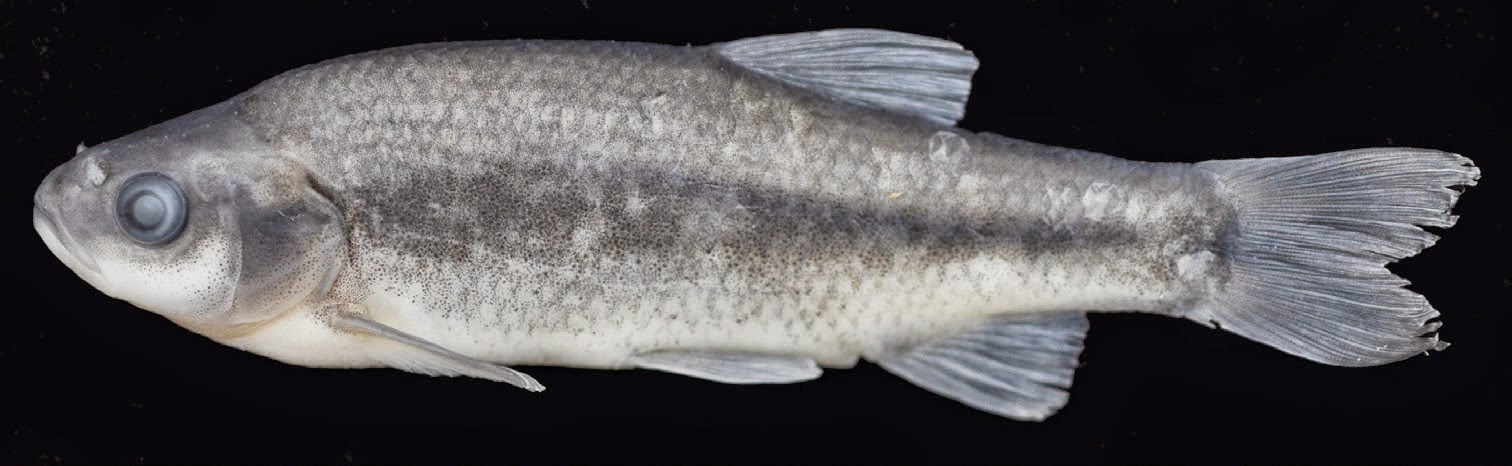
The new species is named Salmo kottelati, in honour of the ichthyologist Maurice Kottelat, for his studies of the Fish of Europe and Asia. The fish are greenish to silvery in colour, with brown on the back and flanks, darker towards the dorsal (upper) surface. The males are slightly larger than the females, with adult male Fish measured at 122–210 mm and adult females at 98–208 mm. The males have longer heads and jaws and a greater mouth gape than the females.

Salmokottelati, (b) male and (c) female. Turan et al. (2014).

See also…

http://sciencythoughts.blogspot.co.uk/2014/06/a-new-species-of-minnow-from-southeast.html
A new species of Minnow from southeast Turkey.
http://sciencythoughts.blogspot.co.uk/2012/08/a-new-species-of-toothcarp-from-iran.html A new species of Toothcarp from Iran.            The Toothcarps of the genus Aphanius are the only Eurasian members of the Family Cyprinodontidae; all other members of the family are restricted to the Americas, where they are variously known as Pupfish, Flagfish and Killifish (the term Killifish is also used...

Follow Sciency Thoughts on Facebook.